HOW WE EVOLVE

THE KNOWING-DOING GAP: When Insight Does Not Create Impact

In my coaching work, I meet many leaders who already have loads of insight. In fact, can’t count the number of times a client has said to me, “I know what I should be doing… I’m just not doing it.” They’ll even rattle off (cue ominous music) “the list”: delegate more, ask better questions, listen to understand, stop over-functioning, have the tough conversation, get out of the weeds, make time for strategy.

They can talk about these things eloquently. They’ve attended the workshops, read the books, or journaled about it on a retreat. But when Monday morning rolls around and their calendars fill with the usual urgent meetings, all that knowing and good intentions get choked out by old habits and urgent priorities. And when one of those priorities starts flaming, it’s hard to remember what we ‘know’ but haven’t quite ‘embodied’ yet. And for many leaders, that’s where progress stalls.

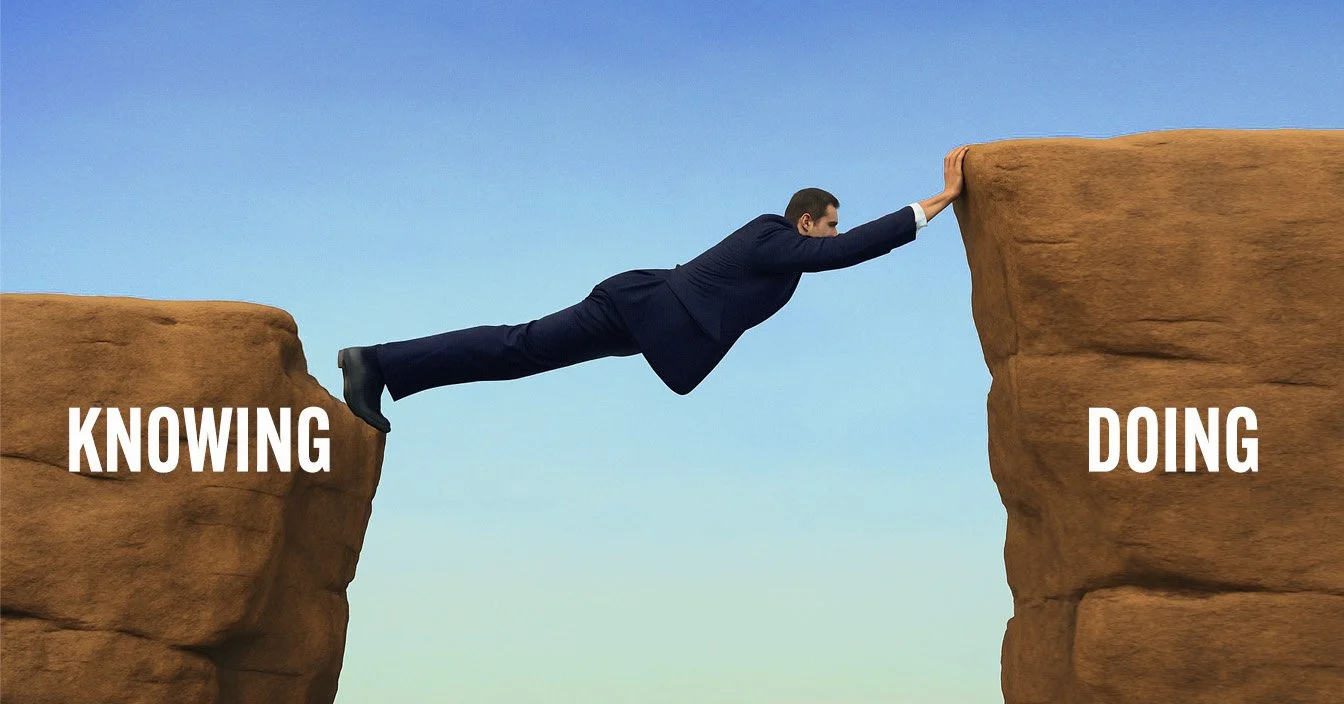
The struggle to turn knowing into consistent behavioural change is real. Researchers Jeffrey Pfeffer and Robert Sutton at Stanford call this the knowing–doing gap – the persistent tendency for organizations and individuals to know what to do, but failing to act on it.


WHY KNOWING IS NOT ENOUGH

Pfeffer and Sutton’s research showed that the problem isn’t knowledge, it’s follow-through. Leaders nod along in agreement during training, then return to business as usual.

Neuroscience helps explain why. Aha moments have been linked to activity in our reward circuits, which helps to explain why it feels so good when we have an insight. That spike of reward makes us feel like something has shifted, but unless it’s paired with concrete practice, the idea remains an “interesting thought” rather than becoming encoded in us as a new behaviour.

In other words, insight is the spark, but repetition is the fuel.


DANIEL’S STORY: FROM INSIGHT TO IMPACT

My client Daniel had been in his VP role for 3 years. During a triangulation meeting at the kick-off of our coaching program, Daniel’s leader told me that he was a brilliant strategist, and deeply respected, but she worried about his pacing because he often seemed exhausted. At our next session, I asked Daniel about that comment, and he told me, “I know I should be delegating more, but when the stakes are high, it just feels faster if I do it myself.” His team had stopped bringing him fully formed solutions because they knew he’d jump in and fix things anyway, so why bother?

We didn’t start with a grand delegation overhaul. Instead, Daniel chose one recurring meeting (a weekly project status update from his team) and agreed to limit his contributions to clarifying questions only. No problem-solving, no swooping in to rescue, no taking the wheel because ‘his way’ was the ‘right way’. Just genuinely curious questions intended to help his team think more deeply about their progress.

The first week of experimenting was painful. “I bit my tongue so hard I thought it might bleed”, he told me in our next session. His team knew something felt different, but didn’t know quite what to make of this different version of Daniel. They presented their updates, looked at him for answers, and the silence made him squirmy – his people too. But he sat in the discomfort of it and managed to stay quiet.

By the third week, something shifted: one of his directors spoke up with a decision Daniel would normally have made. Another shared a bold idea that improved the way they did project oversight. Daniel told me later, “They weren’t perfect, but they were better than I expected them to be. And that’s when I realized that I’ve been underestimating them.”

Shortly after, the team was running the meeting without him stepping in at all. Delegation didn’t happen because Daniel suddenly “knew” he should. It happened because he behaved differently. Daniel had chosen one small, visible experiment and stuck with it long enough for this ‘new way’ to become ‘the way’.


THE TRAP OF “GOOD INTENTIONS”

For many leaders, reflection feels like progress, but without action, it isn’t enough. Sure, after a new aha moment, we can sometimes translate “knowing better” into “doing better.” But other times, awareness shakes us to the core, because we can see the gap clearly, yet have no idea how to close it.

Research from Harvard Business School (Gino & Pisano, 2014) shows that reflection paired with practice improves performance, while reflection on its own rarely shifts behaviour.

“I’ve been thinking about how I need to have that tough conversation.”
“I’ve been meaning to make more time for strategy.”
“I know I should stop filling silences in meetings.”

Thinking about it feels productive. But teams only experience behaviours, not intentions. If you intend to empower yet keep jumping in with answers, your impact is still disempowerment, no matter what you “know.”


BRIDGING THE GAP: WHAT WORKS

Here are four evidence-backed moves that help close the knowing–doing gap:

1. Tiny Experiments
Start small. Insights stick more reliably when translated into if–then plans and repeated practice. Instead of “be a better listener,” try “count to three before responding.” Instead of “do more strategy,” try “schedule 30 minutes every Friday to explore one strategic idea.”

2. Make It Visible
When people track and publicly share progress, they follow through more often. Tell someone what you’re experimenting with: your team, your coach, your peer, and invite feedback.

3. Tight Review Loops
Don’t wait a quarter to reflect. End the day with a simple check-in: Did I run the experiment? What happened? What behaviour do I need to adjust? What will I try tomorrow? Research shows short, structured reviews enhance learning and later performance.

4. Look For and Celebrate the Micro-Wins
Momentum matters. When you notice even a small improvement, pat yourself on the back. It helps you build the confidence to keep experimenting.


Leadership credibility isn’t built only on what you know. It’s built on what people see you do when it counts. So keep seeking out insights and then dare to act on them, letting those actions quietly reshape how you show up. The ripple effects will be visible in your team long before you may even notice them yourself.

Have you been sitting on an insight that hasn’t yet made its way into action? If you’re ready to close your own knowing–doing gap, you don’t have to figure it out alone. If you’re ready to explore, experiment, practice, and see real, lasting results, I’d love to be your coach. Let’s connect at www.leslierohonczy.com.


MENTOR, COACH, TEACHER, OR ADVOCATE: Choose Your Ally Wisely

My first career mentor was a petite powerhouse of a woman named Marie-Lyne. She didn’t hand me a checklist or a script. She encouraged me to get curious about my ‘wiring’, and what makes me tick. She saw my potential before I did. And she held up a mirror that changed how I saw myself and the people I was leading. That single experience transformed my leadership, and it taught me a lesson I return to often: the ally you choose doesn’t just matter; it can shape the leader you become and even change the course of your career.

I know this won’t come as a shock, but not all help is created equal. And if you’ve ever mixed up the role of a mentor with a coach, or a teacher with an advocate, you’re not alone. The lines can blur easily, so let’s get clear on who’s who in the zoo and what they do.


THE MENTOR: WISDOM ON LOAN

Mentors are the wise guides who share their lived experience. They’ve walked further down the road you’re on, and they can shine a light on what’s ahead, to help you see the potholes and boulders. The best mentors share their experiences navigating them by giving you their perspective on what worked for them, what didn’t, and what to watch out for.

Mentors can be inside your organization, offering insight into the culture, hidden rules, and landmines, or outside your company, bringing a broader industry or leadership perspective. Either way, the mentoring relationship is usually long-term and fluid, often lasting years.

Context: Let’s say you’re getting ready to deliver your first board presentation, and you’re nervous. A great mentor can tell you about when they were learning how to present in high-stakes situations, and the techniques they used to structure their presentation, and to calm their nerves.

Best moment to seek a mentor: when you’re at an inflection point in your career and need stories and context from someone who has already wrestled with the decisions you’re facing.


THE COACH: YOUR UNBIASED MIRROR

Coaching is different from mentoring in that the Coach doesn’t give you their experience or answers; they help you find your own. A qualified coach has a deep understanding of human development, and they use exploratory techniques like deep listening and powerful questions to create a safe, non-judgmental, structured space where you can unpack patterns, blind spots, and assumptions that no longer serve you, and experiment with new ways of approaching your coaching topic.

Where mentors lean on their experience, coaches focus on the process of self-exploration, awareness-building, and identifying limiting beliefs. Coaching is structured, with a well-defined topic, a clear aspirational future state, specific developmental goals, regularly scheduled sessions, and measurable outcomes. Unlike mentors or sponsors, a coach isn’t judging your performance or lobbying for your promotion. They walk alongside you, helping you bridge the gap between how you’re approaching your topic now and the vision you’re aiming for.

Context: One of my executive coaching clients explained our relationship to their leader this way: “My coach doesn’t give me advice. She gives me better questions than I was asking myself.” That’s the essence of coaching. In our board presentation example, a good coach will help you explore the limiting belief that triggers your nerves, and to develop techniques that quiet your inner critic in the moment.

Best moment to seek a coach: when you have a specific topic that you need to address, to shift not only what you’re doing but how you’re showing up.


THE TEACHER: BUILDING NEW KNOWLEDGE

When you have a knowledge gap, you need instruction. Teachers, trainers, and facilitators give you structured knowledge, practical tools, frameworks, techniques, and practice, so you can build your skills and capability.

Context: When you’re learning to deliver a board presentation, a teacher can show you the mechanics: how to structure slides, how to pace your delivery, how to manage Q&A. It’s skill-building, plain and simple.

Best moment to seek a teacher: when your gap is tactical and you need proven methods to close it quickly.


THE ADVOCATE: YOUR VOICE IN THE ROOM

Advocates, often called sponsors, open doors. They’re the senior leaders who mention your name when promotions or assignments are being discussed. They stake their reputation on your potential, and they make introductions that change the trajectory of your career.

Here’s the catch: you might not even know you HAVE a sponsor. You don’t usually choose an advocate the way you choose a mentor or coach. They choose you, based on what they’ve seen and the trust you’ve built. You can’t force it, but you can improve the odds by doing excellent work, making your contributions visible, and cultivating relationships with leaders who have influence.

Context: Your sponsor may have been tracking your progress for years, and when a board seat or a major assignment comes up, they’re the one who puts your name forward.

Best moment to seek an advocate: when you’re ready for the next level and need someone with power to clear the path.

A SIMPLE DIAGNOSTIC

Most leaders will need all four types of allies at different times in their career journeys. The mistake isn’t choosing the wrong ally once. It’s assuming one ally can fill every role forever.

So when you’re wondering “Who do I need right now?”, ask yourself:

  • Do I need stories from lived experience? Mentors give hindsight.

  • Do I need clarity and self-awareness? Coaches offer foresight and development.

  • Do I need tactical skills? Teachers help you build skills.

  • Do I need doors opened? Earn the trust of an advocate who can create access.

Marie-Lyne was the first person to show me how powerful the right ally can be. Over the years, I’ve had the privilege of learning from some wonderful mentors, coaches, teachers, and advocates. Their impact reminds me daily that the right support, offered at the right time, can transform a leader’s path.

If you’re at a crossroads and wondering what kind of support you need next, I’d be glad to have that conversation. And if it turns out that executive coaching is the ally you’re looking for, I’d love to explore how we can work together to help you move forward with confidence.

TELLING WOMEN TO 'JUST SPEAK UP': The Problem with Performative Confidence

“You just need to speak up more.”

That’s the feedback my coaching client received from someone on the executive team. She’s a brilliant woman, promoted six months ago, building her team, and is delivering consistent results. Her response? “Speak up more? I’m going hoarse trying to be heard.” 

This is what lazy feedback sounds like. It lands with a thud and no instruction manual. It’s like being told to ‘just play better’ – without knowing which game you’re in, what the rules are, or who’s even keeping score. And yet, women still show up, adapt, and perform. That’s not a confidence gap – that’s a context gap. 


CONFIDENCE ISN’T A CHARACTER TRAIT 

Often, signs of wobbly confidence are treated like a personal failing, or like something women need to ‘fix.’ But that’s not how confidence works. Confidence is a response to context. It’s not that women lack confidence. It’s that they’ve learned there is a cost to displaying it. 

Research from Yale, McKinsey, and Catalyst confirms what many women already know in their bones because they’ve lived it: when we assert ourselves, advocate for our work, or step confidently into leadership space, we’re often judged more critically than our male peers. In cultures like these, success doesn’t automatically follow confidence; it follows calibration. Women learn to weigh every word, tone, and gesture to reduce the potential risk of backlash.

Women don’t dial themselves down out of fear; they do it because experience has taught them how the room tends to respond. We see it every time our ideas are restated by others and only then are taken seriously; when we’re interrupted mid-sentence in a way our male peers aren’t; or when we’re judged as abrasive for using the same tone that makes a man “decisive”. 


THE CREDIBILITY-COMPETENCE TIGHTROPE 

Here’s the impossible equation women are expected to solve: Be warm AND authoritative. Approachable AND assertive. Powerful but NOT pushy. Focus too much on competence, and you’re labelled cold. Lead with approachability, and you’re often underestimated. 

This dynamic, often called the “competence-likability trade-off,” shows up consistently in executive coaching conversations. Sheryl Sandberg described it in her acclaimed book ‘Lean In’ as one of the core tensions women face in leadership. While this pattern is especially well-documented for women, it also affects racialized leaders, neurodiverse professionals, and anyone whose communication style doesn’t match the dominant leadership norms that reward confidence only when it looks and sounds a certain way. 

It creates a constant pressure to perform, but only within a narrow set of rules. “Be confident, but not cocky. Speak up, but don’t overshadow. Be authentic, but only in ways that feel familiar and safe to others.” Telling women to "just project more confidence" doesn’t fix that tension. At best, this advice is unhelpful. At worst, it quietly holds women responsible for navigating a system that still penalises them for showing up fully. 


THE REAL COST OF PERFORMATIVE CONFIDENCE 

I’ve coached hundreds of women who had mastered the ‘act’: the composed tone, carefully measured eye contact, impeccable posture, firm handshake, and polished executive presence. They’d done everything ‘right’. And still, many felt invisible, disconnected from their own voice, and bone-tired from keeping up the performance. 

Performative confidence doesn’t empower – it depletes. 

Grounded confidence feels different. It’s anchored in purpose, emotional congruence, and what I call your ‘ness’: the distinctive wiring that makes you uniquely you. This isn’t about acting. It’s about aligning. We don’t need more women adapting to a narrow version of leadership. We need more workplaces that create the conditions for authentic confidence to thrive. 


SO WHAT ACTUALLY HELPS? 

Here’s what I’ve learned from almost two decades of coaching: 

  1. Confidence grows in context, not in isolation. Instead of asking, “Why doesn’t she speak up?”, ask, “What makes this environment unsafe for her to contribute fully?”

  2. Visibility is relational. Confidence doesn’t live inside one person. It grows in rooms where people are invited in, where their contributions are amplified, and where feedback fuels growth, not fear.

  3. Self-awareness beats self-promotion. Encouraging women to double down on their authentic leadership identity – their ‘ness’ – is far more powerful than any tips on vocal tone or standing tall.

  4. The real work is rewiring the system. Instead of ‘fixing’ women with one-size-fits-all advice, we need to take a closer look at the systems and cultures that still reward confidence in some forms – and penalise it in others. The question isn’t “How do we help women show up more confidently?” It’s “What needs to shift so their confidence can actually land?” 


READY FOR A CHANGE? 

If you're a woman in leadership, you don’t need to fake anything, or turn up the volume, or fit into someone else’s version of presence. You need the space to ground yourself in your wiring, your values, your way of leading. And if you're a leader or ally who wants to support that, the shift starts with curiosity, not critique.  

Try asking:

  • What messages do we send about who gets to speak up, and how are those messages being communicated, implicitly or explicitly?

  • How is confidence interpreted differently depending on who’s expressing it, and who’s listening?

  • In what ways does our culture invite real presence, and when might we be unintentionally rewarding performative behaviours instead?

  • What might shift or become possible if we broadened our definition of executive presence to include a wider range of authentic leadership styles?

Confidence isn’t something women are missing. It’s something that’s often misinterpreted, undervalued, or penalised, depending on who’s expressing it and how closely they match the ‘acceptable’ template. 

If you're a woman in leadership ready to trade performative behaviours for authentic presence, let's talk. Executive coaching can help you reconnect with your voice, your values, and a leadership style that doesn’t require you to shrink or shape-shift. 

And if you're a leader or ally working to foster a more inclusive leadership culture, coaching can help you examine how confidence is encouraged, interpreted, and rewarded in your organisation – and what may need to evolve.

RADICAL SELF-COMPASSION: How High-Achieving Leaders Tame Their Inner Dialog

You’ve got the title, the credentials, and the career wins. And still, a voice in your head whispers, “Not good enough.”

 You’re not alone. I hear some version of this almost daily from the brilliant, high-performing leaders I coach. They’ve led multi-million-dollar transformations, delivered record-breaking quarters, built respected teams, and still feel like they’re faking it.

 Not all the time, of course. But sometimes, in the quiet moments. Or in the Boardroom. Or when getting unexpected feedback. I’ve often said that this harsh inner dialog seems to exist in epidemic proportions. Leadership is hard enough; being your own worst critic makes it exponentially harder.

 Let's look at some of the dangerous myths we find in leadership cultures about the harsh messaging we inflict on ourselves. See if you have any of these limiting beliefs:

  1. If I stop being hard on myself, I’ll lose my edge.

  2. Self-compassion is indulgent or weak.

  3. Without my inner drill sergeant barking in my head, I won’t perform as well.

 These myths need to be retired pronto, because self-compassion is a leadership advantage, not a weakness.


YOUR INNER DIALOG

Most of us have an internal narrative that runs in the background, until that uncomfortable moment when we're feeling vulnerable, and it leaps onto center stage. It's usually the result of a limiting belief that’s been rolling around inside of us (perhaps unexamined), influencing how we perceive ourselves and others. 

 Your inner dialog might sound like “You should’ve known that.” Or “They’re going to figure out you’re not as good as they thought you were.” This persistent mental commentary typically has an uncomfortably pointed message and zero nuance, all delivered via shame, comparison, and second-guessing. And while it might feel like this is a key part of how you protect yourself from failure or humiliation, what it’s really doing is just keeping you small.

 If you’ve ever held back a comment in a senior meeting, over-prepared out of fear of looking incompetent, or felt like a fraud despite plenty of positive feedback to the contrary, you’re familiar with this inner dialog.


HOW INNER DIALOG HIJACKS YOUR LEADERSHIP

For many leaders, the inner dialog gets louder as they climb higher, where the risks are greater, and the expectations are higher.

 Here’s what I often see with my coaching clients:

  • Perfectionism posing as excellence: You rework the presentation ten times, not because it’s not good, but because that narrative says it’s never good enough.

  • Silencing yourself in the room: You hold back bold ideas because that limiting belief says, “Say that, and you’ll look foolish.”

  • Over-functioning for approval: You carry too much for your team. You hustle for validation instead of leading from a centred, grounded stance.

  • Withholding feedback: You avoid tough conversations because you tell yourself that you're not experienced enough to deliver them well.

 And as if that weren't compelling enough, know this: your inner dialog isn't just harsh; it’s contagious. As leaders, when we operate from self-judgment, we unintentionally create cultures where others do the same.


THE RADICAL SELF-COMPASSION ANTIDOTE

I use the word “radical” deliberately. Not because it’s trendy, but because it feels radical to treat ourselves with compassion in a world that trains us to be relentlessly hard on ourselves.

 To be clear, self-compassion isn’t self-pity. And it’s not letting yourself off the hook. It’s the quiet discipline of truthfully acknowledging your intentions, your effort, and your limits, and leading yourself the way you’d lead someone you deeply respect.

 Dr. Kristin Neff, Associate Professor of Educational Psychology at the University of Texas at Austin and pioneer in the field of self-compassion research, defines self-compassion with three elements:

  1. Mindfulness: noticing when you’re struggling

  2. Common humanity: remembering that imperfection is part of being human

  3. Self-kindness: responding to your mistakes with understanding instead of judgment

 And the data backs it up. Leaders who practice self-compassion are more resilient, more adaptable, and more likely to take bold risks because they aren’t afraid that a mistake will destroy their credibility.


PRACTICES TO DIAL DOWN THE DIALOG

When you catch yourself in the grip of a limiting belief or a harsh inner dialog, try this practice:

 1. Identify the Message.
Write down your inner dialog’s message, exactly as you hear it. Use the same tone and words that arise in you. For example, "You haven't prepared enough, and now the Board is going to see how incompetent you really are." This simple act of writing down the message creates needed distance and clarity.

2. Rewrite the Script.

Reframe the harsh message with one that is more positive and less judgmental. For example, “I might mess up. And I’ll recover. I’ve done it before.”
“I’ve prepared for this. I’ve earned my seat at this table.”

3. Switch the Lens.

Consider, “If a colleague or friend said this about themselves, what would I say?”
Now, say that to yourself.

4. Bring in the Body.
Unclench your jaw. Soften your shoulders. Ground your feet. Take some deep breaths all the way to the bottom of your lungs. These micro-shifts signal safety to your nervous system and help reduce your uncomfortable emotions.

5. Remember Who You Are.
You don’t have to become someone else to lead powerfully. You need to become more you. Lead from the place of authenticity: your values, wiring, and presence.


WHAT THIS MEANS FOR YOUR LEADERSHIP

When we practice self-compassion, we don’t lower the bar, we raise it. We stop wasting energy in a constant war with ourselves. We show up bolder. We recover faster. We create psychological safety by modelling it. And we give the people around us permission to do the same.

 You don’t have to bully yourself into better performance. You don’t need to wait until you feel 'worthy' to speak up. And you certainly don’t have to silence your doubts or needs to be taken seriously.

 There’s a better way. If you’re ready to explore how to identify limiting beliefs that are getting in your way, let’s talk. It might be the most radical (and effective) move you make this year.

INFLUENCE MAPPING: A Tool for Strategic Career Growth  

Leslie Rohonczy, IMC™, PCC, Executive Coach, Leadership Expert, Speaker, Author

I started working with a senior leader a few months ago, and was excited to help him explore his coaching topic. He wanted to become a high-performing executive and strengthen trust with his peer group. His intention was clear and his commitment seemed high.

In one of our early sessions, I asked him to walk me through his key relationships; the people whose support, trust, and collaboration would be essential to his success. He paused, then said, “Well… I think I have good relationships with most people.”

It wasn’t a bad answer. But it was vague, which told me we’d struck a golden coaching opportunity. I walked him through a powerful tool I developed called the Influence Map. This deceptively simple visual tool helped us map out who mattered most, how much trust existed, whether the influence flowed one way or both, and what kind of emotional cost each relationship carried.

Within minutes, the picture was clear. He was pouring energy into a relationship that wasn’t strategic, avoiding a critical alliance because it felt hard, and underestimating how much invisible credibility he’d already earned in a few places where he’d assumed indifference. He realized that, when it came to strategic relationships, he didn’t need more effort; he needed more precision.

Influence mapping makes visible the invisible social ecosystem you’re leading in. And once you see it, you can lead inside it with far more intention and confidence.


 WHY INFLUENCE MAPPING MATTERS

Influence at the executive level doesn’t follow job titles or org charts. It moves through the channels of trust, clarity, alignment, and shared purpose. If you're trying to drive change, shape culture, or lead cross-functionally, you need more than positional authority. You need strategic influence.

 The Influence Map helps you:

  • Clarify who matters most to your success

  • Diagnose the quality and direction of those relationships

  • Get conscious about where you're spending too much or too little energy

  • Make behavioural choices that improve trust and impact

Many leaders don’t realise until they map it out that they’re overspending influence capital in the wrong places, under-investing in key allies, or coasting in relationships that are quietly draining their credibility.


HOW TO USE THE INFLUENCE MAP

STEP 1: IDENTIFY THE KEY PLAYERS
Using the Influence Map template, place your name in the centre. Then, in the surrounding circles, add the names of individuals who significantly impact your ability to succeed, grow, and lead effectively. Think beyond your immediate team: include your boss, cross-functional partners, direct reports, key external stakeholders, or influential board members. Influence is about proximity to power and perception, not just title.

 STEP 2: TAKE A RELATIONSHIP SNAPSHOT
For each individual, reflect on these four indicators:

  • Trust Level (Low, Medium, High): Is this relationship built on mutual trust?

  • Influence Flow (One-Way or Two-Way): Do you influence each other, or is the flow lopsided?

  • Current Currency: What do you bring to this relationship that earns you influence? Clarity? Calm? Creativity? Reliability? Insight?

  • Emotional Cost (Low, Medium, High): How much energy does this person require from you?

This step alone can surface powerful insights. I’ve seen clients realise that the person they’re working hardest to impress doesn’t actually influence the outcomes that matter most.

STEP 3: DEFINE YOUR STRATEGIC INTENT
Ask yourself:

  • What is the strategic purpose of this relationship?

  • What would make this connection more effective?

  • What’s one behavioural shift I could try to improve it?

Maybe it’s slowing your pace with a fast-moving peer. Or being more transparent with a cautious, trust-sensitive stakeholder. Or having clearer asks with someone who always offers support but rarely follows through.

 STEP 4: PRIORITISE YOUR INFLUENCE
Use simple symbols to code your map:

  • STAR = Needs your attention

  • CHECKMARK = Strong and stable

  • TRIANGLE = Draining without enough return

 Then ask:

  • Who are your allies and advocates?

  • Who represents active friction?

  • Where is there untapped opportunity?

Mapping this visually helps you spot patterns. Maybe all your strong relationships are downward, and you’ve neglected peer or upward influence. Or maybe one draining connection is hijacking your attention and causing unproductive spirals.


EXPLORE POWER DYNAMICS AND POLITICAL ACUMEN

Influence is relational, but it’s also political. Not in the Machiavellian sense, but in the sense of understanding where power lives and how decisions are made.

For each person on your map, ask:

  • What motivates or unsettles them?

  • How do they like to receive information?

  • How is power expressed in this relationship, and how do I tend to respond?

  • What other relationship could help me improve this one?

One client discovered that his most difficult cross-functional partner was deeply influenced by someone he hadn’t built a strong connection with – a surprising but powerful pivot point. Strengthening that second relationship softened the resistance in the first.


ACTION PLAN: WHERE TO START

Choose one relationship on your map that is costing you significant energy but yielding low influence or trust in return. Ask yourself:

  • What am I trying to get from this relationship?

  • Is that realistic, or am I overplaying it?

  • Could a shift to curious diplomacy help? Or is a strategic withdrawal more appropriate?

Influence is rarely about pushing harder. It’s about choosing where and how to invest, creating conditions where trust can take root, and where alignment becomes possible.


READY TO MAP YOUR INFLUENCE?

You don’t need to overhaul your entire relationship strategy overnight. But you do need to look at it. Influence is one of your most valuable leadership assets, and yet most executives don’t take the time to map, audit, or recalibrate it.

Try the Influence Map. Get curious. And if you want help unpacking the patterns or crafting a game plan to lead with more impact and less friction, let’s talk.

I coach senior leaders to build trust, navigate power dynamics, and lead with clarity, confidence, and connection. Reach out today to grow your leadership influence, at www.leslierohonczy.com.

WHEN LEADERS FEEL ALONE: A Case for Peer Coaching & Truth Circles

Leslie Rohonczy, IMC™, PCC, Executive Coach, Leadership Expert, Speaker, Author

Every day, I carve out time to reflect on the leadership challenges my clients are facing, so that I can write about the real, messy, rewarding work of leading with presence, self-awareness, and courage. My hope is that these insights help others navigate the complexities of leadership and life with a little more clarity and a little more heart.

But tonight is different.

It is 10:45 p.m. I just got home from dinner with a dear friend, a senior executive whose words have been echoing in my mind ever since: "I’ve got over 300 people reporting up to me, and some days, I feel like I’m alone on an island, shouting into the wind."

She is not alone. In fact, she is the second leader this week who has shared something similar. Leadership, especially at the top, can be profoundly isolating. You carry the weight of decisions that impact careers, livelihoods, industries, and futures. You absorb pressure from boards, shareholders, regulators, markets, your peers, and your teams. You understand the unspoken expectation that no matter what hits the fan, you will respond with poise, clarity, and good judgment.

While everyone else sees your title, your strategy, and your calm exterior, few ever glimpse the toll it can take on the human being inside.


THE LEADERSHIP ARMOUR

Most senior leaders I work with are superbly competent. Many are also quietly exhausted. They have mastered the art of appearing composed while navigating relentless complexity, protecting others from uncertainty, and showing up as strong, steady, strategic leaders, even when they are carrying the full weight of the unknown on their backs.

The higher you climb up the leadership ladder, the harder it becomes to say simple, human things like "I don’t know," "I am not sure I handled that well," or "I am struggling." Vulnerability may be a popular leadership buzzword right now, but not every boardroom is a psychologically safe place to take off your leadership armour. In some environments, showing uncertainty is still risky business.

So leaders learn to wear the armour. Not because they are inauthentic, but because it feels necessary. Protecting others often comes at the quiet cost of denying themselves. And that cost can be steeper than it looks from the outside.


THE COST OF ISOLATION

Speaking of cost, recent research suggests that leadership loneliness is more common, and more costly, than we may know. A 2023 report by Odgers Berndtson found that one in five employees worldwide feel lonely at work, and nearly half of CEOs report feeling the same way. It is not just about feelings. Loneliness erodes performance, resilience, and well-being, at every level of leadership.

The cost of loneliness is not just personal; it is organisational. Isolated leaders are more likely to second-guess decisions (their own, and others’), are less likely to seek critical feedback, and are slower to course-correct when something is not working.

And leadership isolation does something worse: it dulls instinct. It disconnects leaders from their own wisdom, and from the human signals around them. That’s why creating space for honest sharing without fear of judgment is essential.


PEER COACHING AND TRUTH CIRCLES

A well-structured Peer Coaching Circle is not a gripe session. It is a professionally facilitated conversation where senior leaders drop their armour, share the truth about challenges they are facing, and receive powerful questions and unvarnished insights in return.

Imagine stepping into a circle where, for once, you do not have to perform or protect. A room where your peers meet your honesty not with judgment, but with curiosity. Where questions spark new awareness, and shared wisdom means you walk away with new ideas and solutions to your problem. Where you are reminded that your struggles are not a weakness; they are part of the work of leadership itself.

In these confidential conversations, trust is sacred, peers understand the stakes, and participants are committed to mutual growth and support. They are coaching-based, designed to spark reflection, accountability, and courageous growth. Most importantly, they are deeply humanising: these shared leadership moments of truth remind leaders that their struggles are normal, not shameful.


WHY THEY WORK

Peer Coaching Circles work because they invite participants to share challenges without judgment, and without the layer of armour that often gets in the way. They collapse the exhausting illusion that you are supposed to figure it all out alone and create a shared space where real conversations help leaders grow. They also address what traditional leadership development often misses: that growth is not just about learning new skills; it’s also about dropping old armour that no longer serves you.

Research from the Centre for Creative Leadership (CCL) confirms that peer networks are among the most effective methods for senior leader development, particularly in fostering adaptive leadership, cross-boundary collaboration, and decision-making agility. In one study, CCL found that structured peer learning initiatives significantly outperformed individual learning in terms of sustained behaviour change and performance improvement.


REAL TALK, REAL RESULTS

I have facilitated hundreds of executive coaching circles over the years and have seen what happens when the armour comes off. The dedicated VP who said to his team, "I feel like I have lost my leadership mojo." The seasoned CFO who finally asked, "Why has no one been willing to tell me this?" The newly minted SVP who said, "I’ve tried everything I can think of, but nothing is working."

What followed was not judgment. It was clarity. Support. Cohesion. And next-level leadership.


RE-THINK LEADERSHIP SUPPORT

Leadership doesn’t have to be lonely. We have to stop pretending that senior leaders have all the answers and don’t need support; not just in theory, but in practice.

If you are a senior leader reading this, ask yourself:

  • Where do you go to be fully honest, where you do not have to ‘perform’ for others?

  • Who holds up the mirror for you when no one else will?

  • When was the last time someone challenged your thinking, not your authority?

  • How would it feel to be armed with new awareness and real solutions?


If you don’t have answers, maybe it is time to try something different, and find your circle. Even the strongest leaders need a soft place to land occasionally. And in the right circle, with the right people, you will remember: you were never actually alone.

If you are interested in exploring a facilitated Peer Coaching Circle for your leadership team, reach out for a free discovery conversation at www.leslierohonczy.com.

THE UNSCRIPTED LEADER: When Over-Preparing is Under-Performing

Leslie Rohonczy, IMC™, PCC, Executive Coach, Leadership Expert, Speaker, Author


 You’ve done the prep. Nailed the slides. Practiced every line. But if you’re being honest, there’s still that low buzz of anxiety in your body, making you feel unsettled, as if you’re holding your breath, hoping nothing goes off-script.

 It makes sense. When the stakes are high, over-preparing feels like a smart move. But trying to control every variable can quietly choke off your impact. Leaders who script everything often miss the moments that matter most; those unscripted, human, real-time moments where connection, trust, and credibility are built.

 And the leadership landscape today is anything but predictable. We’re navigating this post-pandemic, post-election, mid-polarization, emerging recession time that impacts every aspect of our businesses: supply chains, staffing, climate, policy, trade, employee wellness, and shareholder value. Everything is in flux. Leaders are asked to make bold decisions with often blurry or incomplete information, and to communicate clearly and confidently amid constant change. It's a big ask to show up with poise when predictability has left the building.

 But the greatest pressure may not be coming from 'out there'. It’s likely an 'inside' job.

 Feeling the need to over-prepare, over-script, and rehearse every move to avoid being seen as anything less than polished is a common executive coaching topic. One client, a brilliant and capable executive, would script every communication, rehearse for days, and second-guess himself constantly. He wasn’t lacking competence; in fact, he was overflowing with skills, capability, and drive. But he was trapped by a perfectionist inner critic. Wired for achievement and image-conscious, the more he tried to get it right, the more disconnected and stressed he became.

 This is the moment we’re in: external turbulence colliding with an internal craving for control and validation. But here’s a little nugget to hold onto the next time you’re feeling the urge to over-prepare:

 Detouring into uncertainty doesn't take you off the path. It is the path.

 So, how do you lead without a script? How do you stay fully present and in your body, in the moment, and in relationships, when the certainty you usually rely on isn’t there? How do you keep your voice clear and grounded when the pressure is rising and the path ahead is anything but obvious?

 As an executive coach, I meet clients right at this crossroads. It’s not that they need more information; they’re already swimming in data. Through coaching, they develop integration; a clearer sense of who they are as leaders; a vision for how they want to lead; and a way to tap into their internal compass to help them explore new paths with genuine curiosity. Most of all, they learn how to trust that they will find the words, the insightful perspectives and ideas, the next step, and their confidence in the moment; not because it was rehearsed, but because it was real.


 What Over-Preparing Steals from You

It might feel like you're taking the responsible approach, and of course, some preparation is necessary! But too much of it can dull your leadership edge.

 Here’s what can get lost in the process due to over-preparation:

  • Spontaneity. Over-scripting blocks the kind of responsive, in-the-moment connection that builds trust.

  • Presence. If you're focused on remembering your lines, you're not actually in the moment with your people, and they can often (more often than you may realize) feel the distance.

  • Curiosity. Over-prepared leaders tend to stick to their script, rather than listening for new data or perspectives that might improve outcomes or understanding.

  • Authenticity. This might be the most important one of all. When everything is polished and pre-planned, the unique qualities that make you you often disappear. And in times of change, that's exactly what people want to follow: realness, not rehearsed perfection.

 In other words, over-preparing might feel safe, but it quietly erodes the very things that make your leadership impactful.

 Here’s what I’ve learned: Leading without a script requires three things that coaching builds powerfully over time:


1.      VOICE CLARITY: Knowing What You Stand For
In times of uncertainty, people don’t just need direction, they need anchoring. Coaching helps leaders articulate their core values, strengths, and leadership principles so they can speak from a place of alignment, not performance. When your inner clarity is strong, you don’t need a script. You just need to show up.

 One leader I coached said, "I kept looking for the 'right' message. What I needed was to say something true, not perfect." Once she found the courage to name what she did know, and what she didn’t, her team leaned in, not away.


2.      PRESENCE UNDER PRESSURE: Staying Regulated When Others Are Spinning
When tension is high, people look to leaders not just for answers, but for energy regulation. Coaching helps leaders understand their own emotional wiring, build tools for emotional regulation, and manage their inner state so they can model calm in the chaos.

 One VP I worked with love the coaching practice that she called her "One-Minute Reset", a quick breathing practice combined with a reset phrase that she used before tough town halls or uncertain board presentations. She stopped trying to deliver the perfect answer. She showed up grounded, and her credibility soared.


3.      STRATEGIC EXPERIMENTATION: Leading with Curiosity Instead of Control
Leaders often think their value comes from having the answers. But in today's environment, it's more valuable to ask the right questions. Coaching supports a mindset shift: from prediction to experimentation. From control to curiosity.

 Instead of locking into a brittle plan, great leaders run their leadership like an innovation lab. They test. They learn. They adjust. Coaching provides the space to reflect on what’s working, what’s not, and what to try next.


Leading Without a Script

Leading without a script isn’t the same as leading without a net. In fact, leading without a script might just be your next level of leadership development. It is certainly a call to deepen your self-awareness and build a stronger presence through bolder experimentation. In an era of uncertainty, the leaders who rise aren’t the ones who always have the perfectly polished answer. They’re the ones who keep showing up, grounded, human, and clear on who they are.

 Leadership without a script isn’t a sign of failure. It’s an invitation to lead with more clarity, more presence, and more courage than ever before. If you’re tired of performing and ready to lead from a place of confidence and real connection, Executive Coaching can help. Let's talk about how to develop your leadership to be less filtered, more comfortably unscripted, and authentically you. 

 Reach out for a free exploratory conversation at www.leslierohonczy.com.

LEADERSHIP BOUNDARIES: How Setting Them Helps You Lead Better

Leslie Rohonczy, IMC™, PCC, Executive Coach, Leadership Expert, Speaker, Author


If you had to write your current leadership job description, would it look more like a recipe for burnout? Deliver outstanding results. Develop every employee. Wow the board. Oh, and by the way, still have a personal life. No wonder so many leaders are overwhelmed. But real leadership isn't about doing more. It's about protecting the space to think, connect, and guide others wisely, and that starts with the boundaries you set… and keep.

I know... easier said than done. Let's dive in.


THE INVISIBLE BURDEN OF LEADERSHIP

If you’re a senior leader trying to do it all, you’re not alone. Many of my coaching clients describe their days as a blur of meetings, decisions, endless MSTeams conversations, strategy pivots, performance conversations, and late night emails before bed. They want to lead well, delegate decisions, grow their people, and focus on strategy. But the gravitational pull of "just getting it done" can be relentless.

I'm currently working with a senior leader who came to our coaching program showing classic signs of executive burnout: chronic sleep disruption, decision fatigue from being the go-to for every issue, and the heavy emotional load of being both the informal mentor and the motivational poster boy for the entire executive team. He was expected to guide his peers, champion innovation, and stay relentlessly positive for his employees. It wasn’t sustainable. And it wasn’t healthy and effective leadership, either.

When we explored his patterns, it became clear: he had no boundaries. We spent the next several sessions talking about how important it is for leaders to develop this skill, and how boundaries don’t restrict leadership; they enable it.


WHY LEADERS NEED BOUNDARIES

A healthy boundary isn’t a wall. It’s more like a fence with a gate; it lets you decide what you let in and what you keep out.

Without boundaries, your calendar fills with other people’s priorities. Your mind starts tuning into problems that don’t belong to you, like a radio stuck on someone else’s station. Before long, your leadership becomes reactive instead of strategic.

And neuroscience tells us that when your cognitive load is maxed out, your ability to think strategically and regulate your emotions drops like a stone. Without boundaries, even the most well-intentioned leaders lose their edge.


WHEN BOUNDARIES MATTER MOST

Lack of leadership boundaries are often visible to the naked eye (and to your colleagues) and show up in more ways than we realise. In fact, they often hide in plain sight, and can show up as:

  • Chronic overcommitment and unrealistic workloads

  • Micromanaging or difficulty delegating

  • People-pleasing and conflict avoidance

  • Constant urgency and inability to prioritise

  • Blurry role expectations or lack of clarity about who the decision-maker is

  • Emotional over-responsibility for others' stress or performance

These behaviours are clear signals that leadership boundaries have broken down. By naming the most common categories where boundaries fail, we can start to make clearer, more deliberate choices about what to reinforce, what to release, and what to reframe.

1. Decision-Making Boundaries: Not every decision should land on your desk. Get clear on what decisions belong to you, and what belongs at other levels. If your team is coming to you with every minor decision, you haven’t delegated – you’ve just distributed tasks.

2. Time and Attention Boundaries
Strategic thinking needs white space. Block it. Guard it. And stop glorifying back-to-back days as evidence of effectiveness. The best leaders protect time to think, reflect, and prepare.

3. Emotional Boundaries
Empathy is essential. But caring doesn’t mean carrying. Leaders who absorb everyone's stress eventually become the stressor. Learn to support without overidentifying.

4. Role Boundaries
Are you leading the work, or doing the work? The higher you go, the more your value lies in thinking, direction-setting, and people leadership. If you're still the fixer, you're limiting your team's growth and your own impact.


WHY SETTING BOUNDARIES FEELS SO HARD

While we're at it, let’s name the elephant: what often makes boundary-setting hard is the corporate culture itself. Many leaders work within management systems that reward over-functioning. Inside an over-achieving culture, people often wear their workaholism as a badge of honour ("Look at me! I'm SO busy!").

And as if that wasn't enough, leaders don’t just have to wrestle with their own beliefs about boundaries – they also face pushback from above. The boss who frowns at you for blocking thinking time in your calendar. The praise lavished onto the ones who work late or respond instantly; always 'on'. This creates a culture of conformity, where boundary-setting feels like rebellion or even dereliction of duty. 

When leaders are so steeped in this culture that they feel there's no choice but to grind themselves into the ground, what should they do?

  • Frame boundaries in terms of business impact. (“I block two hours a week to think deeply about our strategy. It helps me bring sharper insight to our executive meetings.”)

  • Find allies who are also hungry for a healthier way to lead, and have leadership culture conversations with each other. A rising tide lifts all boats.

  • Get curious about the nature of this culture you’re part of, and what's driving it. What stories are being told about what leadership should look like? Who benefits from that story staying in place?

Remember: your organisation may not change overnight, but your choice of boundaries can influence the system more than you think. Boundaries sound simple, but our resistance is real, because many leaders have limiting beliefs about setting them; that saying no means you're not a team player; that availability equals leadership; and that if they don’t do it, it won’t get done right.

These beliefs aren’t loyalty, and they are certainly not serving you or your organization. They’re over-functioning habits dressed up as commitment. And they cost us trust, team development, innovation, and time we’ll never get back.


THREE STRATEGIES TO BUILD STRONGER LEADERSHIP BOUNDARIES

If you're ready to experiment with boundaries but aren’t sure where to begin, here are three practical starting points.

1. Frame Boundaries as a Leadership Service
The next time you’re tempted to jump in and solve a problem, ask yourself: Am I helping them grow? Or am I rescuing them because it's faster? Boundaries create space for others to learn, decide, and lead.

2. Practice Micro-Scripts for Protecting Boundaries
Have a few simple phrases at the ready, to pull out when you need them:

  • “That decision belongs with you. What are you leaning toward?”

  • “I’m booked right now. Can we talk tomorrow when I can give you my full attention?”

  • “Let’s clarify where this decision lives on our team.”

  • "My capacity is full at the moment, but I can take that on next month."

Boundaries don’t have to be dramatic. They just need to be consistent.

3. Create a Boundary Map
Try this exercise:

  • List your current commitments.

  • Label them: Keep, Delegate, or Revisit.

  • Then ask: What boundary would protect and ensure my best contribution?

Small boundary shifts create big ripple effects. 

If you want to dig deeper, you can check out the resources in my previous articles. Each offers additional practices and insights that complement this one:


HERE'S YOUR INVITATION

Boundaries aren’t just a self-care practice. They’re a discipline of high-performing leadership. Your boundaries model what’s healthy for your team. And your organisation. (And yes, for your family, too.) Boundaries don't make you less available, they make you more impactful. 

So here's your invitation: define your role not by what you can handle, but by what only you should handle. Think of your leadership boundaries not as 'selfish', but as the highest form of respect: for your team, your mission, and yourself.

Want to explore how setting healthy leadership boundaries could transform your leadership impact? I offer a free discovery conversation to help you explore how executive coaching can strengthen your boundaries, resilience, and strategic leadership. Let's connect.

THE CONFIDENCE MYTH: What I Learned (the Hard Way) About Building Real Confidence

Leslie Rohonczy, IMC™, PCC, Executive Coach, Leadership Expert, Speaker, Author

MAY 2025

There’s a weird myth about confidence out there, and I don't have a hot clue where it came from. It's the idea that you’re either born with confidence or you’re not. That some people are just lucky enough to “have it.” And the rest of us…? Well, sorry about our luck.

Like so many of us, I bought into that myth for a long time. And honestly? It just kept me small. Safe. Protected from... what? Judgment? From being seen as 'too much', 'too loud', taking up too much space?

If you’re thinking, "Yeah, me too," you're in good company! So many of us are not born confident. I certainly wasn't! I had to build it, brick by wobbly brick. Through late-night doubts, shaky first steps, awkward experiments, and moments when my inner critic fired up the flamethrower and scorched my ass.

I learned along the way that confidence isn’t something you’re handed. It’s something you create.

Here’s how.


Confidence Isn’t Magic – It’s Motion (and a New Deal with Failure)

If I had waited until I “felt ready,” I’d still be sitting on the sidelines, perfectly preparing. But confidence doesn’t come from waiting. It comes from moving – from taking imperfect, courageous action before you feel fully prepared.

I really wish someone had told me this little nugget sooner: make friends with failure. Not the dramatic, life-or-death, fatal flaw kind of failure. I mean the everyday, small, awkward misses; the times when things don’t land quite the way you hoped.

Early on, I thought every stumble I made seemed to confirm a limiting belief I had that I wasn’t good enough. Now I see it differently: if I’m learning, it's not failure – it's just data. Feedback. An indicator of growth. It’s your brain using that new data to learn, course-correct, and get sharper for next time.

One of the biggest confidence boosts you can give yourself after a stumble is learning to say, "I’m not there... yet." The real magic is in the willingness to reframe, reflect, tweak, and try again.

Confidence doesn’t mean you’ll never fall. It means you trust yourself to get up, dust off, and take a next step, smarter for having tried.


Confidence Comes from Owning Your 'Ness', Not Borrowing Someone Else's

In my early leadership days, I thought if I could just act like some of the impressive leaders around me, I’d finally feel confident. Spoiler alert: copying others just didn't work. Sure, there's some truth to the old 'fake it til you make it' chestnut, but every time I tried to wear someone else’s leadership “suit,” it felt stiff and exhausting, like I was showing up to a marathon in a full hazmat suit.

Real confidence didn’t click for me until I started leading with my own ‘Leslie-ness’ – the gifts and abilities that made me unique: my creativity, ability to connect dots, love of emotional intelligence, voracious curiosity, and powerful questions.

Confidence isn’t about volume, bravado, or mimicking. It’s about alignment and letting your best, truest self lead the way. You have your own 'ness,' too, and trust me, it’s your biggest asset!


Your Inner Critic Isn’t Going Away – But You Can Change the Relationship

Even today, after all the hard work and awareness-building, my inner critic still pipes up sometimes (I call her 'Mimi', after the Drew Carey Show character Mimi Bobek haha!) She says things like: "Are you sure you’re ready for this?" "Maybe you should wait until you’re better prepared." "Don't be so bold! Everyone will think you're a showoff!"

I used to think confidence meant silencing that voice. In fact, I've wanted to throw Mimi into the trunk of my car and push it off a cliff many times! But that never works, because our Inner Critics have an important job: they try to keep us safe by making us aware of something they think we’re not aware of. (They just have a weird way of going about it!)

Today I realize that I don't need to kill 'Mimi', I just need to keep her out of the driver’s seat. When I notice that she is starting to fire up, I picture her riding in the backseat of my car; hands off the wheel and no access to the radio, thank you very much! And I’m the only one allowed to choose the route. (Thanks to Liz Gilbert for this wonderful idea!)

You don’t have to eradicate self-doubt to be confident. You just have to stop letting it make your decisions.


Failure Isn’t Fatal – It’s Fuel

We’ve all heard the term ‘failing fast,’ usually tossed around by well-meaning leaders who want to encourage quicker thinking and braver experiments. It's meant to free us from worrying about getting everything perfect, to help us be more confident, and to nudge us into trying bolder, out-of-the-box ideas. And while those intentions are good, true failure is still emotionally messy, discouraging, and painful.

I understand it differently now: Failure isn’t a dead end. It’s just an unintended result. When something doesn’t go the way I'd hoped, I’ve learned to step back and ask: What part worked? What part didn’t? What did I learn that I can apply next time?

Over the years, I've been steadily building this reflection muscle, and while it hasn't always been easy, it has helped me turn misses into insights and wobbly results into stepping stones. Confidence grows when you realize you’re not fragile, flawed, or failing; you’re learning, adapting, and getting stronger.


Confidence Is a Practice, Not a Personality Trait

If you’re waiting to magically feel confident all the time, let me save you the suspense: you’ll be waiting forever. Confidence isn’t a trophy you win once and display forever. It’s a living, breathing practice.

Some days it flows through you easily. Other days, you’ll have to dust it off and rebuild it, piece by piece. And that’s normal. But every time you step up, even when you’re unsure, you’re proving something important to yourself: that you can handle the unknown; that you can learn as you go; and that you are braver and stronger than your fear.

If confidence has ever felt like something other people had and you didn’t, hear this message loud and clear: it’s not something you’re born with; it’s something you build, one imperfect action at a time; one courageous experiment at a time; one “not yet” moment at a time.

So go ahead, take up your space. Say the thing. Try the new way. Wobble your way forward. The future you (the one who already knows you are enough and that you belong), is cheering you on.

And so am I.

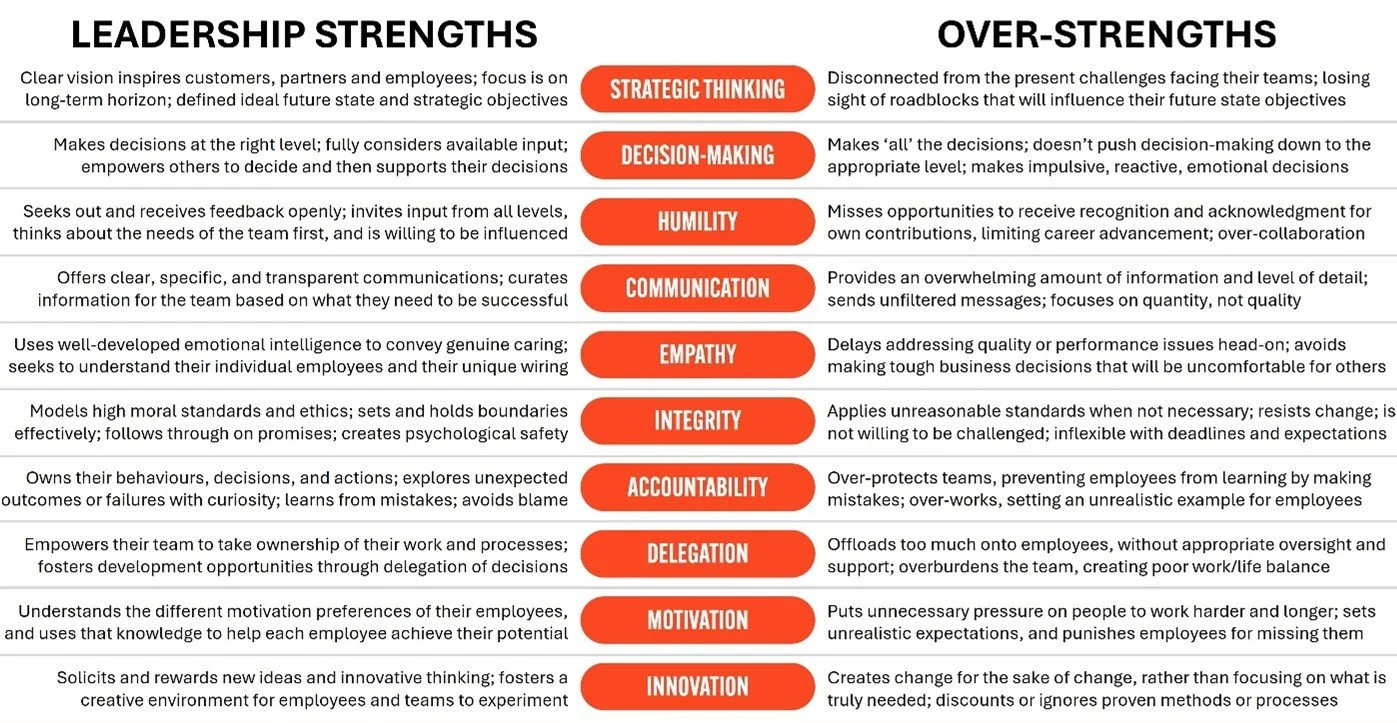
LEADERSHIP STRENGTH AT FULL VOLUME: The Strength vs Overstrength Paradox

Leslie Rohonczy, IMC™, PCC, Executive Coach, Leadership Expert, Speaker, Author

A senior leader walks into a team meeting (doesn’t that sound like the opening line to a joke!?), excited about his newly minted strategic vision, and confidently shares several decisions that he’s made. He offers a long list of ideas for reaction and execution, and he poses some powerful questions he wants answered. Each of these things is a quality leadership behaviour. So why does the room fall silent?

Chances are they’re not in awe; they’re overwhelmed.

This is a common occurrence in leadership, but it isn’t a villain story; it’s a visibility story – one that happens every day in organizations where well-intended leaders lean a little too far into their strengths. And the very qualities that earned them trust, promotions, and praise start to have the opposite effect.

This is the strength/over-strength paradox, and at its heart, it is a deceptively simple idea: a leadership strength, when overplayed, becomes a liability.

And yet, many leaders aren’t aware it’s happening until the damage is done. Why? Because they’re doing what’s always worked. Until it doesn’t.

WHY THIS MATTERS MORE THAN EVER

Trust in leadership is one of the strongest drivers of employee engagement and performance. And yet, in multiple global studies, more than half of employees say they don’t feel seen, heard, or understood by their leaders. That’s not just a gap – that’s a chasm! And in that chasm lurks the over-strength trap.

Think of your leadership as a soundboard in a recording studio. Every leadership attribute is an individual channel on the board:

  • strategic vision

  • decision-making

  • humility

  • communication

  • empathy

  • integrity

  • accountability

  • delegation

  • motivation

  • innovation

  • negotiation

  • change management

  • critical thinking

  • other (your unique leadership attributes)

When tuned just right, they create a harmonious mix. But push the fader too high on any one strength, and suddenly what was once inspiring becomes jarring. What was pleasing is now uncomfortable. What had been clear is now out of phase. And even though the other channels are set at the right volume, it can ruin the whole mix.

Let’s break it down using the graphic below, a snapshot of nine core leadership strengths (there are many others, some unique only to you!) Here’s what can happen when their volumes go unchecked.

STORIES FROM THE FRONT

Here’s where theory meets reality. These five short case studies are based on real coaching themes that have played out in boardrooms, team meetings, and one-on-ones. They showcase the human side of leadership; the moment where a well-meaning strength quietly shifts into overdrive, and the team dynamic shifts in response. If any of these stories feel familiar, you’re not alone – and you’re not off track. You’re just being invited to listen differently to your leadership ‘mix’, so you can make some adjustments, and tune your soundboard accordingly.

Case #1: The Strategic Visionary

Rajesh was known for his powerful strategic thinking. His colleagues described him as “the guy who could see around corners”. His head was typically five years ahead of the others on his team, who were still focused on Q1. His team was inspired... at first. But soon, they started feeling disconnected from the day-to-day realities. When asked what they needed to succeed, one team member quietly said, "I just need to know what I should be doing tomorrow." Rajesh had slipped into overstrength. His people felt abandoned in the present, trying to navigate the complexities on their own.

Case #2: The Empathetic Avoider

Marissa had developed a high level of emotional intelligence and compassion throughout her leadership career. Her people loved her warm personality; she was a great listener and genuinely seemed to care about them. She remembered birthdays, gave ‘free’ days off when they felt overwhelmed, and offered a soft shoulder to cry on when there was trouble at home. She also actively looked for developmental opportunities to offer each of her employees that would help them grow their careers. But when it came time to have hard conversations like missed deadlines, employee conflicts, or poor performance, she froze. Her empathy channel was so loud that it had drowned out her leadership accountability channel. She became avoidant, and slowly her team’s accountability eroded to the point that Marissa’s group developed a reputation for poor performance, which caused her top performers to look elsewhere, and made recruiting new employees difficult.

Case #3: The Humble Underdog

David was seen as a humble guy. He was always quick to credit his team for any successes and rarely took the spotlight. But over time, his unwillingness to take centre stage meant that he was invisible most of the time, which became a liability. Without the willingness to take up his full leadership space, the executive team couldn’t see his impact. David’s team, once proud of his modesty, started wondering if he lacked confidence in them – or in himself. It was an unnecessary distraction from the team’s mission and targets. Some became disengaged, while others tried to compensate by becoming more vocal (with uneven results). David’s humility had become an overstrength that muted his ability for bold influence, and his career stalled.

Case #4: The Delegating Ghost

Carla was an expert delegator. She understood delegation of authority thresholds and empowered her delegates to make decisions on her behalf and take action accordingly. She trusted her team and rarely micromanaged. But Carla wasn’t big on oversight. In fact, you could say she was allergic to it. Bored with mundane operational details, Carla preferred to live in the future, playing with strategic modelling and innovation trends. But without regular check-ins, guidance, and oversight, not only were projects veering off course and timelines slipping, but her people began to resent her, too. To her employees, Carla hadn’t delegated; she’d disappeared.

Case #5: The Motivational Machine

Jorge brought infectious energy to his leadership conversations. He was all about goal setting, giving recognition, and getting people fired up. His favourite expression was “push through”, something he often told employees when they raised concerns about their workload or capacity challenges. He was proud of how much his team could deliver, but as burnout crept in, his relentless positivity became exhausting. The team felt pressured to always perform at 110%, and some began hiding their struggles for fear of letting him down.

What once inspired them became a stress multiplier, and Jorge ended up with three employees on short-term stress leave.

All five of these leaders were doing what they thought was right. And they weren’t wrong. They just didn’t notice when their strengths started working against them.

BEST PRACTICES FOR BALANCING ACTS

So, how do you keep your soundboard balanced when the volume has crept up too high on one channel? How do you raise the volume on other channels to compensate? The following tips are some quick but powerful ways to ensure your leadership is landing the way you intend. These practices are grounded in real coaching tools and everyday leadership behaviours that can help you calibrate your leadership mix.

Make Feedback Normal, Not Formal

Build feedback into everyday conversation. The best leaders are curious, not just about ideas, outputs, metrics, and strategy, but about their own leadership impact. Ask: "What’s something I’m doing that’s getting in the way right now?"

Name Your Over-Strength

Introduce the strength/overstrength paradox concept to your team. Invite them to help you calibrate. It creates safety, builds trust, and diffuses the fear that giving feedback means they’re criticizing your character. Ask yourself: "Where might my team be seeing more of this strength than they need right now? What’s the unintended consequence I haven’t noticed yet?"

Coach the Strength Back to Centre

When a strength starts showing up too often or too intensely, it’s not about switching it off. It’s about adjusting the channel volume. Get back to the core purpose of the behaviour and check in on how it's being received. Ask yourself: "What’s the original intention here? What’s the ripple effect? What would ‘just enough’ look like?"

Use the 3-Point Leadership Lens

This quick tool helps leaders get out of autopilot and into alignment. Every time you lean on a strength, check:

  • is it aligned with the mission?

  • is it right for this moment?

  • is it working for the people?

What worked in the past may not land now, especially in times of change. Ask yourself: "Is this strength in service of the bigger picture – or is it just my default setting?"

Revisit Regularly

Strengths evolve. So should your leadership. Schedule quarterly self-check-ins, and invite an executive coach to help you explore your blind spots. Ask yourself: "What strengths have I been leaning on heavily this quarter? When I pause to consider whether they’re still fit for purpose, what do I notice?"

THE INVITATION

Leadership isn’t about turning every channel up to eleven. It’s about learning to engineer your soundboard. A little more clarity here, a little less volume there. Bringing in the bass line of strategy without drowning out the higher notes of empathy. The best leaders aren’t the loudest or smartest in the room. They’re the most attuned.

When your strength becomes someone else’s struggle – it’s time to rebalance. So here’s an opportunity to experiment: Be in relationship with your leadership strengths. Take the time to listen to each channel in relation to the other channels, and in relation to the overall mix. Notice what needs adjustment, what’s sitting just right in the mix, and what might need a gentle nudge back to centre.