
by Leslie Rohonczy, IMC, PCC, Executive Coach & Author
(LISTEN TO NARRATED AUDIOARTICLE VERSION)
If you're like most ambitious leaders, you probably know where you want to go. And also like many leaders, you may never have stopped to ask yourself what's pulling you there.
Promotion conversations usually revolve around readiness. Do you have the experience? Have you demonstrated executive presence? Can you think strategically? Are you ready to lead at the next level? These are important questions, and organizations should absolutely be asking them. They're just not the questions that intrigue me most.
When a client tells me they're hoping to become a Vice President, a C-suite executive, or even to make the move into their first leadership role, I'm curious about something else: "What is it about that role that's so appealing to you?"
At first, the answer is usually broad, and typically, "I want to make a difference." It's a perfectly reasonable answer. It just isn't the whole answer.
As we continue the conversation, something fascinating almost always emerges. Two leaders can be pursuing the same promotion for completely different reasons. One is captivated by the opportunity to shape the organization's future. Another lights up when talking about developing people. A third is excited by the challenge of operating at a completely different level. Someone else feels a responsibility to step forward because they know they can help. From the outside, they appear to be travelling the same road. Under the hood, though, they're powered by very different engines.
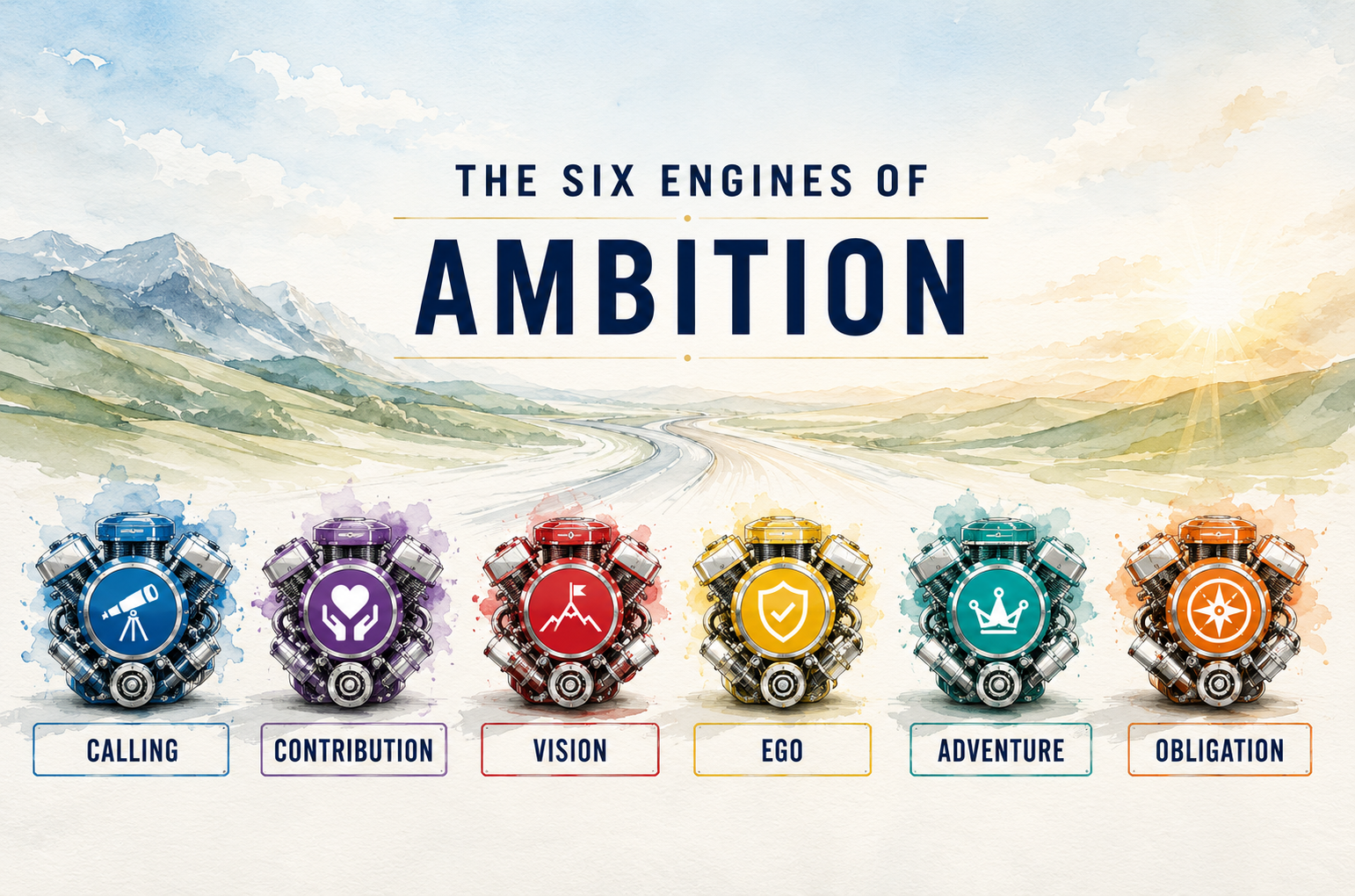
After seeing this pattern again and again over the years, I began sketching what eventually became the Six Engines of Ambition model. These engines represent the motivations that create the horsepower behind our ambition. We all have all six within us, but each contributes a different amount of power. That mix is unique to each person, and it often shifts as our careers evolve.
Before reading further, resist the temptation to decide which engine you are. That's a bit like asking which instrument matters most in an orchestra. Almost nobody is powered by a single engine. Instead, notice which descriptions resonate most strongly with you. You're not looking for one answer; you're discovering the mix of engines in your profile.
Calling is the engine of purpose. If this is one of your strongest engines, the organization's mission matters deeply to you. You're less attracted to leadership itself than to the opportunity to advance something you genuinely believe deserves your energy. Ask yourself what excites you most about the next promotion. If your answer begins with the organization's purpose rather than your own career, then your Calling Engine is probably doing a lot of the work. Its shadow appears when the mission becomes so intertwined with your identity that disagreement starts feeling personal.
Contribution is the engine of service. These leaders gain enormous satisfaction from making other people's lives better. They enjoy coaching, mentoring, removing obstacles, and creating environments where others can thrive. They're often the people who leave a meeting thinking less about how they performed and more about whether everyone else left feeling heard, supported, or inspired. Their shadow is over-functioning. Helping gradually becomes rescuing, and before long, they're carrying responsibilities that belong to someone else.
Vision is fueled by possibility. These leaders naturally look over the horizon. They become energized imagining what the organization could become three, five or ten years from now. They enjoy building, transforming, and creating. If you find yourself becoming impatient with conversations that never seem to move beyond today's operational issues, the Vision Engine may be one of your dominant drivers. Its shadow appears when tomorrow becomes so exciting that today starts feeling like an inconvenience.
Adventure is the engine of growth. Some people see uncertainty and instinctively think, that sounds interesting. New challenges, unfamiliar situations, and bigger problems energize them rather than intimidate them. Every promotion is another chance to discover what they're capable of. Their shadow appears when climbing becomes more rewarding than contributing, leaving them constantly searching for the next mountain before fully appreciating the one they're already standing on.
Obligation is fueled by responsibility. I've coached many leaders who never set out to become senior executives. They simply looked around, saw a need, and concluded that someone had to step forward. They care deeply about doing the right thing and are often the people organizations depend on during difficult times. If you've ever caught yourself thinking, If I don't do this, who will?, there's a good chance the Obligation Engine is one of your strongest drivers. Its shadow is becoming indispensable. Delegation becomes difficult because being the dependable one has become part of your identity.
Ego is the engine most people are reluctant to acknowledge. There is often a degree of shame attached to admitting it's one of our drivers because we associate ego with being egotistical or self-aggrandizing. I don't believe that's true. Recognition matters. Achievement matters. Titles matter. Human beings have always cared about status, and healthy ambition has fueled extraordinary careers. There's nothing inherently wrong with wanting to accomplish something significant or being proud when others recognize your contribution. The shadow appears only when the title becomes more important than the work, or when your sense of self becomes defined by the title on your business card.
One of the things I find most fascinating is that these engines rarely stay in the same proportions throughout a career. I coached a newly promoted manager early in my coaching career. About fifteen years later he called me again because he was trying to decide whether to pursue an executive role. On paper, it looked like the obvious next step. He had the experience, the credibility, and the support of his organization. Yet something just didn't feel quite right.
As we explored what was creating the hesitation, he said, "I don't actually want the title. I want the chance to shape where we're going." That moment changed the conversation. Until then, he believed he was pursuing a promotion. What he eventually discovered was that, unlike fifteen years earlier, he was now being driven by the Vision Engine. Once he understood that, he also realized there were several ways to influence the organization's future, only one of which involved the executive role he'd been focused on.
I've watched similar discoveries unfold many times. Leaders realize they've been driven primarily by the Contribution Engine without ever recognizing it. Others discover that their Obligation Engine has been making career decisions for years. Some come to appreciate their Ego Engine for giving them the confidence to pursue opportunities they might otherwise have avoided, while realizing it no longer needed to be their dominant engine. The engines themselves aren't the problem. The problem is allowing them to operate without ever noticing which one is doing most of the driving.
The goal isn't simply to identify your ambition engine; it's to understand your Ambition Profile. Once you do, career decisions become clearer, and you begin recognizing why certain opportunities immediately excite you while others, despite offering more money or prestige, leave you feeling meh. That's when you stop measuring your ambition against someone else's and begin making choices that are genuinely aligned with your own motivations.
Your next promotion may change your title. But understanding your Ambition Profile may change your career.
YOUR COACHING CHALLENGE
BUILD YOUR AMBITION PROFILE: Spend some time with the Six Ambition Engines definitions above, and estimate your current profile by assigning a percentage to each one. You may have a sense of your strongest, and your weakest engines – fill those in first. Don't answer based on who you aspire to become. Base your answers on the choices you've consistently made in your career. Your total should equal 100%.
Calling: _____%
Contribution: _____%
Vision: _____%
Adventure: _____%
Obligation: _____%
Ego: _____%
Now ask yourself three questions:
Which ambition engine has generated most of the horsepower that got me where I am today?
Which engine may be revving higher than it should be?
Over the next five years, which engine do I want fueling this next chapter?
Your answers may reinforce the career path you're already on, or they may point you in an entirely different direction. Either way, you'll gain insights into yourself that many ambitious leaders never stop to examine.