
Coaching

HOW METAPHORS REVEAL WHAT ADVICE MISSES: Borrow this Powerful Tool from a Master Coach

By Leslie Rohonczy, IMC™, PCC

Executive Coach | Leadership Development Expert | Author | Speaker | ©2026 | www.leslierohonczy.com


Halfway through an executive coaching session with a senior leader, I saw it: that juicy a-ha moment when an insight sparks, and the body responds before the words arrive. My client’s posture shifted as I offered him a metaphor for what he was experiencing. He leaned forward and began nodding, then his hands joined the conversation. “That’s it,” he said. “That’s exactly me. Do you have a camera in my office?”

For the record, I don’t have cameras hidden in my clients’ offices. But what I did have was a metaphor that illustrated something true about how he had learned to operate. It was a unique lens that reflected back to him the strengths he relied on, the pressures he carried, the ways he protected himself, and the costs of those strategies.

And, maybe most importantly, he felt seen. He understood that I ‘got’ him and wasn’t judging him. We now had a safe, shared language for exploring something that had previously been difficult for him to name. That’s one reason I return to metaphor so often in my executive coaching work.

I should clarify what I mean by metaphor. I’m not suggesting that leaders dust off those tired old sports clichés we’ve all heard a thousand times: keep your eye on the ball, step up to the plate, get back in the game. Those expressions may add a bit of colour to a conversation (if you like the colour beige), but they rarely reveal anything new. A developmental metaphor is personal, specific, and rich enough to help someone recognize a pattern in how they operate, then explore its strengths, limitations, and possibilities.

But metaphor isn’t just a powerful coaching tool; leaders can use metaphors when coaching and developing their employees, too. You don’t need to be a professional coach, invent elaborate imagery, or turn every one-on-one into a voyage of symbolic discovery. Sometimes one well-timed image can help an employee describe a challenge they’re having more clearly, so they can examine it with less defensiveness, and imagine a different way of responding.

The metaphor itself is not the point. What matters is what it helps someone recognize about what’s happening now, and the new possibilities that recognition opens.


MOVING FROM INSIDE THE PATTERN TO OUTSIDE IT LOOKING IN

When a behavioural pattern is deeply embedded, we don’t typically experience it as a pattern; we just experience it as our reality.

The leader who throws on his cape and flies in to rescue the team may believe, “This is what responsible leadership looks like.” The person who puts on a suit of armour before a difficult conversation may believe, “I need this protection to remain composed.” The executive who moves at jet-boat speed may see the wake she leaves behind her, without fully recognizing how hard it is to bring other people along with her.

Metaphor can help someone gain enough distance to examine what is happening. Instead of saying, “I’m impatient and terrible at bringing people along,” a leader can begin to notice, “I can feel my jet boat accelerating again.” Instead of thinking, “I shut people out,” someone might say, “This suit of armour is getting too heavy.” Instead of thinking, “It’s all up to me,” someone might notice, “I’ve picked up everyone else’s backpacks again.” Instead of thinking, “If I don’t get them engaged and developing, I’m not doing my job,” a leader can begin to notice, “I’m pulling up every seedling to make sure it’s growing.”

That small change in language matters. The behaviour is still theirs to understand and address, but it no longer defines the whole person. They can step back, observe it, and begin making more deliberate choices.

Research on metaphor supports its role in helping people make sense of complex or less tangible experiences by connecting them with something more concrete and familiar. A metaphor will not automatically produce insight or behavioural change. It does, however, create another way to explore an experience and experiment with different responses.

What felt personal and loaded yesterday can become something two people place between them and examine together today. It leads to powerful questions like, “What does the armour protect?” “When did the jet boat become necessary?” “What might you be taking away from your employees by flying in to rescue them?” “What are you trying to prevent by tending the garden so intensely?” These questions invite curiosity into a conversation where judgment, frustration, or defensiveness may have been getting in the way.


A LENS, NEVER A LABEL

There is a risk in all of this, of course. A metaphor can become so clever, appealing, or memorable that the person offering it falls in love with it. Once that happens, we may start trying to stuff the other person’s experience into our beautifully shaped metaphor, instead of allowing their experience to shape it.

A metaphor should offer a lens through which someone can examine their experience. It should never become a label that defines them.

When I offer a metaphor to a client, I tell them explicitly that I am not attached to it. Leaders can give an employee the same permission: “This image may not fit. We can play with it, change it, challenge it, or throw it out, and find something else that feels more like it fits your experience.”

I once offered a Labrador Retriever guide dog as a metaphor for a client’s ability to guide a new leadership team through a merger with another group. I thought it fit beautifully. He was terrified of dogs. Needless to say, we found a new metaphor. The person being coached gets the deciding vote. It’s as simple as that.

Even a metaphor that resonates with several people may mean something different to each of them. A gardener might represent patience and trust for one leader. For another, it might reveal a tendency to overwater every plant, pull up the seedlings to check whether they are growing, and take personal responsibility for the weather. Same garden. Entirely different coaching stance.


HOW METAPHOR SHAPES MY COACHING

Integral Coaching Canada’s methodology has deeply shaped my use of developmental metaphor.

In my executive coaching work, metaphor can help a client recognize how they currently approach an important challenge and envision a broader, more intentional way of leading. That developmental work is far more extensive than the simple application I am sharing here.

Leaders are often given objectives such as “delegate more,” “become more strategic,” “communicate differently,” or “strengthen executive presence.” These may be worthwhile goals, but they rarely help someone recognize what to do differently when the pressure is on.

A strong metaphor gives the objective shape and texture.

Consider the leader whose approach resembles a jet racing boat. They are fast, responsive, decisive, and highly capable of reaching a destination quickly. Those strengths may have been richly rewarded throughout their career. At the same time, there is very little room in the boat for anyone else, and the leader’s speed may leave a wake of dependency, confusion, or disengagement behind them.

Simply advising this leader to slow down probably won’t create much change. The metaphor opens a richer developmental conversation:

  • When does speed genuinely matter?

  • Who needs to be in the boat with you?

  • When would creating shared ownership matter more than arriving first?

  • How will you retain your decisiveness while making more room for others?

The metaphor makes an abstract objective easier to recognize and work with in real situations.

What follows is a simple way for leaders to experiment with metaphor in developmental conversations. It is not a substitute for professional coach training or a complete coaching methodology. Four clever questions do not make anyone a Master Coach before lunch, but they can help you have more effective developmental conversations with your direct reports.

WHERE USEFUL METAPHORS COME FROM

Often, people hand us their metaphors without realizing it.

An employee may describe themselves as running on a treadmill, carrying everyone else’s load, juggling ten balls, playing every instrument, or wearing armour into important conversations. That language is worth noticing because it may reveal how they already understand their experience.

Imagine an employee saying, “I feel as though I’m juggling ten balls and everyone keeps throwing me another one.”

A leader could move immediately into workload solutions. Or they could become curious about the image:

  • Which balls cannot be dropped?

  • Which ones belong to you?

  • Which were handed to you by someone else?

  • Are any still in the air because you haven’t decided where they belong?

The metaphor does not replace a practical conversation about workload. It helps both people understand the workload more precisely before deciding what to do about it.

Sometimes, the person creates the image. Sometimes, you build it together. Occasionally, you may offer one based on what you’ve observed. However it emerges, the employee needs room to define its meaning, revise it, or reject it.

A rejected metaphor is useful information. It tells you that you have not yet found language that belongs to the person.


METAPHOR CAN HELP A TEAM SEE ITSELF

Metaphor can also help a group name how it wants to work together.

In my work with teams, I have seen the value of creating a collective metaphor that captures the team’s strengths, aspirations, relationships, and shared responsibilities. A team might identify itself as a pod of dolphins, for example, and develop its own understanding of what that image represents about how members navigate, communicate, protect one another, and move together.

The power comes from the meaning the team creates, rather than from the leader arriving with a polished image and announcing, “Good news, everyone. We’re dolphins now.”

A shared metaphor can give a team shorthand for conversations that would otherwise be difficult to begin. When the pod of dolphins is functioning well, what’s happening to make it so? When food sources are scarce and the pressure is on to find food, how does the pod adapt? What causes some dolphins to be separated from the pod, and how do the others help them navigate their way back?  

Because the metaphor belongs to everyone, it can become a useful reference point for reflecting on collective behaviour without immediately blaming an individual. The team can then discuss whether it’s living into its chosen image and what may need attention when it’s not.

Used thoughtfully, a collective metaphor can help a team name the culture it wants to create and recognize the everyday behaviours required to make that culture real.


USING METAPHOR WITHOUT GETTING IN ITS WAY

If you want to experiment with metaphor in a developmental conversation, a few practices matter:

  • Listen for images already embedded in the person’s language. Their metaphor will often resonate more deeply than one imported from outside.

  • Offer your own images lightly. “I wonder whether this is a little like…” creates more room than “Here is what you are.”

  • Watch what happens before you elaborate. Changes in posture, energy, expression, words, or engagement may tell you whether the image is opening the conversation or closing it down.

  • Let the person define the details. Ask what the metaphor means to them instead of explaining what you believe it ought to mean.

  • Explore both its value and its cost. A jet boat, suit of armour, conductor, gardener, or superhero contains strengths as well as limitations. Development begins with understanding the whole pattern.

  • Remember your authority. An employee may agree with a metaphor because their leader offered it. Make disagreement easy and explicit.

  • Allow the metaphor to evolve. As the person develops, the image may acquire new features, change form, or become unnecessary.

Most importantly, don’t confuse recognition with transformation. A metaphor can create a powerful moment of awareness and insight, but insight is the beginning. Sustainable change still requires practice, reflection, experimentation, and new choices under real pressure.


YOUR COACHING CHALLENGE

Think about someone you are coaching or developing who has you feeling stuck. In your next conversation, listen carefully for the images embedded in how they describe their experience.

If none emerges naturally, you might ask:

“If this challenge were a vehicle (or a landscape, object, animal, machine, or character), what might it be?”

Then remain curious: What does the image reveal about how they currently see themselves or the situation? What strengths exist within it? What does the image protect, restrict, overlook, or leave behind? If it evolved to represent how they would like to approach the situation, what would change?

Resist the temptation to interpret the image for them or steer them toward the answer you think they need. The metaphor may help you see where their development could go next. More importantly, it may help them see it for themselves.

If you would like to explore the metaphors shaping how you lead, or create a collective metaphor that helps your team strengthen how it works together, I would love to help. Reach out to arrange a free exploratory executive coaching conversation at leslierohonczy.com.


AM I COACHABLE? A 5-Step Self-Assessment For Leaders Considering Executive Coaching

LISTEN TO THE NARRATED AUDIOARTICLE VERSION

Are you coachable? How do you actually know?

Have you received feedback about something you know you should work on, but you’re not fully convinced you’ll be able to shift it? Are you curious about executive coaching, but unsure whether you have what it takes to do the work well? Does having coaching support sound appealing, but you’re not sure this is even the right time to take the leap with a qualified coach?

Here’s what may already feel familiar to you. You’re not lacking in capability or motivation, but there’s likely something you can’t yet see clearly: a blind spot, a limiting belief, or a habitual response that’s shaping your behaviour. You’re thoughtful, competent, and you’ve likely spent a great deal of time analysing your situation, and still, something feels stuck.

You may have replayed the feedback conversation, talked it through with trusted people, read the latest trending books, attended the workshops, or listened to the podcasts. On paper, you may even know what you should do next. Yet when the moment arrives, the behaviour doesn’t quite shift, the decision doesn’t land, or the same pattern shows up again. Sometimes awareness is enough to be able to change a behaviour. But when insight doesn’t translate into different choices or behaviours, and you’re not sure how to work with that gap or blind spot, that’s where coaching can make a meaningful difference. 

If any of this sounds familiar, you’re in good company. Many people wrestle with the vulnerability it takes to seek this kind of support. When curiosity about coaching appears, it’s typically because you want greater awareness and traction. The question becomes: are you ready?

Over the years, I’ve worked with hundreds of leaders across sectors, levels, and personalities, and one thing has become very clear: executive coaching can be powerful, practical, and genuinely transformative. It can also be frustrating, circular, and expensive when the timing or focus is off. That difference often gets described as coachability, but it’s worth pausing here to name a distinction that will shape how you read the rest of this article.

This article’s designed to help you assess that for yourself with honesty and without judgement, while also helping you separate two things that are often blurred together: coachability and readiness. It isn’t meant to convince you to hire me or to position executive coaching as a cure-all. Its purpose is to help you decide whether this is the right conversation for you, right now.

WHAT COACHABILITY IS AND WHAT IT IS NOT

Before diving in, one important clarification. Coachability and readiness are related, but they’re not the same thing.

Coachability speaks to how you typically relate to feedback, uncertainty, and personal change. Readiness speaks to timing, context, and capacity, including what else is happening in your life and in the system around you.

You can be deeply coachable and still not ready. You can also feel ready for support, but struggle with some of the habits that make coaching effective. This assessment’s designed to help you notice both.

Coachability isn’t about being agreeable, positive, or easy to work with. Some of my most coachable clients are sceptical, analytical, and openly challenging, while some of the least coachable are polite, enthusiastic, and highly articulate about why nothing can really change.

Coachability also isn’t about having a clear goal perfectly defined right out of the gate. Many people start coaching with a vague sense of discomfort rather than a neat objective, and that isn’t a problem. In fact, it’s often a strong starting point for the coach and client to begin exploring and then crystallising the coaching topic.

Coachability’s about how you relate to yourself, your patterns, personality wiring, and defence mechanisms, and the possibility that your current way of operating, however successful it’s been in the past, may now be limiting you.

The most reliable way to assess coachability isn’t through labels or personality types, but through how you respond to a small set of very specific questions.

A SELF-ASSESSMENT YOU CAN ACTUALLY USE

Read the prompts below slowly and resist the urge to “perform insight,” meaning the temptation to sound self-aware rather than notice what’s actually happening for you in real time. Pay attention to your internal reactions as much as your answers, because irritation, resistance, relief, and curiosity are all useful data.

To make this more practical, I invite you to use a simple rating scale alongside each question. This isn’t a scorecard, and it isn’t a pass or fail test. It’s a way to notice patterns in how you typically respond.

After each question, rate yourself on a scale from 1 to 5 based on which description fits you most often.

1 = I’m protective or defensive by nature, even if I understand the feedback or situation intellectually

2 = I can occasionally stay open at first, but I close down when things start to feel uncomfortable

3 = I can sometimes stay open and reflective, but when the pressure builds, I revert to familiar patterns

4 = I can usually stay open and reflective, even when challenged, though certain situations still test me

5 = I can almost always stay curious, grounded, and willing to learn, even when the feedback or situation feels uncomfortable

There are no good or bad numbers here. The purpose is to notice where openness comes easily for you, and where it reliably gets harder.

1. HOW DO YOU RELATE TO FEEDBACK THAT DOES NOT MATCH YOUR SELF-IMAGE?

Think about the last piece of feedback that genuinely caught you off guard, not the kind you expected and not the kind you politely dismissed. What happened internally? Did you feel curious, even briefly, about what the feedback might be pointing to, or did your energy go immediately into explaining context, questioning the feedback giver’s intent, or coming up with reasons why the feedback was technically inaccurate?

Your self-assessment score: _____

Coachability doesn’t require you to agree with feedback, but it does require a willingness to stay present long enough to learn something from it. When feedback reliably triggers defensiveness, justification, or a strong need to be seen as right, coaching often feels uncomfortable very quickly. That doesn’t signal failure; it signals that the work will require a level of self-honesty you may or may not be ready to engage.

2. ARE YOU MORE INTERESTED IN EXPLAINING YOUR PATTERNS OR EXPLORING THEM?

Many leaders are excellent narrators of their own behaviour. They can explain why they react the way they do, how their background shaped them, and what pressures they’re under. This level of insight is valuable, and it’s also where progress often stalls.

Your self-assessment score: _____

Coachability shows up when someone’s willing to move beyond explanation into experimentation. Instead of staying with the question of why they’re like this, they become willing to ask what happens if they try something different.

When analysis consistently replaces action, coaching can feel repetitive. When experimentation’s allowed, even imperfectly, coaching tends to gain momentum.

3. HOW DO YOU HANDLE NOT KNOWING?

Executive roles reward decisiveness, expertise, and confidence, while coaching asks for something slightly different. It asks you to sit, at least temporarily, in uncertainty.

Your self-assessment score: _____

The question isn’t whether you enjoy not knowing, but whether you can tolerate it long enough to observe yourself in action. Leaders who are highly coachable aren’t less intelligent or decisive; they’re simply willing to slow their thinking long enough to notice what emerges.

When not knowing feels intolerable, or when ambiguity immediately reads as incompetence, coaching may feel destabilising rather than supportive.

4. DO YOU SEE YOURSELF AS PART OF THE PATTERN, EVEN WHEN OTHERS ARE INVOLVED?

Most leadership challenges involve other people, whether a peer, a boss, a team, or a system that genuinely makes things harder. Coachability doesn’t mean taking responsibility for everything, but it does involve examining how you’re participating in the pattern, even when others are clearly contributing.

Your self-assessment score: _____

It’s also important to name something explicitly here. Even highly coachable leaders can struggle to make progress if the system around them is misaligned. Organisational culture, role clarity, sponsorship, workload, and political dynamics all matter.

Coaching works best when there’s enough room in the system for reflection, experimentation, and learning. If your environment consistently punishes candour, vulnerability, or thoughtful pacing, that doesn’t mean you’re not coachable. It means readiness may depend as much on context as on personal willingness.

When your energy’s consistently focused on how to get others to change, coaching may feel limited. When curiosity extends to what’s within your control, including how you show up under pressure, and when the system allows some space to work with that, coaching has room to work.

5. ARE YOU WILLING TO EXPERIENCE DISCOMFORT IN SERVICE OF GROWTH?

Effective coaching isn’t confrontational, but it isn’t always comfortable. It surfaces habits you rely on, questions assumptions that’ve served you well, and invites you to experiment with behaviours that may feel awkward at first.

Your self-assessment score: _____

Coachable leaders aren’t fearless. They’re willing to feel mildly incompetent for a short period of time while learning something new. When discomfort consistently registers as danger, coaching may feel more threatening than helpful, which makes readiness an important consideration rather than a character judgement.

HOW TO MAKE SENSE OF YOUR RATINGS

Before moving on, pause and look across your ratings as a whole. Don’t add them up yet or average them. This isn’t about a score. What matters most is the pattern.

Notice where your ratings tend to cluster. Are there one or two questions where openness comes more easily for you, and one or two where defensiveness or hesitation reliably shows up? Those areas often point to the exact places where coaching does its most useful work.

If most of your ratings fall in the 4 to 5 range, coaching often feels like a stretch that’s energising rather than destabilising. You’re likely able to stay curious under pressure and to work productively with challenge.

If your ratings tend to cluster around 2 to 3, coaching can still be highly effective, but it may require a bit more time and patience as you build tolerance for uncertainty, feedback, or discomfort.

If several of your ratings are consistently at 1 or 2, that doesn’t mean coaching won’t work. It does suggest that timing, scope, or support structure matter greatly, and that naming this openly with a coach would be essential.

The goal of this assessment isn’t to decide whether you’re good enough for coaching. It’s to help you decide whether you’re ready to engage the work honestly, with support that fits where you are right now.

WHEN COACHING IS PROBABLY NOT THE RIGHT FIT

Coaching may not be the best investment at this moment if you’re primarily seeking advice or expert direction, if validation feels more important than challenge, if you hope a coach will fix a situation without requiring you to change how you operate within it, or if you’re navigating acute crisis, burnout, or mental health concerns that’d be better supported through therapy or medical care.

These aren’t character flaws; they’re signals about timing and fit.

WHEN COACHING TENDS TO WORK EXTREMELY WELL

Coaching’s often most effective when you sense that your current success is built on patterns that may not scale, when you’re willing to examine how your impact differs from your intent, when you want greater internal steadiness alongside external performance, and when you’re open to being surprised by what you discover about yourself.

This is often the point at which leaders move from doing leadership to inhabiting it more fully.

A FINAL REFLECTION BEFORE YOU DECIDE

The most coachable people I work with aren’t the ones who feel ready, confident, or certain. They’re the ones who are willing to tell the truth to themselves about where they are, without dramatizing it or minimising it.

If this article stirred defensiveness, curiosity, recognition, or resistance, that response matters more than whether you liked what you read.

YOUR COACHING CHALLENGE

At this point, you’ve taken an honest look at how you tend to relate to feedback, uncertainty, discomfort, and change.

Rather than treating this as a standalone exercise, I invite you to use what you’ve noticed to clarify your potential coaching topic.

Look back at your ratings and reflections and ask yourself:

  • Where did I feel the most friction or defensiveness?

  • Which question felt closest to a live issue in my leadership right now?

  • What pattern, belief, or habit seems to sit underneath that reaction?

Those answers often point directly to a meaningful coaching focus, not a vague goal, but a real edge you’re currently navigating.

If you’re noticing a clear theme and you’re curious to explore it with support, an exploratory coaching conversation can help you test whether this is the right time, the right scope, and the right kind of coaching for you. There’s no pressure and no obligation, just a chance to think out loud with someone certified to help you explore yourself and your situation more fully.

Reach out for a free exploratory Executive Coaching conversation at www.leslierohonczy.com.

WHAT REALLY HAPPENS IN A COACHING SESSION: A Look Inside the Conversations That Make a Difference

(LISTEN TO THE NARRATED AUDIOARTICLE VERSION)

When people come to talk to me, they’ve usually already done a lot of thinking. They’re often feeling the weight of responsibility, and a surprising amount of self-pressure. They've analyzed decisions, rehearsed and replayed conversations, weighed options, and tried to make sense of what’s in front of them. And despite their best efforts to reason it through, something still feels unresolved.

I always begin where my client is, and with the situation as it is: what happened, what was said, what didn’t land, who reacted and how, what now feels risky, uncomfortable, or unresolved. These details are necessary, and are often the most honest entry point into what’s really happening for them, and how I can help.

During that important first meeting, they’ll often describe their coaching objective as wanting advice or perspective, not because they don’t trust themselves, but because they’re looking for a way through a situation that feels risky, stubborn, or unresolved. In environments that reward decisiveness and momentum, it’s natural to want an efficient and responsible way to problem-solve, even when the terrain is complex or emotionally charged.

But as our conversation unfolds, something else starts to come into view. Alongside the situation itself, they begin to notice their interpretation of what’s happening, the assumptions they’re making, the habits of thought they return to, and the blind spots that may be shaping their reactions. Over time, many realize that changing other people, or waiting for the context to improve, isn’t what coaching is about, and wouldn’t actually help them be more effective or successful in what they’re trying to navigate.

During these early conversations, something subtle but remarkable takes place: the conversation gradually shifts without either of us forcing it. People begin to hear themselves differently. They notice where a particular frustration keeps reappearing, or how strongly they react to a certain powerful question. Sometimes they pause and say, almost to themselves, “Wow, I’ve never thought about it that way before,” or “I’ve been feeling this for so long, but I haven't been able to put it into words until now.”

What’s happening in those moments isn’t accidental. It’s the result of two unique perspectives coming together in service of the client. For the coach's perspective, it means careful listening (to what's being said, and what isn't), well-timed questions intended to create new insight, and attention to patterns the client may not yet be aware of. It also means creating enough room for them to think out loud and examine their patterns without feeling judged or rushed toward a solution. And from the client's perspective, it’s an opportunity to see themselves in the system more clearly, and to notice how their own wiring, assumptions, and patterns are shaping what’s possible. In that kind of space, behaviour, motivation, and context start to connect in ways that are almost impossible to access on their own, especially during a busy workday.

What often comes into focus next isn’t a neat answer, but a clearer sense of orientation. With a coach as a thinking partner, people gain new perspectives and start to see what matters most to them, what they’ve been protecting, and where they may have been holding back. That clarity is very practical. It shapes how they approach the situation, what they’re prepared to challenge, and what they’re willing to let go of.

I see this play out in small, ordinary moments all the time. A client will be describing a familiar frustration they have with a colleague or stakeholder, and I ask them what they notice about how that person is wired, what they tend to value first, or what reliably gets their attention. There’s often a pause, sometimes a laugh, and then something like, “Oh. I’ve been coming at them from my own perspective and preferences. Now I see why that wasn’t landing.” Nothing has been solved yet, but the person is suddenly inside the situation rather than just reacting to it.

Other times, someone has been circling an issue for a while, speaking carefully and professionally, sometimes even guardedly, when a word or phrase I offer really lands for them. I’ll offer it more as a mirror than a diagnosis or conclusion, and they’ll often stop mid-sentence for a long pause, followed by, “Yes! That’s it. That's how I feel!” In that moment, the issue moves from being a heavy, internal tangle to something clearer and more usable; something they can actually engage with rather than silently absorb.

And sometimes, the shift is even simpler. Some people arrive determined to make the right decision and are frustrated that they haven't been able to until now. As they talk through the trade-offs, the risks, and what matters most to them, I've seen many people stop mid-sentence and say, “I think I already know what I should do.” What they needed wasn’t a better answer, but enough space to trust the one that was already there, just out of sight.

Through the coaching process, people often come to realize that what they needed wasn’t direction, but permission. Permission to acknowledge doubt without immediately correcting it. Permission to name a value conflict they’ve been trying to smooth over. Permission to admit that something which looks sensible on paper doesn’t actually sit well with them in practice. Permission to experiment. Permission to do something outside of their comfort zone.

Language plays a central role here. Many people arrive with a strong sense that something isn’t right, but without the words to describe it clearly. When they find language for that experience, their relationship to it changes. It becomes something they can work with, rather than something that weighs on them in the background. Coaching doesn’t solve the puzzle for someone; it helps them see the shape of it more clearly.

My role as coach in these conversations isn’t to improve the question or guide someone toward a better answer. I stay with the question they bring. I listen for what seems to matter, and I help them stay with their own thinking long enough to understand it more fully. When insight emerges, it belongs to them.

Sometimes that insight leads directly to a next step. Sometimes it reframes the situation enough that the path forward looks different. Sometimes it simply provides steadier footing before any action is taken. When advice or perspective becomes useful in later coaching conversations, it lands because it’s connected to the person’s own understanding, not because it replaces it.

Near the end of a coaching session, people will often comment that they feel clearer or more settled, even though nothing external has changed. Their role may still be demanding. The decision they need to make may still be complex. That difficult relationship may still require care. What’s shifted is how they’re carrying it, and that shift alone can make the next step feel more manageable.

They leave with a stronger sense of their own judgment and a clearer internal reference point. That doesn’t come from being told what they need or should do. It comes from having time to think in a specific way that connects their experience with their values and their choices.

Many leaders and professionals are surrounded by input, opinions, data, and constant expectations, yet they are still expected to decide, act, and lead with confidence. Over time, this pressure can make it hard to see clearly what is actually asking for attention, or what part of the situation is truly theirs to own and work with. At its best, coaching helps people make sense of complex situations, work through difficult emotions without being overwhelmed by them, and arrive at decisions they can stand behind. That clarity shows up in very practical ways, in the choices they make, the conversations they have, and the steadiness they bring to moments of uncertainty.

YOUR COACHING CHALLENGE

Set aside 15 minutes of uninterrupted time to reflect or write about what is currently stretching, frustrating, or unsettling you in your leadership. Where you feel least at ease, most unsure, or preoccupied? How would you like to think, feel, and behave differently in this situation if you could? This reflection forms the foundation of your coaching topic.

Next, write down what you want to change in those situations, beginning with "I'd like to be more able to...". Here are some actual client examples of powerful coaching topics to use as inspiration:

I'd like to be more able to:

  • communicate clearly and calmly under pressure

  • enhance my influencing skills and leadership presence

  • step into my new role and lead my former peers with confidence

  • influence with steadiness and credibility when the stakes are high

  • manage my emotional interior when in conflict with others

  • build a strong relationship with my leader based on trust and clear expectations

  • balance my career strategy with my personal resilience

  • authentically and confidently embrace my full leadership role

  • make powerful leadership choices aligned with strategic business objectives

When you can write your coaching topic in one clear sentence, you’ve usually put your finger on the real work, the place where your leadership is being tested, and where focused coaching can make the greatest difference.

If you’re curious about what this kind of conversation could offer you, reach out for a free exploratory Executive Coaching conversation at www.leslierohonczy.com.

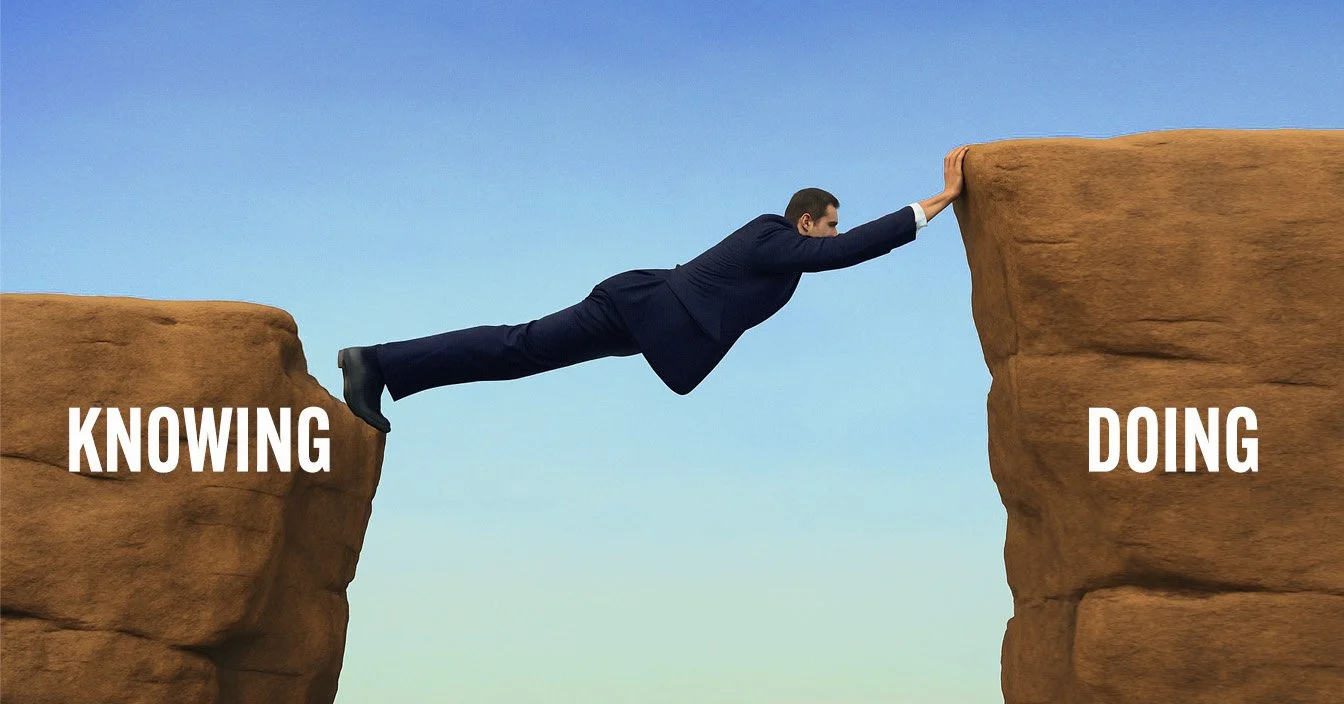
THE KNOWING-DOING GAP: When Insight Does Not Create Impact

In my coaching work, I meet many leaders who already have loads of insight. In fact, can’t count the number of times a client has said to me, “I know what I should be doing… I’m just not doing it.” They’ll even rattle off (cue ominous music) “the list”: delegate more, ask better questions, listen to understand, stop over-functioning, have the tough conversation, get out of the weeds, make time for strategy.

They can talk about these things eloquently. They’ve attended the workshops, read the books, or journaled about it on a retreat. But when Monday morning rolls around and their calendars fill with the usual urgent meetings, all that knowing and good intentions get choked out by old habits and urgent priorities. And when one of those priorities starts flaming, it’s hard to remember what we ‘know’ but haven’t quite ‘embodied’ yet. And for many leaders, that’s where progress stalls.

The struggle to turn knowing into consistent behavioural change is real. Researchers Jeffrey Pfeffer and Robert Sutton at Stanford call this the knowing–doing gap – the persistent tendency for organizations and individuals to know what to do, but failing to act on it.


WHY KNOWING IS NOT ENOUGH

Pfeffer and Sutton’s research showed that the problem isn’t knowledge, it’s follow-through. Leaders nod along in agreement during training, then return to business as usual.

Neuroscience helps explain why. Aha moments have been linked to activity in our reward circuits, which helps to explain why it feels so good when we have an insight. That spike of reward makes us feel like something has shifted, but unless it’s paired with concrete practice, the idea remains an “interesting thought” rather than becoming encoded in us as a new behaviour.

In other words, insight is the spark, but repetition is the fuel.


DANIEL’S STORY: FROM INSIGHT TO IMPACT

My client Daniel had been in his VP role for 3 years. During a triangulation meeting at the kick-off of our coaching program, Daniel’s leader told me that he was a brilliant strategist, and deeply respected, but she worried about his pacing because he often seemed exhausted. At our next session, I asked Daniel about that comment, and he told me, “I know I should be delegating more, but when the stakes are high, it just feels faster if I do it myself.” His team had stopped bringing him fully formed solutions because they knew he’d jump in and fix things anyway, so why bother?

We didn’t start with a grand delegation overhaul. Instead, Daniel chose one recurring meeting (a weekly project status update from his team) and agreed to limit his contributions to clarifying questions only. No problem-solving, no swooping in to rescue, no taking the wheel because ‘his way’ was the ‘right way’. Just genuinely curious questions intended to help his team think more deeply about their progress.

The first week of experimenting was painful. “I bit my tongue so hard I thought it might bleed”, he told me in our next session. His team knew something felt different, but didn’t know quite what to make of this different version of Daniel. They presented their updates, looked at him for answers, and the silence made him squirmy – his people too. But he sat in the discomfort of it and managed to stay quiet.

By the third week, something shifted: one of his directors spoke up with a decision Daniel would normally have made. Another shared a bold idea that improved the way they did project oversight. Daniel told me later, “They weren’t perfect, but they were better than I expected them to be. And that’s when I realized that I’ve been underestimating them.”

Shortly after, the team was running the meeting without him stepping in at all. Delegation didn’t happen because Daniel suddenly “knew” he should. It happened because he behaved differently. Daniel had chosen one small, visible experiment and stuck with it long enough for this ‘new way’ to become ‘the way’.


THE TRAP OF “GOOD INTENTIONS”

For many leaders, reflection feels like progress, but without action, it isn’t enough. Sure, after a new aha moment, we can sometimes translate “knowing better” into “doing better.” But other times, awareness shakes us to the core, because we can see the gap clearly, yet have no idea how to close it.

Research from Harvard Business School (Gino & Pisano, 2014) shows that reflection paired with practice improves performance, while reflection on its own rarely shifts behaviour.

“I’ve been thinking about how I need to have that tough conversation.”
“I’ve been meaning to make more time for strategy.”
“I know I should stop filling silences in meetings.”

Thinking about it feels productive. But teams only experience behaviours, not intentions. If you intend to empower yet keep jumping in with answers, your impact is still disempowerment, no matter what you “know.”


BRIDGING THE GAP: WHAT WORKS

Here are four evidence-backed moves that help close the knowing–doing gap:

1. Tiny Experiments
Start small. Insights stick more reliably when translated into if–then plans and repeated practice. Instead of “be a better listener,” try “count to three before responding.” Instead of “do more strategy,” try “schedule 30 minutes every Friday to explore one strategic idea.”

2. Make It Visible
When people track and publicly share progress, they follow through more often. Tell someone what you’re experimenting with: your team, your coach, your peer, and invite feedback.

3. Tight Review Loops
Don’t wait a quarter to reflect. End the day with a simple check-in: Did I run the experiment? What happened? What behaviour do I need to adjust? What will I try tomorrow? Research shows short, structured reviews enhance learning and later performance.

4. Look For and Celebrate the Micro-Wins
Momentum matters. When you notice even a small improvement, pat yourself on the back. It helps you build the confidence to keep experimenting.


Leadership credibility isn’t built only on what you know. It’s built on what people see you do when it counts. So keep seeking out insights and then dare to act on them, letting those actions quietly reshape how you show up. The ripple effects will be visible in your team long before you may even notice them yourself.

Have you been sitting on an insight that hasn’t yet made its way into action? If you’re ready to close your own knowing–doing gap, you don’t have to figure it out alone. If you’re ready to explore, experiment, practice, and see real, lasting results, I’d love to be your coach. Let’s connect at www.leslierohonczy.com.

MENTOR, COACH, TEACHER, OR ADVOCATE: Choose Your Ally Wisely

My first career mentor was a petite powerhouse of a woman named Marie-Lyne. She didn’t hand me a checklist or a script. She encouraged me to get curious about my ‘wiring’, and what makes me tick. She saw my potential before I did. And she held up a mirror that changed how I saw myself and the people I was leading. That single experience transformed my leadership, and it taught me a lesson I return to often: the ally you choose doesn’t just matter; it can shape the leader you become and even change the course of your career.

I know this won’t come as a shock, but not all help is created equal. And if you’ve ever mixed up the role of a mentor with a coach, or a teacher with an advocate, you’re not alone. The lines can blur easily, so let’s get clear on who’s who in the zoo and what they do.


THE MENTOR: WISDOM ON LOAN

Mentors are the wise guides who share their lived experience. They’ve walked further down the road you’re on, and they can shine a light on what’s ahead, to help you see the potholes and boulders. The best mentors share their experiences navigating them by giving you their perspective on what worked for them, what didn’t, and what to watch out for.

Mentors can be inside your organization, offering insight into the culture, hidden rules, and landmines, or outside your company, bringing a broader industry or leadership perspective. Either way, the mentoring relationship is usually long-term and fluid, often lasting years.

Context: Let’s say you’re getting ready to deliver your first board presentation, and you’re nervous. A great mentor can tell you about when they were learning how to present in high-stakes situations, and the techniques they used to structure their presentation, and to calm their nerves.

Best moment to seek a mentor: when you’re at an inflection point in your career and need stories and context from someone who has already wrestled with the decisions you’re facing.


THE COACH: YOUR UNBIASED MIRROR

Coaching is different from mentoring in that the Coach doesn’t give you their experience or answers; they help you find your own. A qualified coach has a deep understanding of human development, and they use exploratory techniques like deep listening and powerful questions to create a safe, non-judgmental, structured space where you can unpack patterns, blind spots, and assumptions that no longer serve you, and experiment with new ways of approaching your coaching topic.

Where mentors lean on their experience, coaches focus on the process of self-exploration, awareness-building, and identifying limiting beliefs. Coaching is structured, with a well-defined topic, a clear aspirational future state, specific developmental goals, regularly scheduled sessions, and measurable outcomes. Unlike mentors or sponsors, a coach isn’t judging your performance or lobbying for your promotion. They walk alongside you, helping you bridge the gap between how you’re approaching your topic now and the vision you’re aiming for.

Context: One of my executive coaching clients explained our relationship to their leader this way: “My coach doesn’t give me advice. She gives me better questions than I was asking myself.” That’s the essence of coaching. In our board presentation example, a good coach will help you explore the limiting belief that triggers your nerves, and to develop techniques that quiet your inner critic in the moment.

Best moment to seek a coach: when you have a specific topic that you need to address, to shift not only what you’re doing but how you’re showing up.


THE TEACHER: BUILDING NEW KNOWLEDGE

When you have a knowledge gap, you need instruction. Teachers, trainers, and facilitators give you structured knowledge, practical tools, frameworks, techniques, and practice, so you can build your skills and capability.

Context: When you’re learning to deliver a board presentation, a teacher can show you the mechanics: how to structure slides, how to pace your delivery, how to manage Q&A. It’s skill-building, plain and simple.

Best moment to seek a teacher: when your gap is tactical and you need proven methods to close it quickly.


THE ADVOCATE: YOUR VOICE IN THE ROOM

Advocates, often called sponsors, open doors. They’re the senior leaders who mention your name when promotions or assignments are being discussed. They stake their reputation on your potential, and they make introductions that change the trajectory of your career.

Here’s the catch: you might not even know you HAVE a sponsor. You don’t usually choose an advocate the way you choose a mentor or coach. They choose you, based on what they’ve seen and the trust you’ve built. You can’t force it, but you can improve the odds by doing excellent work, making your contributions visible, and cultivating relationships with leaders who have influence.

Context: Your sponsor may have been tracking your progress for years, and when a board seat or a major assignment comes up, they’re the one who puts your name forward.

Best moment to seek an advocate: when you’re ready for the next level and need someone with power to clear the path.

A SIMPLE DIAGNOSTIC

Most leaders will need all four types of allies at different times in their career journeys. The mistake isn’t choosing the wrong ally once. It’s assuming one ally can fill every role forever.

So when you’re wondering “Who do I need right now?”, ask yourself:

  • Do I need stories from lived experience? Mentors give hindsight.

  • Do I need clarity and self-awareness? Coaches offer foresight and development.

  • Do I need tactical skills? Teachers help you build skills.

  • Do I need doors opened? Earn the trust of an advocate who can create access.

Marie-Lyne was the first person to show me how powerful the right ally can be. Over the years, I’ve had the privilege of learning from some wonderful mentors, coaches, teachers, and advocates. Their impact reminds me daily that the right support, offered at the right time, can transform a leader’s path.

If you’re at a crossroads and wondering what kind of support you need next, I’d be glad to have that conversation. And if it turns out that executive coaching is the ally you’re looking for, I’d love to explore how we can work together to help you move forward with confidence.

WHAT’S ‘RIGHT’ WITH YOUR LEADERSHIP: Focusing on 'What’s Strong', Not ‘What’s Wrong'

Leslie Rohonczy, IMC™, PCC, Executive Coach, Leadership Expert, Speaker, Author

I read a comment recently on LinkedIn that hit me like a brick: “Every article I see is about what NOT to do.”

It's true! We spend a lot of time on this platform talking about what leaders need to improve: gaps to close, skills to develop, behaviours to fix, limiting beliefs to ferret out and overcome. I have read an endless stream of articles promising to help leaders improve all different aspects of their leadership skills. Hell, I've even written a pile of those articles!

It's not just LinkedIn; so many leadership posts, podcasts, and frameworks focus on what we’re doing wrong and how to do better. Now, I love a good stretch goal. But what if the secret to growing as a leader isn’t focusing solely on fixing what’s wrong, but it’s in noticing what’s right.

When we only ever start with what’s missing, we miss something important: the opportunity to build on what’s already strong, to get more of what’s already working. What’s already in you.

So, let’s try something different. Let’s take a short detour from the relentless pursuit of self-optimisation, and take a good, generous look at what’s already right. Not because you’ve “arrived”. But because that’s where the gold is.


WHAT IF YOUR STRENGTHS ARE HIDING IN PLAIN SIGHT?

Here’s something I’ve seen again and again in coaching sessions: people often don’t recognise their own brilliance. Why? Because it comes so naturally to them, they assume it’s nothing special.

I had a coaching client who was struggling to identify her leadership superpowers. “I’m just doing my job,” she said, genuinely baffled. But when I interviewed each person on her team, as part of a coaching observation program, they all talked about how deeply they felt seen and heard by her; how she was able to synthesize competing priorities into clear action steps; and how she made people feel calm in the midst of the chaos of change they were navigating.

When I pointed out that none of this made it onto her self-assessment, she started to see herself differently. It took some digging, but eventually she could acknowledge that while her leadership wasn't flashy, it was stabilising and quietly powerful; the kind of leadership that people trusted.

She hadn't realised that it was a strength because it didn’t feel 'hard'. When something feels easy, it’s easy to overlook. But often, that’s the sign that it’s one of your strengths.


THE EXPERIMENT: ‘REFLECT + RECOGNISE’ PRACTICE

Grab a pen, and let’s take five minutes and experiment with flipping this script.

Instead of asking what you need to fix, try these instead:

  • What have I done in the past month that felt satisfying or energizing?

  • When did I feel most like myself as a leader?

  • What feedback have I received that surprised me in a good way?

  • What comes easily to me that others find difficult?

  • Where have I had a positive impact recently, even if it wasn’t in my job description or span of control?

You might be surprised by what emerges. The goal here isn’t to build a brag list. It’s to surface the invisible strengths that are already part of your leadership fabric.


TURNING UP WHAT’S WORKING

There’s a place for closing gaps and learning new skills, of course. But if you want to grow your leadership skills quickly and sustainably, start by turning the dial up on what’s already resonating.

Ask yourself:

  • What’s one thing I do consistently well?

  • How might I use that strength in a new or more intentional way?

  • Where is that strength underused right now?

For example, if you're naturally great at drawing people into a shared purpose, how might you apply that gift to a new cross-functional initiative that’s been stalling? If your team always feels heard in 1:1s, but you’re less visible in larger meetings, what would it look like to bring that same presence to group settings?

This isn’t about perfection. It’s about intention and precision.


THE ‘BLIND SPOT’ OF YOUR OWN GENIUS

Here’s a simple coaching question that I’ve used hundreds of times:

“What do people often come to you for?”

Not what’s in your job description. Not what you think your value is. But what people actually seek you out for.

Sometimes the answer is strategic clarity, or empathy, or decisiveness, or storytelling. Sometimes it’s humour, or calmness under pressure, or the ability to translate ideas into action.

Whatever it is, that’s your gold. And once you know what it is, you can choose to lean into it even more deliberately.

You might even start to enjoy your leadership more.


FROM SELF-IMPROVEMENT TO SELF-RECOGNITION

The leadership development world doesn’t often say this out loud, but I’m going to: You’re probably doing better than you think.

And even if you have areas you want to grow, that growth becomes easier when it’s built on a foundation of confidence, awareness, and strength.

So take a breath. Notice what’s already working. And give yourself permission to get really good at more of that. Because sometimes the best way to grow is to notice what’s already working for you and others.


Would you like a powerful framework to uncover your own invisible strengths and learn how to use them more intentionally in your leadership? Reach out. That’s the kind of conversation I love to have.

POWERFUL QUESTIONS & WHERE TO FIND THEM

by Leslie Rohonczy, Executive Coach, IMC, PCC | ©2024 | www.leslierohonczy.com 

As a leader, your role often involves sharing your wisdom and experience with employees, peers, partners, and superiors. But before offering advice, ask yourself a powerful question: “How might I help this person to create insights and grow awareness through asking a powerful question?”

You’ll know you’re on the receiving end of a powerful question by the impact you feel from its weight. A powerful question sparks significant "a-ha" moments, suddenly illuminating new perspectives, provoking insight and new awareness, and acting as a catalyst for personal and professional growth. The power of a powerful question is undeniable.

When we’re on the receiving end of a powerful question, our brains naturally go looking for an answer. We’re wired for it. But the effectiveness of this process largely depends on how, when, and what type of question is asked.

One of the most common questions I encounter in my coaching and leadership training sessions is, “What makes a question ‘powerful,’ and where can I find them?” Unfortunately, there’s no standard cheat sheet of powerful questions you can tuck into your back pocket and whip out when you need a good one – it just doesn’t work that way. The most powerful questions are created in the moment, born of genuine curiosity, emerging from what we’re hearing, and intended to create new insights.


THE NATURE OF POWERFUL QUESTIONS

Powerful questions prompt people to think in new ways, leading to new insights, actions, or commitments. They are delivered with a keen sense of timing and rapport, respecting the individual's current state. For instance, consider asking, “I understand this is a big decision for you and that it naturally causes some anxiety. How do you think you’ll feel once the decision is made and you’re ready to move forward?” This question acknowledges the present concern and guides the person towards visualizing a positive outcome.

Questions can vary greatly in their effectiveness. Closed-ended questions typically yield yes or no answers and may not encourage deeper thought. On the other hand, 'good enough' questions offer some value, helping individuals explore their feelings or instincts. For example, asking a colleague, “What does your instinct tell you to try next?” might help them tune into their intuition. However, the most impactful questions expand awareness while inspiring action. Avoid questions that merely suggest a course of action or present a laundry list of possible solutions without engaging deeper thinking.


WHAT MAKES A QUESTION POWERFUL?

The intention behind your question is critical; it should be to create new awareness in the other person. This requires genuine care and curiosity, with questions often starting with "What," "When," "How," "Who," or "If." Notice that “Why” isn’t listed. If you ask your employee "Why haven't you made a decision?", they may not know why. A more powerful question might be, “What are you most concerned about in making this decision?” This encourages the person to reflect on underlying fears or concerns.


DISCOVERING POWERFUL QUESTIONS

To find powerful questions, you must listen carefully to uncover the real issue and what's beneath the surface of what's being said. Stretch your thinking and encourage others to do the same. Often, the simplest questions are the most powerful. “What’s next?” “How will you do that?” “What might get in your way?” and “What do you want?” Listening attentively allows you to tailor your questions to the person's unique situation.

But not all questions are created equal. Avoid closed-ended questions and those that suggest solutions disguised as questions. For instance, asking, “Why don’t you try X?” is not as effective as asking, “What options have you considered?” Additionally, avoid multiple-choice questions that can overwhelm the person with choices. The most effective questions are open-ended and invite exploration, without fishing for specific answers.


EXAMPLES OF POWERFUL QUESTIONS

  • "What would you like to achieve by the end of this 1:1 coaching conversation?"

  • "What would you like more of in your life? Less of?"

  • "If you could change just one thing right now, what would it be?"

  • "What's the first (or easiest) step you could take within the next week?"

  • “What are you avoiding? What do you NOT want to look at or talk about?”

  • "How does that serve you?"

  • “How might you show up differently if you weren’t worried about being judged”?

  • "How will you celebrate reaching that milestone? Describe how it will feel to achieve it."

  • “What do you need to see, feel, have, or do, in order to be brave?

  • "What are you taking away from this conversation today?"


CHARACTERISTICS OF GREAT QUESTIONS

Three aspects make questions great: curiosity, authenticity, and fluidity. Great questions are curious: they reflect a genuine interest in the person’s experiences, beliefs, and assumptions. It’s essential to be comfortable with silence after asking a question and avoid filling the space with more words. Great questions are authentic: they do not lead the person to a preconceived answer.

Instead, they are open and exploratory. And great questions are fluid: they adapt, based on the responses you receive as the conversation evolves. If a question doesn’t yield a clear answer or deeper insight, approach the issue from a different angle.


TIPS FOR ASKING POWERFUL QUESTIONS

  1. Minimize "why" questions: These can often be unproductive for two reasons: they may put the person on the defensive; or the person may not know ‘why’ they behave a certain way. Instead, get more specific in your question.

  2. Avoid sharing similar experiences: Resist the ‘me too’ urge and stay in exploration mode with your employee. Their experience may feel familiar, but it’s not the same as your experience. Sharing your experience may come across as ‘counterfeit empathy’, stealing the learning opportunity away from your employee, and the coaching opportunity away from you.

  3. Embrace silence: Give the person time to think and respond without rushing to fill the gap. This is especially true for more introverted types, who prefer to think before speaking. If you ask a great question, and then add more details to fill the silence, you’re interrupting their think time. Learn to sit in silence while someone processes your question.

  4. Avoid multiple-choice questions: It isn’t helpful to offer potential ‘right answers’ (e.g.: “Did you miss the deadline because you’re over-capacity, or just not interested in this project?”). The truth may be completely different than the two choices you offered, but the question has them focused on which choice is closest to their truth. Multiple-choice questions can limit exploration and overwhelm the person.


THE COURAGE TO ASK QUESTIONS
Asking questions rather than offering advice takes courage. It requires you to resist the urge to provide solutions and instead foster a space where others can develop their own understanding and solutions. This process not only helps them grow, but also strengthens your mentoring and coaching abilities.

While there is no handy, back-pocket list of powerful questions (because they arise from what you’re hearing), Michael Bungay Stanier’s book "The Coaching Habit" is an excellent resource for learning how to amp up your question game. It delves into the various question types and provides practical examples to enhance your skills.


SEVEN AWESOME QUESTIONS TO GET YOU STARTED
While there isn’t a handy ‘cheat sheet of powerful questions’ to pull out when you’re stuck, thanks to Michael Bungay Stanier, author of The Coaching Habit, here are seven CATEGORIES of questions that can be super helpful:

  1. The KICKSTARTER Question: It's a great opening question that replaces small talk with something a little crunchier. For example, ‘So what's on your mind today?’ This question says, "Let's talk about the thing that matters most to you."

  2. The AWE Question: That's A.W.E., which is an acronym for ‘and what else?’ This magic little question creates a lot more wisdom, insight, self-awareness, and possibilities out of thin air. ‘And what else’ can also be ‘and who else’, or ‘and why else’, or ‘how else’.

  3. The FOCUS Question: This helps you to help someone focus on and solve the right problem. It can help them grow a new problem-solving muscle while demonstrating that you're really interested in their input and can also help drive accountability and engagement.

  4. The FOUNDATION Question: Sometimes this can cause a deer-in-the-headlights reaction in that the person may not be able to answer your question. That's okay… ask it anyway. It's planting a seed that they can reflect on which will create new insight for them and help them untangle their wants from their needs. For example, ‘What do you want and what is really driving that want?’

  5. The LAZY Question: Sometimes, in our good intentions to be helpful, we can kind of get in the way. If, for example, we step in and take over or become too directive, it can create an unintended but uncomfortable power dynamic between the two of you. Instead, simply ask, ‘How can I help?’ An even more direct version of this is ‘What do you want from me?’ Just make sure that your tone is positive on that one.

  6. The STRATEGIC Question: This is focused on what NOT to do. It helps your employee to be really clear and committed to their yeses, bringing clarity to both of you. For example, you can ask, ‘So if you're saying yes to this, what are you saying no to?’

  7. The LEARNING Question: According to neuroscience research, most classroom learners will not retain most of the content they’re taught, unless they can put it into action quickly, actively processing and integrating the information. You can help to create the space for those learning moments when meeting with your employees. When they return from a conference, training session, or workshop, ask what was most useful to them in that learning experience. This helps them really make the connection between new information, and what's already within their awareness.

FREE COACHING PRACTICE: JAR MEDITATION

 by Leslie Rohonczy, Executive Coach, IMC, PCC | ©2024 | www.leslierohonczy.com

In our fast-paced world, finding moments of stillness and clarity can seem like a luxury. Yet, these moments are essential for our mental and emotional well-being. One powerful practice that can help us cultivate a sense of inner peace and allow for new insights to drop into us, is meditation. Today, we're going to explore a technique that will help you experience meditation in a different way.

Imagine yourself standing in the middle of a huge room. It's spacious, and completely empty, except for one thing—a large glass jar. This jar represents your mind, and it holds your thoughts, represented by different colourful bubbles.

As you stand in the room, allow yourself to become aware of your thoughts. Just notice them, as you think about your day, your life, your worries, your dreams—anything that happens to float by or that typically occupies your mind.

Now, as these thoughts pop up, one by one, imagine that you are gently placing each thought bubble into the jar. Visualize each thought taking on this round shape as you do this—positive or negative, it doesn't matter. Once you've filled the jar with your thoughts, step back and observe. Notice that you're not engaging with the thoughts anymore; you're simply watching them, neutrally observing.

Now, imagine yourself slowly backing away from the jar. You move towards the door and can still see the jar with your swirling thoughts, as you step outside through the door. In this state of neutral observation, you're detached from the thoughts, just observing without judgment or analysis.

Spend a few peaceful moments (30 seconds, or 30 minutes; it’s up to you) in this calm state, then allow yourself to say thank you to the day, and return into the large room. Thank the room for holding this space for you, and send your gratitude to the jar that is holding all of your thoughts.

And if there are some thoughts that you feel would be better off remaining in the jar, leave them there. You can always come back for them another time if you really need them. But for now let them remain here. Feel the lightness in your body; in your heart; in your mind.

Remember, meditation is not about suppressing or controlling your thoughts. It's about cultivating awareness and acceptance of whatever arises in your mind. By focusing outside the jar of your thoughts, and observing them from a distance, you'll gain valuable insight into your inner world.

So, the next time you feel overwhelmed or stressed, find a quiet space, close your eyes, and visualize yourself in that vast room, with your jar of thought bubbles. Allow yourself to become aware of your thoughts, then gently place them into the jar where you can just observe them, as they are. With practice, you'll find yourself feeling more centered, grounded, and able to tap into your wisdom and find greater clarity in your life.