HOW WE WORK

A LEADERSHIP TEAM ON PAPER: From Everyone for Themselves to Delivering What Matters Most

By Leslie Rohonczy, IMC™, PCC

Executive Coach | Leadership Development Expert | Author | Speaker | ©2026 | www.leslierohonczy.com


This is Part 1 of a six-part series adapted from my book Coaching Life, where I’m revisiting some of my favourite sections through the lens of what senior leaders face at work.

Every executive at the table can show you what their department delivered last quarter. Now ask them which of their own priorities they’d be willing to move so the business can deliver on its most important one. That’s a different meeting.

In Chapter 11, ‘Change & Growth,’ I tell the story of a leadership team whose strategy had changed dramatically. The organization needed leaders to involve employees more in solving problems, a departure from a management style that expected the boss to have all the answers. There was another shift the executives had to make, and it was closer to home. They had to start working differently with each other.

They each led their own group and tended to stay in their own sandbox. They rarely crossed into a colleague’s area to flag a problem or work through a solution together. That had a direct impact on the change they were leading. How could they ask employees to think beyond their own areas when the people asking them to do it seldom stepped out of theirs?


WHAT CAN ONLY BE DELIVERED TOGETHER

A leadership team can spend most of its meeting time sharing updates, and they come away better informed about the business. There’s value in that. But if the discussion ends with each executive going back to deliver the plan they walked in with, what’s the point of meeting? What work is the group actually doing together?

Google’s Project Aristotle began with a version of that question. In studying 180 teams at Google, the researchers distinguished between groups that mainly exchanged information and teams whose members depended on each other to get their work done. That one distinction gives us a better starting point than the org chart ever could. Where does the business need us to make a decision that none of us could make well from our own seat?

For example, in a company has made faster customer onboarding its top priority, they might start to see the Sales team get contracts signed more quickly, and a reduction in the time it takes for Operations to set up a new account once the paperwork is complete. But customers still wait just as long because incomplete paperwork keeps bouncing between the two teams.

From their individual perspectives, both Sales and Operations have hit their targets. So who owns the days of delay that customers spend waiting between those two steps? If each executive can only change what happens inside their own department, the answer may be nobody. Fixing it could mean asking Sales to spend more time upfront, even if that makes its own numbers look worse. Or it could mean changing what Operations requires before it can start. Either way, somebody has to be willing to change a plan on behalf of the bigger picture, even if it’s something that’s working perfectly well by their own group’s measures.


WHEN A PEER ASKS YOU TO GIVE SOMETHING UP

It’s easy to support a company-wide priority when it fits the plan we already had. It starts to really get interesting when a peer asks us to lend them our best people for six weeks. We've made promises to our own team, and this will require us to break them to do it.

That’s a legitimate concern. The leadership team needs to hear about the likely impacts, what will slip, and who will feel it most. It also needs to decide collectively whether the business can live with that cost. When a trade-off stays implicit, the executive who makes room for the shared priority can end up explaining a missed target as though it was their mistake. Anyone would be reluctant to volunteer twice for that arrangement.

This is also where 'productive conflict' can be a gamechanger. When a peer can say, “I think your plan moves the bottleneck to my team,” can we stay with the substance of that observation, without throwing up the heat shields? How we respond in that moment shapes what our peers will be willing to raise next time. You can read more about this in WHO WILL DISAGREE WITH YOU TO YOUR FACE?

With the team I wrote about in Coaching Life, we used group coaching to practice working through conflict and holding each other accountable. I also coached some members individually. Some chose to leave during the transition. Among those who made the shift, what stood out to me was their willingness to get curious about colleagues' differing views and to try a different way of working, even (especially) when it still felt awkward.


YOUR COACHING CHALLENGE

At your next leadership meeting, pick one business priority that keeps coming back with a progress update and the same unresolved problem. Ask each executive to look beyond the part they own. Where does progress depend on a peer changing something? What might that change cost the peer’s team, and are you prepared to make that trade-off together?

If you agree to move people or delay a commitment, record what you’re choosing to give up alongside what you expect the business to gain. Then bring that decision back alongside the next round of departmental results. A leader who took a hit on their own target to deliver a decision the team made should be able to count on the team to own it with them.

The next time your leadership team reviews a row of green indicators, look for the result that’s still stuck between two of them. That may be the work you most need each other to do.


If you’d like to explore more of Coaching Life, links to the paperback and audiobook are on Leslie Rohonczy’s book page. For more leadership articles like this one, connect with Leslie Rohonczy on LinkedIn, or visit www.leslierohonczy.com

IS LEADERSHIP DEBT MAKING YOUR TEAM WORK HARDER? Five-Minute Fixes from an Executive Coach 

By Leslie Rohonczy, IMC™, PCC

Executive Coach | Leadership Development Expert | Author | Speaker | ©2026 | www.leslierohonczy.com


A meeting ends five minutes early. Hallelujah for small miracles! We could use those five minutes to finally get back to that person who asked, “Which of these two assignments is the priority?” But do we? No... we open our inbox just for a second, and five minutes later, we’ve replied to a lunch invitation and read half an email chain we wish we’d never been copied on. And that priority question? It's still waiting.

Meanwhile, without an answer to the question, the team is pushing both assignments forward and doubling their efforts to cover the uncertainty we’ve left them with. What slipped off our radar is now stretching their capacity, and their workdays.

That’s called leadership debt: the accumulating cost of leadership work we leave unresolved. In this case, our team members are paying for our delayed decision with their time and attention.

As an executive coach working with senior leaders, I offer these five questions to help identify leadership debts and ideas for how to address them.


FIVE QUESTIONS TO KILL LEADERSHIP DEBT

1. What am I postponing that’s creating extra work for someone else?

Perhaps someone keeps chasing approval for a recommendation you’ve already decided to support. Close that loop. If you can’t make the final decision, clarify what can proceed: “Start the analysis, and hold the purchase until I confirm on Thursday.” Then check your reason for waiting. Do you need information that could change the decision, or are you hoping another spreadsheet will make the responsibility feel lighter for you?

2. What haven’t we clarified that keeps bringing this back to me?

Imagine your employee checks every decision with you. Before concluding they lack confidence, ask: “What makes it difficult for them to move ahead without checking with me?” Perhaps their authority is unclear, or your response to a previous decision made checking seem necessary. Use the conversation to agree on a specific decision they can own, including when they should involve you.

3. What might someone now be doing because of how I responded?

You said, “It needs more detail.” They could be adding twenty slides when you wanted a clearer explanation of one assumption. Be specific, and spend the five minutes having a clarifying conversation: “Your recommendation is clear. What I need is the reasoning behind the revenue estimate.” This kind of reflection on our thinking and responses helps us catch unintended consequences. Check what they understood before they spend an evening revising.

4. What have I added without deciding what can stop?

That 'quick request' you make takes time, even if it only takes twelve seconds to assign it. Look at the last thing you added to someone’s workload. Did you adjust anything else to make room for it? Use your five minutes to make the trade-off explicit: “This takes priority over the monthly report, so you can move that deadline to next week.” Otherwise, we’re leaving them to guess about priorities, to negotiate competing commitments, or to extend their day to accommodate ours. Or all three.

5. What feedback am I withholding that someone needs to succeed?

You want to keep editing and rewriting someone’s recommendations because they buried the decision under pages of background. They may think you enjoy editing, and maybe you do, but your five minutes would be better spent identifying one example and the change you need: “Please revise this to lead with your recommendation, then include the background that supports it.” If the issue needs a fuller conversation, use five minutes to schedule and prepare for it. Repeatedly fixing someone's work without explaining why leaves them dependent on corrections they could learn to make themselves.


WHEN FIVE MINUTES WON’T FIX IT

These five-minute fixes can prevent some avoidable work today, and can smooth out areas of leadership friction, but they can't compensate for a system that expects heroics on the daily, or leadership roles designed without enough time to actually lead well.

Some leaders have genuinely unreasonable workloads. Suggesting they can solve that with better habits simply hands exhausted people another to-do.

If developing people is truly part of the job, organizations need to leave capacity for it. Persistent overload calls for decisions about what stops and which decisions and responsibilities can move down the chain. And that includes examining the workloads we set for our own teams.

Executive coaching can help you recognize the patterns that keep work coming back to you, and explore what makes them difficult to change. If you’re seeing yourself in these questions, I’d welcome an exploratory conversation about how coaching could support you.


YOUR COACHING CHALLENGE

For the next week, carve out five minutes each day to address one thing your team is having to work around. Choose one of these practices, then check whether your action helped.

Start with something manageable, and see what becomes easier for both you and your team. Those five minutes might give everyone a little breathing room.


For more leadership articles, connect with Leslie Rohonczy on LinkedIn, or visit www.leslierohonczy.com

IS AI KILLING OUR CURIOSITY? Critical Curiosity & Leadership Judgment in the AI Age

By Leslie Rohonczy, IMC™, PCC

Executive Coach | Leadership Development Expert | Author | Speaker | ©2026 | www.leslierohonczy.com


Have you ever noticed how tempting it is to accept an AI tool’s answer without questioning it? It looks and sounds so convincing, and heaven knows we’re all overloaded these days. Who has time to question something that already looks thoroughly thought through? After all, “AI checked it” can feel like permission to act.

But what did it check, against what information, and who examined the answer? Our curiosity needs to survive that moment, before the decision comes back to bite us in the butt.

I've noticed a common theme with many clients over the past six months. They talk about how quickly these convincing AI answers get accepted without challenge. With teams increasingly busy and expected to do more with less, an answer that looks and feels complete can be awfully tempting. Their concern, and mine too, is what happens to our human curiosity when we start accepting that appearance as enough.

Those conversations helped shape my newest keynote and interactive workshop, Critical Curiosity in the AI Age, which I developed for a senior leadership group I’m working with.

In the session, we discover where to find powerful questions, how to dial up our innate curiosity, and how to fine-tune the questions that help us decide if a recommendation actually holds up. We also explore how to help the person who’s bringing the recommendation forward do more of that thinking themselves, so they get better at spotting what needs checking before their next recommendation lands on your desk.


WHEN AN ASSUMPTION ACQUIRES A BUDGET

See if this scenario is familiar: customer satisfaction has declined, and a senior leader says, “We don’t have enough people answering customer inquiries.” It sounds reasonable. The team is busy, customers are unhappy, and hiring seems like a sensible response.

By the next meeting, it has become “our customer service staffing problem.” It suddenly appears as a headline in the quarterly update deck, then acquires a budget request, and AI is asked to create the staffing plan. Back comes a polished recommendation with recruitment priorities and measures of success.

But nobody has examined what customers are actually unhappy about. Are they waiting too long for a response, or contacting the organization repeatedly because nobody resolves their issue? More people might help, but the team has started solving a problem it hasn’t adequately defined or understood.

This is the echo effect to watch for: an interpretation gets repeated until people begin treating it as an established fact. And when that explanation comes from someone who is senior, it’s even more likely that the next person will treat it as a conclusion rather than one possibility.

AI can become another voice repeating the original assumption, sometimes even the loudest voice. A recommendation built around that assumption can feel like independent confirmation. Using AI to develop a recommendation doesn’t, by itself, challenge or verify the assumptions behind it.

We used to call this “GIGO” in the old days: garbage in, garbage out. Today, the output can come back beautifully packaged and stated with such certainty that it makes questionable input hard to spot.


THE HUMAN SKILL BEHIND THE DECISION

This is the kind of conversation participants practice in Critical Curiosity in the AI Age, using my ECHO Check process. It gives leaders and the people presenting recommendations a shared structure for examining the thinking behind them.

Each element serves a distinct purpose:

  • EXPLAIN: Make the reasoning behind the recommendation visible, in their own words, including why the person presenting it finds it convincing.

  • CHALLENGE: Examine the assumptions and evidence, bringing what’s missing or uncertain into view.

  • HONE: Improve the recommendation in light of what is revealed during the Challenge conversation.

  • OWN: Clarify who is accountable for the decision, how its impact will be assessed, and when to reconsider it.

The person presenting the recommendation stays involved throughout the process. They identify what needs checking and work out how the findings should change their proposal, with the leader and others helping them think more deeply.

In IF AI SAVES TIME, WHO GETS THE TIME BACK?, I explored how leaders can preserve opportunities for employees to develop judgment as AI takes on more work. These conversations give us a way to do that within the work that already needs doing.

For an already-busy leader, that might sound like another demand on limited time. But skipping these questions won’t necessarily save you time. You may end up spending far more time and effort solving the wrong problem, then dealing with new issues your solution creates. A few powerful questions up front can help you understand what you’re agreeing to before you commit the budget and everyone’s sweat equity.

Of course, that depends on whether your questions actually invite people to think. Sometimes we’re just asking them to agree with us.


A QUESTION CAN OPEN THINKING OR CLOSE IT

A leader might say, “Don’t you think we should look at the process first?” It has a question mark at the end, but it’s clearly just a suggestion dressed up in a question suit.

There’s a different possibility when the leader is prepared to learn something. A genuinely curious question can help the employee notice a gap in their own understanding, and their answer can reveal where the conversation needs to go next.

That requires good listening chops and a willingness to reconsider your own position. Asking questions becomes much less useful if you’ve already decided which answers you’re willing to accept.

We sometimes put these capabilities under the dreaded “soft skills” label. But they’re relevant to decisions involving real budgets and consequences for customers. There’s very little softness about discovering that your expensive solution addressed the wrong problem.

As I explored in WHO WILL DISAGREE WITH YOU TO YOUR FACE?, the leader’s response matters. If uncertainty receives an impatient dismissal, asking people to be more curious won’t accomplish much.


WHAT ARE WE SECRETLY HOPING FOR?

This next part might be a bit uncomfortable, but stay with me. Our own preferences belong in this examination too. Sometimes we’re drawn to a recommendation because it confirms what we’re hoping for.

I occasionally give a coaching client a simple practice when they’re trying to determine how they really feel about two choices. We take a coin and assign one choice to heads and the other to tails, then toss the coin. I ask them to notice, while the coin is spinning in the air, which result they’re secretly hoping for. I’ve found that moment remarkably useful for bringing an unacknowledged preference into view.

The coin doesn’t decide for them, and their preference doesn’t establish which choice is best. It reveals where they’re already invested in the answer, which can get in the way of weighing the options.

We can bring that awareness to a recommendation. Perhaps hiring feels more manageable than investigating where the existing process is breaking down. Or maybe the proposed action supports a position we’ve already announced. How might that preference affect what we’re willing to question? Our preferred answer deserves a good hard look, too.


FROM UNDERSTANDING TO PRACTICE

In Critical Curiosity in the AI Age, participants work through a scenario together, practicing questions and listening to what the answers reveal. They compare what different groups noticed and examine how those discoveries affect the proposed action.

Everyone begins with the same scenario, but different questions can bring different uncertainties into view. Another group may notice something yours overlooked or ask a question that changes how you understand the problem. That comparison allows participants to examine the limits of their own questioning.

Understanding the four elements of the ECHO Check gives people a starting point. The workshop gives them practice using it when an answer sounds convincing and the pressure is on to make a decision. Participants then choose where to apply the learning in their own work and develop the powerful questions they intend to use after the session.


YOUR COACHING CHALLENGE

Over the next week, notice the decisions moving through your team. Pay particular attention to recommendations that arrive polished and ready to approve, whether they come from AI or another source.

Where can you see the reasoning behind them? Where does everyone seem to be relying on someone else having checked? Where is curiosity missing?

Then consider where a session like this could help your organization:

  1. Where have you had to revisit a decision because an assumption wasn’t examined, and what did that cost in time, resources, and missed opportunities?

  2. Who would benefit from practicing together, including those presenting recommendations and those approving them?

  3. What would you want them to do differently afterward, both in making decisions and in how they develop employees’ judgment?

Choose a specific decision that’s worth discussing with your colleagues and explore where stronger questions could help. Their perspectives may help you spot assumptions or question something before it becomes accepted as fact.


If you’re planning a leadership event or seeing these patterns in your team’s decisions, I’d welcome a conversation about bringing Critical Curiosity in the AI Age to your organization. Tell me where convincing recommendations are moving faster than the questions they deserve. Get in touch.


For more leadership articles, connect with Leslie Rohonczy on LinkedIn, or visit www.leslierohonczy.com

IF AI SAVES TIME, WHO GETS THE TIME BACK? Leaders Decide If AI Builds Capacity or Creates More Work

By Leslie Rohonczy, IMC™, PCC

Executive Coach | Leadership Development Expert | Author | Speaker | ©2026 | www.leslierohonczy.com


An employee figures out how to use AI to turn a two-hour daily task into a 20-minute one. On paper, the organization has just gained 100 minutes of capacity every week. In practice, that gain only matters if someone decides what the time is for.

Does it get allocated to deeper thinking, stronger relationships, harder problems? Does the organization reduce staffing? Does the employee just become responsible for producing more, faster? Or does it vanish into the hazy workplace swamp of meetings, messages, and overflowing inboxes?

LinkedIn is filthy with articles either fear-mongering or cheerleading about AI. So many leadership articles seem to focus on how much time AI can save. I'm interested in a different question: what will leaders decide to do with that time?

If every efficiency gain is immediately converted into more volume, we're not improving the system: we're standing in a sinking boat, bucket in hand, while a larger hose pours in work faster than we can bail.

I’m not an AI expert, and I don’t claim to be one. What I do have is a front-row seat to senior leaders trying to make sense of the expectations AI is creating inside their organizations. From that vantage point, recovered time looks less like a technology question and more like a leadership decision.

There's a second question tucked inside this one, and it may matter even more: if AI takes over more of the work people have traditionally used to learn their craft, how will they develop the judgment to know whether that work is any good?


RECOVERED TIME GETS CLAIMED, NOT KEPT

I read about a study done just last year that got me thinking. The Harvard Business School working paper studied 78 employees at IG Group, who were asked to use generative AI to produce online investment articles. Across participants, the average time spent coming up with the concepts for an article fell from about 63 minutes to 23. The writing phase fell from 87 minutes to 22.

Those are significant gains, but they tell us nothing about how the recovered time should be used. Workplace capacity rarely sits around waiting to be thoughtfully allocated. Those gains get claimed, or they evaporate.

In 2025, Microsoft analyzed billions of anonymized Microsoft 365 records and found that the average worker receives 117 emails and 153 Teams messages every weekday. It described an “infinite workday” stretching from early-morning email into late-night inbox checks. The warning leaders should sit with is this: AI can accelerate a broken system unless organizations also rethink the rhythm of work.

I've coached enough senior leaders to know that warning is right on the money. Adding a faster tool to an already-overflowing workday and inefficient systems doesn't create breathing room. It just teaches the broken system to run faster while pouring in just as much, if not more.

THE WORK ISN’T JUST OUTPUT, IT’S DEVELOPMENT

Imagine that you’re a junior analyst who spends hours reviewing data and preparing a first draft, only to notice that two numbers don't quite line up. Much of that labor might be ideal for AI assistance, but it’s not ideal for your development. You’re also learning which anomalies deserve attention, developing a feel for what "normal" looks like, encountering your own assumptions, making mistakes, and discovering why those mistakes matter. You’re building judgment because your apprenticeship is built into your everyday work.

According to a 2026 OECD review, generative AI can be a genuine boost to learning, offering personalized help and fast access to information. But it also flagged a real risk: people leaning on AI output without stopping to evaluate it. Whether that hurts critical thinking long term depends on how the technology gets used, whether it becomes a tutor and practice partner that sharpens our thinking, or something that steals the learning opportunity from us by supplying the answer before we've wrestled with the question. Most organizations haven't yet decided which one they're building toward.


A POLISHED ANSWER CAN HIDE AN EMPTY TOOLBOX

That same Harvard Business School research also compared three groups doing web-analyst work: 12 experienced web analysts, 26 marketing specialists with adjacent skills, and 40 technology specialists whose day-to-day work had little in common with writing investment articles. With AI assistance, all three groups scored about the same on conceptualization. Then came the writing, and the gap showed up: the technology specialists' articles scored roughly 13 percent lower on quality than the other two groups.

Put simply: AI can give you the map, but you still need experience to navigate the terrain. That matters for leaders because AI-assisted work can look impressively complete while hiding how little the person behind it actually understands.

We can no longer assume that a polished first draft reveals much about someone’s real capability. The risk appears when leaders mistake output for judgment. It usually shows up later: when circumstances change, when the AI gets something wrong, or when the employee has to defend the recommendation under pressure. The question is not just “can they produce it?” It is “can they explain it, challenge it, adapt it, and tell you when it should not be trusted?”


RECOVERED CAPACITY NEEDS AN OWNER AND A PURPOSE

Plenty of people have a legitimate claim on recovered capacity. The organization wants output. Employees need relief from unsustainable workloads. Teams need time for learning and collaboration. Customers benefit from more attention. Leaders finally get room for the strategic work that operational urgency keeps crowding out.

So who decides? Leave it undecided, and your existing habits will fill the vacuum for you. Here’s what I’ve noticed: in a volume-driven culture, the time becomes more volume. In a meeting-heavy culture, it becomes more meetings. In an understaffed team, it disappears into the backlog before anyone even notices it existed. "Saving time" isn't a full AI strategy on its own. We still have to decide what the recovered time is for, who benefits, and how we'll explain that decision to our people.

Part of that decision is knowing which friction to protect. Some is worth killing off (nobody needs the character-building experience of reformatting the same information into six different templates). But other effort is developmental, not wasteful. Struggling with a problem before you consult AI builds your reasoning and confidence. Drafting a first recommendation reveals the gaps in your own understanding. Reviewing the source material yourself exposes contradictions that a tidy AI summary would smooth over for readability. Remove the friction, and you create capacity. Remove the developmental effort, and you create dependency.

I'm not suggesting we ban AI from developmental work; that would kill off real learning too. What I am suggesting is designing the process on purpose: have the employee form their own view first, then compare it against the AI's output, identify where they diverge, verify the evidence, and explain the final recommendation in their own words. Sure, this will be slower than just taking the first polished answer, but it builds the judgment they'll actually need when the answer isn't obvious, when the context shifts, or when the technology gets it wrong.


PRODUCTIVITY NEEDS TWO SETS OF METRICS

Most organizations are already tracking the usual productivity measures: cycle time, tickets closed, drafts produced, cost per transaction, AI usage rates, error rates, and throughput per employee. And we can all agree these are important. But they don’t tell us whether AI is building a healthier system or merely helping a strained one move faster.

The missing column should track what actually happens to recovered capacity: hours reinvested in learning, manager coaching hours, rework and escalation rates, employee workload scores, after-hours activity, time spent on complex problem-solving, quality-review outcomes, protected learning time, and whether people can still explain, challenge, and defend the work AI helped produce.

Does the AI technology build up our human capability, or just erode the practice that builds it? If experienced employees developed their judgment by doing the reps, how will less-experienced employees develop theirs without them? Are workloads genuinely getting more sustainable, or just expanding to soak up every bit of gain that AI hands you?

If the only thing people can point to after AI adoption is "we process more work, faster," don't be surprised when employees conclude the reward for becoming more efficient is simply more work. That's not a recipe for enthusiastic adoption. It never has been.


YOUR COACHING CHALLENGE

Over the next two weeks, pick one area of your team's work where AI is already saving time, or soon will. Work through these questions:

  1. What capacity could realistically be recovered, and how would we know?

  2. If nobody makes an explicit decision, where is that time most likely to go by default?

  3. Ideally, what portion should improve performance, and what portion should strengthen learning, relationships, innovation, or workload sustainability?

  4. What judgment have experienced employees built by doing the work AI may now perform?

  5. How will newer employees build that same judgment without the same reps?

  6. Where should AI assist, and where should employees still be expected to think, attempt, question, wrestle with, and decide for themselves?

  7. What would a fair, transparent conversation with employees about recovered capacity actually sound like?

The future of work will be shaped by what AI becomes capable of doing. It will be shaped just as much by what leaders choose to do with the capacity it creates, and by what they still ask human beings to practice, learn, and own.

If this is showing up in your organization after an AI rollout, a retention concern, a succession pipeline where judgment gaps are surfacing earlier than expected, or a reorg redefining what “senior” means, I’d be glad to help you explore it through an executive coaching lens. Reach out for a free exploratory conversation at www.leslierohonczy.com.
 

For readers who want to explore the research behind this article in more depth, here are the links:

LEAVE IT WHERE IT LIES: The Leadership Habit That Creates More Friction Than Accountability

(LISTEN TO NARRATED AUDIOARTICLE VERSION)

Over almost twenty years, I've had the privilege of observing hundreds of one-on-one conversations between leaders and their employees. Some have been inspiring. Others have been uncomfortable. And some have definitely changed careers. Through all of those observations, one pattern keeps appearing, regardless of the leader's experience, industry, or personality wiring. By the time the conversation ends, only one person seems to be carrying the outcome, and surprisingly often, it's the leader.

A while ago, I was coaching a senior executive who told me he felt completely exhausted. His workload was heavy, to be sure, but not extraordinarily unmanageable; nothing had gone spectacularly wrong, and no crisis was unfolding around him. In fact, his team was capable, he described his own leader as very supportive. But he seemed to be carrying something a lot heavier than just his workload. When I asked what was weighing on him, he named one of his Directors, explained how frustrated he was with this person’s lack of accountability, and said, "I've tried everything!" As coaches, we've all learned to be curious whenever someone says they've tried everything, so we unpacked what "everything" meant.

He'd had several coaching conversations with this Director, had given him clear feedback, clarified expectations, asked thoughtful questions, and offered him support. He'd challenged when necessary and followed up on established commitments. By any reasonable standard, he was doing what good leaders do.

When he told me, "I just can't get him to take ownership", something shifted. It was such an off-handed comment that would’ve been easy to let pass. But it piqued my curiosity, so I asked him a question: "Can you actually make another adult take ownership?" He smiled almost immediately. "No." "So why are you carrying responsibility for whether he does?" He got reflective for a minute, processing this new a-ha.

It turned out he wasn't exhausted because his Director wasn't changing. He was exhausted because he'd given himself the responsibility for whether his Director changed. Those are two very different things.

I've come to believe this is one of the biggest hidden drivers of Leadership Friction. Leaders are unknowingly creating drag in their own leadership by carrying outcomes that don’t actually belong to them. And that in turn creates drag in the very systems they’re trying to streamline. Then they worry about whether feedback lands; they replay difficult conversations in the car on the way home, wondering whether someone was offended, whether the team bought into the decision, or if an employee will finally follow through this time. Every minute of attention invested there is attention unavailable for the work leaders actually own.

Most of the time, it happens for a very understandable reason: they care. In fact, I've noticed it's often the leaders who care the most who are most likely to fall into this leadership hole. They genuinely want people to succeed, and they want coaching conversations to make a difference. They want their employees to grow, and the team to thrive. Those are all signs of a leader who is deeply invested in other people.

Unfortunately, things start to go sideways when caring becomes carrying. Without realizing it, many leaders begin accepting assignments nobody ever gave them. They believe it's their responsibility to get their employee to embrace feedback, stay motivated, agree with a decision, change their behaviour, or repair a difficult relationship. Those may be the outcomes we hope for, but they're not outcomes that we can own.

There's an important distinction here that has fundamentally changed the way I think about leadership. As leaders, we are absolutely responsible for the quality of our leadership: for preparing well, communicating clearly, listening carefully, asking thoughtful questions, setting expectations, providing meaningful feedback, creating psychological safety, and removing unnecessary obstacles. We own all of that.

What we don't own is another person's decision. Once the conversation is over, another adult gets a vote. Actually, they get the only vote that matters: they decide whether they'll reflect on the feedback, and if they'll do anything with it to change their behaviour. They decide whether they'll honour the commitment they just made, and whether they'll grow. Every one of us retains the freedom to choose how we respond. As leaders, we can influence that choice, but we can't make it for someone else.

I sometimes use gardening as a metaphor for leadership. A gardener can prepare the soil, water consistently, remove weeds, and create excellent growing conditions. They can do almost everything possible to help a plant flourish. What they can't do is stand over the garden tugging on the stem because they're impatient for it to grow. Everyone understands that pulling harder doesn't accelerate growth. It damages the plant. Yet leaders often do exactly that. We explain again, send another article, schedule another follow-up, remind, rescue, and worry. Before long, we're investing more energy in another person's accountability than they are. That's not accountability. That's Leadership Friction. It's effort being invested where effort has very little ability to positively influence the result.

One of the most useful questions I ask my executive coaching clients is surprisingly simple: "What part of this actually belongs to you?" That question almost always changes the conversation because it redirects the leader's attention away from someone else's choices and back toward their own leadership. Sometimes the answer is that they haven't been clear enough. Sometimes they've avoided an uncomfortable conversation or softened feedback that needed to be direct. Occasionally, they realize they've genuinely done everything good leadership requires, and the next move belongs entirely to the other person.

That realization can feel strangely uncomfortable. Many leaders unconsciously equate carrying the outcome with caring about the person. But they're not the same thing. In fact, I've often found the opposite is true: when leaders stop rescuing people from responsibility, accountability becomes much easier to see. Employees begin carrying more of their own development because the leader has stopped carrying it for them.

That's often the moment leadership becomes more effective. The conversations become calmer, feedback becomes clearer, and the leader becomes more present because they're no longer trying to engineer the other person's reaction. They simply show up, lead well, and allow other adults to make their own adult decisions. Responsibility has finally been returned to its rightful owner.

And perhaps that's the real lesson. Leadership isn't about making other people change. It's about creating the best possible conditions for change, then respecting another person's freedom to decide what they'll do next.

That may feel like a lighter burden. In my experience, it's also a far more effective way to lead.


YOUR COACHING CHALLENGE

I'd like to invite you to experiment with a practice I often use with executive coaching clients. I call it Leave It Where It Lies.

For the next week, pay attention to the moments when you find yourself carrying the emotional weight of another person's choices, replaying a conversation, worrying about whether someone will change, or wondering if your feedback landed.

When you notice yourself doing it, don't try to solve the problem just yet. Pause instead. Then ask yourself: "What part of this situation genuinely belongs to me as the leader?" If the answer reveals something you've been avoiding, perhaps you need to have a clearer conversation, provide more direct feedback, set stronger expectations, or create better conditions for success. That's your work. Own it fully.

Then ask yourself a second question: "What part of this belongs to someone else?" If the answer is, their motivation... their behaviour... their commitment... their response... their decision..., simply say to yourself: "That's not mine." Then make a conscious decision to leave it where it lies.

If you worry that others may think you don’t care or have lowered your expectations, simply remind yourself that another adult deserves the dignity of carrying their own responsibility.

At the end of each day, reflect on where you successfully left responsibility where it belonged, and on where you found yourself picking it up again. What did you notice about your own energy, thinking, and the quality of your leadership when you carried only what was yours?

You may discover that leadership doesn't become lighter because you care less, but because you're finally carrying the things that are truly yours.

LEADERSHIP FRICTION: How Canadian Leaders Can Take the Parking Brake Off Productivity

by Leslie Rohonczy, IMC, PCC, Executive Coach & Author

(LISTEN TO THE NARRATED AUDIOARTICLE VERSION)

What if the biggest drag on organizational performance isn't effort or access, but the way leaders unintentionally slow things down? Canada has spent years trying to solve its productivity problem. I can't help but wonder whether we're diagnosing the wrong patient.

Governments debate productivity, economists analyze it, CEOs talk about it on earnings calls, and we hear about technology, innovation, regulation, investment, artificial intelligence, and labour shortages in the media and online. Those conversations matter because according to OECD's 2025 Economic Survey, Canada's productivity has been lagging its peers for many years.

But after spending almost two decades coaching leaders inside organizations, I've become convinced there's another part of the conversation that deserves more attention: Leadership. More specifically, how small leadership behaviours that seem completely harmless on their own can slow an organization to a crawl.

Imagine driving your car with the parking brake engaged on one click. You'd probably still get where you're going, but the engine would need to work a little harder, and you'd burn a bit more fuel. You might not even notice it at first.

Now imagine clicking that parking brake up another notch; then another; and another. Eventually, you'd be pressing the accelerator harder and harder, while wondering why the car feels sluggish.

That's what I see inside many organizations. One extra approval; one more meeting that "everyone should attend"; one leader stepping in to do because it's faster than explaining; one decision climbing another level because it feels safer to have the boss review it first." None of those things feels like a crisis, but collectively, it's like driving with the parking brake on.

Leaders who create the most friction are often the hardest-working people in the organization. They're dedicated, they care deeply, they're incredibly capable... and they're also exhausted. I've lost count of the number of leaders who've told me, "I'm involved in everything," with a touch of pride. When they offer this up as evidence of their commitment, I see it as a warning light on their leadership dashboard.

One senior executive I coached was frustrated that every important decision landed on her desk. She genuinely believed her leaders lacked confidence. I spent several weeks observing her leadership team meetings and one-on-one meetings. Whenever a difficult question surfaced, all eyes turned toward her. Experience had taught them that if they waited a few more seconds, the answers would arrive. From her perspective, she was simply being helpful. But before anyone else had a chance to wrestle with the issue (and learn from the experience), she'd offered a suggestion, answered the question, or made the decision herself.

As a leader, when you're capable, experienced, and genuinely committed to helping your people succeed, stepping in feels responsible, and the truth is that sometimes it is. But the challenge comes when that strong desire to help turns into over-functioning.

One of the practices I use to coach leaders is called 'Leave It Where It Lies'. It's super simple, and a great practice to experiment with. If someone else owns the work, the decision, or the problem, leave the ownership with them. Coach them, support them, challenge their thinking, and ask powerful questions designed to create greater awareness. Just don't slip the backpack onto your own shoulders because you think you can carry it more easily.

Unnecessary approvals send a message. Jumping in to rescue teaches a lesson, and decisions you reclaim make the next one more likely to find its way back to your desk. None of that shows up on your productivity dashboard, but it definitely slows the entire organization down, one click of the parking brake at a time.

What if, instead of focusing on becoming more personally productive, we focused on removing friction for everyone around us instead? Ask: "Where have I become a bottleneck? What am I holding that someone else is ready to carry? What would happen if I resisted the urge to help for just sixty more seconds?"


YOUR COACHING CHALLENGE

Over the next week, become a student of your own leadership friction. Don't try to change anything at first. Just notice the moments when you feel the urge to step in, approve something, answer a question, solve a problem, rescue someone who's struggling, or join a meeting because you're worried they might need you.

When you notice the impulse, pause and ask yourself:

  • Does this really belong to me? If not, who does it belong to?

  • What might happen if I leave ownership with the owner?

  • How might I build capability, instead of dependency?

Then make a conscious choice. You may still decide to step in, and sometimes that's exactly what good leadership requires. The goal isn't to become less helpful. It's to become more intentional about when your help creates momentum, and when it just adds another click to the parking brake.

Canada's productivity challenge is real, and solving it will require action from everyone: governments, educators, investors, innovators, and business leaders alike. And inside our own organizations, every one of us can start making a contribution tomorrow morning.

Remember that the parking brake doesn't come off all at once; it comes off one click at a time. What if that's how organizations can become more productive, too?

 If you’d like to explore leadership productivity in your organization, reach out for a free exploratory executive coaching conversation at www.leslierohonczy.com.

LET'S STOP CALLING IT CHANGE RESISTANCE: Mistaking Confusion for Resistance is Solving the Wrong Problem

by Leslie Rohonczy, IMC, PCC, Executive Coach & Author

(LISTEN TO NARRATED AUDIOARTICLE VERSION)

"People just don't like change." I've heard that sentence hundreds of times over the years, usually from a frustrated leader trying to explain why an important initiative isn't gaining traction.

I don't buy it. People change all the time. We change jobs, get married, become parents, move across the country, learn new technologies, adapt to reorganizations, new bosses, new colleagues, and entirely new careers. If humans were naturally resistant to change, civilization would have ground to a halt somewhere around the invention of indoor plumbing.

So perhaps we've been diagnosing the wrong problem all along. In my experience, people aren't nearly as resistant to change as leaders imagine. But they ARE resistant to confusion, and that's a big difference.

Imagine you're standing in an airport waiting to board a flight. The departure board suddenly flashes "Gate Changed." No problem. You gather your things and head to the new gate. Now imagine the board starts changing every few minutes. Gate 18. Gate 26. Back to Gate 18. Flight delayed. Actually... on time. Please wait for further announcements. No explanation. No updates. No one seems to know what's happening.

You haven't become resistant to flying; you've become exhausted by trying to make sense of conflicting information. And that's what organizational change often feels like.

One executive I coached was convinced her leadership team was pushing back on a major transformation. "They just won't get on board," she told me. As we unpacked what was happening, a different picture emerged. Different executives were communicating different priorities. Success hadn't been clearly defined. As a result, some teams had already started changing their processes, while others had been told to wait. Timelines shifted weekly. Nobody knew which decisions had actually been made and which were still under discussion. Her team wasn't resisting the future, as she'd thought; they were just trying to survive the present. That distinction completely changes the leadership response.

If we assume people hate change, we tend to push harder. We communicate more frequently; another town hall with another corporate slide deck. We repeat the vision one more time, hoping it'll resonate, and that enthusiasm will eventually take over.

Sometimes the problem isn't a lack of communication. It's a lack of clarity.

Cognitive psychology and neuroscience researchers have long recognized that uncertainty increases cognitive load. When we can't confidently predict what's happening around us, our brains naturally direct more energy to monitoring for risk and filling in the gaps. That leaves us with less mental capacity for creativity, problem-solving, collaboration and learning.

When information is missing, we rarely leave the blanks empty. Our brains naturally want to connect all the bits and pieces of data we do have, by filling in the story with imagined information. It's a normal human response. And we rarely get it right. "I guess my role isn't important anymore." "They've probably already made the decision." "I'd better wait before I commit." "They're changing direction again."

As an executive coach, I spend a surprising amount of time helping leaders separate facts from the stories they've unconsciously constructed. Organizations do exactly the same thing. Confusion is a story factory. The irony is that leaders often perceive these behaviours as evidence that people are resistant or hesitant. People are asking lots of questions, waiting, and not taking initiative. From the leader's perspective, it looks like reluctance. But from the employee's perspective, it feels more like self-protection.

If we're striving to eliminate uncertainty, we're on a fool's errand. It just isn't possible. Markets shift, customers evolve, governments turn over, technology advances, and tactical plans evolve.

What if instead, we focused on eliminating unnecessary confusion. How? By making decisions visible, clearly explaining what is known, what remains uncertain, and when more information will be available, while carefully distinguishing between firm decisions and emerging possibilities. And by transparently acknowledging the ambiguity, rather than masking it with false certainty. And by recognizing that clarity is not achieved through a single announcement, but cultivated through an ongoing, intentional leadership practice.

In coaching conversations, when I hear a leader say, "My team is resisting change," I almost always become curious about something else. I wonder what the team might be confused about. And when I ask that question, it usually leads us somewhere much more useful. Because once confusion is reduced, something remarkable often happens: the resistance starts dissipating on its own.

Perhaps people were never resisting the change. Perhaps they were just trying to find stability as the ground moved under them, before taking the next step. And that is a very human thing to do.


YOUR COACHING CHALLENGE

Choose a current change your team is navigating and set aside 20 minutes to work through this exercise.

  1. Write down the change in one clear sentence.

  2. List the key areas where confusion might exist. For example: priorities, roles, timelines, decision-making, success measures.

  3. For each area, ask yourself: What have I explicitly communicated? What might still be unclear or inconsistent? Where could people be filling in the gaps with their own assumptions?

  4. Identify one or two specific actions you can take this week to reduce that confusion, such as clarifying a decision, aligning messaging with your leadership team peers, or naming what is still unknown.

  5. Check in with your team and ask them directly: “What feels unclear right now?” Listen without correcting or defending.

  6. Reflect on what shifted when you focused on increasing clarity.

If you're curious about creating greater clarity, alignment, and confidence in your leadership team, I'd love to explore it with you. Reach out for a free exploratory Executive Coaching conversation at www.leslierohonczy.com

LEADERSHIP ALTITUDE: Are You a Helicopter, Jet, or Starship?

(LISTEN TO NARRATED AUDIOARTICLE VERSION)

I talk a lot about altitude with my executive coaching clients. One conversation in particular was with a senior leader who sat down across from me and said, "I'm working ridiculous hours, I'm constantly busy, and yet it feels like I'm falling further behind every week."

What struck me wasn't the workload itself, but the contradiction. Things were ticking along well, her team was delivering, and her dashboard showed everything was under control. But she spent most of her days bouncing from issue to issue, rarely finishing what she had planned to accomplish before the next urgent matter popped up. Because she was dependable and responsive, decisions, problems, requests, and approvals continually found their way to her. And every day, she felt like she was climbing up the down escalator.

As we unpacked her reality, we noticed a pattern emerging. There was a common thread at play: decisions flowed through her; problems landed on her desk; questions had to be answered by her. Her team depended on her for direction, approvals, information, and problem-solving, leaving her days consumed by operational details, responding to issues, and helping people navigate obstacles.

Of course, these are all important activities, to be sure. It might be tempting to think that she was not delegating well, or that she was a workaholic, but the real issue turned out to be her leadership altitude. She was spending most of her time operating at a Manager altitude, instead of the more strategic Vice-President altitude. In essence, she hadn't adjusted her altitude with her new responsibilities and span of control. That conversation stayed with me because I've seen countless versions of it throughout my years of executive coaching: leaders unaware they are flying at the wrong altitude.


THE ALTITUDE GAP

One of the most common, and most challenging, leadership transitions a leader can make is the shift from managing day-to-day operations and individual contributors, to leading other leaders, systems, functions, and strategy.

As leaders move through organizations, the horizon line they're responsible for monitoring expands. They become accountable for larger systems, more people, greater complexity, and decisions whose consequences may not appear for years. But many leaders continue operating at the altitude that made them successful in their previous role.

The behaviours that help someone become an outstanding Supervisor differ from those required to become an outstanding Director. The strengths that help someone succeed as a Director may eventually become limitations as they move into Vice-President, Executive, and C-suite leadership. That's why so many talented leaders feel overwhelmed. They're trying to lead a large organization while spending most of their time solving low-altitude problems.

Over the years, I've developed metaphors for leadership using three aircraft: the Helicopter, the Jet, and the Starship. Each operates at a different altitude and provides a different perspective. And each becomes increasingly important as a leader's scope of responsibility expands.


THE HELICOPTER

Imagine your leadership as a helicopter hovering a few hundred feet above the ground. You're no longer standing in the middle of the action, but you're still close enough to see what's happening on the ground. You can spot bottlenecks, notice tension between teams, identify missed handoffs, and observe where work is getting stuck.

This is the altitude of operational leadership, where leaders coach people, remove obstacles, allocate resources, clarify priorities, and help teams navigate challenges. Helicopter altitude keeps leaders connected to reality because they can still see the work as it unfolds.

Most of us spend a significant portion of our early leadership careers here. Supervisors, Managers, Team Leads, Project Managers, and frontline leaders often need to operate predominantly at this altitude because their success depends on helping people execute effectively to produce results.

The challenge is that Helicopter altitude feels productive. You can see a problem and solve it. You can answer a question and help someone move forward. You can remove a roadblock and watch progress happen almost immediately. The feedback is instant, and that sense of usefulness can become habitual.

Over time, some leaders become so accustomed to solving problems that they unknowingly train everyone around them to bring problems to them. Decisions, accountability, and responsibility all begin to migrate upward. And before long, the leader knows everything that's happening this week and very little about what needs to happen three months or three years from now.

I've worked with executives whose calendars looked like emergency dispatch units. Every issue found its way to them, minor conflicts required their involvement, and difficult decision somehow became their responsibility. They were admired, trusted, hardworking... and exhausted.


THE JET

As leaders move into larger and more complex roles, another shift begins to happen. The work itself becomes less visible. At first, it can feel uncomfortable, especially if you've built their careers on being knowledgeable, responsive, and closely connected to the work. Climbing higher often means giving up some of that visibility.

A Director overseeing six teams can't possibly keep track of every conversation, customer issue, project challenge, or interpersonal conflict occurring across their organization. And a Vice-President, responsible for several other leaders, hundreds of employees, and complex organizations, certainly can't.

What emerges in its place is something different: noticing patterns. Instead of seeing a single employee struggling, leaders begin noticing recurring turnover across a department. Instead of focusing on one delayed project, they begin recognizing a resource allocation issue affecting multiple teams. Individual events still matter, but they become clues pointing toward something larger, rather than signals to jump into action and solve them.

This is Jet altitude. The horizon expands dramatically. Details become harder to see (as they must), but the broader landscape becomes clearer. Leaders begin examining how departments interact, where priorities collide, what external conditions will likely impact their business, how information flows through the organization, and which systems are producing the outcomes they see.

The questions change as well. Rather than asking, "How do we solve this problem?" leaders begin asking, "Why does this problem keep appearing?" Rather than focusing on individual performance, they start paying attention to the systems and structure, processes, communication channels, incentives, governance, and culture.

Many leaders arrive at positions that require Jet altitude long before they become comfortable operating there. They continue solving issues one at a time, when the real opportunity is to improve the system creating those issues in the first place.

Jet altitude comes with its own traps, however. Leaders can become so fascinated by the system of strategy, frameworks, organizational design, and planning that they lose touch with the people living inside it. Most of us have experienced a strategic initiative that looked brilliant in a boardroom and bewildering everywhere else. Reality has a way of exposing details that weren't visible from 40,000 feet.


THE STARSHIP

The further leaders advance, the more another question begins to emerge. The focus shifts from "What's happening?" and "Why is it happening?" to a different question altogether: "What will happen next?" This is where Starship altitude becomes necessary.

Imagine looking back at Earth from space. Cities fade from view. Roads become invisible. Eventually, even national borders lose their meaning. Our perspective changes completely.

At Starship altitude, we stop focusing primarily on operations and organizational systems. Our attention shifts toward forces that may shape the organization for years, and sometimes decades, into the future.

We begin asking different kinds of questions: What technological shifts are reshaping the industry? How will demographics change the workforce? What customer expectations are emerging? What assumptions do we hold today that future leaders may laugh at? What must this organization become if it hopes to remain relevant ten or twenty years from now?

This is the altitude of enterprise leadership. It's where leaders wrestle with the big, bold questions of purpose, direction, positioning, legacy, and long-term relevance. They are less concerned with certainty, and more with understanding what version of the future may be emerging and how today's decisions might improve the organization's chances of thriving within them.

Starship altitude is partly about learning to notice what others overlook. Tomorrow rarely arrives all at once. The clues are usually visible long before the disruption becomes obvious, but they can be easy to miss when your attention is consumed by today's challenges.

Starship altitude has risks of its own. We've all encountered leaders who seem permanently stationed in orbit. They speak passionately about the next decade while their teams are struggling with problems that have existed for the last two years. Their vision may be compelling, but their connection to present-day reality becomes increasingly thin.

Organizations need leaders who can imagine the future, but they also need leaders who understand the realities of today.


WHEN SUCCESS BECOMES A LIABILITY

Promotions can create an unexpected problem: the behaviours that helped us earn a promotion to the next level of leadership frequently become the very behaviours that limit us afterwards.

The Manager who built a reputation for being responsive becomes the Vice-President who can't stop getting involved. The Director who became successful through personal expertise struggles to delegate decisions. The executive who built a career by solving problems continues solving them long after the role requires system-level thinking instead.

That's why leadership transitions can feel surprisingly uncomfortable. The issue is rarely intelligence, capability, commitment, or work ethic. It's altitude. The role requires one perspective while the leader continues operating from another.

That's exactly what was happening with the Vice-President I mentioned earlier. She was struggling because her responsibilities had evolved, but her altitude had not. Once she began spending less time solving operational issues and more time leading at the altitude her role demanded, something interesting happened. Her calendar became less crowded; her teams became more capable; her decisions became more strategic. And she finally stopped feeling like she was climbing the down escalator. What a relief!


YOUR COACHING CHALLENGE

The Altitude Audit: Set aside 10 minutes and reflect on the past two weeks. First, ask yourself:

  • Have I been spending most of my time at Helicopter altitude, focused on tasks, issues, and execution?

  • Have I been operating primarily at Jet altitude, focused on systems, priorities, and cross-functional outcomes?

  • Have I been spending meaningful time at Starship altitude, scanning the horizon and thinking about the future?

Now ask a second question: What altitude does my role actually require most often?

Notice any gap between where you've been spending your time and where your leadership responsibilities require you to be. Then reflect on:

  • What keeps pulling me toward my current altitude?

  • What leadership challenges might be connected to this gap?

  • What important signals, opportunities, or risks might I be missing?

  • What is one thing I could do this week to operate at the altitude my role requires?

Many leadership challenges are not capability problems; they're altitude problems. Sometimes the most important growth a leader can make is learning to see a different horizon.

If you're curious about how your own leadership altitude may be helping or limiting your effectiveness, I'd love to help you explore it. Reach out for a free exploratory executive coaching conversation at www.leslierohonczy.com.

WHAT MUSICIANS CAN TEACH US ABOUT LEADERSHIP: Lessons from the Stage

(LISTEN TO NARRATED AUDIOARTICLE VERSION)

I've read hundreds of leadership books. Some were brilliant, some were forgettable, and a surprising number appeared to have been written by people who’ve likely never actually met another human being in the wild.

In fact, some of the most useful leadership advice I've ever encountered came from a conductor, a bass player, a jazz musician, a record producer, and a pop star.

Let’s start with one of the most profound leadership books I’ve ever read. It was co-written by Benjamin Zander, conductor of the Boston Philharmonic Orchestra, and Rosamund Stone Zander, who was trained as a family systems therapist and has coached organizations around the world. I read their book, The Art of Possibility years ago, and it has stayed with me in a way most leadership books haven’t.

That raises a fair question. Why write about a book that is more than two decades old when leaders are already drowning in newer books, newer models, newer acronyms, and newer ways to make a perfectly good meeting sound like a government procurement process?

Because while some ideas age, other ideas deepen. The Zanders’ work has deepened for me because it speaks to something leaders are still wrestling with every day: How do you help people perform at their best when pressure is high, trust is fragile, attention is scattered, and everyone is carrying more than they are saying out loud?

Benjamin Zander has a famous line that has lodged itself permanently in my leadership brain: the conductor does not make a sound. The person standing at the front, a visible focal point for the performance, and getting all the attention and accolades, never plays a single note. In fact, they don’t make a sound. That idea is so simple it almost sneaks past you. A conductor has enormous responsibility and very little direct control, which is a pretty accurate description of senior leadership on most days.

You can't force trust. It doesn’t magically appear because you demand it. Engagement is not something people hand over on command. Creativity, courage, and ownership don't show up because someone in a leadership role says they should, no matter how inspiring your town hall deck may be.

What you can do is create conditions for clarity. You can set the tempo. You can help people hear one another. You can notice when the brass section is overpowering the strings, which is also an excellent metaphor for certain executive teams I've seen in action.

This is where I think musicians have a strange and wonderful advantage as leadership teachers. They spend their lives working with the same forces leaders work with every day: ego, pressure, collaboration, uncertainty, discipline, and the occasional public flop.

They also can't hide behind strategy language when things go sideways. If the music is off, everyone knows it, even if they can't name the particular instrument or musical error. But they feel it.

Victor Wooten, the great bassist and author of another of my favourite books, The Music Lesson, offers a leadership insight I wish we talked about more. He writes about music as a language, something learned through listening, feel, relationship, and practice. Victor talks about how we learn language as babies, as a metaphor for becoming a skilled musician. As babies, we’re not taught the grammatical rules and structure of the English language; we learn to speak English by being immersed in it, observing, experimenting, and trying new moves.

Leadership is similar. We can study the grammar of leadership all day, and I love a good leadership model as much as the next executive coach, but people do not experience us as models. They experience our attention, curiosity, timing, style, and whether we listen before we jump in with the answer we had already tucked in our pocket.

Wooten also writes about space as part of music. That one should be required reading for anyone who has ever filled a silence in a meeting because the pause made them feel squirmy. But silence isn't something to be avoided at all costs. The moment a pause appears, there's no need to rush to fill it with another opinion, explanation, or attempt to move the conversation along.

Musicians know the value of silent pauses, called ‘rests’ in music notation. The rests are part of the music, equally as important (and sometimes even more important than) the notes. In leadership, the pause is often where the more honest thought finally has room to arrive.

Herbie Hancock has told a story about playing with Miles Davis that has stayed with me for years. During a performance, Hancock played what he thought was the wrong chord, and was rattled in the moment. Miles responded by playing something that made the chord work. That story captures one of the most mature leadership behaviours I know: the ability to work with what has happened rather than burn energy wishing the original plan had survived contact with reality.

Leaders face wrong chords all the time. A project stalls, a stakeholder reacts badly, a talented person disappoints you, or the meeting takes a turn no one predicted. Some leaders freeze because reality has deviated from the sheet music in front of them. Others adjust and find the next note by listening for what's emerging.

Then there's Taylor Swift. She may seem like an unusual addition to a list that includes conductors, jazz musicians, classical performers, and music producers, but I think she offers one of the most powerful leadership lessons of all.

Years ago, when ownership of her master recordings became a highly public issue, she faced a situation many leaders encounter in one form or another. Something important was no longer under her control.

Most people, when faced with that situation, focus on the fight. They pour their energy into winning the argument, defeating the opponent, or getting back what was lost. Taylor Swift chose a different path. Rather than spending years fighting a battle on someone else's terms, she re-recorded her catalogue and created a new version of the future. That strikes me as a remarkably useful leadership lesson.

When leaders feel stuck, they often assume they have two choices: accept reality or fight reality. Sometimes there is a third option. Build a different game. I can't tell you how many times I've watched leaders exhaust themselves trying to force a door open when they would have been far better served looking for a different entrance altogether.

Rick Rubin brings a different kind of wisdom into the conversation. In his amazing book, The Creative Act, he writes about creativity through the lens of attention, receptivity, and noticing what wants to emerge. That may sound a bit woo-woo until you consider the damage that can be caused by action without awareness. Many leaders are praised for moving quickly, making decisions, and pushing things forward, even when they are moving quickly in the wrong direction. Rubin’s work reminds me that insight often starts before action. It starts with noticing the pattern, the tension, the missing conversation, or the thing everyone has learned to politely step around.

Yo-Yo Ma offers another leadership lesson, especially through his long-standing work with Silkroad, the organization he founded to bring together artists and cultural traditions from around the world to create something meaningful together. At first glance, that sounds like a music project. In reality, it is a masterclass in collaboration across difference. How do people with different histories, perspectives, experiences, and ways of seeing the world create something together without sacrificing what makes each of them unique?

That feels painfully relevant right now. Many leaders are trying to create alignment in environments where people don't see the world the same way, don't process information the same way, and don't always feel safe saying what they really think. Ma's work reflects a deep respect for curiosity, difference, and the discipline required to create something meaningful across traditions. Curiosity is not decorative in those conditions. It is operationally useful.

Then there is Wynton Marsalis, who has often described jazz as a metaphor for democracy. I think it also offers a useful lens for leadership. Jazz succeeds because each musician has the freedom to contribute their own voice while staying accountable to the rhythm, structure, and needs of the ensemble.

That is also what healthy organizations are trying to build. People need room to think and contribute, but they also need enough shared structure that the whole thing does not turn into twelve soloists competing for oxygen.

I think this is why music keeps giving me better leadership metaphors than most leadership books. Music understands influence without control. It understands dynamics, tension, timing, cadence, pace, listening, calibration, collaboration, and the reality that performance depends on both individual mastery and collective trust. When we pay attention to the whole sound, we notice who is carrying too much and who has gone silent, and we can sense when the tempo is too fast for the quality of performance that’s required.

True leadership is not about proving your own brilliance; it's about making more brilliance possible around you. What stays with me is that every one of these musicians, in very different ways, points to the same truth. Leadership involves shaping the conditions that allow great performances to happen, helping people contribute their best work and connect it to something larger than themselves. The leaders people remember are the ones who helped others find their voice, trust one another, and create something better than any one person could have produced alone.

If you want to expand your leadership repertoire, reach out for a free exploratory Executive Coaching conversation at www.leslierohonczy.com.

STILL FOLLOWING MOLDY LEADERSHIP ADVICE? What We've Unlearned Since Then

Leslie Rohonczy, IMC, PCC, Executive Coach & Author

 (LISTEN TO NARRATED AUDIOARTICLE VERSION)

I recently fell down one of those internet rabbit holes that begins with good intentions and ends with me wondering how humanity has survived itself thus far. One of the rabbit holes I fell into (consider yourself warned) was a website called theretrocodex.com, which is essentially a curated archive of things people once believed with remarkable confidence, only to be proven outrageously wrong later. Medical advice, scientific assumptions, cultural 'facts,' all neatly organized by decade, like a museum of human certainty gone terribly sideways. Honestly, it is fantastic!

There is something I find comforting about discovering that entire generations confidently believed things that now sound absurd. Weirdly, it makes me hopeful about the future, and hey, I'll take hope wherever I can find it these days.

Did you know, for example, that margarine was once marketed as a healthy alternative to butter? Or that doctors once endorsed cigarettes? Entire industries were built on 'facts' that now seem unfathomable to most of us.

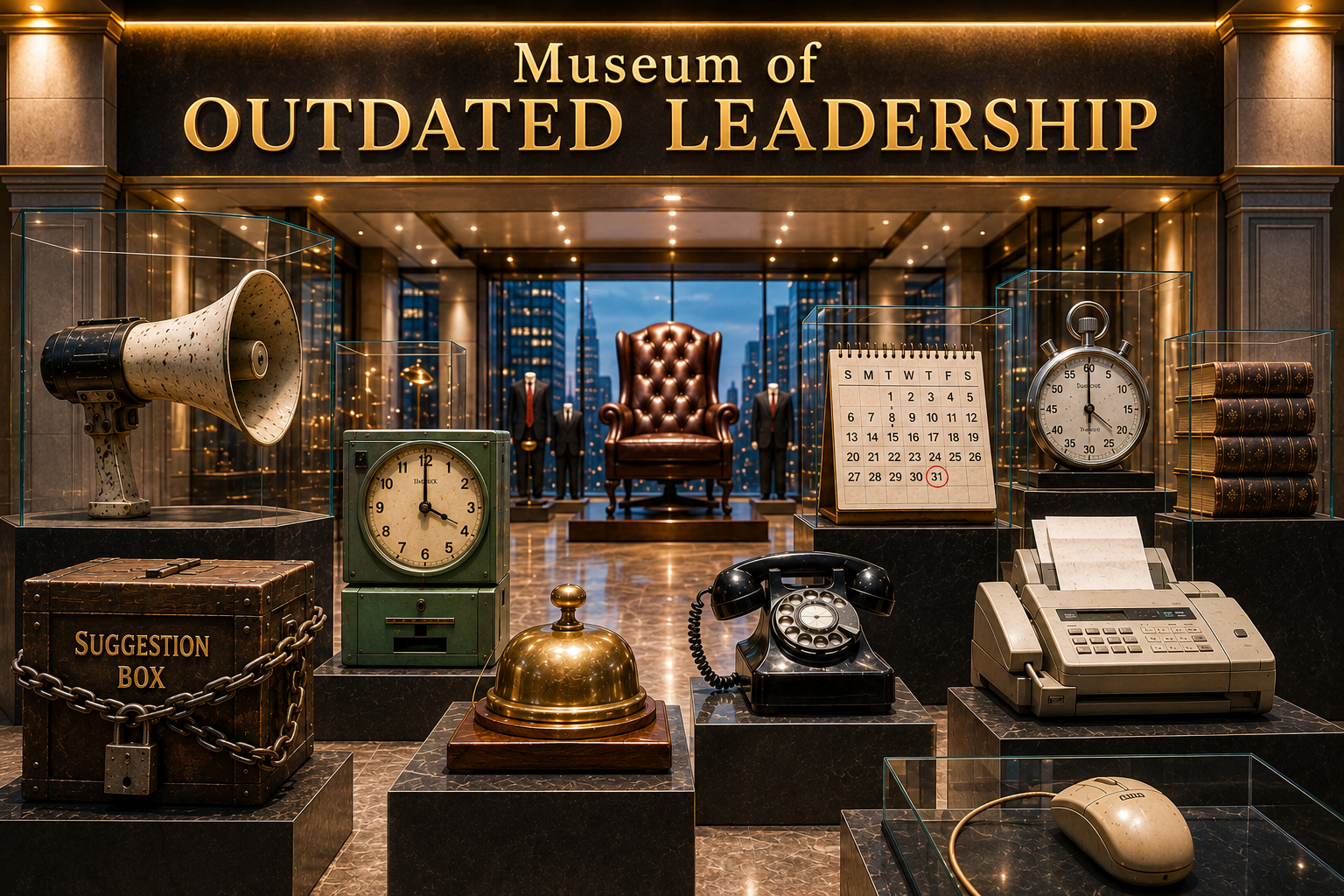
And naturally, I wondered: where is the RetroCodex for leadership? Well, friends, I'm sorry to be the bearer of bad news, but there isn't one. But if one did exist, some of the outdated leadership beliefs I've helped clients with in my executive coaching work would deserve a prominent place of honour, right beside smoking cigarettes in the office and mandatory skirts and stockings dress code (yep, it used to be a thing.)

The uncomfortable truth is that outdated leadership beliefs rarely look outdated when you're on the inside of them. They usually appear dressed up as other things, like professionalism, accountability, belonging, executive presence, or 'the way things are done around here.'

So in the spirit of public service, let’s scrape the mold off a few winners and see how today's truth challenges those outdated assumptions.

1.  GOOD LEADERS ALWAYS HAVE THE ANSWERS

This one has had an impressively long shelf life. For decades, leadership was often associated with certainty. The person at the top was expected to know, decide, direct, and project confidence, preferably without visible hesitation. That may have worked when business environments were slower and hierarchies were tighter. Today, that model starts to crack under complexity.

Amy Edmondson’s research on psychological safety at Harvard has shown that high-performing teams thrive when leaders create the conditions where people can raise concerns, share ideas, and challenge assumptions without fear. Learning organisations depend on candour, not theatrical certainty.

We have all seen the alternative: a leader makes a spectacularly wrong decision with unwavering confidence, and no one flags their concerns.

TODAY'S TRUTH: Don't pretend to know everything. People can often tell when you're bullshitting anyway, and that erodes trust faster than honest uncertainty ever will. Focus instead on creating enough trust that the best thinking in the system actually surfaces.

2.  IF YOU WANT SOMETHING DONE RIGHT, DO IT YOURSELF

Ahhh... the unofficial anthem of overwhelmed leaders everywhere. This belief often disguises itself as high standards. Sometimes it's called accountability. Sometimes it is a genuine focus on quality. And sometimes, if we are being really honest, it is ego dressed up in sensible shoes.

Liz Wiseman’s work in Multipliers draws a sharp distinction between leaders who expand the capability around them and those who unintentionally diminish it by becoming the bottleneck.

If every important decision, approval, rescue mission, or client issue must pass through you, that is not leadership excellence. It is a leadership model built on dependency.

TODAY'S TRUTH: Your job is not to be the hero of every operational subplot. Modern leadership means building capability, trusting good people with meaningful ownership, and resisting the seductive little voice that says, “Honestly, it’ll just be faster if I do it myself.”

3.  PROFESSIONALISM MEANS EMOTIONAL RESTRAINT

There was a time when professionalism seemed to require becoming emotionally indistinguishable from office furniture. Steady; controlled; stoic even (and before the modern Stoicism enthusiasts come for me, I'm referring to emotional suppression, not Stoic philosophy.) 

The assumption was that emotion made leaders look weak, messy, or unstable. Daniel Goleman’s work on emotional intelligence helped challenge that premise by showing that leadership is deeply relational work. People don't stop being human when they log in to work in the morning.

This does not mean unfiltered emotional leakage, dramatic oversharing, or turning every meeting into personal theatre, but real emotion that others can feel, recognize, and understand because it's authentic and universally human.

TODAY'S TRUTH: Professionalism is not the same as emotional suppression. Knowing and naming what you're feeling, understanding how it affects your behaviour, and paying attention to what others may be experiencing in response to you are all aspects of emotional maturity.

4.  PEOPLE NEED TO BE WATCHED TO STAY PRODUCTIVE

Well, this belief got a fresh makeover during the Covid pandemic, didn't it? While remote work was a lifesaver (and business saver), it was also uncharted territory for businesses. Suddenly, some leaders became strangely obsessed with green dots, login times, and whether Margaret was really still working at 4:17 p.m.

Microsoft’s 2022 Work Trend Index report identified what they called productivity paranoia: 87% of employees said they were productive at work, but only 12% of leaders said they had full confidence their team was productive. Yikes, talk about a delta! This should not have surprised anyone: adults generally perform better when treated like adults.

TODAY'S TRUTH: Trust, clear expectations, autonomy, and meaningful accountability outperform surveillance. If your management strategy involves monitoring mouse movement, the issue may be less about productivity and more about trust and empowerment. Either way, it's worth exploring with a curious mindset.

5.  PSYCHOLOGICAL SAFETY MEANS BEING NICE

This one needs to be escorted out of the building along with its little cardboard box full of platitudes, toxic positivity, and matching 'Teamwork Makes the Dream Work' mugs.

Somewhere along the way, psychological safety got mistaken for permanent politeness, with no space or tolerance for disagreement, no discomfort, and no challenge. But that interpretation misses the point entirely.

Amy Edmondson has been clear that psychological safety supports high standards and honest conversations. It creates the conditions for people to speak honestly, take interpersonal risks, admit mistakes, and challenge thinking.

TODAY'S TRUTH: On a high-performing, healthy team, people can respectfully disagree, raise concerns, share their authentic views, and challenge ideas without fearing social punishment. If everyone is smiling while important truths remain unsaid, what you may be looking at is conflict avoidance dressed up as harmony.

6.  YOU NEED MORE EXECUTIVE PRESENCE

Translation: Somehow be more impressive (but we will provide zero operational definition for what that means, or how to do it.)

Executive presence has suffered some unfortunate branding. For years, executive presence has been confused with airtime, extroversion, charisma, confidence theatre, and that oddly polished panel-discussion voice people seem to acquire at conferences.

Susan Cain’s bestselling book Quiet challenged the long-standing assumption that extroversion naturally equals leadership effectiveness. Adam Grant’s research has also highlighted that leadership effectiveness depends far more on context and behaviour than personality stereotypes.

TODAY'S TRUTH: Influence is not volume, charisma, theatre, or performative posturing. Some of the most compelling leaders I've seen in action are quiet. They don't suck all the air out of the room trying to show how smart they are. They may say less, but when they do speak, people pay attention because their contribution actually moves the conversation forward.

7.  IF I'M BUSY, I'M IMPORTANT

Does your calendar resemble an aggressive game of Tetris? For years, chronic busyness has functioned as a strange status symbol. Packed calendars, midnight email replies, and performative exhaustion sends the message that if I am overwhelmed, I must be important.

Microsoft’s research on the 'infinite workday' has shown how digital work has steadily eroded boundaries, recovery time, and focus.

Packed calendars and performative exhaustion do not signal importance. Sometimes they convey weak boundaries, poor capacity management, or reactive operational focus with little strategic value.

TODAY'S TRUTH: Busy is not a leadership competency. Modern leadership requires protected thinking time, sound judgment, and enough strategic altitude to notice what others miss. If your calendar leaves no room to think, you may be demonstrating operational stamina while actively undermining your strategic credibility.

8.  LEADERS ARE NOT TO BE CHALLENGED

There was a time when leaders were expected to project authority and maintain distance. They did not invite dissent, challenge, input, or inconvenient truths from the people below them. Leadership was something to be respected, and in some workplaces, even feared. Suggesting to your boss that they might handle something differently would have been career-limiting behaviour.

Some remnants of that thinking still linger. Edgar Schein wrote extensively about how hierarchy can inhibit honest communication, especially when leaders fail to create the conditions for upward candour. And as leaders progress up the ladder and gain more authority, people often become even more selective about what they share with them.

TODAY'S TRUTH: If people decide that telling you the truth is unsafe, inconvenient, or pointless, you may be the last person to know what is actually going wrong. Strong leaders create the conditions for honest feedback to travel upward, not just downward.


SO WHAT IS STILL SITTING IN YOUR LEADERSHIP ATTIC?

The tricky thing about outdated leadership beliefs is that many of them genuinely did work back in the day, or at least seemed to. Some rewarded us earlier in our careers, which is exactly what makes them so sticky. The people who believed those old RetroCodex 'facts' were not foolish; they were operating with the assumptions, norms, and accepted wisdom of their time. Leadership is no different.

Nobody wakes up in the morning and consciously decides to lead like it's 1987. Old beliefs linger because they once helped us succeed, feel competent, or stay safe in systems that rewarded them. That does not make someone a bad leader. It simply means leadership has evolved.

Some of today’s most confidently held leadership beliefs will eventually look just as dated. The more interesting question is which ones you may still be holding onto without realizing it.

YOUR COACHING CHALLENGE

Most outdated leadership beliefs do not announce themselves with a little flag that says Hello, I am obsolete. They tend to feel sensible, responsible, and strangely familiar. This practice is designed to help you uncover one belief that may still be shaping your leadership, and then test whether it still deserves shelf space.

YOUR LEADERSHIP RETROCODEX

STEP 1: SPOT THE MOLD: Read through the beliefs in this article and notice which one made you uncomfortable, slightly defensive, oddly validated, or uncomfortably seen. That reaction is useful. Complete this sentence: One leadership belief I may still be holding onto is... Examples: "Good leaders should always have the answer." "If I want something done right, I should handle it myself." "Being busy means I am valuable."

STEP 2: TRACE ITS ORIGIN STORY: Most leadership beliefs started life as adaptations, not mistakes. Ask yourself: Where did I learn this? Who modelled this for me, or rewarded me for it? When did this belief first help me succeed? What did it help me avoid?

STEP 3: EXAMINE THE CURRENT COST: Now get brutally honest. Ask yourself: How might this belief be limiting me now? What does it cost my team? How does it affect trust? What undesirable behaviour does this belief keep reinforcing?

STEP 4: WRITE THE UPDATED LEADERSHIP TRUTH: If your old belief belongs in the RetroCodex, what replaces it? Complete this sentence: Today’s truth for me is... Example: Old belief: I need to stay involved in everything important. Today’s truth: My leadership value grows when I build capability instead of dependency.

STEP 5: RUN A LIVE EXPERIMENT: Within the next week, experiment with deliberately behaving according to your updated belief. Say less in the meeting. Delegate the thing. Ask the uncomfortable question. Admit you don't know. Protect thinking time. Invite dissent. Whatever your belief requires.

STEP 6: REFLECTION QUESTIONS: What happened? What surprised me? What story did my inner narrator start telling? What felt easier than expected? What still felt risky? What does this tell me about my next experiment?

If outdated leadership beliefs are influencing how you lead, and you're curious about what stronger, more modern patterns might serve you better, reach out for a free exploratory Executive Coaching conversation at www.leslierohonczy.com.