
HOW WE EVOLVE

IS IT ADAPTABILITY OR SELF-ABANDONMENT? 5 Signs You’re Losing Your Authenticity as a Leader

I was watching the 1999 movie Runaway Bride on a rainy Sunday. In it, Julia Roberts plays a woman who has become remarkably skilled at adapting herself to each man she plans to marry. Every fiancé likes his eggs prepared differently, and every time, she claims that his favourite is hers too. Eventually, she sits down with a plate of eggs prepared in several different ways because she has no idea how she actually likes them.

I'm sure that no one has ever derailed their career by pretending to like scrambled eggs. But changing your leadership identity with every new boss or initiative can be considerably more expensive.

Imagine working for three different executives in three years. The first rewards decisiveness, so you learn to arrive with an answer. The second values collaboration, so you become careful not to sound too certain. The third wants relentless optimism, so you become reluctant to name risks or issues.

You've adapted successfully to all three. But when someone finally asks what you genuinely think about a significant decision, you can bet that you'd struggle to answer. Like Julia Roberts’ character surveying that plate of eggs, you will have become much better at identifying other people’s preferences than locating your own.

Adaptability is one of the most celebrated qualities in leadership, and for good reason. Knowing how to read the room, flex your communication style, support a decision you might not have made yourself, and keep things moving when the organizational furniture is being rearranged around you are all important leadership skills.

But adaptability has a shadow side. If you keep reshaping yourself around every new person, priority, pressure, and preference, eventually you may struggle to remember what you genuinely stand for.


THE LINE IS EASY TO MISS

Self-abandonment is a pretty weighty term, but it doesn’t feel that way at the beginning, which is why it can take on a life of its own without our awareness. It usually happens one reasonable little accommodation at a time.

Your new boss prefers shorter, more decisive conversations, so you become more concise. That makes sense. Then you notice that questions are interpreted as resistance, so you begin asking fewer of them.

The organization announces an ambitious transformation, and you help your team get behind it. That is part of leadership. Then you realize the timelines are unrealistic, but everyone else appears enthusiastic, so you keep your concerns to yourself.

Your workload expands temporarily during a reorganization. You agree to stretch because the business genuinely needs you. Six months later, the temporary arrangement has become your job, and you've stopped mentioning the cost because you don't want to appear inflexible.

No single decision feels dramatic enough to count as self-abandonment. The pattern becomes visible only when you step back far enough to see what has accumulated. You are working harder to anticipate what other people want than to determine what you believe. You are editing your contribution before anyone else has the opportunity to respond to it. You have become exceptionally skilled at reading the room while gradually disappearing from it.


AUTHENTICITY DOESN’T MEAN REFUSING TO ADAPT

Leaders sometimes confuse authenticity with saying everything they think, exactly as they think it. That would not be authenticity. Effective leadership requires judgment about timing, language, context, and audience. You can remain true to your values while changing how you express them. You can disagree with a decision and still help implement it responsibly. You can choose not to raise every concern in every meeting without becoming complicit or voiceless. The crucial question is whether you are making these choices consciously.

Healthy adaptability sounds like this: “I understand what this situation requires, and I am choosing how best to respond.” Self-abandonment sounds more like this: “I know what I think, but it no longer feels safe, useful, or career-enhancing to let anyone else know.”

In a study published in The Journal of Psychology, research on authenticity at work supports the idea that it is distinct from simply “fitting in” at work, and that it is meaningfully related to well-being outcomes such as burnout and boredom. In other words, when people feel unable to show up authentically, it can be associated with poorer experiences at work (https://pubmed.ncbi.nlm.nih.gov/30285570/).

It means that fitting in and feeling like you can be yourself aren’t the same thing.

None of this means every preference needs to be defended as identity. Refusing to learn a new system because “that’s just not me” isn’t authenticity; it’s avoidance. But it does mean that repeatedly overriding your own judgment, values, and limits comes at a cost.


THE DEEPER ISSUE IS SELF-TRUST

When we keep overriding ourselves, we often assume the problem is confidence. Sometimes it is, but the deeper issue may be self-trust.

Confidence asks, “Can I handle this?” Self-trust asks, “Can I rely on my own perceptions, judgment, values, and experience, even when other people see things differently?”

Leaders with self-trust can reconsider an opinion without assuming they were wrong to hold it. They can receive feedback without reconstructing their entire identity around it, and adapt to a new boss without treating that person’s preferences as universal leadership law. And they can also recognize that discomfort doesn't automatically mean they are doing something wrong or need to change themselves.

Organizations send constant signals about what gets rewarded. We learn which opinions receive the nod of approval, which questions make the room tense, and which behaviours are described as “not quite executive enough.” We also notice who gets invited back into the conversation. Responding intelligently to those signals can be politically astute. The danger begins when we allow them to replace our internal compass.

Our organizations hired us for our experience, judgment, and perspective. If we continually reshape all three to resemble the people above and around us, we may become easier to manage. We may also become considerably less valuable.


FIVE SIGNS WE MAY HAVE CROSSED THE LINE

The shift from adaptability to self-abandonment often appears in ordinary leadership habits. These patterns can be difficult to recognize in ourselves because many of them begin as reasonable leadership choices. Any one of these behaviours may be situational, but a repeated pattern deserves a closer look.


1. WE CONSULT THE ROOM BEFORE WE CONSULT OURSELVES

Before deciding what we think, we scan for the safest or most popular position. By the time we read everyone else’s reactions, our own view has become difficult to locate. Reading the room is a valuable leadership capability. The problem begins when everyone else’s response becomes the raw material from which we construct our own.

2. WE KEEP MOVING OUR LIMITS

We agree to one more responsibility, one more unreasonable deadline, or one more evening of work. Every exception can be justified, but together, the exceptions become our operating model. Adaptability sometimes requires a temporary stretch. Self-abandonment turns temporary stretches into permanent expectations because we are reluctant to risk disappointing anyone by resetting the boundary.

3. WE TRANSLATE DISAGREEMENT INTO PERSONAL FAILURE

When someone challenges our view, we don't just reconsider the idea; we immediately question whether we were too direct, too difficult, too sensitive, too cautious, or simply too much (or not enough). Thoughtful leaders examine their impact. When we are losing self-trust, we may automatically assume that another person’s discomfort is evidence of our own failure.

4. OUR LEADERSHIP IDENTITY CHANGES WITH EVERY NEW BOSS

Different leaders reward different behaviours based on their own personal communication preferences and decision-making styles. We may find ourselves reshaping our style to match shifting expectations, which can gradually dilute our own sense of self. Expanding our range is healthy. The concern is whether each adaptation adds to our leadership capacity or replaces a piece of it.

5. WE FEEL RELIEF WHEN SOMEONE ELSE SAYS WHAT WE WERE THINKING

This can be one of the clearest clues. We had the concern, question, or alternative perspective, but waited until someone else made it safe to acknowledge. There are sensible reasons to choose the right moment or allow another person to lead. But if our first reaction is consistently relief that someone else took the risk, it may be worth asking why our own voice remained suppressed.


KEEP YOUR CENTRE AND EXPAND YOUR RANGE

The answer is not to become less adaptable. Senior leaders need considerable range, especially when organizations are contending with new technologies, changing workforce expectations, economic uncertainty, and frequent structural change. The opportunity is to build that range around a stable centre of gravity

Our centre includes the values we protect, the judgment we've earned through experience, the limits required for sustainable performance, and the leadership contribution we want to make. Our range includes the many ways we can communicate, collaborate, experiment, and respond.

A tree survives strong winds partly because it can bend and flex, but its ability to move also depends on having roots. Professional roots don't make us rigid; they allow us to flex without being carried away.

One place to begin is by separating what must remain stable from what is available for adaptation:

  • Our communication style may be adaptable, but our integrity is not.

  • Our methods may be adaptable, but our standards cannot disappear.

  • Our timing may be adaptable, but our conviction that an important risk needs to be raised may remain firm.

  • Our role may evolve, but our values are non-negotiable.

These distinctions are rarely obvious in the moment. They become clearer when we move beyond asking, “What does the organization need from me?” to ask a deeper question: “What do I need to remain authentic as a leader?”


BEFORE WE ADAPT AGAIN

The next time we feel pressure to reshape ourselves around a person or situation, we can pause long enough to examine what we are changing.

We can ask ourselves:

  • Where am I deciding to override my judgment, and what's driving my decision?

  • What specifically am I trying to avoid?

  • What have I not yet said, and what's holding me back from saying it now?

  • Which part of this situation genuinely requires my flexibility?

  • Which value, limit, or responsibility needs to remain intact?

  • If I continue responding this way for another year, what will the impact be on me?

Most leadership accommodations and adjustments are simply part of working effectively with other human beings, who remain stubbornly committed to being different from us. The challenge is to notice when a useful strength has started working against us. Adaptability should give us more ways to lead, connect, and navigate complexity, not require us to leave ourselves behind.


YOUR COACHING CHALLENGE

Find 30 minutes of quiet time when you can do this exercise in a calm state, without rushing or being interrupted.

Recall one recent moment when you adapted yourself to the room, then left the conversation feeling frustrated, diminished, resentful, or unlike yourself. Reconstruct that moment as specifically as you can, and when you have it clearly in your mind, answer the following questions:

  1. Before you began adjusting to everyone else, what did you genuinely think, want, need, or believe?

  2. What did you choose to say or do instead, and what were you trying to protect: approval, credibility, belonging, harmony, opportunity, or something else?

  3. What did you assume might happen if you expressed your real perspective, held your limit, or acted on your own judgment? What evidence supports that assumption, and what evidence challenges it?

  4. Who or what benefited from your accommodation? What did it cost you, your team, or the quality of the decision?

  5. If you could replay that moment with both adaptability and self-trust, what would you keep about your approach, and what would you change?

  6. Identify one upcoming situation in which you are likely to repeat this pattern. What, specifically, will you say, ask, decline, or protect so that you can remain flexible without leaving yourself behind?

We don’t need to reject other people’s preferences or sample every possible kind of egg. We simply need to know which choices are genuinely ours.

Adaptability remains one of the great strengths of effective leadership. Self-trust prevents that strength from becoming an over-strength and consuming the leader who possesses it.

If you want to explore how to remain adaptable without losing your self-trust or leaving yourself behind, reach out for a free executive coaching conversation at leslierohonczy.com.


HOW METAPHORS REVEAL WHAT ADVICE MISSES: Borrow this Powerful Tool from a Master Coach

By Leslie Rohonczy, IMC™, PCC

Executive Coach | Leadership Development Expert | Author | Speaker | ©2026 | www.leslierohonczy.com


Halfway through an executive coaching session with a senior leader, I saw it: that juicy a-ha moment when an insight sparks, and the body responds before the words arrive. My client’s posture shifted as I offered him a metaphor for what he was experiencing. He leaned forward and began nodding, then his hands joined the conversation. “That’s it,” he said. “That’s exactly me. Do you have a camera in my office?”

For the record, I don’t have cameras hidden in my clients’ offices. But what I did have was a metaphor that illustrated something true about how he had learned to operate. It was a unique lens that reflected back to him the strengths he relied on, the pressures he carried, the ways he protected himself, and the costs of those strategies.

And, maybe most importantly, he felt seen. He understood that I ‘got’ him and wasn’t judging him. We now had a safe, shared language for exploring something that had previously been difficult for him to name. That’s one reason I return to metaphor so often in my executive coaching work.

I should clarify what I mean by metaphor. I’m not suggesting that leaders dust off those tired old sports clichés we’ve all heard a thousand times: keep your eye on the ball, step up to the plate, get back in the game. Those expressions may add a bit of colour to a conversation (if you like the colour beige), but they rarely reveal anything new. A developmental metaphor is personal, specific, and rich enough to help someone recognize a pattern in how they operate, then explore its strengths, limitations, and possibilities.

But metaphor isn’t just a powerful coaching tool; leaders can use metaphors when coaching and developing their employees, too. You don’t need to be a professional coach, invent elaborate imagery, or turn every one-on-one into a voyage of symbolic discovery. Sometimes one well-timed image can help an employee describe a challenge they’re having more clearly, so they can examine it with less defensiveness, and imagine a different way of responding.

The metaphor itself is not the point. What matters is what it helps someone recognize about what’s happening now, and the new possibilities that recognition opens.


MOVING FROM INSIDE THE PATTERN TO OUTSIDE IT LOOKING IN

When a behavioural pattern is deeply embedded, we don’t typically experience it as a pattern; we just experience it as our reality.

The leader who throws on his cape and flies in to rescue the team may believe, “This is what responsible leadership looks like.” The person who puts on a suit of armour before a difficult conversation may believe, “I need this protection to remain composed.” The executive who moves at jet-boat speed may see the wake she leaves behind her, without fully recognizing how hard it is to bring other people along with her.

Metaphor can help someone gain enough distance to examine what is happening. Instead of saying, “I’m impatient and terrible at bringing people along,” a leader can begin to notice, “I can feel my jet boat accelerating again.” Instead of thinking, “I shut people out,” someone might say, “This suit of armour is getting too heavy.” Instead of thinking, “It’s all up to me,” someone might notice, “I’ve picked up everyone else’s backpacks again.” Instead of thinking, “If I don’t get them engaged and developing, I’m not doing my job,” a leader can begin to notice, “I’m pulling up every seedling to make sure it’s growing.”

That small change in language matters. The behaviour is still theirs to understand and address, but it no longer defines the whole person. They can step back, observe it, and begin making more deliberate choices.

Research on metaphor supports its role in helping people make sense of complex or less tangible experiences by connecting them with something more concrete and familiar. A metaphor will not automatically produce insight or behavioural change. It does, however, create another way to explore an experience and experiment with different responses.

What felt personal and loaded yesterday can become something two people place between them and examine together today. It leads to powerful questions like, “What does the armour protect?” “When did the jet boat become necessary?” “What might you be taking away from your employees by flying in to rescue them?” “What are you trying to prevent by tending the garden so intensely?” These questions invite curiosity into a conversation where judgment, frustration, or defensiveness may have been getting in the way.


A LENS, NEVER A LABEL

There is a risk in all of this, of course. A metaphor can become so clever, appealing, or memorable that the person offering it falls in love with it. Once that happens, we may start trying to stuff the other person’s experience into our beautifully shaped metaphor, instead of allowing their experience to shape it.

A metaphor should offer a lens through which someone can examine their experience. It should never become a label that defines them.

When I offer a metaphor to a client, I tell them explicitly that I am not attached to it. Leaders can give an employee the same permission: “This image may not fit. We can play with it, change it, challenge it, or throw it out, and find something else that feels more like it fits your experience.”

I once offered a Labrador Retriever guide dog as a metaphor for a client’s ability to guide a new leadership team through a merger with another group. I thought it fit beautifully. He was terrified of dogs. Needless to say, we found a new metaphor. The person being coached gets the deciding vote. It’s as simple as that.

Even a metaphor that resonates with several people may mean something different to each of them. A gardener might represent patience and trust for one leader. For another, it might reveal a tendency to overwater every plant, pull up the seedlings to check whether they are growing, and take personal responsibility for the weather. Same garden. Entirely different coaching stance.


HOW METAPHOR SHAPES MY COACHING

Integral Coaching Canada’s methodology has deeply shaped my use of developmental metaphor.

In my executive coaching work, metaphor can help a client recognize how they currently approach an important challenge and envision a broader, more intentional way of leading. That developmental work is far more extensive than the simple application I am sharing here.

Leaders are often given objectives such as “delegate more,” “become more strategic,” “communicate differently,” or “strengthen executive presence.” These may be worthwhile goals, but they rarely help someone recognize what to do differently when the pressure is on.

A strong metaphor gives the objective shape and texture.

Consider the leader whose approach resembles a jet racing boat. They are fast, responsive, decisive, and highly capable of reaching a destination quickly. Those strengths may have been richly rewarded throughout their career. At the same time, there is very little room in the boat for anyone else, and the leader’s speed may leave a wake of dependency, confusion, or disengagement behind them.

Simply advising this leader to slow down probably won’t create much change. The metaphor opens a richer developmental conversation:

  • When does speed genuinely matter?

  • Who needs to be in the boat with you?

  • When would creating shared ownership matter more than arriving first?

  • How will you retain your decisiveness while making more room for others?

The metaphor makes an abstract objective easier to recognize and work with in real situations.

What follows is a simple way for leaders to experiment with metaphor in developmental conversations. It is not a substitute for professional coach training or a complete coaching methodology. Four clever questions do not make anyone a Master Coach before lunch, but they can help you have more effective developmental conversations with your direct reports.

WHERE USEFUL METAPHORS COME FROM

Often, people hand us their metaphors without realizing it.

An employee may describe themselves as running on a treadmill, carrying everyone else’s load, juggling ten balls, playing every instrument, or wearing armour into important conversations. That language is worth noticing because it may reveal how they already understand their experience.

Imagine an employee saying, “I feel as though I’m juggling ten balls and everyone keeps throwing me another one.”

A leader could move immediately into workload solutions. Or they could become curious about the image:

  • Which balls cannot be dropped?

  • Which ones belong to you?

  • Which were handed to you by someone else?

  • Are any still in the air because you haven’t decided where they belong?

The metaphor does not replace a practical conversation about workload. It helps both people understand the workload more precisely before deciding what to do about it.

Sometimes, the person creates the image. Sometimes, you build it together. Occasionally, you may offer one based on what you’ve observed. However it emerges, the employee needs room to define its meaning, revise it, or reject it.

A rejected metaphor is useful information. It tells you that you have not yet found language that belongs to the person.


METAPHOR CAN HELP A TEAM SEE ITSELF

Metaphor can also help a group name how it wants to work together.

In my work with teams, I have seen the value of creating a collective metaphor that captures the team’s strengths, aspirations, relationships, and shared responsibilities. A team might identify itself as a pod of dolphins, for example, and develop its own understanding of what that image represents about how members navigate, communicate, protect one another, and move together.

The power comes from the meaning the team creates, rather than from the leader arriving with a polished image and announcing, “Good news, everyone. We’re dolphins now.”

A shared metaphor can give a team shorthand for conversations that would otherwise be difficult to begin. When the pod of dolphins is functioning well, what’s happening to make it so? When food sources are scarce and the pressure is on to find food, how does the pod adapt? What causes some dolphins to be separated from the pod, and how do the others help them navigate their way back?  

Because the metaphor belongs to everyone, it can become a useful reference point for reflecting on collective behaviour without immediately blaming an individual. The team can then discuss whether it’s living into its chosen image and what may need attention when it’s not.

Used thoughtfully, a collective metaphor can help a team name the culture it wants to create and recognize the everyday behaviours required to make that culture real.


USING METAPHOR WITHOUT GETTING IN ITS WAY

If you want to experiment with metaphor in a developmental conversation, a few practices matter:

  • Listen for images already embedded in the person’s language. Their metaphor will often resonate more deeply than one imported from outside.

  • Offer your own images lightly. “I wonder whether this is a little like…” creates more room than “Here is what you are.”

  • Watch what happens before you elaborate. Changes in posture, energy, expression, words, or engagement may tell you whether the image is opening the conversation or closing it down.

  • Let the person define the details. Ask what the metaphor means to them instead of explaining what you believe it ought to mean.

  • Explore both its value and its cost. A jet boat, suit of armour, conductor, gardener, or superhero contains strengths as well as limitations. Development begins with understanding the whole pattern.

  • Remember your authority. An employee may agree with a metaphor because their leader offered it. Make disagreement easy and explicit.

  • Allow the metaphor to evolve. As the person develops, the image may acquire new features, change form, or become unnecessary.

Most importantly, don’t confuse recognition with transformation. A metaphor can create a powerful moment of awareness and insight, but insight is the beginning. Sustainable change still requires practice, reflection, experimentation, and new choices under real pressure.


YOUR COACHING CHALLENGE

Think about someone you are coaching or developing who has you feeling stuck. In your next conversation, listen carefully for the images embedded in how they describe their experience.

If none emerges naturally, you might ask:

“If this challenge were a vehicle (or a landscape, object, animal, machine, or character), what might it be?”

Then remain curious: What does the image reveal about how they currently see themselves or the situation? What strengths exist within it? What does the image protect, restrict, overlook, or leave behind? If it evolved to represent how they would like to approach the situation, what would change?

Resist the temptation to interpret the image for them or steer them toward the answer you think they need. The metaphor may help you see where their development could go next. More importantly, it may help them see it for themselves.

If you would like to explore the metaphors shaping how you lead, or create a collective metaphor that helps your team strengthen how it works together, I would love to help. Reach out to arrange a free exploratory executive coaching conversation at leslierohonczy.com.

10 C-SUITE ATTRIBUTES THAT MATTER MORE THAN EVER: Executive Leadership Has Changed. Have Our Leaders?

By Leslie Rohonczy, IMC™, PCC

Executive Coach | Leadership Development Expert | Author | Speaker | ©2026 | www.leslierohonczy.com


Imagine being handed the keys to the C-suite today. Congratulations! Now, about that job description. The economy is uncertain. Geopolitics has wandered straight into your strategic plan. Canada’s relationship with its largest trading partner is fractured. AI is changing work faster than many organizations can redesign it. Your people are tired of change, but you need them to get better at it, quickly. And somewhere in the middle of all this, you’re still expected to deliver the quarter. Welcome to the executive team.

This is an interesting time to be a senior leader in Canada.

For many years, I was the Corporate Coach at Export Development Canada, coaching leaders inside an organization devoted to helping Canadian companies grow internationally. One thing I learned from that experience is that moving beyond familiar territory asks something different of leaders. Assumptions get challenged. Relationships work differently. Risk changes. What made you successful somewhere familiar may be surprisingly unhelpful somewhere new. And that feels particularly relevant now more than ever.

EDC just reported (September 2026) that 72% of Canadian exporters plan to pursue new markets over the next two years, up from 65% just five months ago. Europe and Asia-Pacific are attracting particular interest. At the same time, companies are navigating tariffs, geopolitical instability, rapid technological change, productivity pressures and economic uncertainty.

KPMG recently asked Canadian CEOs which leadership capabilities they consider most important for navigating geopolitical instability and sluggish economic growth. Their answers included leading transformation and culture change, faster decision-making under pressure, stronger strategic foresight and scenario planning, and AI understanding and literacy.

The demands of the senior leadership job are changing.

So perhaps the question for boards, CEOs, and executives aspiring to the C-suite is no longer simply, “Who has performed well enough to get there?” We might also ask, “Who has the range to lead from there now?”

What does that kind of range look like in practice? While the answer will vary by organization, industry, and circumstance, some leadership capabilities are becoming increasingly important as the demands on senior executives change. These ten stand out to me, not as a definitive checklist, but as a useful way to examine whether our leadership capabilities are keeping pace with the world we’re being asked to lead in.

Here are ten leadership attributes I believe deserve particular attention.


TOP 10 LEADERSHIP ATTRIBUTES


1. STRATEGIC FORESIGHT

Nobody gets issued a crystal ball with their executive parking pass. Strategic foresight is something more useful anyway. It’s the ability to look beyond the most likely future and consider several plausible ones. What happens if a major market becomes less accessible? Or if a competitor changes your industry's economics? What if AI fundamentally changes the work? Or the assumptions underneath your five-year strategy stop being true?

It’s impossible to accurately predict the future, anyway. The real objective is to become less surprised by it.

STRATEGIC EXECUTIVE QUESTION: What would have to happen for our current strategy to stop making sense?


2. ADAPTIVE DECISIVENESS

Executives have always made difficult decisions. What has changed is how frequently they may have to make them without enough information. Waiting for certainty can feel responsible. Sometimes it is. Sometimes it is indecision dressed up in a respectable suit.

Adaptive decisiveness means making a sound decision with the best information available, explaining the reasoning, watching what happens, and being willing to change course when the evidence changes.

Changing your mind because the facts changed isn’t weak leadership. Refusing to change it because your ego is now attached to the decision might be.

STRATEGIC EXECUTIVE QUESTION: Where are we waiting for certainty when what we actually need is a thoughtful decision?


3. GLOBAL AND GEOPOLITICAL CURIOSITY

For Canadian executives, geopolitics can no longer be something that happens somewhere else. Trade policy, currencies, regulation, supply chains, energy, political relationships and cultural differences can affect customers, costs and growth surprisingly quickly. And as more Canadian companies branch out to explore markets beyond the United States, leaders will increasingly encounter places where the familiar rules of business don’t necessarily apply.

That calls for something deceptively simple: curiosity, the willingness to understand before assuming, and occasionally to say, “We don’t know enough about this yet.”

STRATEGIC EXECUTIVE QUESTION: Which assumptions about our markets, customers, and competitors are we treating as facts?


4. ENTERPRISE THINKING

Many executives reach the C-suite because they have become exceptionally good at a specific function: finance, operations, technology, marketing, people, sales. Then the job changes. At the enterprise level, the question is no longer simply, “What is best for my function?” It becomes, “What does the whole organization need?”

A technology decision can create a people problem. A cost reduction can create a customer problem. A growth opportunity can introduce risks another executive sees more clearly than you do.

Strong C-suite leaders gradually loosen their grip on their functional identity and become stewards of the whole enterprise. In my coaching work, I’ve seen how challenging that transition can be, especially when functional expertise has been such an important part of a leader’s success.

STRATEGIC EXECUTIVE QUESTION: When my functional interests and the needs of the enterprise collide, which one wins?


5. TECHNOLOGICAL JUDGMENT

I deliberately haven’t called this AI expertise. Most executives don’t need to become technologists. They need enough understanding to ask good questions and enough judgment to recognize bad answers.

PwC’s 2026 Global CEO Survey found that only 12% of CEOs reported both revenue and cost benefits from AI, while 56% reported neither. That doesn’t argue against AI. It argues for thoughtful leadership around where and how it is being used.

Where does AI genuinely create value? What work should disappear or change? What should remain distinctly human? What risks are being introduced? Who remains accountable for the decisions? I explored another aspect of this question recently in IF AI SAVES TIME, WHO GETS THE TIME BACK? The technology may create capacity. But leadership must still decide what that capacity is for.

STRATEGIC EXECUTIVE QUESTION: Are we using AI because we can, or because we are clear about the value we want it to create?


6. THE ABILITY TO BUILD ADAPTABILITY

Deloitte’s 2026 Global Human Capital Trends research found that 85% of leaders consider building organizational and workforce adaptability critical. Only 7% say they are leading in helping their workforce continuously grow and adapt. That gap should get our attention.

Organizations can’t keep throwing change at people and calling their ability to absorb it “resilience.” Adaptability requires context, priorities, learning, tolerance for experimentation, permission to stop doing some things, and enough stability to innovate. Otherwise, adaptability becomes exhaustion, and exhausted people aren’t particularly strategic or creative.

STRATEGIC EXECUTIVE QUESTION: How are we building our organization’s capacity to adapt, rather than simply asking people to absorb more change?


7. EMOTIONAL SELF-REGULATION

This capability doesn’t appear on a balance sheet, but its consequences sure do. When uncertainty rises, people watch their leaders more closely. An executive who becomes reactive, defensive, or visibly anxious can send that anxiety through an organization faster than a layoff rumour.

Senior leaders don’t need to become emotionless. They need enough self-awareness to recognize what is happening inside themselves, enough social awareness to sense how others are feeling and anticipate how they may respond, and enough self-regulation to consciously choose what they send outward, and how. And remember, the higher the position, the bigger the wake you’ll leave behind you.

STRATEGIC EXECUTIVE QUESTION: Under pressure, what am I transmitting to others, and is it helping them respond at their best?


8. TRUST-BUILDING CANDOUR

I’ve seen uncertainty create an interesting communication problem in organizations. Leaders are often tempted to wait until they have answers before saying anything. And employees are often most hungry for communication when answers don’t exist yet.

Candour means being able to say what we know, what we don’t know, what has changed, what we are considering, and what happens next. It also means creating enough safety for other people to be candid with us. The more senior you become, the more courage it can take for someone else to tell you they think you’re wrong. I explored this more deeply in DO PEOPLE DISAGREE WITH YOU TO YOUR FACE?, because one of the less obvious risks of gaining authority is gradually losing access to the candid disagreement you need most.

If nobody challenges your thinking anymore, it might be worth wondering why.

STRATEGIC EXECUTIVE QUESTION: How am I creating the conditions to discover what people really know, see and believe, especially when it differs from what I want to hear?


9. TALENT MULTIPLICATION

There’s a point in an executive career when your greatest contribution shifts from what you can personally accomplish yourself, to what you can inspire and enable others to accomplish through your leadership.

Your job increasingly becomes creating the conditions for others to think, decide, challenge, experiment, and lead. That means developing successors, giving away meaningful authority, coaching rather than rescuing, and resisting that seductive little voice that says, “It would be faster if I just did it myself.” In truth, yep, it probably would. That’s why the habit is so dangerous.

If too many decisions still need you, eventually you become part of what’s slowing the organization down.

STRATEGIC EXECUTIVE QUESTION: Where am I adding value by being involved, and where has my involvement started preventing someone else from growing?


10. INTELLECTUAL HUMILITY AND COURAGEOUS CURIOSITY

The further people rise in an organization, the easier it can become to confuse experience with certainty. Experience is enormously valuable, until the environment changes enough that some of what we ‘know’ becomes an assumption worth examining.

Curious executives ask what they are missing, whose perspective they haven’t heard, what evidence would cause them to change their minds, and which assumption would be most dangerous if it were wrong.

Perhaps the hardest question is also the shortest: “Could I be wrong about this?”

That doesn’t diminish executive authority. Used well, it strengthens it.

STRATEGIC EXECUTIVE QUESTION: What am I so certain about that I’ve stopped being curious about it?


THE C-SUITE MAY NEED MORE RANGE

Canadian companies are being asked to protect what works while exploring what comes next. The expectation is to maintain U.S. relationships where possible, while building new ones, to invest while managing uncertainty, to leverage the hell out of AI while figuring out where it actually creates real value, and to transform our organizations while keeping people capable of absorbing the transformation.

Those challenges require strategy, capital, and execution. They also require leaders with range.

Perhaps that gives us a different way to think about C-suite readiness. Experience still matters, of course, but experience tells us what worked before. Leadership becomes particularly interesting when the environment stops cooperating with our experience.

The executives who lead Canadian organizations successfully through the next decade may be the ones whose ability to learn, unlearn, decide, and adapt, will help them survive and thrive without losing sight of the people they are asking to come with them.


YOUR COACHING CHALLENGE

Take another look at the ten attributes, but don’t choose the three you’re best at. That’s too easy. Instead, reflect on which one made you slightly uncomfortable.

Reflect on these two questions:

  1. Where is that capability being tested in your leadership right now, and what do you tend to do instead?

  2. If the demands of your role change faster than you do over the next three years, which capability will you wish you had started developing today?


WHY DO YOU REALLY WANT TO LEAD? 5 Uncomfortable Questions to Ask Yourself

By Leslie Rohonczy, IMC™, PCC

Executive Coach | Leadership Development Expert | Author | Speaker | ©2026 | www.leslierohonczy.com


Ask someone why they want a bigger leadership role, and you'll usually hear the standard answers: "I want to make a difference" or "I want to help people grow." Both may be completely sincere; admirable even, and definitely plausible. Also, probably not the whole story.

Perhaps you really want greater influence, recognition, money, authority, or challenge. Perhaps the promotion would prove something to a former boss, a parent, a colleague, or yourself. There's no shame in any of these drivers, and they don't make you unfit to lead. They make you human.

The risk begins when we refuse to examine those motivations more deeply. An unacknowledged need doesn't disappear when the promotion is announced. It just gets a larger office, a bigger budget, and more people to influence.


YOUR AMBITION IS DATA

Leadership researchers Kim-Yin Chan and Fritz Drasgow introduced the term ‘motivation to lead’ in their research on the three sources of leadership motivation: we may be drawn to leadership because we enjoy it and see ourselves as leaders; because we feel a duty to step forward; or because we're willing to accept the costs and responsibilities involved. Their findings also showed that motivation to lead adds meaningful information when predicting leadership potential.

In other words, the motivation for why we lead deserves more attention than a common question during a promotion interview.

Most of us have a mix of motives, not just one. We can care deeply about helping others, enjoy being influential, and appreciate the salary increase. Self-awareness asks us to recognize what's driving us, so those motives don't take over when pressure rises.

The more useful question, then, isn't simply, “Do I want the job?” It’s, “Do I want the work the job will require of me?” That work comes with a few uncomfortable tests.


FIVE POWERFUL QUESTIONS

Here are five questions that can help you look beneath those standard polished reasons for wanting to lead and examine what may also be driving you. Whether you’re considering a leadership role or already in one, reflect on them with curiosity rather than trying to produce “right” answers. They can help you distinguish between wanting the title and wanting the work that comes with it. They can also help you anticipate where your motives could shape your behaviour, and make more deliberate choices about the kind of leader you want to be.


1. WOULD YOU STILL WANT TO LEAD WITHOUT THE RECOGNITION?

Imagine that your new title will impress no one. There's no spotlight, no special recognition, caché, or fancy office that comes with this promotion. And you'll still have to address poor performance, defend an unpopular decision, absorb pressure from above, and support people through uncertainty.

Does the work still interest you? Not the title, but the day-to-day work required. This simple question can help you separate attraction to the role from appetite for its actual, although less glamorous, responsibilities.


2. ARE YOU WILLING TO GIVE AWAY DECISIONS AND CREDIT?

Many people earn leadership roles because they're excellent operational problem-solvers. They're great at doing the work, and they often get fulfillment from it. Then they're promoted as a reward for doing it so well, only to discover that the promotion has taken them away from the very work that made them happy and successful.

Their value used to come from doing and solving problems exceptionally well. But on the other side of a promotion, their value as leaders must now come from building other people's judgment, coaching and guiding them for development and performance, and getting the work done through others.

That can be a tough pill to swallow for someone who loves the doing part. Suddenly, they're standing outside the fun stuff like a kid looking in a candy shop window. Solving the problem themselves would be faster. Rewriting the work would be easier. Making the decision would feel satisfying. Being in the action would be juicy. And without realizing it, they become the bottleneck.

Leadership asks us to let someone else wrestle with a problem, try new things, explore solutions, make a sound decision, implement it, and receive the credit. If your identity depends on being the person with the answers, leadership can expose that dependency pretty quickly.


3. CAN PEOPLE DISAGREE WITH YOU SAFELY?

Authority changes conversations. Even warm, approachable leaders underestimate how much people edit themselves around power. Gallup has reported that managers account for approximately 70% of the variance in employee engagement across business units. How a leader listens, responds, delegates, recognizes, and corrects has enormous consequences.

As your authority grows, people are less willing to risk candour. You can make it safer by receiving feedback openly while resisting the urge to explain it away. You can also reward people who surface risks, and allow disagreement to influence your thinking. If everyone agrees with you, it may be because your judgment is consistently sound, but it may also be because people don't feel safe challenging you. That possibility deserves investigation too.


4. DO YOU WANT TO GROW PEOPLE, EVEN WHEN IT SLOWS YOU DOWN?

“I want to develop others” sounds splendid until development becomes inconvenient. Real development requires time, clarity, stretch, experimentation, unintended consequences, feedback, and room to learn. Sometimes it means watching someone take the scenic route to a conclusion you reached ten minutes ago. Sometimes it means coaching a capable person who may eventually outgrow your team.

“Developing people” can't survive as a slogan. It has to appear in calendars, assignments, actions, conversations, and decisions about who gets opportunities, recognition, and visibility.


5. WHAT DO YOU EXPECT LEADERSHIP TO PROVE?

This may be the most revealing question of all. Complete these sentences from your own individual perspective, without answering on behalf of your organization, your team, or the interview panel:

  • When I reach the next level, I'll feel...

  • I'll finally know...

  • Other people will see me as...

  • I'll no longer have to...

  • I'll have proved...

Read your answers with curiosity. Look for the emotional contract you may be trying to sign with the role or title. A promotion can give you more authority. It can't permanently settle whether you're intelligent, valuable, respected, or enough. When we ask a title to do that for us, we get unintended consequences: we may hoard decisions to feel essential, avoid feedback to preserve a feeling of certainty, or overwork to justify our place. Those patterns are costly, but they're coachable once we become aware of them.


THE QUESTION BEHIND THE QUESTION

Wanting to lead isn't evidence that you should. Some uncertainty about whether leadership is right for you may reflect a healthy respect for what the role will require of you.

Before pursuing the next title, we might ask a more demanding set of questions: Do I want to hold power, and how would I use it responsibly? Can I help others become less dependent on me? Am I willing to hear what authority makes harder for people to say? Can I remain curious about my impact when my intentions are good?

The strongest motivation for leadership may not be pure selflessness or naked ambition, but the willingness to keep examining both, while accepting responsibility for what our motives produce in other people.


YOUR COACHING CHALLENGE

Write down every reason you want your current leadership role, or the next one. Include the obvious reasons, and also include the private reasons you would choose to edit out of an interview answer. Then ask: When this motive is healthy, how does it strengthen my leadership? When it takes over, what might other people experience from me? You don't need perfectly selfless motives to lead well. You need to understand what is driving you, recognize how those motives shape your decisions and relationships, and take responsibility when they begin to lead you instead of serving the people you lead.


SOURCES

Chan, K. Y., and Drasgow, F. (2001). Toward a theory of individual differences and leadership: Understanding the motivation to lead. Journal of Applied Psychology, 86(3), 481 498. Gallup (2015). Managers Account for 70% of Variance in Employee Engagement.

WHAT’S YOUR ‘-NESS’? (And Are You Making the Most of It?)

Long before we acquired the title, built the résumé, learned the leadership language, and figured out which parts of ourselves were considered suitably professional, there was something distinctive about how each of us showed up in the world. A particular combination of gifts, instincts, values, passions, and quirks. Something people could feel in our presence, even if neither they nor we had a name for it. I call that our “-ness.”

I get to work with some pretty remarkable people, each with their own way of thinking, connecting, creating, and contributing. One leader brings order to situations that feel chaotic to everyone else. Another can walk into a tense room and help people exhale. Someone else asks the question that can cut through six weeks of circular discussion and gets everybody looking at the real issue.

These abilities may not appear in their job descriptions. They may never have been formally taught. Often, the person doesn’t even recognize them as unusual.

That’s the funny thing about our most natural gifts: because they come naturally to us, we assume they come naturally to everyone. They don’t.


WHAT EXACTLY IS OUR “-NESS”?

Our “-ness” is the distinctive combination of qualities we bring to the people and situations around us. It includes our strengths, values, talents, passions, instincts, emotional range, and ways of seeing. It’s less about what we do than about what becomes possible because we are there.

My own “Leslie-ness” is rooted in creativity, empathy, emotional intelligence, decisiveness, and an insatiable curiosity about why people do what they do. It helps me see patterns in people’s behaviour, understand their wiring, and find language or metaphors that allow them to see themselves differently.

My husband Imre’s “-ness” is different. He plans, anticipates, and takes care of details that help other people feel safe. He is naturally in service, often noticing what someone will need before they know they need it.

Neither combination is better. They create different kinds of value. When I ask a coaching client, “What is your Steve-ness?” or “What is your Diana -ness?”, the question often earns me a puzzled look followed by a laugh. That’s useful. Playfulness can sometimes get us past the polished leadership answer and into something more honest. Then the exploration begins:

  • What do people consistently come to you for?

  • What becomes easier when you’re involved?

  • What do you notice that others often miss?

  • When do you feel most fully yourself?What would be lost if you stopped bringing that part of yourself to your work?

Those questions take us somewhere a competency assessment can’t always reach.


OUR “-NESS” IS FOUND IN OUR IMPACT

Many of us initially describe our “-ness” with a collection of adjectives: creative, kind, analytical, courageous, funny, calm, strategic. That’s a useful beginning, but it doesn’t tell the whole story. To understand our “-ness,” we also need to understand its effect.

Consider the difference between these two descriptions: “I’m highly analytical” and “I help people find clarity inside complicated problems”. The first names a quality. The second reveals its impact.


In my own example, “I’m empathetic” becomes “People tell me things they haven’t been able to say anywhere else.” “I’m creative” becomes “I help people see possibilities they couldn’t see before.” “I’m decisive” becomes “I help groups stop circling and commit to a direction.”

Our “-ness” lives at the intersection of what comes naturally to us and what it makes possible for others.

There is research behind the value of bringing our natural strengths to work. A 2025 meta-analysis study examined character-strength use across workplace studies and found meaningful positive associations with both work performance and employee well-being. In plain language, possessing strengths matters, but having the opportunity to use them matters just as much. If we don’t, we risk knowing exactly who we are but still working in ways that leave our best qualities sitting unused in the parking lot.


HOW LEADERS LOSE TOUCH WITH THEIR “-NESS”

As leaders become more senior, they receive an astonishing amount of information about who they are supposed to be. They should be more strategic, more decisive, more diplomatic, more concise, more inspiring, more executive-like. Some of that feedback may be useful. Leadership requires range, and most of us need to develop capabilities that don’t come naturally.

The trouble begins when expanding our range turns into replacing ourselves. A warm, relational leader believes that ‘executive presence’ requires emotional distance. A thoughtful leader starts giving instant answers because everyone else at the table appears certain. A creative leader becomes so consumed by operational demands that she stops imagining or being curious. A naturally direct leader learns to soften every message until nobody knows what he actually thinks.

Eventually, these leaders can become highly skilled versions of someone they believe they are supposed to be. They may still perform well and may even be promoted, but leadership starts to feel more effortful, and the people around them often sense a lack of authenticity, like something has gone missing.

Development should give us more ways to be ourselves. It shouldn’t require us to become unrecognizable.


WHEN OUR “-NESS” BECOMES TOO MUCH OF A GOOD THING

There is another possible complication: a natural gift can become less helpful when we apply it unconsciously. Our strong empathy muscles can turn into absorbing everyone else’s emotions. Our decisiveness can become impatience and recklessness. Our creativity can keep producing possibilities when the team desperately needs a decision. Our need to be helpful can steal the development opportunities from others. Our calmness can look like detachment. Our desire to serve can lead us to carry work that belongs to other people.

Researchers studying character strengths have explored their underuse, overuse, and context-sensitive use. Our qualities are not innately good or bad, the real question is whether we are using the right strength, in the right amount, for the situation in front of us.  This doesn’t make the strength less authentic. It makes the leader more discerning.

Creativity is part of my “Leslie-ness”, but that doesn’t mean every executive coaching session needs twelve new ideas, a framework, and an elaborate metaphor involving an air-traffic control tower. Sometimes the most useful contribution I can make is to stop creating and help someone choose.

Our “-ness” always comes with a shadow side, and knowing the shadow allows us to use the gift with greater skill.


MAKING MORE OF WHAT IS ALREADY THERE

Once we have language for our “-ness,” we can become more intentional about where and how we use it. We can ask:

  • Where am I currently making the best use of these qualities?

  • Where have I been muting them to fit someone else’s image of leadership?

  • Where might I be relying on them too heavily (an over-strength)?

  • What situations bring out the clearest and most generous expression of them?

  • What do I need to develop so that my natural gifts have even greater impact?

That last question is especially important because embracing our “-ness” doesn’t mean giving ourselves permanent permission to avoid what’s uncomfortable. “I’m a big-picture person” can’t become an excuse to ignore details that affect other people. And “I’m direct” doesn’t release us from considering how our message will land. “I’m highly relational” does not mean we can avoid a difficult performance conversation. Authenticity without self-awareness can become self-indulgence. Our work is to honour what is natural in us while developing the range to use it responsibly.


YOUR COACHING CHALLENGE

Set aside 30 minutes when you’re unlikely to be interrupted. Give yourself enough time to get beyond the first, polished answer and reflect on these questions:

  1. What do people consistently experience or receive when I’m at my best?

  2. What comes naturally to me that I may have underestimated because it seems ordinary?

  3. Where am I currently suppressing part of my “-ness” to match someone else’s idea of leadership?

  4. When does one of my natural gifts become too much of a good thing (an over-strength)?

  5. What could become possible if I used my “-ness” more intentionally?

You might also ask three or four people who know you in different parts of your life:

“When I’m at my best, what is distinctively me?” Don’t ask only colleagues. A longtime friend, sibling, partner, former employee, or adult child may recognize something your professional world has never named. Listen for patterns, particularly in the impact people describe.


WHAT WOULD BE LOST WITHOUT YOUR “-NESS”?

Finding our “-ness” isn’t about manufacturing a personal brand or finding three marketable adjectives for our LinkedIn profile. It’s about understanding the particular contribution we are equipped to make.

And once you’ve done the deep work of identifying your -ness, know that it's likely to evolve as you do. There isn’t one permanent definition. We keep growing, and different parts of us will become more visible as our lives and leadership evolve. But there is often a recognizable thread running through all of it: the way we help, challenge, steady, connect, illuminate, seek clarity, create, or make things possible.

Ask yourself, “What is my ‘-ness’, and are the people I lead, my peers, and my leaders, getting enough of it?”


If you’d like support in deepening your self-awareness, understanding your distinctive leadership strengths, and expanding the impact you’re able to create, reach out for a free exploratory executive coaching conversation at www.leslierohonczy.com.

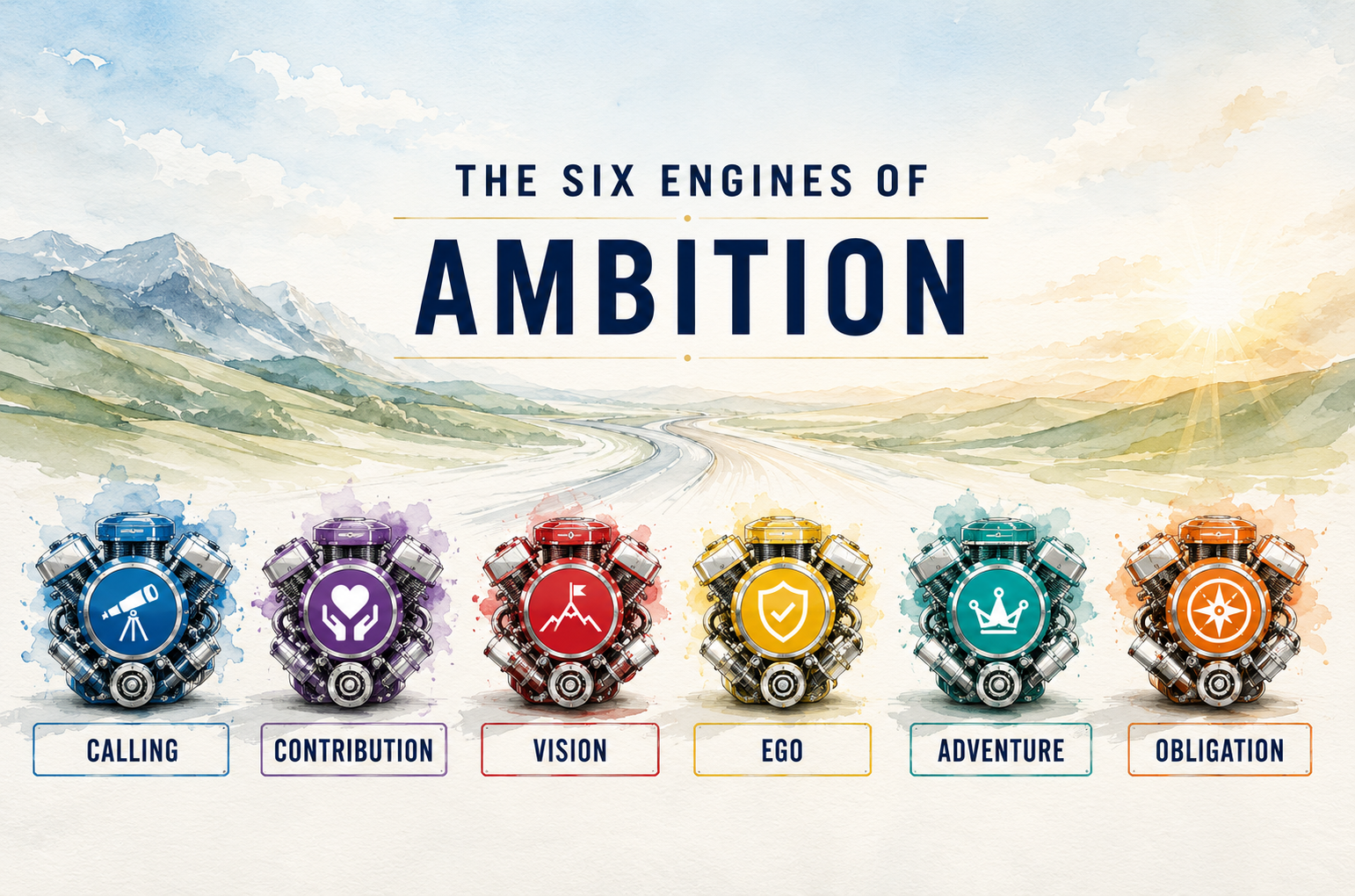
THE SIX ENGINES OF AMBITION: Do You Know Your Ambition Profile?

by Leslie Rohonczy, IMC, PCC, Executive Coach & Author

(LISTEN TO NARRATED AUDIOARTICLE VERSION)

If you're like most ambitious leaders, you probably know where you want to go. And also like many leaders, you may never have stopped to ask yourself what's pulling you there.

Promotion conversations usually revolve around readiness. Do you have the experience? Have you demonstrated executive presence? Can you think strategically? Are you ready to lead at the next level? These are important questions, and organizations should absolutely be asking them. They're just not the questions that intrigue me most.

When a client tells me they're hoping to become a Vice President, a C-suite executive, or even to make the move into their first leadership role, I'm curious about something else: "What is it about that role that's so appealing to you?"

At first, the answer is usually broad, and typically, "I want to make a difference." It's a perfectly reasonable answer. It just isn't the whole answer.

As we continue the conversation, something fascinating almost always emerges. Two leaders can be pursuing the same promotion for completely different reasons. One is captivated by the opportunity to shape the organization's future. Another lights up when talking about developing people. A third is excited by the challenge of operating at a completely different level. Someone else feels a responsibility to step forward because they know they can help. From the outside, they appear to be travelling the same road. Under the hood, though, they're powered by very different engines.

After seeing this pattern again and again over the years, I began sketching what eventually became the Six Engines of Ambition model. These engines represent the motivations that create the horsepower behind our ambition. We all have all six within us, but each contributes a different amount of power. That mix is unique to each person, and it often shifts as our careers evolve.

Before reading further, resist the temptation to decide which engine you are. That's a bit like asking which instrument matters most in an orchestra. Almost nobody is powered by a single engine. Instead, notice which descriptions resonate most strongly with you. You're not looking for one answer; you're discovering the mix of engines in your profile.

Calling is the engine of purpose. If this is one of your strongest engines, the organization's mission matters deeply to you. You're less attracted to leadership itself than to the opportunity to advance something you genuinely believe deserves your energy. Ask yourself what excites you most about the next promotion. If your answer begins with the organization's purpose rather than your own career, then your Calling Engine is probably doing a lot of the work. Its shadow appears when the mission becomes so intertwined with your identity that disagreement starts feeling personal.

Contribution is the engine of service. These leaders gain enormous satisfaction from making other people's lives better. They enjoy coaching, mentoring, removing obstacles, and creating environments where others can thrive. They're often the people who leave a meeting thinking less about how they performed and more about whether everyone else left feeling heard, supported, or inspired. Their shadow is over-functioning. Helping gradually becomes rescuing, and before long, they're carrying responsibilities that belong to someone else.

Vision is fueled by possibility. These leaders naturally look over the horizon. They become energized imagining what the organization could become three, five or ten years from now. They enjoy building, transforming, and creating. If you find yourself becoming impatient with conversations that never seem to move beyond today's operational issues, the Vision Engine may be one of your dominant drivers. Its shadow appears when tomorrow becomes so exciting that today starts feeling like an inconvenience.

Adventure is the engine of growth. Some people see uncertainty and instinctively think, that sounds interesting. New challenges, unfamiliar situations, and bigger problems energize them rather than intimidate them. Every promotion is another chance to discover what they're capable of. Their shadow appears when climbing becomes more rewarding than contributing, leaving them constantly searching for the next mountain before fully appreciating the one they're already standing on.

Obligation is fueled by responsibility. I've coached many leaders who never set out to become senior executives. They simply looked around, saw a need, and concluded that someone had to step forward. They care deeply about doing the right thing and are often the people organizations depend on during difficult times. If you've ever caught yourself thinking, If I don't do this, who will?, there's a good chance the Obligation Engine is one of your strongest drivers. Its shadow is becoming indispensable. Delegation becomes difficult because being the dependable one has become part of your identity.

Ego is the engine most people are reluctant to acknowledge. There is often a degree of shame attached to admitting it's one of our drivers because we associate ego with being egotistical or self-aggrandizing. I don't believe that's true. Recognition matters. Achievement matters. Titles matter. Human beings have always cared about status, and healthy ambition has fueled extraordinary careers. There's nothing inherently wrong with wanting to accomplish something significant or being proud when others recognize your contribution. The shadow appears only when the title becomes more important than the work, or when your sense of self becomes defined by the title on your business card.

One of the things I find most fascinating is that these engines rarely stay in the same proportions throughout a career. I coached a newly promoted manager early in my coaching career. About fifteen years later he called me again because he was trying to decide whether to pursue an executive role. On paper, it looked like the obvious next step. He had the experience, the credibility, and the support of his organization. Yet something just didn't feel quite right.

As we explored what was creating the hesitation, he said, "I don't actually want the title. I want the chance to shape where we're going." That moment changed the conversation. Until then, he believed he was pursuing a promotion. What he eventually discovered was that, unlike fifteen years earlier, he was now being driven by the Vision Engine. Once he understood that, he also realized there were several ways to influence the organization's future, only one of which involved the executive role he'd been focused on.

I've watched similar discoveries unfold many times. Leaders realize they've been driven primarily by the Contribution Engine without ever recognizing it. Others discover that their Obligation Engine has been making career decisions for years. Some come to appreciate their Ego Engine for giving them the confidence to pursue opportunities they might otherwise have avoided, while realizing it no longer needed to be their dominant engine. The engines themselves aren't the problem. The problem is allowing them to operate without ever noticing which one is doing most of the driving.

The goal isn't simply to identify your ambition engine; it's to understand your Ambition Profile. Once you do, career decisions become clearer, and you begin recognizing why certain opportunities immediately excite you while others, despite offering more money or prestige, leave you feeling meh. That's when you stop measuring your ambition against someone else's and begin making choices that are genuinely aligned with your own motivations.

Your next promotion may change your title. But understanding your Ambition Profile may change your career.


YOUR COACHING CHALLENGE

BUILD YOUR AMBITION PROFILE: Spend some time with the Six Ambition Engines definitions above, and estimate your current profile by assigning a percentage to each one. You may have a sense of your strongest, and your weakest engines – fill those in first. Don't answer based on who you aspire to become. Base your answers on the choices you've consistently made in your career. Your total should equal 100%.

  • Calling: _____%

  • Contribution: _____%

  • Vision: _____%

  • Adventure: _____%

  • Obligation: _____%

  • Ego: _____%

Now ask yourself three questions:

  1. Which ambition engine has generated most of the horsepower that got me where I am today?

  2. Which engine may be revving higher than it should be?

  3. Over the next five years, which engine do I want fueling this next chapter?

Your answers may reinforce the career path you're already on, or they may point you in an entirely different direction. Either way, you'll gain insights into yourself that many ambitious leaders never stop to examine.

HOW OLD IS THE PERSON STEERING YOUR CAREER? Your Destination Was Chosen by Someone Who No Longer Exists

Leslie Rohonczy, IMC, PCC, Executive Coach & Author

 (LISTEN TO NARRATED AUDIOARTICLE VERSION)

The first few years of my adult life were the striving years. Striving to make ends meet, striving to get noticed in my career, among a sea of other young professionals who always seemed to be better at standing out from the crowd than I was; striving for a promotion to the next level, without ever really asking myself why a title was my end game; striving to feel my own worth, when I didn’t feel at all worthy.

And when I finally got that hard-fought promotion, and found myself in that shitty little clapboard office in the middle of the advertising department at our local newspaper, I had a sphincter-shifting moment of clarity: “Was THIS what I had been working so long and hard for? This office with no window and no purpose? How could all of my striving, motivation, blood, sweat, and tears really have been about THIS?!”

That experience, and that question, changed my career. The promotion was exactly what I'd wanted, which was precisely the problem. I'd spent years chasing a destination chosen by a version of me who no longer existed.

At the time, I couldn't have explained what was happening. I just knew something felt profoundly off. Looking back now, I realize it was the first time I'd noticed that somewhere between the striving and the arriving, it was me that had changed, not the destination.

That experience isn't unique to me. I've heard versions of this experience in many of my executive coaching conversations. The offices are usually much nicer than mine was, and the titles on the business card are more impressive, but eventually the same uncomfortable question appears: Now what? Or sometimes: Is this really all there is?

Life reshapes us while we are busy building our careers. The destination we chose at twenty-eight no longer fits the person we've become at forty-eight, but we may not see it if we don't pause long enough to notice the mismatch.

A few weeks ago, I found myself watching a YouTube video of a single sculler crossing a perfectly calm lake. There was something mesmerizing about how the boat cut through the glassy water. Every stroke looked powerful yet effortless, as it glided across the water with absolute purpose.

I find rowing kind of a strange way to travel. The boat moves confidently forward while the rower faces the opposite direction. Rowers can clearly see where they've been. They can study the wake they've left behind, and can appreciate every kilometer they've already travelled. The one thing they can't actually see is where they're going.

Hey, that also describes many leadership careers! Early in our careers we choose a direction that makes complete sense at the time. We pursue promotions, bigger teams with more span of control, financial security, influence, recognition, and the opportunity to prove ourselves. We want to make our parents proud, build something meaningful, provide for our families, or finally settle that relentless inner voice insisting we're still not enough.

There is nothing wrong with any of those motivations. In fact, they often provide exactly the fuel we need during those demanding early years. But life has a habit of changing us while we're busy rowing.

Successes often turn out to be less satisfying than we imagined. We experience illness, burnout, unexpected opportunities, disappointments, and moments of clarity we never saw coming. And over time, our definition of success begins to evolve. Status starts giving way to significance. Recognition becomes less important than contribution. Freedom matters more than prestige.

The person holding the oars today isn't the same person who first climbed into the boat and set the direction. Yet many of us continue rowing toward the same destination simply because that's where we pointed the boat years ago.

One of my favourite coaching questions catches people completely off guard: How old is the person currently steering your career?

Sometimes it's the twenty-five-year-old you who's desperate to prove she belongs. Or the young father determined to build financial security for his new family. Sometimes it's the ambitious new executive convinced that one more promotion will finally deliver the satisfaction they've been chasing.

That younger version of ourselves deserves enormous respect. They worked hard, took risks, made sacrifices, and created opportunities that today's version of us benefits from every single day. But they couldn't possibly have known who we would become. They didn't know which experiences would shape us, what losses we would endure, what relationships would change us, or how dramatically our understanding of a meaningful life would evolve.

So why are they still deciding where we're headed?

I think this is where many can get stuck. It might feel like lost ambition after decades of investment and building up our expertise, relationships, credibility, and identity. Changing direction can begin to feel like admitting those investments were mistakes. They weren't. They just brought us to the place where we're finally experienced enough to ask a better question.

Instead of asking, “Can I get there?” the question becomes, “Do I still want 'there'?”

That may be one of the hardest career questions we'll ever ask ourselves because the answer often asks us to loosen our grip on a destination we've carried for years; one that feels like our encoded mission, because we've been chasing it so long.

One of the greatest gifts coaching has ever given me is permission to pause before pushing forward. We're conditioned to believe that success comes from rowing harder. Sometimes it does. But sometimes, the wisest thing a rower can do is lift the oars from the water, let the boat glide, and take some time to turn around and really study their trajectory.

Only then can you answer the question, "does this destination still belong to the person I am today?" I encourage leaders to ask themselves uncomfortable questions as part of the process. Questions like, "If you were choosing your career today, would you choose the same destination?" "Which ambitions genuinely belong to you, and which belong to a younger version of yourself?" "What are you continuing simply because you've already invested so much?" "What gives you energy today that barely mattered ten years ago?" "If nobody else's expectations mattered, where would you point the boat?"

Sometimes the answers are deeply reassuring. You discover you're exactly where you're meant to be, and you begin rowing again with conviction because your destination has been consciously chosen by the person you are today, and not inherited from someone you used to be.

Other times the answers lead somewhere entirely different: a new awareness, a different role, a revised definition of success, a shift in priorities, or a career that finally reflects the person you've become instead of the person you once were.

Neither outcome means your younger self got it wrong. That version of you did exactly what they were supposed to do: they got you this far. But at some point, every leader deserves to ask a simple question: Who is this person holding the oars now?

The younger version of you chose a destination with the wisdom they had at the time. You don't owe them blind obedience. You owe them gratitude.

Now it's your turn to decide where the boat goes next.


YOUR COACHING CHALLENGE

This week, spend ten uninterrupted minutes with a blank sheet of paper. Across the top, write this question: How old is the person currently steering my career?

Don't answer it too quickly. Think about the ambitions you're pursuing right now, the goals you're sacrificing for, the opportunities you're saying yes to, and the ones you're turning down.

Then ask yourself: If I were starting my career today, with everything I've learned about myself over the past twenty years, would I still choose this destination?

If the answer is yes, you've just reaffirmed that you're rowing with purpose. If the answer is no, don't panic. You don't have to change direction tomorrow. You simply need to acknowledge that the person holding the oars today deserves a voice in deciding where your boat goes next.

LEADERSHIP ALTITUDE: Are You a Helicopter, Jet, or Starship?

(LISTEN TO NARRATED AUDIOARTICLE VERSION)

I talk a lot about altitude with my executive coaching clients. One conversation in particular was with a senior leader who sat down across from me and said, "I'm working ridiculous hours, I'm constantly busy, and yet it feels like I'm falling further behind every week."

What struck me wasn't the workload itself, but the contradiction. Things were ticking along well, her team was delivering, and her dashboard showed everything was under control. But she spent most of her days bouncing from issue to issue, rarely finishing what she had planned to accomplish before the next urgent matter popped up. Because she was dependable and responsive, decisions, problems, requests, and approvals continually found their way to her. And every day, she felt like she was climbing up the down escalator.

As we unpacked her reality, we noticed a pattern emerging. There was a common thread at play: decisions flowed through her; problems landed on her desk; questions had to be answered by her. Her team depended on her for direction, approvals, information, and problem-solving, leaving her days consumed by operational details, responding to issues, and helping people navigate obstacles.

Of course, these are all important activities, to be sure. It might be tempting to think that she was not delegating well, or that she was a workaholic, but the real issue turned out to be her leadership altitude. She was spending most of her time operating at a Manager altitude, instead of the more strategic Vice-President altitude. In essence, she hadn't adjusted her altitude with her new responsibilities and span of control. That conversation stayed with me because I've seen countless versions of it throughout my years of executive coaching: leaders unaware they are flying at the wrong altitude.


THE ALTITUDE GAP

One of the most common, and most challenging, leadership transitions a leader can make is the shift from managing day-to-day operations and individual contributors, to leading other leaders, systems, functions, and strategy.

As leaders move through organizations, the horizon line they're responsible for monitoring expands. They become accountable for larger systems, more people, greater complexity, and decisions whose consequences may not appear for years. But many leaders continue operating at the altitude that made them successful in their previous role.

The behaviours that help someone become an outstanding Supervisor differ from those required to become an outstanding Director. The strengths that help someone succeed as a Director may eventually become limitations as they move into Vice-President, Executive, and C-suite leadership. That's why so many talented leaders feel overwhelmed. They're trying to lead a large organization while spending most of their time solving low-altitude problems.

Over the years, I've developed metaphors for leadership using three aircraft: the Helicopter, the Jet, and the Starship. Each operates at a different altitude and provides a different perspective. And each becomes increasingly important as a leader's scope of responsibility expands.


THE HELICOPTER

Imagine your leadership as a helicopter hovering a few hundred feet above the ground. You're no longer standing in the middle of the action, but you're still close enough to see what's happening on the ground. You can spot bottlenecks, notice tension between teams, identify missed handoffs, and observe where work is getting stuck.

This is the altitude of operational leadership, where leaders coach people, remove obstacles, allocate resources, clarify priorities, and help teams navigate challenges. Helicopter altitude keeps leaders connected to reality because they can still see the work as it unfolds.

Most of us spend a significant portion of our early leadership careers here. Supervisors, Managers, Team Leads, Project Managers, and frontline leaders often need to operate predominantly at this altitude because their success depends on helping people execute effectively to produce results.

The challenge is that Helicopter altitude feels productive. You can see a problem and solve it. You can answer a question and help someone move forward. You can remove a roadblock and watch progress happen almost immediately. The feedback is instant, and that sense of usefulness can become habitual.

Over time, some leaders become so accustomed to solving problems that they unknowingly train everyone around them to bring problems to them. Decisions, accountability, and responsibility all begin to migrate upward. And before long, the leader knows everything that's happening this week and very little about what needs to happen three months or three years from now.

I've worked with executives whose calendars looked like emergency dispatch units. Every issue found its way to them, minor conflicts required their involvement, and difficult decision somehow became their responsibility. They were admired, trusted, hardworking... and exhausted.


THE JET

As leaders move into larger and more complex roles, another shift begins to happen. The work itself becomes less visible. At first, it can feel uncomfortable, especially if you've built their careers on being knowledgeable, responsive, and closely connected to the work. Climbing higher often means giving up some of that visibility.

A Director overseeing six teams can't possibly keep track of every conversation, customer issue, project challenge, or interpersonal conflict occurring across their organization. And a Vice-President, responsible for several other leaders, hundreds of employees, and complex organizations, certainly can't.

What emerges in its place is something different: noticing patterns. Instead of seeing a single employee struggling, leaders begin noticing recurring turnover across a department. Instead of focusing on one delayed project, they begin recognizing a resource allocation issue affecting multiple teams. Individual events still matter, but they become clues pointing toward something larger, rather than signals to jump into action and solve them.

This is Jet altitude. The horizon expands dramatically. Details become harder to see (as they must), but the broader landscape becomes clearer. Leaders begin examining how departments interact, where priorities collide, what external conditions will likely impact their business, how information flows through the organization, and which systems are producing the outcomes they see.

The questions change as well. Rather than asking, "How do we solve this problem?" leaders begin asking, "Why does this problem keep appearing?" Rather than focusing on individual performance, they start paying attention to the systems and structure, processes, communication channels, incentives, governance, and culture.

Many leaders arrive at positions that require Jet altitude long before they become comfortable operating there. They continue solving issues one at a time, when the real opportunity is to improve the system creating those issues in the first place.

Jet altitude comes with its own traps, however. Leaders can become so fascinated by the system of strategy, frameworks, organizational design, and planning that they lose touch with the people living inside it. Most of us have experienced a strategic initiative that looked brilliant in a boardroom and bewildering everywhere else. Reality has a way of exposing details that weren't visible from 40,000 feet.


THE STARSHIP

The further leaders advance, the more another question begins to emerge. The focus shifts from "What's happening?" and "Why is it happening?" to a different question altogether: "What will happen next?" This is where Starship altitude becomes necessary.

Imagine looking back at Earth from space. Cities fade from view. Roads become invisible. Eventually, even national borders lose their meaning. Our perspective changes completely.

At Starship altitude, we stop focusing primarily on operations and organizational systems. Our attention shifts toward forces that may shape the organization for years, and sometimes decades, into the future.

We begin asking different kinds of questions: What technological shifts are reshaping the industry? How will demographics change the workforce? What customer expectations are emerging? What assumptions do we hold today that future leaders may laugh at? What must this organization become if it hopes to remain relevant ten or twenty years from now?

This is the altitude of enterprise leadership. It's where leaders wrestle with the big, bold questions of purpose, direction, positioning, legacy, and long-term relevance. They are less concerned with certainty, and more with understanding what version of the future may be emerging and how today's decisions might improve the organization's chances of thriving within them.

Starship altitude is partly about learning to notice what others overlook. Tomorrow rarely arrives all at once. The clues are usually visible long before the disruption becomes obvious, but they can be easy to miss when your attention is consumed by today's challenges.

Starship altitude has risks of its own. We've all encountered leaders who seem permanently stationed in orbit. They speak passionately about the next decade while their teams are struggling with problems that have existed for the last two years. Their vision may be compelling, but their connection to present-day reality becomes increasingly thin.

Organizations need leaders who can imagine the future, but they also need leaders who understand the realities of today.


WHEN SUCCESS BECOMES A LIABILITY

Promotions can create an unexpected problem: the behaviours that helped us earn a promotion to the next level of leadership frequently become the very behaviours that limit us afterwards.

The Manager who built a reputation for being responsive becomes the Vice-President who can't stop getting involved. The Director who became successful through personal expertise struggles to delegate decisions. The executive who built a career by solving problems continues solving them long after the role requires system-level thinking instead.

That's why leadership transitions can feel surprisingly uncomfortable. The issue is rarely intelligence, capability, commitment, or work ethic. It's altitude. The role requires one perspective while the leader continues operating from another.

That's exactly what was happening with the Vice-President I mentioned earlier. She was struggling because her responsibilities had evolved, but her altitude had not. Once she began spending less time solving operational issues and more time leading at the altitude her role demanded, something interesting happened. Her calendar became less crowded; her teams became more capable; her decisions became more strategic. And she finally stopped feeling like she was climbing the down escalator. What a relief!


YOUR COACHING CHALLENGE

The Altitude Audit: Set aside 10 minutes and reflect on the past two weeks. First, ask yourself:

  • Have I been spending most of my time at Helicopter altitude, focused on tasks, issues, and execution?

  • Have I been operating primarily at Jet altitude, focused on systems, priorities, and cross-functional outcomes?

  • Have I been spending meaningful time at Starship altitude, scanning the horizon and thinking about the future?

Now ask a second question: What altitude does my role actually require most often?

Notice any gap between where you've been spending your time and where your leadership responsibilities require you to be. Then reflect on:

  • What keeps pulling me toward my current altitude?

  • What leadership challenges might be connected to this gap?

  • What important signals, opportunities, or risks might I be missing?

  • What is one thing I could do this week to operate at the altitude my role requires?

Many leadership challenges are not capability problems; they're altitude problems. Sometimes the most important growth a leader can make is learning to see a different horizon.

If you're curious about how your own leadership altitude may be helping or limiting your effectiveness, I'd love to help you explore it. Reach out for a free exploratory executive coaching conversation at www.leslierohonczy.com.

OUR CAREER-LIMITING ADDICTION TO CERTAINTY: Why Some Leadership Decisions Stay Stuck

(LISTEN TO NARRATED AUDIOARTICLE VERSION)

Are you waiting for information you can’t possibly obtain? I don't mean that you're looking in the wrong place. I’m talking about information you’re waiting for that literally does not yet exist.

That may sound strange, but I see it regularly in my executive coaching work with leaders. The decision might involve any number of challenging scenarios: a strategic shift, a career move, a difficult conversation, an investment in a new opportunity. The details vary, but the pattern is remarkably consistent: a leader wants more information, clearer insight, and greater confidence that the decision will work out as they intend. On the surface, that sounds sensible. And most of us would prefer thoughtful leaders to impulsive ones.

The challenge, however, is one of diminishing returns: some decisions eventually reach a point where additional thinking stops producing additional clarity. The facts have been gathered, the options have been explored, trusted people have offered their perspectives, and the risks are reasonably well understood. But there it sits, parked, waiting for... what?

In my executive coaching work with leaders, I've noticed that people rarely get stuck because they haven't thought enough. By the time they're talking to me, they've usually considered their situation from every conceivable angle. They've researched, talked it through with trusted colleagues, slept on it, revisited it, and probably had the conversation with themselves a dozen times.

But something often goes unnoticed: the quest for information that belongs to a future chapter of the story. They assume that if they think a little deeper, analyze a little harder, or wait a little longer, the missing piece will eventually appear. Sometimes it does, and sometimes the information they're looking for can only emerge after action begins.

I was reminded of this recently while speaking with a client who was considering a significant career move. She had done her homework thoroughly. She understood the opportunity, the risks, and the trade-offs involved. She had spoken with people she respected and spent considerable time reflecting on the decision. At one point, she made a joke about it and said she was waiting for the universe to send her a registered letter confirming she was making the right choice. The image made us both smile because it captured the situation, and her wiring, perfectly. (Sometimes, clients come up with the perfect metaphor on their own.)

She wasn't avoiding the decision or being careless. She had simply reached the point where further analysis was unlikely to produce anything meaningfully new. The information she wanted was on the other side of the decision, the result of experiencing it firsthand.

Many leadership decisions eventually arrive at this point. More analysis feels productive because analysis has served us well throughout our careers. Gathering information is often the right response to uncertainty. The difficulty comes when we continue gathering long after we've exhausted what the current chapter can teach us.

Ronald Heifetz's work on Adaptive Leadership offers a useful distinction here. Technical problems can often be solved through expertise and existing knowledge. Adaptive challenges are different. They require learning, experimentation, and movement into territory where important answers emerge only after action has begun.

Senior leaders encounter these challenges constantly. Markets change. Technologies reshape industries. Customer expectations evolve. Business models that once seemed stable begin to shift. In situations like these, leaders often keep searching for information that nobody has access to yet. Not the board. Not the consultants. Not the person with twenty years of industry experience.

Reality is frustrating that way. It tends to hold onto certain information until somebody actually does something. Leaders who would never describe themselves as risk-averse can find themselves waiting for reassurance that cannot be obtained ahead of time. The decision remains under review, another meeting gets scheduled, another discussion takes place, and the future remains politely on hold.

Meanwhile, reality keeps moving. Competitors make decisions, employees draw conclusions, and opportunities evolve. More importantly, new information appears when somebody tests an idea, enters a market, has a conversation, launches a project, accepts a role, or declines one. Action reveals things that analysis cannot.

That's why people who move sometimes appear to have better information than everyone else. In many cases, they created it. I’m not advising recklessness or abandoning thoughtful analysis. Good leaders should examine assumptions, consider consequences, and seek wise counsel. The challenge is recognising when analysis has delivered everything it can reasonably provide. Many important leadership decisions don't begin with certainty. They begin with a willingness to learn.

My client eventually made her move. What struck me afterwards wasn't whether the decision worked out. It was how little new information appeared between the moment she felt stuck and the moment she finally acted. The certainty she had been waiting for never arrived. What arrived was the next chapter of information. Once she stepped into the experience, she began learning things that had been impossible to know beforehand. Those insights had never been available to her while she was standing still.

That realization has stayed with me because it applies to far more than career decisions. Some of the information we want most is unavailable until we begin moving toward it.

YOUR COACHING CHALLENGE

  • Think about a decision you've been carrying for a while.

  • Write down the information you believe you still need before acting. Then write down what information could only become available after you take action.

  • As you compare the two lists, notice whether you've been waiting for information that genuinely exists or information that belongs to a future chapter of the story.

  • If certainty never arrives, what decision would you make based on what you already know?

  • Sit with that question for a few minutes and notice what emerges.

Reach out for a free exploratory Executive Coaching conversation at www.leslierohonczy.com.

YOU DON'T NEED TO BE LESS HUMAN TO BECOME MORE STRATEGIC: Growing into Senior Leadership Without Losing Yourself

Leslie Rohonczy, IMC, PCC, Executive Coach & Author

 (LISTEN TO NARRATED AUDIOARTICLE VERSION)

I don’t often write about the end of a coaching engagement. Usually, the stories I share in these Leadership articles come from the beginning, when a leader is naming the thing that isn’t working, or from the messy middle, where self-awareness is rising, old habits are getting exposed, and trying on different ways of leading can feel awkward, vulnerable, and occasionally a bit like wearing someone else’s shoes. The ending is different. It's where you find out what actually changed.

I recently wrapped up a coaching program with a senior leader I’ve had the genuine pleasure of working with over several months. Near the end of our conversation, she named something that many leaders I've coached have wrestled with. She reflected on how much of her early career success had come from being deeply involved, highly responsive, emotionally available, and someone people could count on without hesitation. She built strong teams, led in a highly hands-on, relational way, and noticed what others missed.

She said, “What I’m realizing is that the strengths that helped me succeed as a Manager and Director still matter, but how I express them has to change as I grow into a more senior role.”

That landed, because I have heard versions of this tension many times in coaching conversations. A leader gets promoted because they are capable, dependable, thoughtful, and trusted. They build a reputation by being the person who gets things done, notices what others miss, responds quickly, supports their people, and carries a lot without complaint. Then, somewhere along the way, the feedback changes. Suddenly, they are being told to be more strategic, to lead at a higher level, to stay out of the operational weeds, or to focus less on execution and more on enterprise thinking.

And what many deeply relational leaders hear in that feedback is something far more unsettling. "Does that mean I need to stop caring so much? Be less available? Become one of those polished executives who have mastered the art of sounding profound while saying almost nothing at all?"

It can create a genuine identity wobble because, for many leaders, especially high performers, the behaviours that built their early success were quite intentional. They became trusted because they were emotionally present for their people. They became promotable because they were dependable and productive. They earned influence because people experienced them as thoughtful, caring, and deeply committed. So when leadership growth requires change, it can create a real fear that the people around you may experience you as less caring, less accessible, or somehow less 'you'. Becoming more strategic can feel unsettlingly close to becoming less recognisable to yourself.

My client said something else in our closing conversation that I suspect will resonate with more than a few people. We were talking about confidence in the context of external validation, positive feedback, visible signs of success, and being seen as capable. She said, “Even just becoming aware of that has shifted my thinking.” Because once you notice that your confidence has been partly outsourced to the reactions of others, you begin to reclaim some authorship over it.

She also described a deeply human aspect of this coaching work: we build insight and self-awareness, and our confidence can feel steady for weeks, until something comes along that throws us off balance, and we find ourselves slipping back into old habits of thinking and reacting. That’s normal. Greater self-awareness does not mean those moments disappear forever. It means we recognize them faster. With practice, the distance between being triggered and catching ourselves in our 'old way' gets shorter and shorter. We still have the occasional wobble. We just recover quicker.

I see this pattern so often in coaching with leaders growing into more senior leadership roles. Many eventually discover that some of their most valued strengths become 'over-strengths' at more senior levels. Responsiveness can become reflexive order-taking, where the instinct to be helpful overrides the discipline to assess whether the ask actually belongs at your altitude. Inclusiveness can become over-consulting, where the desire to bring people along starts slowing decision-making long after sufficient input has been gathered. Ownership can become over-functioning, where personal accountability turns into doing work that should be delegated, because trusting others feels riskier than stepping in yourself. Emotional generosity can become protective insulation, where the instinct to care protects people from meaningful accountability, hard truths, and the consequences that would ultimately help them grow.

Those qualities are not inherently problematic. The challenge is that leadership context changes, and with it, what the role actually requires. Many of the skills that help someone thrive as a manager aren't the same ones required for senior or executive leaders to be successful. If you remain endlessly accessible, when do you think? If every decision requires broad consensus, when do you decide? If you keep solving problems your team should be solving, how do they grow? And if your calendar looks like a losing game of executive Tetris, where exactly is strategic leadership supposed to happen?

This is where many leaders give me the hairy eyeball, because this developmental ask can feel emotionally confusing, as the internal questions sound like: "Am I becoming colder? Am I losing what made me effective? Am I becoming less authentic?"

In my experience, the leaders who successfully navigate this transition don't become less human as they grow, but they do become more discerning. They get clearer about where their time creates the most value, become more intentional with their energy and attention, stop equating constant 'doing' with leadership contribution, and learn that protecting thinking time is part of the role, not an indulgence. They also become more willing to disappoint someone in the short term if the longer-term decision serves the broader organization. That is leadership maturity in action.

Let me put on the gender lens for a minute. For many women, there can be extra complexity layered into this transition. I say this thoughtfully, not as a sweeping generalization. Many women have spent years being socially rewarded for being accommodating, relational, highly capable, emotionally tuned in, and endlessly dependable. Add perfectionism, caregiving conditioning, or internalized pressure to be both competent and likeable, and this transition can carry extra emotional texture. And that means the leadership identity work can sometimes be more nuanced for women.

What I have consistently seen in leaders who navigate this transition well is something I deeply respect. They don't harden or become emotionally beige, and they don't confuse detachment with sophistication. They keep their humanity, while becoming much more deliberate about where that humanity gets expressed.

Before we wrapped up, my client said something that captured this beautifully: “It’s really about becoming more aware of where I put my energy and time. The things that helped me succeed still matter. But how I do them has just evolved.” That is leadership growth. Learning how to lead in a way that matches the altitude of the role, without losing the parts of yourself that made people want to follow your lead in the first place.


YOUR COACHING CHALLENGE

For the next two weeks, become a curious observer of your own leadership habits.

Pay attention to moments where you instinctively step in, respond immediately, over-consult, solve a problem that arguably belongs to someone else, say yes when your calendar is already gasping for oxygen, or stay deeply involved in work that may no longer require your altitude.

The goal is not to change anything immediately. The goal is to notice. Catch yourself in real time and ask: Is this a strength serving the current role, or a legacy habit from an earlier chapter of leadership?

At the end of your observation period, spend some time reflecting on these questions:

  1. Which behaviour(s) showed up most often?

  2. Which of these once served you well, and how?

  3. What leadership need were these behaviours originally helping you meet: competence, control, belonging, approval, usefulness, certainty, or something else?

  4. Which of these habits now creates drag, exhaustion, bottlenecks, or unintended consequences for you and/or others?

  5. Where might your team, your peers, or your organization need something different from you now?

  6. What is one small experiment you could try that would better match the altitude of your current role?

If you're a leader navigating this leadership transition and want to grow your strategic impact without losing the humanity that helps people trust you, reach out for a free exploratory Executive Coaching conversation at www.leslierohonczy.com