HOW WE EVOLVE

LOOK BACK TO MOVE FORWARD: 3 Steps to Define Your Year Ahead

by Leslie Rohonczy, Executive Coach, IMC, PCC | ©2024 | www.leslierohonczy.com

We’re approaching the end of November, and before you know it, this year will be over. If you’re like many executives and leaders I work with, the past eleven months have likely been a whirlwind of decisions, problem-solving, and strategic pivots.

Now, as the year draws to a close, this cacophony of demands are competing loudly for our attention: year-end deadlines, deliverables, and objectives, holiday plans, and a persistent pressure to think ahead. It can feel overwhelming, much like the relentless blanket of tinny holiday music playing everywhere this time of year.

It’s so easy to get lost in this din, but what if we took a powerful pause? What if we step back from the hustle of deliverables and the noise of social expectations, to reflect on the year we’ve just experienced? Reflection isn’t just a feel-good exercise; it’s a leadership tool that turns hindsight into insight. This single act of pausing to reflect could be a game-changer for the road ahead.

As high-performing leaders know that impactful forward momentum often starts with purposeful reflection. In my executive coaching practice, I encourage clients to conduct an annual ‘Year in Review’ practice. This process goes beyond tallying wins and losses; it’s a focused exploration of the intentions you set at the start of the year, the journey you’ve been on (both professionally and personally), the lessons learned from their experiences, and where they want to go in the future. It’s about uncovering patterns – positive and negative, identifying and challenging limiting beliefs, clarifying priorities, and laying the foundation for intentional growth.

The timing for this exercise is perfect. Starting your reflection in early December gives you the space to recalibrate before diving into the new year. So, let’s hit the pause button for a moment. Before you dive headfirst into planning what’s next, take a moment to ask yourself two critical questions: How did I get here? And where do I want to go next?

STEP 1: Reflect on Your Year

Think of your life as a book, with each year representing a new chapter. This is your opportunity to review the chapters that have already been written, to uncover recurring themes, to see how this year’s chapter fits into your overall story, and to decide how you want the next chapter to unfold.

Start by setting the stage for your review:

  • Find a quiet space where you won’t be interrupted.

  • Bring tools that help you capture your thoughts: a journal, digital notebook, or voice recorder app.

  • Set aside at least an hour for this process to ensure depth and focus.

Now, dive into these reflection prompts:

1. What worked?

Look back at the moments when you felt aligned, accomplished, brave, energized, or proud. What decisions, habits, or relationships contributed to those successes? One of my clients, am SVP at an insurance company, discovered that her most impactful projects came from effective delegation. Not only did this alleviate her capacity challenges, but it also created a career development opportunity for an up-and-coming Director. This insight became a catalyst for how they would revamp their talent development system the following year.

2. What didn’t work?

This isn’t about self-criticism—it’s about curiosity. What efforts didn’t pan out, and why? Where did things feel off-track? What unproductive or unintended results emerged? A client once shared how, through this reflection practice, he realized that at the beginning of every year, he would overcommit himself in Q1 by taking on too many projects that didn’t align with his long-term goals. Once he identified this pattern, it allowed him to shift his approach: he committed to saying “no” more often in the future, making the mental space for him to be more discerning with what he said “yes” to.

3. What surprised you?

It’s often the unexpected moments - both positive and challenging - that shape us the most. Did you navigate a crisis with grace and strength you didn’t know you had? Did you make spontaneous decisions that led to amazing outcomes? Were you surprised at what opportunities opened up as a result of trusting your instincts?

4. What will you leave behind?

Growth requires creating space for what truly matters, which often means letting go of what no longer serves you. Is it a limiting belief? An unproductive habit? Or perhaps a role or commitment that no longer aligns with your values? As you reflect, remember to think of your life as a book: How will you clear the page to write a meaningful next chapter?

STEP 2: Choosing Your Word of the Year

Once you’ve sifted through your reflections, it’s time to look ahead with clarity. One simple but profound way to focus your intentions is by choosing a Word of the Year.

This word acts as your North Star—a guiding principle that helps you make decisions, prioritize, and stay grounded in what matters most. It’s less about setting rigid goals and more about defining the energy, mindset, or intention you want to carry into the new year.

How to Choose Your Word

1. Look for themes in your reflection.

What patterns emerged from your review? If you noticed a need for better boundaries, perhaps your word is No. If your highlights revolved around creativity, your word might be Innovate. The CEO of a national manufacturing company told me about a bold experiment he tried last year: launching a pilot program to test same-day delivery in select locations. The program required cross-departmental collaboration, quick problem-solving, and innovative thinking - qualities he loved seeing in action. To his surprise, the program not only exceeded revenue projections but also revealed untapped talent and creativity within his team. He realized that these results were born from taking calculated risks and empowering his team to innovate. He set a clear intention for the next year: to prioritize initiatives that foster collaboration and bold experimentation. As a result, he intends to scale up the business next year while keeping his team engaged and motivated.

2. Think about your aspirations.

What would make 2025 feel successful - not just professionally, but personally as well? One client, a CFO balancing high stakes work with parenting, chose the word Presence to remind herself to stay engaged in the moment, whether at the office or the dinner table.

3. Make it personal and inspiring.

Avoid words that feel trendy or vague. Your word should resonate deeply with you. Once you’ve chosen your word, give it a place of honor. One of my clients wrote hers on the first page of her planner. Another set it as a weekly calendar reminder. And another created a colourful painting of her word to hang in her office. These small acts keep the intention front and center.

Here are a few examples of words and the themes they can represent. Remember that your word should be deeply meaningful to you, so if you don’t see one that really resonates for you, find a word that does.

  • Abundance: Focusing on opportunities, growth, creating a mindset of plenty rather than scarcity.

  • Alignment: Ensuring your actions, values, and goals are in harmony.

  • Authenticity: Leading with your true self, building trust, encouraging openness.

  • Balance: Managing work, life, and personal well-being with greater harmony.

  • Clarity: Clear vision, focused decision-making, and transparent communication.

  • Collaboration: Working more closely with others, creating synergies, building stronger teams.

  • Confidence: Strengthening self-belief, taking decisive action, trusting your judgment.

  • Connection: Building deeper relationships with your team, peers, clients, family.

  • Courage: Taking bold risks, making tough decisions, stepping out of your comfort zone.

  • Empowerment: Giving yourself and others the tools, authority, and confidence to take initiative.

  • Focus: Prioritizing what matters most, eliminating distractions, staying on track.

  • Freedom: Gaining autonomy in your decisions, actions, lifestyle choices.

  • Generosity: Giving more of your time, knowledge, or resources to support others.

  • Gratitude: Fostering appreciation for both big wins and small victories, finding joy in everyday moments.

  • Growth: Personal development, business expansion, learning, career development.

  • Impact: Making meaningful contributions, both professionally and personally, that leave a lasting legacy.

  • Inclusion: Fostering an environment where all voices are heard, valued, and respected, promoting diversity and equity in decision-making, ensuring equal opportunities for all.

  • Innovation: Introducing new ideas, processes, technologies that drive change.

  • Integrity: Staying true to your values, being authentic, holding yourself accountable.

  • Joy: Finding fulfillment and pleasure in both work and personal life.

  • Mastery: Committing to honing your skills, becoming an expert, excelling in your field.

  • Mindfulness: Staying present, reducing stress, cultivating awareness in every aspect of your life.

  • Patience: Cultivating the ability to wait, listen, allow things to unfold at their own pace.

  • Presence: Being fully engaged in the moment, enhancing focus, being mindful in your interactions.

  • Purpose: Deepening your understanding of what truly drives you and aligning your actions with your mission.

  • Resilience: Bouncing back from challenges, maintaining strength in tough times, staying adaptable.

  • Service: Helping others, adding value to your community, creating a positive influence.

  • Simplicity: Streamlining processes, reducing clutter, focusing on what truly matters.

  • Sustainability: Prioritizing long-term health, work-life balance, eco-friendly practices in your personal and professional life.

  • Transformation: Embracing change, personal reinvention, leading transformative projects or teams.

  • Vision: Creating a compelling future, setting ambitious goals, inspiring others.

STEP 3: Bridging Reflection and Action

Reflection and intention-setting are valuable on their own, but their true power lies in translating them into action. Here are a few ways to bring the process to life:

1. Turn your lessons into strategies: For example, if you noticed a pattern of over-committing, create a filter you can use for saying “yes” in the future. One of my clients asks herself, “Will this move me closer to, or further away from my vision?” before agreeing to new projects.

2. Anchor your word in your habits: Let’s say your word is Balance. What specific changes will help you live that word? Perhaps it’s blocking off time for self-care or limiting after-hours emails. Or looking for as many examples of balance in your life as you can find – what we go looking for, we usually find.

3. Share your word: Accountability is a game-changer. Share your word with a coach, mentor, trusted friend, or family member. One leader I worked with even shared hers with her entire team, framing it as a shared commitment to living the value of Transparency.

WHY THIS MATTERS

Leadership is about more than just driving results - it’s about intentional growth. Taking time for a Year in Review and choosing a Word of the Year isn’t just a reflective exercise; it’s a powerful leadership development practice.

When you understand where you’ve been and where you want to go, you can lead yourself - and others - with clarity, purpose, and confidence.

As the saying goes, “The best way to predict the future is to create it.” Before the December cacophony takes over, pause to reflect on your story so far, so you can be intentional about the next chapter you’re about to write.

YOUR TURN

Ready to give this a try? Schedule some reflection time before the new year. And when you’ve chosen your Word of the Year, I’d love to hear it, so message me!

Here’s to closing this year with insight, and to writing the next one with intention and greater awareness. Onward to your next great chapter!


FUTURE OF LEADERSHIP: Innovative Leadership Development

by Leslie Rohonczy, Executive Coach, IMC, PCC | ©2024 | www.leslierohonczy.com

Imagine that we lived in a world where traditional leadership skills are obsolete; replaced by a need for constant innovation, adaptability, and lifelong learning. In this scenario, the old playbook for leaders is no longer sufficient. Clearly, what got you here, won’t get you – and your organization – where you need to go.

The question isn't whether you're keeping up with the latest trends—it's whether you're anticipating the future and preparing for it today. Tomorrow’s effective leaders aren't just competent; they're curious, agile, emotionally intelligent, and relentlessly focused on personal and organizational growth.

Let’s explore some of the innovative leadership development methods that can help you ‘future-proof’ your skills and cultivate a culture of continuous learning within your organization.


Experiential Learning Beyond the Classroom

Experiential learning isn't just the latest leadership buzzword. It's a proven, innovative, and dynamic approach that puts leaders in real-world scenarios, enabling them to develop their leadership skills through direct experience.

Unlike traditional classroom settings that focus on downloading theory and information to students, experiential learning helps leaders learn by doing. Think of it as the difference between reading about the physics of balance required to ride a bike without falling, versus actually hopping on a two-wheeler and learning by feeling it for yourself. Sure, you can read all you want about balance, but until you can experience the physical sensation of it, with all the subtle adjustments and awareness required, it’s just theoretical, and not yet ‘in your bones’. 

For example, imagine taking part in a simulation where you’re leading a complex project launch. In this scenario, you must guide your cross-functional team through the entire project lifecycle, from initial planning to execution and post-launch evaluation. Team members come from different departments, each with their own priorities, challenges, methodologies, and processes. Your role as the leader is to navigate these dynamics, align the team's efforts, and ensure clear communication and decision-making for a successful project delivery.

Scenarios like these are powerful learning opportunities that let leaders experience delegation, conflict resolution, and motivational skills in real-time, and help embed nuanced learning and insights about managing diverse teams. Putting theory into practice in this way improves learning retention, raises self-awareness and skill levels, and is a great opportunity to evaluate your strengths and gaps.

Another example involves a "leadership rotation" where leaders switch roles with their peers, to lead a different division or function. Over a set period, they must lead their temporary teams to address specific challenges, like managing a product recall or launching a new customer loyalty program. This rotation not only provides a holistic view of the business, which helps grow these leaders to be ready for the next level of leadership but also challenges them to adapt their leadership style to different team dynamics and operational demands.


Coaching, Mentoring, and a Hybrid Model: The Best of Both Worlds

Coaching focuses on the "inner game" of leadership. Working with a coach, or holding peer coaching circles, can help leaders identify and overcome limiting beliefs, improve self-awareness, develop emotional intelligence and awareness of others’ ‘wiring’, adapt their style to different communication preferences, set boundaries, and hold others accountable.

Mentoring brings in practical, hands-on experience. Mentors are typically further down the road that the mentee is traveling. They share their experiences, providing real-world examples of what works and what doesn't, valuable insights about specific challenges, and advice and strategies based on their personal experiences. Sometimes mentors are less experienced, as in the case of ‘reverse mentoring’, where young employees mentor senior leaders about emerging culture and industry trends, and first-hand customer experience challenges.

Bring these two powerful concepts together, and you have a hybrid coaching and mentoring program that pairs a new executive with an experienced coach to work on growing their leadership EQ (emotional intelligence) while also having access to a mentor who has led similar projects and is willing to share their guidance. The beauty of this model is its versatility—it can be tailored to the specific needs of the leader, whether they require more focus on personal growth or practical business acumen (which may fluctuate over time).


Resilience and Agility: Thriving in Uncertainty

We hear a lot about ‘resilience’ and ‘agility’ in leadership books and articles, often in the context of coping with an increasingly volatile and unpredictable world. Think of this dynamic duo of skills as your leadership compass that helps you navigate the complexities of your business. Resilient leaders can withstand setbacks and adapt to new challenges, while agile leaders are quick to pivot and embrace change.

But resilience isn't just about bouncing back from adversity; it's about thriving while you’re knee-deep in challenge. It involves cultivating a positive mindset, practicing self-care, and maintaining a sense of purpose. A resilient leader views a ‘failed’ project not as a defeat but as a learning opportunity. She prefers to reframe the outcomes as ‘unintended results’ and explores all aspects of the engagement with curiosity, specifically to grow and improve her leadership skills, improve the process, and empower her team.

Agility, on the other hand, is about being flexible and open to new ideas. It's the ability to shift gears quickly in response to changing circumstances. Agile leaders are not bogged down by rigid plans; instead, they are comfortable with ambiguity and willing to experiment. This helps you quickly adapt to new technologies, crises, shifting business strategies, or emerging opportunities.

Leaders can cultivate these skills through practical exercises like scenario planning and resilience training workshops, peer coaching, and executive coaching. Scenario planning involves imagining various future scenarios and developing strategies for each. This exercise helps leaders think on their feet and prepare for the unexpected. Resilience training might include mindfulness practices, stress management techniques, and workshops on fixed and growth mindsets, and positive psychology.


Empathy and Virtual Presence: Leading from Afar

Empathy and virtual presence have become critical in the age of remote work. With teams often spread across different locations, leaders who find new ways to connect and communicate create engaged, successful teams. And that means empathy is more important than ever. The ability to understand and share the feelings of others helps leaders build trust, foster collaboration, and support teams' well-being.

In a virtual environment, empathy is expressed through active listening, open communication, and genuine interest in team members' experiences. For example, during video calls, leaders can ask about their team's well-being, show appreciation for their work, and acknowledge their challenges. This practice not only strengthens relationships; it also fosters a supportive and inclusive culture.

Practicing empathy also involves actively seeking feedback from team members and taking the time to understand their unique perspectives and concerns. This feedback loop is essential for continuously improving virtual leadership and ensuring the team feels heard and valued.

Being "present" even when not physically co-located is not only possible, it’s a core skill for leaders in the future. There are several ways to develop your leader presence and influence through digital platforms:

  • Set the tone for digital engagement by mastering and proficiently using collaboration platforms like Zoom, Microsoft Teams, or Slack yourself. When you embrace and model using these collaboration tools, and a myriad of others that surely will follow, you’ll streamline communication and improve engagement for your organization. It will also make you more accessible to your employees, a key factor in employee engagement.

  • And speaking on engagement, set clear expectations about engagement, communication, and transparency. Have a team discussion about how and when you expect team members to engage, define the service level agreements for responding to emails or messages, identify the preferred channels for urgent issues versus casual updates, and the level of transparency expected in communications.

  • Host virtual town halls regularly to communicate important updates, share organizational news, and connect with the team. These meetings provide a platform to address your entire organization, answer questions, and offer insights into the company's direction. They also allow employees to voice concerns, ask questions, and feel heard. Regular town halls help maintain transparency and keep everyone informed, reinforcing a sense of community and shared purpose.

  • Video updates from leaders can be a powerful way to communicate key messages, especially when they require a more personal touch, such as a briefing on company performance, reassurance during crisis management, key departure information, emerging opportunities, and new initiatives announcements. Leaders can use video to explain the reasoning behind certain decisions, with nuanced context that written communications might lack. This transparency in decision-making helps build trust, as employees can see the thought process and considerations that contributed to your decisions.

  • Spontaneous check-ins (I call them ‘J5’ meetings: ‘just five minutes’) are similar to the random encounters in hallways or lunchrooms when we’re in person. Try instant messaging an employee with a quick thank you for sending you an interesting article. Ping someone a birthday wish. Ask a question to help a colleague discover a new perspective. These casual, informal connections go a long way to building team engagement and cohesion.


Encouraging Lifelong Learning: Never Stop Growing

Leaders who commit to lifelong learning not only enhance their own capabilities but also set a powerful example for their teams. Start by creating a culture where it’s safe to be curious and experiment. Being transparent about your own learning journey means that you share links to great articles, insights from the books you’re reading, and takeaways from workshops, webinars, and online courses you enjoyed. This simple leadership move not only demystifies the learning process but also inspires others to invest in their development. And employees who attend industry conferences, participate in cross-departmental projects and pursue further skills development help to foster a culture of continuous improvement.

In the future, employees will look for ample learning opportunities as part of their employee experience, beyond the standard mandatory training programs. One effective approach is to provide access to online learning platforms like Coursera, LinkedIn Learning, or Udemy, where employees can explore courses on a wide range of topics at their own pace. This flexibility allows them to tailor their learning to specific interests and career goals. You might even arrange internal workshops and training led by industry experts or in-house career development and learning specialists.

And, while you’re establishing a learning culture in your organization, build in the expectation for employees and leaders to ‘teach back’ what they learned while attending seminars, workshops, conferences, or courses. Encouraging employees to share their expertise through lunch-and-learn sessions, blogs, or peer coaching builds the foundation for a knowledge-sharing culture, helps disseminate knowledge across the organization, and empowers employees to take ownership of their learning journey.


If you’re looking for innovative, diverse learning opportunities to help grow your leadership into the future, reach out to explore Executive Coaching and Leadership Development, at www.leslierohonczy.com.

BUILDING EXECUTIVE PRESENCE: Elevate Your Impact

by Leslie Rohonczy, Executive Coach, IMC, PCC | ©2024 | www.leslierohonczy.com

As a leader on a career path to the Executive floor, you may have been told to invest in developing your ‘executive presence’. That term gets tossed around in leadership development discussions and HR conversations, often without a frame of reference for what it means or the specific actions required to develop it.


WHAT IS EXECUTIVE PRESENCE?

Pinning down a singular definition can be elusive. Definitions will vary across corporate cultures and can be influenced by the company’s strategic goals, your leader’s ‘wiring’, HR’s leadership competencies and talent grid criteria, the company’s culture around the level of accountability, the scope of decision-making at each leadership level, and your own beliefs about what it means to "take up your leadership space."

What constitutes executive presence in a brand-new tech startup might look very different from what it means in a traditional legal firm. But at its core, executive presence is the ability to project confidence, gravitas, and authenticity that inspires, influences, and steers the organization toward success.


ENABLER #1: AUTHENTICITY

Think about someone with an amazing leadership presence who you’ve observed in action. They likely come across as strong in their convictions, well-engaged with people, and passionate about ideas. They probably seem genuine in their thoughts and emotions and exude a balance of confidence, humility, and curiosity.

 In fact, a compelling leadership presence is fuelled by authenticity. There’s little point in projecting a false, curated version of yourself. For one thing, people can often suss that out a mile away; for another, it inhibits your ability to be present with others, or your capacity to focus on what’s happening in the moment. The drive to control others’ perceptions of you is performative and focused on the fear of others’ judgment. This ‘protection instinct’ can often get in the way of truly authentic executive presence.

Think of your leadership authenticity as a magnet, attracting people to you. When you are present, and demonstrating your authenticity, others will want to offer you their authentic selves as well. As I’ve covered in previous articles, the higher up in leadership you climb, the less willing people may be to speak truth to power. But when you can show up authentically, and fully present, you allow others to become present, too. They feel seen and heard by you and it becomes safer for them to tell you what they really think.

When your leadership presence brings out others’ authenticity, you elevate everyone. And authenticity is required to build trust with others. Trust doesn’t rely on facades. It lets others reveal their true thoughts and selves. And speaking of trust…


ENABLER #2: FIVE Cs of TRUST

Executive presence is the medium through which trust and ideas travel. Trust is the conduit of influence, and the only way to establish real trust is by being present. trust allows us to accept the possibility of failure while knowing that if we fail, we won’t be knocked off our axis as a result. And each of us pays attention to distinct aspects of trust, depending on our unique wiring.

Here are the ‘5 Cs of Trust’ – see if you can determine which one is your go-to, and which one(s) you want to experiment more with:

  1. CONSISTENCY: How reliable we are to do what we say we will, and how intentional we are about our yeses and our nos. Our consistency can be observed in our actions, in how we hold ourselves accountable for commitments. It’s how we do what we say we’ll do, when we say we’ll do it.

  2. COMPETENCE: Our abilities, standards, skills, and demonstration that we know what we’re talking about. It’s part facts, knowledge, theory, and skills; and part presence (how we look, act, speak, and communicate). It’s also humility to say we don’t know, when we don’t, instead of pretending to know more than we actually do. People often see through smoke and mirrors eventually.

  3. COMMITMENT: Some people look for the passion in someone’s eyes to know they are trustworthy. Making our commitments visible helps inspire the trust of others. Commitment helps us have productive conflict that moves everyone forward.

  4. CONNECTION: The focus is on creating close, open, accepting connections, others will open up to us more easily because they trust that we won’t judge or criticize them when they’re being vulnerable. They feel seen and heard and can be themselves when they most need to.

  5. CARE: We show that we’re concerned with the welfare of others, rather than pushing our agenda solely for our own benefit. Showing care for others looks like being a good listener, genuinely wanting to understand others’ experiences and emotions, and help them. We demonstrate care with our congruent words and actions. Caring also means offering your observations and feedback with candor, to help the other person grow their awareness (care isn’t about being ‘nice’ while withholding important information the person needs in order to grow).


ENABLER #3: POWER SOURCING

Understanding the difference between personal power and social power is essential for developing executive presence.

Personal power is an internal resource that fuels your most confident and authentic self. It’s about being open, optimistic, and willing to take risks. Personal power gives us the ‘power to’ control our own emotions, states, and behaviors. It’s limitless and rooted in self-assurance, enabling us to lead with integrity and resilience. Personal power is driven by self-confidence and authenticity. Personal power fosters trust and open communication. Personal power is sustainable and grows with self-awareness and continuous improvement.

Social power, on the other hand, is about dominance, influence, or control over others. It’s a finite resource focused on having ‘power over’ others. Social power often seeks control and can lead to fear-based leadership, which undermines trust and collaboration. Social power is driven by a need for control and dominance. It can create fear and reduce team morale. Social power has limited longevity and can diminish over time because it depends on external validation.

As you grow your executive presence and experiment with balancing personal and social power, remember to dial up intimacy, not intimidation. Building relationships based on trust, empathy, and genuine connection is far more effective than exerting control. Contrary to the common myth, power doesn’t corrupt; it reveals. How you wield power, whether personal or social, reflects your character. Choose to lead with personal power to inspire and elevate those around you.


ENABLER #4: NON-VERBAL COMMUNICATION

What we say with our bodies is far more extensive than what we say with our words. Non-verbal communication, including body language, facial expressions, gestures, and sounds, is a critical aspect of developing your executive presence.

Your body language should be congruent with your words, and when it’s not, others notice. A confident posture, firm handshake, and steady (although not creepily long) eye contact can convey authority and assurance. Standing tall with shoulders back and head held high projects confidence and readiness. Using hand gestures to emphasize points conveys enthusiasm and creates a powerful, engaged presence, but overuse can be distracting. Be mindful of your facial expressions to ensure they align with your message. Remember that when we’re under stress, others will believe our non-verbal reactions before our words.


ENABLER #5: ACCURATE SELF-ASSESSMENT

Developing executive presence requires a willingness to self-assess, seek feedback, experiment and adapt, and to continuously improve. Regularly observing your behavior in different situations, taking note of what works and what doesn’t, and then reflecting on your interactions will help you acknowledge your strengths, and identify areas for improvement.

Actively seeking feedback from colleagues, mentors, and peers can provide valuable insights into how others perceive your executive presence. Based on these third-party observations, and your own self-assessments, you can experiment with adjusting your approach and behaviors to see what resonates best with you and your audience.

Your commitment to ongoing growth and development (through experimentation, books, workshops, coaching, mentoring, and leadership trends) will enhance your executive presence over time.


SELF-OBSERVATION EXERCISE

To understand and develop your own executive presence, try this self-observation exercise:

  1. Reflect on Influential Leaders: Think about leaders you admire. What qualities do they possess that contribute to their executive presence? Is it their communication style? Their ability to stay calm under pressure? Their knack for inspiring others? What is it that resonates for you?

  2. Identify Your Strengths and Weaknesses: Take an honest inventory of your own leadership traits. Where do you excel? Where could you improve? Consider seeking feedback from trusted colleagues to gain additional insights.

  3. Notice Where Your Power Comes From: Notice how you source your power. Is it an internal resource that helps you manage your emotions? Does it feel authentic or performative? Is it about dominance, influence, or control over others? What evidence do you check to know you’ve got the right balance?

  4. Observe Your Body Language: Pay attention to how you carry yourself in different situations. Do you stand tall and make eye contact? Make yourself smaller to avoid confrontation? What small adjustments to your posture and gestures might change how you are perceived?

  5. Evaluate Your Communication Skills: How effectively do you convey your ideas? Are you clear and concise, or rambling? Practice active listening and aim to be more deliberate in your speech.

Developing your executive presence is a continuous journey that requires self-awareness, humility, courage, and consistent practice.

If you're ready to take your executive presence to the next level and elevate your impact as a leader, I invite you to reach out and connect with me for Executive Coaching development. Together, we will create a tailored plan to enhance your inspirational leadership skills, build your confidence, and ensure you’re making the impact you aim to achieve.

CHANGING BEHAVIOUR BY CHALLENGING ASSUMPTIONS

by Leslie Rohonczy, Executive Coach, IMC, PCC | ©2024 | www.leslierohonczy.com

Do you ever find yourself lost in thought, unaware of what's really going on in your mind? Many of us move through life on autopilot, unconsciously navigating our daily routines. This mental shortcut is often helpful—imagine having to think about every step of making coffee each morning! Thankfully, our brains have already made a mental map of the rooms and daily behaviors that we typically engage in. We don’t have to make every little decision consciously – where the light switch is located, how many steps to the sink, where the cups are located, how to make the tap water flow – these are all done on autopilot, reserving our cognitive brain power for more important things.

This autopilot mode becomes evident when we arrive at work without remembering the commute or realize we've nodded through a meeting without absorbing a word. We might even snap, "I'm not mad!" when we're clearly upset. These moments show how much we operate on unconscious patterns.

But what if we could expand our awareness and become more intentional about our thoughts, feelings, and perceptions? By practicing 'intentional noticing,' we can step outside our immediate experiences, view them from new perspectives, and uncover hidden insights that can transform our mindset and behavior.

Awareness isn't easy; we often live subject to our perceptions, believing our beliefs and behaviors are fixed parts of our identity. You might see yourself as shy, conflict-averse, or unable to learn new skills. These self-narratives can limit us, driving unconscious beliefs and actions.

The goal of this coaching practice is to foster self-awareness, identify limiting beliefs, and generate fresh insights. It helps you explore unseen possibilities and guides you toward your aspirational self. By turning 'subject' into 'object,' we can examine what's causing our discomfort, gaining clarity and new choices.

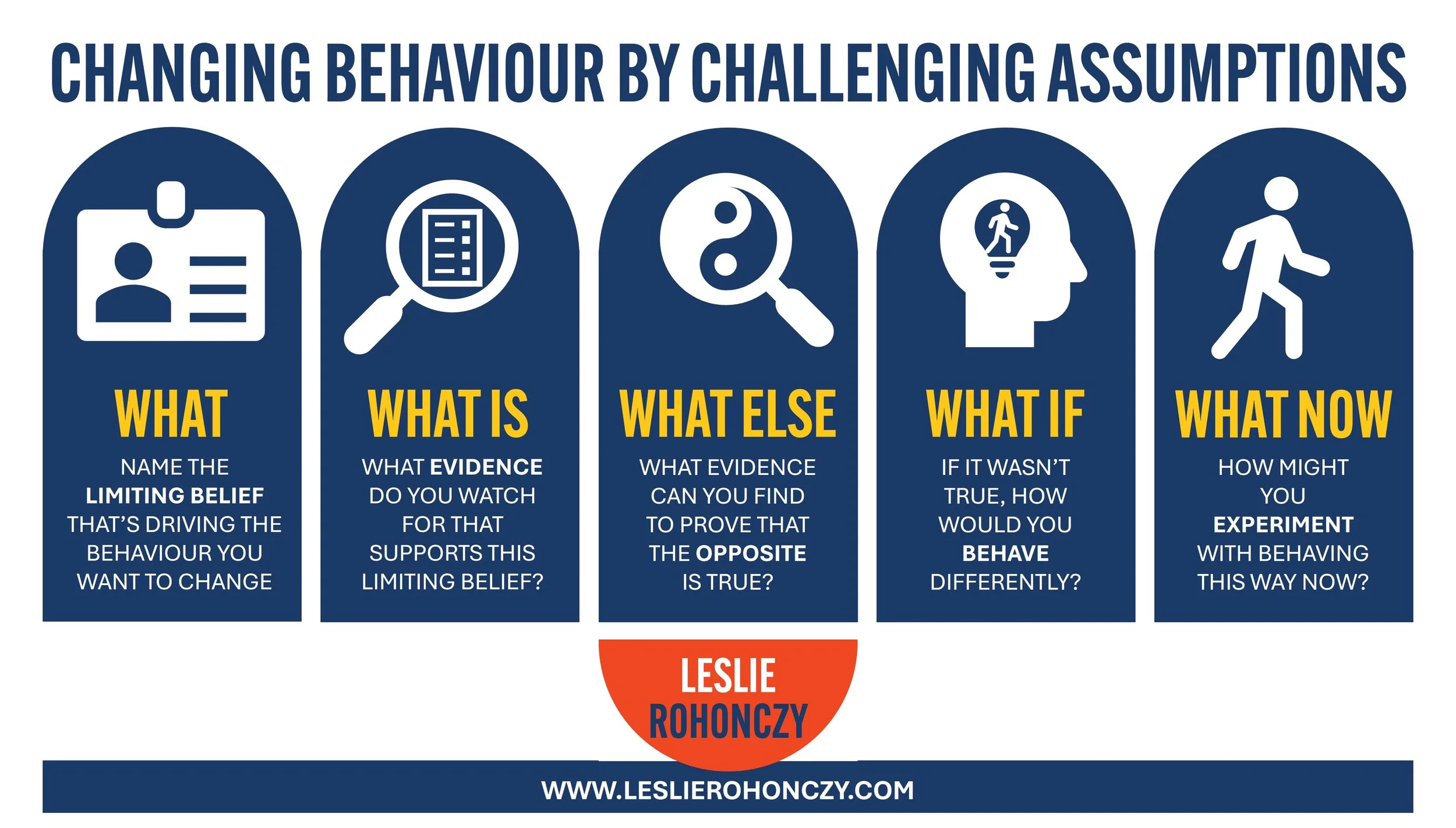
Instructions: Five Steps to Unpack Limiting Beliefs

Find a quiet spot and spend 30 minutes reflecting on the following five questions. Capture your thoughts in a journal as the foundation of your actionable plan.

Step 1: WHAT - Identify the Limiting Belief

Name the belief driving the behavior you want to change. For instance, if you see the world as dangerous, you might avoid speaking up in meetings, focus on safety, and shy away from conflict. For example: "I believe it’s unsafe to speak up, so I stay quiet to avoid drawing attention."

Step 2: WHAT IS - Gather Supporting Evidence

Identify evidence you use to support this belief. You might focus on negative news, crime statistics, and potential risks. For example: "I worry about criticism and negative feedback, ruminating on times when others were shut down or ridiculed for their ideas."

Step 3: WHAT ELSE - Seek Opposing Evidence

Find evidence that contradicts your belief. Ask how you are safe right now, what systems maintain order, how risks can be beneficial, and what rewards may be possible as a result. For example: "When I think about it, there have been meetings where colleagues who spoke up were praised for their input, and their ideas led to productive discussions. My workplace values open communication and has structures in place for respectful dialogue."

Step 4: WHAT IF - Imagine a New Behavior

Visualize how you would act if the limiting belief weren't true. Consider how you'd behave differently and the potential positive outcomes. For example: "If I believed it was safe to speak up, I would share my ideas confidently during meetings, knowing that my contributions are valued and can lead to positive changes. I would engage more actively in discussions and build stronger relationships with my colleagues, and would be recognized for my contributions."

Step 5: WHAT NOW - Experiment with New Actions

How might you experiment with behaving this way now? Start small and gradually build your confidence in acting against your limiting belief. For example: "In the next team meeting, I'll prepare a few points I want to share. I'll start by making a small comment or asking a question to ease into speaking up. Over time, I'll present my ideas and perspectives regularly, inviting feedback and discussion from my colleagues."

HAPPY EXPERIMENTING!

For more coaching and leadership development practices, visit www.leslierohonczy.com.

BREAKING BUSY: Toxic Productivity and the Dark Side of Hustle Culture

by Leslie Rohonczy, Executive Coach, IMC, PCC | ©2024 | www.leslierohonczy.com

 In a world that glorifies hustle, many of us have fallen into the toxic productivity trap: the relentless drive to be constantly busy and accomplished, often at the expense of our well-being. This obsessive pursuit of success can become a destructive cycle, leaving us feeling guilty when we're not working, dissatisfied and exhausted when we are.

But what if there was a way to break free from the chains of toxic productivity? What if we could redefine success in a way that allowed us to mindfully embrace downtime, set boundaries, allow support, and hold ourselves with compassion?


The Productivity Pressure

For many, the pressure to be productive is a constant companion. It urges us on, driven by societal expectations, cultural norms, and the pervasive influence of social media that features perfect, shiny people in states of perpetual productivity. The underlying message is clear: to be valuable, we must be busy, accomplished, and continuously achieving.

I’ve wrestled with toxic productivity for most of my life. I remember always feeling ‘antsy’ in stillness and rarely let myself become truly bored. If boredom somehow snuck through my defense shields, I would twitch and whinge for awhile, and then try to find ways to self-sooth, usually through creative ideation (aka having a party in my head) just so that I would feel productive in some way. Of course, that’s been beneficial in some ways: for channeling creativity, innovation, and problem-solving, for example. But this kind of productivity also has a dark side: it’s been a relentless taskmaster that leaves no room for stillness; only a subtle (and sometimes not so subtle) gnawing feeling of guilt tied to the perception of laziness, or an anxious feeling that I’ve wasted precious time that could have been used more productively. And when I haven’t kept it in check, this constant drive has led to stress, overwhelm, and a sense of not being ‘enough’, no matter how much I achieved.

Even now, people frequently comment on my busyness and level of output. There’s no denying that a part of me that finds it energizing to list the ‘productive’ activities I love so much: executive coaching, team and leadership development sessions, mentoring coaches, making Coaching Minute videos, songwriting, recording and producing original music, rehearsals and live performances, teaching music, writing articles like this one, book events, painting and making jewellery. FUN!! And yet… there’s also considerable discomfort when I read it all in one sentence, because it reveals how deeply I’ve internalized the need to be constantly producing. The concept of 'rest' becomes intertwined with laziness, further fueling a toxic cycle of productivity, guilt and anxiety.

Perhaps this experience resonates for you, too.


The Personal Experience of Toxic Productivity

The internal conflict between the urge to 'do' and the need to 'be' is a common struggle. On one hand, there is a drive to meet deadlines, achieve goals, and maximize every moment. On the other, there’s a longing for peace, for time spent in the present without the looming shadow of the next task. This dichotomy can lead to significant mental and emotional distress. When we're not actively producing, we might feel a pervasive sense of worthlessness or fear that we're falling behind. This can manifest in various ways: stress, burnout, irritability, and physical health issues. When this happens, we know that our productivity has become toxic.

Toxic productivity can show up in different ways: you may seem to others to really have it all together, but you may secretly be battling a constant need to outperform your last achievement. Perhaps you come across as always on top of your game, but you are sacrificing your personal life and mental health to maintain that image. And as much as you’d like to think you’ve got it under control, toxic productivity is not a solitary experience. Many people around us, regardless of their background or profession, can be impacted by our toxic productivity, as they struggle with similar feelings.

The signs of toxic productivity include restlessness and difficulty relaxing, a constant need to be busy, resistance or discomfort with boredom, feeling guilty during downtime, and an inability to enjoy leisure activities without thinking you should be working or producing something useful.

Addressing toxic productivity requires a multifaceted approach. Here are some strategies to help break free from its grip:


Redefine Success

Success has long been equated with constant productivity and visible achievements. However, this narrow definition overlooks the importance of personal fulfillment and well-being as measures of true success. When we expand our understanding of what it means to lead a successful life, we recognize that a balanced integration of achievement with personal satisfaction, happiness, and health is what defines true success.

Consider my client, Laurie, a C-suite executive who, after years of non-stop work, realized she was deeply unhappy despite a long list of professional accomplishments. She began to redefine success by setting goals that included spending quality time with her family, travelling to bucket list destinations, pursuing hobbies, and prioritizing her mental health. As she shifted her focus, Laurie found that she felt more content and balanced in all aspects of her life. She was surprised to discover that her productivity didn't diminish, as she had expected it would; instead, it became more meaningful as it was aligned with her broader sense of purpose and values.

By redefining success, we begin to value moments of joy and relaxation as much as we value career milestones. Wouldn’t it be great if we could feel equally fulfilled by completing a 30-minute meditation as we would by signing a new client. Radical, I know! But this shift allows us to see downtime not as wasted time, but as essential to our overall success.

Redefining success can help mitigate the anxiety associated with feeling unproductive. When we no longer see productivity as the sole measure of our worth, we free ourselves from the constant pressure to perform. This liberation can lead to a healthier, more sustainable work and personal life.

Ultimately, redefining success is about creating a life that feels meaningful and fulfilling, beyond just the narrow definition and metrics of productivity. It encourages us to celebrate our achievements in all areas of life, including those that might not traditionally be recognized, such as personal growth, relationships, and self-care.


Set Boundaries

Boundaries are crucial for maintaining a healthy balance between our work and personal lives. Creating clear lines that separate work time from leisure time, ensuring that one does not encroach on the other, is essential for preventing burnout and preserving mental health.

Travis, the owner of an online marketing business, and self-proclaimed king of the side hustle, used to work around the clock, often sacrificing weekends and evenings to meet client demands. He was proud of the fact that he was a workaholic, and held it as a badge of honour, until he had a medical emergency that was stress-induced. Realizing the toll this was taking on his health and relationships, Travis knew he had to start setting some firm boundaries. He adjusted his pace and communicated his specific working hours to his clients. Outside of these hours, he focused on personal activities and rest. Travis feared he might lose clients by not being constantly available to them, however, to his surprise, most clients respected his boundaries, and his productivity improved significantly during his set working hours. He felt more energized and motivated, and his creativity flourished as he gave himself permission to recharge.

In addition to time-focused boundaries, there are others to experiment with, like creating the physical space for work that is separate from areas designated for relaxation. This can be challenging, especially for those working from home, but even small changes can make a big difference. For example, using a specific desk and chair for work, not having a cell phone beside his bed to charge, and avoiding bringing work-related activities into the family room or bedroom will help us reinforce the mental and physical distinction between work and personal time.

Boundaries are not just about limiting work hours; they also protect and generate specific, intentional time for rest and leisure. By setting boundaries, we prioritize our well-being and ensure that we have the necessary space to recharge. This practice can significantly reduce the feelings of guilt associated with downtime, as we come to see it as a vital part of our overall productivity, health, and self-care.


Practice Mindfulness

My client, Emma, found herself constantly anxious about work. She was a rising star who believed it was her extreme level of productivity that was fuelling her success. Emma longed to be in a steady, loving relationship, but there was just no room in her life for someone else. Emma realized she needed to make some changes, and she began by incorporating some mindfulness activities into her daily routine, beginning with a simple 4-minute breathing meditation (https://youtu.be/ZM3eYRODNbc) in the morning and evening. Over time, she added short meditation sessions and mindful walks during her lunch breaks. These practices helped her feel more grounded and less overwhelmed by her to-do list. And they also helped bring her more clarity and innovation ideas. Emma was thrilled to realize that she had become even more successful by producing less.

Mindfulness involves being fully present in the moment and accepting it without judgment. It can be a powerful tool to combat toxic productivity by helping us focus on the present rather than worrying about future tasks or dwelling on past performance. Mindfulness teaches us to observe our thoughts and feelings without getting caught up in them. For instance, when we notice the feeling of guilt about not working, we can acknowledge it without letting it dictate our actions. After all, this guilty feeling is just an emotion you’re experiencing in the moment, not a directive to take action. This perspective allows us to choose a more compassionate response to ourselves and our need for rest.

Mindfulness isn’t all about sitting cross-legged and chanting ‘ohmmm’ however. We can develop the ability to be mindful and fully present right there in the thick of it! Being fully present while we’re doing tasks can improve our focus and levels of output, lead to more efficient and effective work, and reduce the overall time spent on each task, which in turn, can create more space for relaxation and leisure activities without compromising our productivity. Mindfulness enhances overall quality of life by encouraging us to savour moments of joy and relaxation, making them more fulfilling.


Embrace Downtime

Despite how it may feel, downtime is not a luxury; it's a necessity. Periods of rest are essential for our mental, emotional, and physical well-being. Making time to recharge and enjoy life is a true measure of success, rather than a threat to our productivity.

David, the VP of a software engineering firm, used to feel guilty every time he took a break. He was driven by the belief that constant work was the only path to success. After experiencing some early signs of burnout, David wanted to change his approach, and began an executive coaching program focused on improving his work/life balance. The simple practice of scheduling regular breaks throughout his day had a profound effect on his wellbeing. David ran with the program, and re-dedicated his weekends to rest, family, and playing sports. Over time, he noticed a significant improvement in his energy levels, personal and professional relationships, and overall job satisfaction. David was promoted to CFO shortly after and vowed to maintain this healthy balance. His commitment to protecting downtime had an ancillary effect: because he was able to model healthier behaviours for his team, the engineering firm’s corporate culture, recruiting efforts, and employee retention improved as a result.

Embracing downtime means giving ourselves permission to rest. It involves recognizing that taking a break does not make us lazy; it makes us human. Rest helps our bodies and minds recover and refuels our energy. Engaging in hobbies, spending time in nature, reading, or simply doing nothing can be valuable ways to recharge and enhance our overall sense of well-being. When we view rest as a crucial part of our productivity cycle, we can value it just as much as the work. This shift in perspective can reduce feelings of guilt and anxiety associated with rest, leading to a healthier, more balanced approach to life. Incorporating regular downtime into our schedules can also improve our relationships. When we’re not constantly preoccupied with work, we can be more present with our loved ones, fostering deeper connections and a greater sense of support and fulfillment.


Seek Support

Seeking support is a vital step in addressing toxic productivity. It involves reaching out to friends, family, or mental health professionals to share our experiences and gain perspective. Support systems can provide encouragement, validation, and practical advice for managing the pressures of productivity.

Talking about our feelings can be incredibly liberating. When we share our struggles, we often find that others have experienced similar issues, which can reduce the sense of isolation. Friends and family can often contribute valuable insights and support that help us navigate the pressures of productivity more effectively.

And when friends and family aren’t enough, professional support, such as therapy or coaching, can also be valuable. Mental health professionals can help us identify unhealthy patterns and develop strategies to change them. They can provide tools for managing stress, setting boundaries, and practicing self-compassion.

Support groups can also offer a sense of community and shared experience. Being part of a group where others understand our struggles can be incredibly validating and empowering, as members share practical tips and encouragement for making positive changes.

Consider Maria, a marketing director at a highly successful agency who felt overwhelmed by her workload. During coaching discussions, we discovered that her anxiety response was far beyond the scope of what can be managed through coaching alone, so I encouraged her to seek out a therapist. Through therapy, Maria learned some critical coping strategies that helped her manage her significant anxiety, and through coaching, she learned to set and hold healthier boundaries. She also joined a support group for women who were facing similar challenges, which provided a sense of community and shared understanding. This three-pronged approach to support made a tremendous difference to Maria’s quality of life.

Seeking support can transform our relationship with productivity by helping us recognize that we don’t have to face these challenges alone. It can provide the reassurance and tools we need to prioritize our well-being and redefine our approach to work and rest.


Cultivate Self-Compassion

When we’re in the throes of toxic productivity, self-compassion rarely gets a seat at the table – striving and critical self-judgment take up all the space. But cultivating self-compassion is a powerful antidote to the toxic cycle: treating ourselves with the same kindness and understanding that we would offer to a friend means that we recognize and tolerate our imperfections and struggles, without the guilt-inducing layers of harsh judgment.

Take the example of James, a writer who often berated himself for not meeting aggressive, self-imposed deadlines. His inner critic was relentless, leaving him feeling inadequate, and leading to signs of burnout. After learning about self-compassion as part of his assigned coaching practices, James started speaking to himself differently; with kindness and compassion; with patience, acknowledging his efforts, even when he didn’t meet his goals. This shift in mindset helped him feel more at peace and less stressed.

Self-compassion involves recognizing that everyone makes mistakes and experiences setbacks. It’s about understanding that these moments are part of being human, not signs of failure. Cultivating self-compassion changes the way we view productivity. Instead of seeing it as a measure of our worth, we can see it simply as one aspect of our lives, which reduces the pressure to constantly perform and produce.

Ultimately, self-compassion can help us build a more positive relationship with ourselves. It encourages us to celebrate our efforts and achievements, no matter how small, to be gentle with ourselves when we fall short, and to examine our personal definition of success.

Remember, in the midst of all of the doing, it’s okay to just be. Embrace the present moment and embrace rest as a vital part of a successful, fulfilling and balanced life.

WHAT’S YOUR ‘-NESS’ (And Are You Making the Most of It?)

Leslie Rohonczy, IMC™, PCC, Executive Coach, Leadership Expert, Speaker, Author


Finding Your '-Ness': The Journey to Your True Self

I get to work with some pretty amazing people every day, each on their own unique and personal journey of self-discovery and evolution. And with so much focus on running faster, jumping higher, and succeeding at any cost, it's easy to get caught up in thinking that our external achievements, titles, and accolades are what defines us. But there's a deeper, more profound definition of ourselves that beckons us all: the journey to find our '-ness'.

This concept can be elusive, but it is the essence of who we truly are; our soul, our intrinsic self. It takes practice, patience, and a lifetime of exploration, but it's a journey worth undertaking. In fact, some would argue (me, for one) that this hero’s journey is the one that matters most.


What is '-Ness'?

'-Ness' is a term that encapsulates the core of your being; the authentic self that exists beyond societal roles, expectations, and superficial layers. It's your unique combination of passions, values, strengths, talents, gifts, and quirks. Think of it as your soul’s personal fingerprint: distinctive, irreplaceable, and uniquely you.

For example, my own ‘Leslie-ness’ is related to creativity, empathy, and emotional intelligence. It makes me good at helping people understand their own wiring; at inspiring them to try something new; and at helping them to feel ‘seen’ and understood. My husband’s ‘Imre-ness’ is connected to planning, making others feel safe, and by being in service. How would you describe your own ‘-ness’?

Finding our '-ness' means connecting with our core self, below persona, beyond our title and training, to the deepest place that guides our beliefs, actions, decisions, and interactions. Consider other ‘-ness’ words: 'kind-ness,' 'bold-ness,' 'happi-ness,' and 'calm-ness'; each represents a state, or quality of being, that comes from within.

Your '-ness' is the sum of the authentic traits that blend together to form the essence of your true self. And finding your '-ness' means identifying and embracing those unique qualities and states of being.

When I’m coaching a client who wants to connect to his sense of purpose (let’s call him ‘Steve’), I’ll ask “what is your ‘Steve-ness’?” as a playful way to get him to tell me about himself; to better understand his gifts, how he sees himself, what he values about himself, and how he wants others to see him in return. -Ness is a valuable tool for us both!


The Lifelong Journey Within

For most of us, discovering our '-ness' is not an instant revelation, but rather, a gradual process that unfolds over a lifetime. It requires introspection, self-awareness, and a willingness to face both our light and shadow sides. The journey within can be exhilarating! It can also be challenging. And sometimes it’s both at the same time! But every step we take to discover and define our ‘-ness’ brings us closer to it.


1. Introspection and Self-Reflection

The first step in finding our '-ness' is introspection. This means setting aside time for self-reflection, away from the noise and distractions of everyday life. It involves reflecting on powerful questions: What truly matters to me? What are my core values? What activities bring me joy and fulfillment? What gifts do I value most in myself? Journaling, meditation, and spending time in nature can be powerful tools to guide this introspective process. And if these self-directed activities aren’t your jam, and you feel the need for more structured support, it can be powerful to work with a coach to help you dig deep.

2. Embracing Vulnerability

One of the most essential aspects of discovering your ‘-ness’ throughout this journey is embracing vulnerability. That means being honest with yourself about your fears, weak-nesses, and past mistakes. It’s about acknowledging that you are a work in progress and that it's okay to be imperfect. The renowned vulnerability researcher, Brené Brown, says in her book "Daring Greatly", that embracing our vulnerabilities is the path to greater creativity, innovation, and connection with others.

3. Listening to Your Inner Voice

In our busy lives, we often ignore our inner voice; the quiet, persistent whisper that guides us towards our true path. This inner voice is the manifestation of our '-ness'. Learning to listen to and trust this ‘knowing’ requires mindful-ness and a conscious effort to tune out external pressures and expectations. Practice mindful-ness meditation to help sharpen this inner listening.

4. Living Authentically

As you become more attuned to your '-ness', the next step is to look for more opportunities to live authentically in your ‘-ness’. This means aligning your actions and decisions with what allows you to be the most authentic version of yourself possible. It might involve making difficult choices, such as changing careers, ending relationships, or pursuing a path that others might not understand or accept. Authentic living is not about conforming to societal norms; it’s about honoring your unique essence.

5. Continuous Growth and Learning

Finding our '-ness' is not a one-time achievement; it’s an ongoing journey. As you grow and evolve, so will your understanding of your true self. This requires a commitment to continuous learning and self-improvement. When we stay curious, embrace new experiences, and are open to change, each new experience becomes an opportunity to discover more about ourselves.


The Rewards of Finding Your '-ness'

The journey to finding your '-ness' is challenging, but the rewards are profound. When you connect with your true self, you experience a sense of peace, purpose, and fulfillment that cannot be achieved through external accomplishments alone. Your relationships become more genuine; your work feels more meaningful; your life evolves to be more aligned with your deepest values.


Helping Others on Their Journey

As an executive coach, one of my most rewarding roles is to guide others on their journey to finding their '-ness'. I encourage my clients to explore their inner landscapes, name and confront fears, and embrace their authentic selves. Through this process, they not only become better leaders but also more fulfilled individuals.

Finding your '-ness' is not the end of the journey; it’s the beginning. Your ‘-ness’ becomes the foundation upon which you can build a life of true purpose and joy. It’s about being who you are meant to be, evolving and growing into your potential, and living a life that reflects your deepest truths. As you embark on this lifelong journey, remember that every step, no matter how small, brings you closer to your true self.

Embrace the most important journey of your life­­­: the one within. It is the only journey worth taking, and it is where the real adventure begins.


If you’re interested in discovering your '-ness' with the support of a certified Integral Master Coach™, reach out for a free consultation. I’d be happy to guide you through the transformative process that leads to greater self-aware-ness, authenticity, and fulfillment.

THE VULNERABILITY OF LEADERSHIP: Embracing Vulnerability & Authenticity for High-Performance Success

by Leslie Rohonczy, Executive Coach, IMC, PCC | ©2024 | www.leslierohonczy.com

In the realm of leadership, vulnerability is often perceived as a liability, a chink in the proverbial armor of strength and authority. We see this represented in media, movies, and television shows, like the inept and self-aggrandizing Michael Scott from ‘The Office’, whose misguided attempts at leadership and constant need for validation provide a stark contrast to the notion of vulnerability. His fear of being seen as incompetent leads him to maintain a facade of confidence, often at the expense of his team's well-being and morale.

Or the ruthless and uncompromising Frank Underwood from ‘House of Cards’’. Frank’s Machiavellian tactics and manipulative demeanor exemplify the dark side of leadership, where vulnerability is perceived as a threat to his dominance and authority.

Then there’s the exacting and brutal Miranda Priestly from ‘The Devil Wears Prada’. Her perfectionism and icy personality create a culture of fear and intimidation at ‘Runway’ magazine, stifling any semblance of vulnerability or authenticity among her subordinates.

These characters epitomize the traditional archetype of leadership, where vulnerability is viewed as a weakness to be concealed, rather than embraced. Their portrayals serve as cautionary tales, highlighting the pitfalls of prioritizing power and control over authenticity and connection.

Are these just fictional characters in some of our favourite shows? Well, yes. But also no. These caricatures of leadership are reflections of how our culture interprets and even underscores the message that vulnerability is antithetical to effective leadership, which in turn perpetuates the myth that to be a good leader, you must be invulnerable; impervious; unmoved; unflappable.

Not only is this a terrible way to lead because it ultimately undermines trust, collaboration, and engagement within organizations, but it also is a terrible way to live! Constructing an inauthentic, performative version of yourself can create physical and mental health concerns, career challenges, fractured relationships, poor results, and limited options.

But take a deeper dive into the complexities of leadership, and we see that true strength lies not in the absence of vulnerability, but in the willingness to embrace it. Yet, a growing body of research suggests that embracing vulnerability is not just courageous; it's paramount to becoming a high-performing, successful leader.

Let’s delve deeper, and explore the significance, benefits, and implications of embracing leadership vulnerability, and how it drives personal, team, and organizational success.


Rethinking Leadership: From Strength to Authenticity

When you think about strong leadership, who springs to mind? Our traditional ideas of leadership have often glorified decisiveness, assertiveness, strength, confidence, and even invulnerability. In this myopic, narrow definition, leaders are expected to project an image of unwavering confidence and infallibility, creating a facade of invincibility that leaves little room for doubt, uncertainty, or grace.

However, the landscape of leadership is evolving. In today's complex, dynamic business environment, where uncertainty and change are constants, the need for authentic leaders who aren’t afraid to show vulnerability, acknowledge their limitations, admit mistakes, and openly express their true thoughts and emotions has never been greater.

Consider the character of Captain Jean-Luc Picard from ‘Star Trek: The Next Generation.’ Despite his position of authority as the captain of the USS Enterprise, Picard is depicted as a leader who values empathy, compassion, and open communication. He is not afraid to seek advice from his crew, admit when he's wrong, or express his emotions when faced with difficult decisions. Picard's vulnerability humanizes him as a leader, earning the respect and loyalty of his team.

Or President Josiah Bartlet from "The West Wing" who is admired for his authentic leadership style. Bartlet's response to crises and moral dilemmas exemplifies empathy, compassion, and humility. He has open, transparent dialogue with his advisors, seeks diverse perspectives, and grapples with the ethical implications of his decisions. Bartlet's vulnerability as a leader resonates with audiences, inspiring them to believe in the possibility of principled and compassionate governance.

And let’s include the master of all things vulnerable, the wonderfully goofy human called Ted Lasso from the series of the same name. Ted provides another compelling example of vulnerable leadership. Despite being a fish out of water in his role as a soccer coach in England, Ted Lasso leads with unwavering optimism, kindness, and vulnerability. He openly acknowledges his lack of expertise in the sport and relies on his emotional intelligence and interpersonal skills to connect with his team and foster a supportive environment. Ted's vulnerability allows him to form genuine connections with his players and staff, ultimately leading to their success on and off the field.

These examples challenge the notion that vulnerability is a weakness in leadership and illustrate how embracing vulnerability can foster trust, collaboration, and resilience within organizations. Authentic leaders like Picard, Bartlet, and Lasso inspire others to do the same, creating a culture where authenticity is valued, and leadership is defined by empathy, integrity, and humility.


The Power of Vulnerability: Research Insights

Research in psychology and organizational behavior has shed light on the transformative power of vulnerability in leadership. Recent studies have shown that leaders who exhibit vulnerability are perceived as more authentic, relatable, and trustworthy by their followers. This authenticity fosters deeper connections and stronger relationships within teams.

A study published in the Journal of Applied Psychology (2020, Leroy et al) found that leaders who displayed vulnerability were seen as more approachable and were able to build stronger bonds with their team members.

And, embracing vulnerability has been linked to the creation of a culture of psychological safety within organizations. According to research published in the Journal of Management Development (2019, Day and Fleenor), leaders who create an environment where it's safe to take risks and share ideas foster a sense of belonging and empowerment among employees which, in turn, fuels innovation, creativity, and resilience, driving organizational performance and adaptability in the face of challenges.


Leading with Vulnerability: Strategies for Success

But embracing vulnerability doesn't mean relinquishing authority or competence; rather, it requires a shift in mindset and behaviors towards greater authenticity and humility.

Here are some strategies for integrating vulnerability into your leadership approach:

  • Lead by Example: Sharing personal stories, challenges, and failures with your team fosters empathy and trust, and creates a culture where vulnerability is celebrated rather than stigmatized.

  • Share Your Interior: Allow your employees to see your internal thought processes and emotional reactions, what lights you up, and what makes you nervous or uneasy. And when you don’t know something, just say so. These glimpses of your humanness foster empathy and help you create a culture of trust, where vulnerability is celebrated rather than stigmatized.

  • Encourage Open Communication: Create opportunities for honest and transparent dialogue within your team, and make sure you’re creating psychological safety for them to be transparent, to share feedback, and to speak truth to power. Listen actively and acknowledge your own areas for growth. This sets the tone and promotes a culture of continuous learning and improvement.

  • Embrace Failure as a Learning Opportunity: Share personal stories of your challenges and failures with your team. Instead of hiding mistakes or shortcomings, openly acknowledge them and use them as teachable mentoring moments. Cultivate a growth mindset that views failure not as a setback but as a learning opportunity.

  • Empower Others: Remind your employees (and peers and leader, for that matter) to be authentic and vulnerable in their own interactions, fostering a culture of mutual support and accountability. Using vulnerability in this way is a sign of strength. Recognize your team members when you see them being vulnerable – it’ll help others to step into their power, too.


The Lasting Impact of Embracing Leadership Vulnerability

In this tumultuous modern business world, vulnerability isn't just a buzzword, it's a strategic imperative. It's time to shatter the myth that vulnerability is a weakness; in fact, consider it one of the most important indicators of true leadership potential.

By embracing vulnerability, leaders wield a powerful tool to cultivate authenticity, trust, and resilience within their organizations, igniting a chain reaction of success.


As you continue to lead, remember this: vulnerability isn't a sign of weakness; it's a badge of emotional maturity, courage, and authenticity. It's about daring to show up, flaws and all, and inviting others to do the same. By leading with vulnerability, you set the tone for a culture where authenticity thrives, and trust propels success.

So, let's make a bold commitment to leading with vulnerability, and create a workplace where authenticity isn't just valued—it's celebrated. Let's inspire our teams to embrace their vulnerabilities, take risks, learn by trying, and realize their full potential. The path to lasting leadership impact begins with embracing our own vulnerability first and then empowering others to do the same.

It's time to lead with courage, authenticity, and boldness. Are you ready to take the leap?

FREE COACHING PRACTICE: JAR MEDITATION

 by Leslie Rohonczy, Executive Coach, IMC, PCC | ©2024 | www.leslierohonczy.com

In our fast-paced world, finding moments of stillness and clarity can seem like a luxury. Yet, these moments are essential for our mental and emotional well-being. One powerful practice that can help us cultivate a sense of inner peace and allow for new insights to drop into us, is meditation. Today, we're going to explore a technique that will help you experience meditation in a different way.

Imagine yourself standing in the middle of a huge room. It's spacious, and completely empty, except for one thing—a large glass jar. This jar represents your mind, and it holds your thoughts, represented by different colourful bubbles.

As you stand in the room, allow yourself to become aware of your thoughts. Just notice them, as you think about your day, your life, your worries, your dreams—anything that happens to float by or that typically occupies your mind.

Now, as these thoughts pop up, one by one, imagine that you are gently placing each thought bubble into the jar. Visualize each thought taking on this round shape as you do this—positive or negative, it doesn't matter. Once you've filled the jar with your thoughts, step back and observe. Notice that you're not engaging with the thoughts anymore; you're simply watching them, neutrally observing.

Now, imagine yourself slowly backing away from the jar. You move towards the door and can still see the jar with your swirling thoughts, as you step outside through the door. In this state of neutral observation, you're detached from the thoughts, just observing without judgment or analysis.

Spend a few peaceful moments (30 seconds, or 30 minutes; it’s up to you) in this calm state, then allow yourself to say thank you to the day, and return into the large room. Thank the room for holding this space for you, and send your gratitude to the jar that is holding all of your thoughts.

And if there are some thoughts that you feel would be better off remaining in the jar, leave them there. You can always come back for them another time if you really need them. But for now let them remain here. Feel the lightness in your body; in your heart; in your mind.

Remember, meditation is not about suppressing or controlling your thoughts. It's about cultivating awareness and acceptance of whatever arises in your mind. By focusing outside the jar of your thoughts, and observing them from a distance, you'll gain valuable insight into your inner world.

So, the next time you feel overwhelmed or stressed, find a quiet space, close your eyes, and visualize yourself in that vast room, with your jar of thought bubbles. Allow yourself to become aware of your thoughts, then gently place them into the jar where you can just observe them, as they are. With practice, you'll find yourself feeling more centered, grounded, and able to tap into your wisdom and find greater clarity in your life.

WOOHOO CAREER MOMENTS: Embracing the Power of Courage

 by Leslie Rohonczy, Executive Coach, IMC, PCC | ©2024 | www.leslierohonczy.com


Last week, two coaching conversations left me cheering with joy, and celebrating the courage and determination of two remarkable individuals.

As an executive coach, I have the privilege of witnessing the leadership development journeys of clients who find themselves at a crossroads, wondering how to advance their careers or navigate difficult work environments. And whether they’re looking for strategies to get promoted, or for ways to protect themselves in a toxic culture (or for help in making the difficult decision to leave), the journey towards career fulfillment demands courage.

Recently, I had the pleasure of celebrating with a coaching client who, after months of deep dives into leadership EQ and coaching, bravely addressed a gap identified by her leader. At the beginning of our coaching session, she proudly announced that she had gotten the promotion to a leadership role she’d been working so hard for! I was so excited, a resounding "WOOHOO!" flew out of my mouth!

That same afternoon, I had a very different conversation. It was a heartfelt coaching chat with a senior leader, who shared that she’d finally found the courage to leave her toxic work environment. She spoke with such brave resolve about her pivotal decision, and I was truly inspired by her. And, you guessed it, another resounding "WOOHOO!"

To be clear, I’m not a habitual “WOOHOO-er”. But I had the same reaction to these two very different situations because I was so thrilled by their courage.

Coaching clients invest in their own growth and development with the willingness to take a courageous look at their gaps, assumptions, aspirations, strengths, and shortcomings. They embrace and explore the gift of feedback. They identify and work hard for what they most want from their career. They set boundaries, and then enforce them when those boundaries are crossed. They bravely make a change when opportunity comes calling their name. And they make empowering decisions like these two examples, putting themselves well on the path to healthier, fulfilling, personal and professional growth opportunities!


Unlocking Your "WOOHOO" Moment:

There will be many triumphs, rough patches, and transformations throughout our careers, and no matter whether we’re trying to secure a long-awaited promotion, or to navigate a change in pursuit of greater fulfillment, our courage and resilience will be the cornerstones of our success.

Through personalized guidance and support, coaching programs are tailored to address individual unique needs, personalities, and aspirations. Imagine what might be possible for you if you invested in honing your essential leadership skills, growing your emotional intelligence, and mastering the art of effective communication. From cultivating resilience in the face of adversity to fostering a growth mindset that fuels innovation, coaching equips you with the tools and mindset to overcome obstacles and seize opportunities. By investing in executive coaching, you are investing in your future success, unlocking new possibilities for advancement, fulfillment, and leadership excellence.

If you’re navigating a career decision, or coaching someone who is, here are 5 aspects of the career journey with questions to help you reflect on your own courageous career aspirations (hot tip for leaders: you can use these questions to coach your employees during career development discussions):

1.      DEFINE CAREER SUCCESS

  • What is your definition of ‘career success’? How does this definition support you? And how might it limit you?

  • Imagine your ideal work environment where you feel most fulfilled and energized. What values and culture would it embody, and how does this differ from your current situation?

  • Reflect on the values, priorities, and culture dynamics in your current workplace. How do they align with your personal values, priorities, and working style preferences?

2.      ADDRESS GAPS

  • What feedback have you received in your current role about an area for growth or improvement?

  • How are you leveraging this feedback to propel your career forward?

  • What strengths do you possess that can help you address your gaps, and how will you leverage them?

3.      DECISION-MAKING

  • If you’re facing a challenging career decision, what factors are influencing your choice?

  • What outcomes are you hoping to achieve?

  • What decision would your ‘head’ make? Your ‘heart’? Your ‘gut’? How does each perspective inform or influence your decision?

4.      TAKING ACTION

  • What would you do if you felt more ‘brave’? What’s holding you back from doing that?

  • What do you need to see/hear/feel/do, in order to take more courageous action? What steps can you take today, this week, and this month?

  • Who could help you build the professional skills and experience you need, including stretch assignments or additional training opportunities?

  • Reflecting on your long-term career aspirations, how can you align your actions today with your future goals?

5.      COURAGEOUS MINDSET

  • Considering the importance of a courageous mindset in career choices, when navigating career decisions and transitions, how will you cultivate and maintain your resilience in the face of uncertainty or setbacks?

  • What personal reward will you give yourself for your bravery?

  • What self-compassion messages will you give yourself when you feel uncomfortable, or when things don’t go the way you hoped they would?


If you want to pursue your own ‘WOOHOO” career moment, visit www.leslierohonczy.com to learn more about how my executive coaching and leadership development services can help propel you towards success.

WHAT LIMITING BELIEFS ARE HOLDING YOU BACK?

by Leslie Rohonczy, Executive Coach, IMC, PCC | ©2024 | www.leslierohonczy.com


In a recent coaching session, I worked with a client who had made an important career decision. Together, we explored how certain unconscious, limiting beliefs can silently influence our experiences, behaviors, and perceptions. These beliefs often lurk beneath the surface, shaping our lives without us even realizing it.

What I’ve noticed is that it doesn’t matter whether my client comes from the business or music world; emerging or seasoned professional; CXO or entry-level employee; limiting beliefs can keep us small, stuck, and blocked from living our best lives.

Research by Dr. Carol Dweck, the renowned psychologist who coined the terms "fixed mindset" and "growth mindset", highlights the pervasive nature of limiting beliefs. She describes how beliefs about our abilities can profoundly impact our success. Those with a fixed mindset have the limiting belief that their abilities (or lack of abilities) are innate and unchangeable, leading them to shy away from challenges. Conversely, those with a growth mindset view challenges as opportunities for growth and embrace them wholeheartedly.

Take, for instance, a common limiting belief I’ve seen with clients: expecting other people to react with the same emotions WE would have in a similar situation. The reality is that we’re all wired differently, and we can’t rely on our own emotional wiring and internal perceptions to map how others will react.

Another limiting belief that many of us unconsciously hold is believing that we can somehow control others' thoughts or opinions about us. As I've written in my book, ‘Coaching Life: Navigating Life’s Most Common Coaching Topics’, what others think of you is simply none of your business. Others’ reactions to you – negative or positive – just shows you how others are wired, and what THEY pay attention to. It doesn’t reveal any more to you about who YOU are, your worth, or your value.

If, like many others, this topic of limiting beliefs resonates for you too, here's a powerful four-step coaching practice to tackle limiting beliefs head-on.


Challenge Assumptions with Evidence

1.      Identify the Limiting Belief: Start by pinpointing the belief that is underlying a behavior you wish to change. What limiting belief prevents you from acting they way you want to, or causes you to second-guess yourself? Reflect on past experiences and patterns to uncover the root cause of your limiting belief.

2.      Seek Supporting Evidence: Ask yourself: what evidence can I find that reinforces this belief? Considering both internal experiences and external influences, what evidence or proof confirms this belief to be true? And how do you know they’re true?

3.      What Evidence Proves the Opposite is True: Seek out evidence to challenge or disprove your limiting belief. Challenge yourself to adopt a curious and open-minded approach, striving for as many other perspectives as you can find. The simple act of looking for opposite examples to our limiting beliefs creates relief from the anxiety of harsh self-judgment. (When we go looking for this contrary evidence, we have a pretty good chance of finding it.)

4.      How Would You Behave Differently: Finally, envision how you would behave if this limiting belief were not holding you back, and the opposite were in fact true. Visualize yourself taking bold and confident actions aligned with your true desires and values. Experiment with showing up in this new way, and notice what is more accessible to you as a result – inside of you in the moment; in the room with others; how people respond differently to you; and how you feel differently about yourself, as a result.


Remember, while beliefs shape our reality, they are not immutable truths. By ferreting out our limiting beliefs, one at a time, and then challenging and reshaping them with a growth mindset, we transform our experiences, and have more resources available to realize our true potential.