
Career Compass

HOW OLD IS THE PERSON STEERING YOUR CAREER? Your Destination Was Chosen by Someone Who No Longer Exists

Leslie Rohonczy, IMC, PCC, Executive Coach & Author

 (LISTEN TO NARRATED AUDIOARTICLE VERSION)

The first few years of my adult life were the striving years. Striving to make ends meet, striving to get noticed in my career, among a sea of other young professionals who always seemed to be better at standing out from the crowd than I was; striving for a promotion to the next level, without ever really asking myself why a title was my end game; striving to feel my own worth, when I didn’t feel at all worthy.

And when I finally got that hard-fought promotion, and found myself in that shitty little clapboard office in the middle of the advertising department at our local newspaper, I had a sphincter-shifting moment of clarity: “Was THIS what I had been working so long and hard for? This office with no window and no purpose? How could all of my striving, motivation, blood, sweat, and tears really have been about THIS?!”

That experience, and that question, changed my career. The promotion was exactly what I'd wanted, which was precisely the problem. I'd spent years chasing a destination chosen by a version of me who no longer existed.

At the time, I couldn't have explained what was happening. I just knew something felt profoundly off. Looking back now, I realize it was the first time I'd noticed that somewhere between the striving and the arriving, it was me that had changed, not the destination.

That experience isn't unique to me. I've heard versions of this experience in many of my executive coaching conversations. The offices are usually much nicer than mine was, and the titles on the business card are more impressive, but eventually the same uncomfortable question appears: Now what? Or sometimes: Is this really all there is?

Life reshapes us while we are busy building our careers. The destination we chose at twenty-eight no longer fits the person we've become at forty-eight, but we may not see it if we don't pause long enough to notice the mismatch.

A few weeks ago, I found myself watching a YouTube video of a single sculler crossing a perfectly calm lake. There was something mesmerizing about how the boat cut through the glassy water. Every stroke looked powerful yet effortless, as it glided across the water with absolute purpose.

I find rowing kind of a strange way to travel. The boat moves confidently forward while the rower faces the opposite direction. Rowers can clearly see where they've been. They can study the wake they've left behind, and can appreciate every kilometer they've already travelled. The one thing they can't actually see is where they're going.

Hey, that also describes many leadership careers! Early in our careers we choose a direction that makes complete sense at the time. We pursue promotions, bigger teams with more span of control, financial security, influence, recognition, and the opportunity to prove ourselves. We want to make our parents proud, build something meaningful, provide for our families, or finally settle that relentless inner voice insisting we're still not enough.

There is nothing wrong with any of those motivations. In fact, they often provide exactly the fuel we need during those demanding early years. But life has a habit of changing us while we're busy rowing.

Successes often turn out to be less satisfying than we imagined. We experience illness, burnout, unexpected opportunities, disappointments, and moments of clarity we never saw coming. And over time, our definition of success begins to evolve. Status starts giving way to significance. Recognition becomes less important than contribution. Freedom matters more than prestige.

The person holding the oars today isn't the same person who first climbed into the boat and set the direction. Yet many of us continue rowing toward the same destination simply because that's where we pointed the boat years ago.

One of my favourite coaching questions catches people completely off guard: How old is the person currently steering your career?

Sometimes it's the twenty-five-year-old you who's desperate to prove she belongs. Or the young father determined to build financial security for his new family. Sometimes it's the ambitious new executive convinced that one more promotion will finally deliver the satisfaction they've been chasing.

That younger version of ourselves deserves enormous respect. They worked hard, took risks, made sacrifices, and created opportunities that today's version of us benefits from every single day. But they couldn't possibly have known who we would become. They didn't know which experiences would shape us, what losses we would endure, what relationships would change us, or how dramatically our understanding of a meaningful life would evolve.

So why are they still deciding where we're headed?

I think this is where many can get stuck. It might feel like lost ambition after decades of investment and building up our expertise, relationships, credibility, and identity. Changing direction can begin to feel like admitting those investments were mistakes. They weren't. They just brought us to the place where we're finally experienced enough to ask a better question.

Instead of asking, “Can I get there?” the question becomes, “Do I still want 'there'?”

That may be one of the hardest career questions we'll ever ask ourselves because the answer often asks us to loosen our grip on a destination we've carried for years; one that feels like our encoded mission, because we've been chasing it so long.

One of the greatest gifts coaching has ever given me is permission to pause before pushing forward. We're conditioned to believe that success comes from rowing harder. Sometimes it does. But sometimes, the wisest thing a rower can do is lift the oars from the water, let the boat glide, and take some time to turn around and really study their trajectory.

Only then can you answer the question, "does this destination still belong to the person I am today?" I encourage leaders to ask themselves uncomfortable questions as part of the process. Questions like, "If you were choosing your career today, would you choose the same destination?" "Which ambitions genuinely belong to you, and which belong to a younger version of yourself?" "What are you continuing simply because you've already invested so much?" "What gives you energy today that barely mattered ten years ago?" "If nobody else's expectations mattered, where would you point the boat?"

Sometimes the answers are deeply reassuring. You discover you're exactly where you're meant to be, and you begin rowing again with conviction because your destination has been consciously chosen by the person you are today, and not inherited from someone you used to be.

Other times the answers lead somewhere entirely different: a new awareness, a different role, a revised definition of success, a shift in priorities, or a career that finally reflects the person you've become instead of the person you once were.

Neither outcome means your younger self got it wrong. That version of you did exactly what they were supposed to do: they got you this far. But at some point, every leader deserves to ask a simple question: Who is this person holding the oars now?

The younger version of you chose a destination with the wisdom they had at the time. You don't owe them blind obedience. You owe them gratitude.

Now it's your turn to decide where the boat goes next.


YOUR COACHING CHALLENGE

This week, spend ten uninterrupted minutes with a blank sheet of paper. Across the top, write this question: How old is the person currently steering my career?

Don't answer it too quickly. Think about the ambitions you're pursuing right now, the goals you're sacrificing for, the opportunities you're saying yes to, and the ones you're turning down.

Then ask yourself: If I were starting my career today, with everything I've learned about myself over the past twenty years, would I still choose this destination?

If the answer is yes, you've just reaffirmed that you're rowing with purpose. If the answer is no, don't panic. You don't have to change direction tomorrow. You simply need to acknowledge that the person holding the oars today deserves a voice in deciding where your boat goes next.

IS THIS YOUR 'TRAPEZE MOMENT'? Release the Death Grip On Your Current Bar

By Leslie Rohonczy, IMC™, PCC

Executive Coach | Leadership Development Expert | Author | Speaker | ©2026 | www.leslierohonczy.com


Most of us can picture the glamour and excitement of a trapeze act: the elegant swing, the release and heart-pounding flight through the air, the satisfying grab onto the new trapeze bar, followed by thundering applause. But hold the phone… what about that awkward, slightly terrifying bit in between? The part where the flyer has released their grip on the trapeze bar and, for what feels like forever, is suspended in open air with no connection to anything solid. It’s a hold-your-breath, hope-your-timing-is-good, please-let-this-work kind of moment.

It can feel safer to keep swinging on the same bar we already know. Real change shows up in that split second when we decide to let go and hurtle through the air toward something we can’t yet grab.

If we’ve ever found ourselves staring at our work and thinking, “I can’t keep doing this,” while also having no tidy answer for what comes next, we’re likely there. It doesn’t arrive with fireworks or a perfectly drafted resignation letter. It tends to show up in far less cinematic ways, more like a persistent signal that something no longer fits, like a favourite jacket that used to fit perfectly and now sits just a bit off, no matter how many times we try to adjust it.


WHEN EVERYTHING LOOKS FINE BUT ISN'T

I was coaching a leader recently who had built a strong and credible career over many years. If we were looking for someone who was steady, thoughtful, dependable, respected, capable, and a great people person, he’d be at the top of the list.

From the outside, everything looked… fine. Solid, even. No crisis to solve; no burning platform. No one tapping him on the shoulder saying, “You know what, now would be a great time to blow all this up and see what happens.”

Internally, though, the story was different. He knew, deep down in that ‘knowing place’ we all have, that he needed a change. But the problem was that he couldn’t clearly articulate what he wanted next. There was no neat plan or polished narrative about a bold new chapter. What he did have was a growing awareness that his current situation no longer fit him in the way it once had, and that awareness was only going to become more inconvenient and uncomfortable. So he stayed, gripping tightly to something that had stopped feeling right.

We tend to celebrate decisive moves, promotions, and bold pivots that look great in hindsight. We applaud the hero’s journey once the arc is clear and the ending makes sense. What we tend to skip over is the long, ambiguous stretch in between, when we know it’s time for something different but can’t yet name what that something is without sounding like we’re just making sh*t up as we go.

For many of us, when we find ourselves in that space, we do what we’ve always done well: we use our big brains to analyze and rationalize, believing that we can think our way out of our discomfort. We reflect, analyze, crunch the data, gather perspectives, read articles like this one, and generate insight after insight. It feels productive, and to be fair, it can be helpful as a starting point, but it isn’t a plan of action. Then we pause, often for reasons that sound responsible and strategic in the moment. We wait for a clearer signal, collect a bit more data, and tell ourselves timing matters. All of that can be true, and it also gives us a very comfortable place to remain when things feel uncertain.

Over time, a pattern starts to take shape. Insight leads to hesitation. Hesitation leads to retreat. Retreat leads back to reflection. Around and around we go, often with more sophisticated language each time and less actual movement.


INSIGHT IS CHEAP. EMBODIMENT IS EXPENSIVE

Insight is cheap. Acting on it is what costs us the most, in time, resources, energy, and focus. Think about it this way: we can generate insight by having a conversation, writing a journal entry, or taking a reflective moment to process. These insight-generation acts give us language, perspective, and the sense that we’re getting somewhere, and bonus, it doesn’t require us to change anything yet. What costs us is the moment we decide to act on what we already know to be true.

It might show up as saying the thing we’ve been rehearsing in our heads for months, stepping away from a role we’ve outgrown, or loosening our grip on an identity that no longer fits. These are familiar comforts, and they keep our hands firmly wrapped around the current trapeze bar. And this is where we tend to stall, not because we don’t understand what’s happening, but because acting on that understanding has consequences.


THE MYTH OF READINESS

There’s a psychological layer worth naming. Research in behavioural economics, including the work of Daniel Kahneman, shows that we experience potential losses more strongly than equivalent gains. Leaving a familiar role or identity can feel like a real loss, even though it doesn't fit anymore, and even when we can see the possibility of a new trapeze bar dangling up ahead. From that perspective, staying can feel entirely reasonable. It will also keep us exactly where we are.

Then readiness enters the picture. We assume that at some point in the future, we’ll feel clear, certain, and fully prepared to make a big move. In practice, that feeling rarely shows up in advance. More often, we move first, and then tell ourselves, “I guess I was ready after all.” At the time, it feels more like uncertainty, discomfort, and a slightly unsettling level of exposure, paired with a decision to move anyway.

Which brings us back to the trapeze metaphor, and to a line from a song I wrote called Trapeze, inspired by this exact moment:

Reaching out into the mist you close your eyes

That’s when you discover you can fly

 That’s the reality of it. We don’t reach the next bar by stretching harder while holding on to our current one. The transition becomes possible when we release our grip, even though the next bar isn’t yet in our hands.


THE COST OF STAYING

First, let's look at what we are holding onto. Maybe it's a role that we’ve mastered, a reputation we’ve earned, or an identity that’s been reinforced over years. All that effort, discipline, and contribution we put in over time is precisely what can take up the exact space we'll need to reach for something new. The longer we hold the old bar, the harder it becomes to loosen our grip and engage with what comes next; not because the opportunity disappears, but because our hands are already full.

When clarity is missing, we often try to create it before we move, as if the perfect plan will make everything obvious. In moments like this, honesty tends to be more useful. Honesty about what no longer fits, even if we can’t yet name what would fit better. Honesty about what we’re tolerating, and why. Honesty about what we’re concerned about losing if we let go. Honesty about that whisper of yearning for something different for ourselves.


YOUR COACHING CHALLENGE

Find a quiet place where you won't be disturbed for about 20 minutes. Take a few deep breaths, allow yourself to relax, and fully arrive to this practice.

Listen to the recording of Trapeze here: https://youtu.be/6q_4Tj4nbqg (you can follow along with the lyrics below the video.)

Now consider your own career and what might be calling you toward a new bar. Answer the following questions in your journal:

  • Where are you feeling that pull of something that’s asking more of you right now, even if it’s not fully formed?

  • What has started to feel too small, too tight, or simply no longer yours?

  • When you imagine letting go, what part of that feels energizing, and what part of that feels uncertain or exposed?

  • What are you holding onto that still works, and what does it give you that makes it hard to release?

  • And what could you loosen your grip on (not necessarily a total release), that could help you take a first step in that direction?

If you're experiencing this in-between moment, or are hurtling through that untethered space between bars, this is exactly the kind of transition I can help you navigate in executive coaching. If you'd like to build your capacity to leap while things are still unfolding, reach out for a free exploratory Executive Coaching conversation at www.leslierohonczy.com.

WHAT’S DRIVING YOUR STRIVING? The High Cost of Relentless Achievement

(LISTEN TO THE NARRATED AUDIOARTICLE VERSION)

The first few years of my adult life were the striving years. I worked hard... very hard. I chased credentials, opportunities, accomplishments, experiences, titles, recognition. If there was a ladder nearby, I was halfway up it. If there wasn’t, I would build one.

From the outside, it looked like I was productive, ambitious, and disciplined; the kind of person that people describe as 'driven,' and in some ways, that was accurate. I had energy, curiosity, and a willingness to work hard.

Inside, though, something else was going on. Beneath the ambition was a voice that I hadn’t yet learned to question. It carried a simple message that kept showing up in my thinking: 'you’re not enough'. That belief became the fuel behind my striving behaviour, even though I didn’t recognize it at the time.

Striving became the strategy I used to soothe the 'not good enough' feelings. Adding another achievement felt like a solution. Another milestone appeared, then another goal reached, and surely the next one would finally be the moment when I felt capable, complete, and secure. But that imagined moment of relief never quite materialized, and the finish line just seemed to push further away every time I got close to it.

Some high performers recognize this pattern once they slow down long enough to examine it, because what appears to be ambition on the surface is often something quite different underneath.


THE STRIVING TRAP

There's no doubt that ambition can be healthy. It can push us to learn, create, contribute, and improve. It’s often fueled by curiosity and purpose, and it can produce remarkable outcomes when it’s aligned with meaning.

Striving, however, is often fueled by something else entirely: fear. It could be fear of failure, fear of being exposed, and fear of not measuring up to some invisible standard that lives inside our heads. And sometimes the driver runs even deeper: a belief formed long ago that our worth can only be earned through achievement. I had an executive coaching client who uncovered the limiting belief that if she wasn't working herself to the point of exhaustion, she didn't deserve to relax or be joyful. What she eventually realized was that her exhaustion wasn’t the problem; it was the proof that, as long as she was depleted, she had earned the right to feel okay about herself. The exhaustion wasn’t just about the work anymore; it had become the evidence of her worth.

Researcher Brené Brown has written extensively about the relationship between shame, worthiness, and perfectionism. She describes perfectionism not as a healthy pursuit of excellence, but as a strategy people use to avoid criticism and judgment. In that sense, perfectionism isn’t really about doing great work. It’s about protecting ourselves from feeling inadequate. And that's an incredibly important distinction.


THE INVISIBLE DRIVERS OF RELENTLESS ACHIEVEMENT

Over the years, I’ve coached hundreds of leaders, many operating at the highest levels of their organizations. From the outside, these leaders often appear confident, accomplished, and highly capable. Their colleagues admire them, their teams rely on them, and their organizations reward them.

Once the coaching conversation begins, however, the internal story often begins to emerge, and a more complicated picture comes into view. Some leaders grew up in families where achievement was the price of approval. Others learned early that praise appeared mainly when they performed well. Some internalized the message that being valuable meant being exceptional. These experiences don’t disappear when someone becomes an executive. They simply follow them into the boardroom.

Those early lessons become powerful internal engines. Add perfectionism into the mix, and you get a drive that rarely switches off. The leader becomes productive, respected, and admired. At the same time, the internal experience can feel like a treadmill that keeps accelerating.

I came across some interesting research about the distinction between work engagement and workaholism (Wilmar Schaufeli & Arnold Bakker, 2008; Clark, Michel, Zhdanova, Pui, & Baltes, 2016), which shows that when people are driven by internal pressure rather than genuine engagement with their work, the long-term results are often less positive than expected. Studies examining compulsive work patterns have linked them to emotional exhaustion, stress, and reduced well-being, even among highly successful professionals.

In other words, relentless achievement carries a hidden cost that leaders only begin to see once they pause long enough to examine the forces driving their striving behaviour.


WHEN SUCCESS DOESN’T FEEL LIKE SUCCESS

One of the most revealing moments in coaching often happens after a major success; perhaps a promotion, a major project delivered, or a milestone that took years to reach.

We would expect to feel a level of achievement or celebration. What some leaders feel instead is relief. That reaction can feel surprising, yet what happens in that moment is that the internal critic finally goes silent. We proved something. We cleared the bar that had been looming over us. Then, before long, the voice returns and introduces the next challenge, asking the inevitable question that follows on the heels of every achievement: what comes next?

This is one of the clearest signs that striving is being driven by insecurity. The finish line keeps moving. Not because we lack discipline or ambition, but because the real goal was never the achievement itself. The real goal was feeling worthy, and no external accomplishment can permanently answer that question.


AMBITION WITH AWARENESS

Many remarkable things in the world have been built by ambitious people. Innovation, progress, and creativity often come from individuals who are willing to pursue bold ideas and difficult goals. The important distinction lies in the motivation behind the drive, because the source of that motivation determines whether ambition expands possibility or ultimately traps a leader on a moving treadmill of achievement.

Ambition says that we want to build something meaningful or explore what’s possible. Striving, driven by insecurity, says that we need to prove something about ourselves so that we can feel acceptable. Ambition expands possibility. Striving often narrows it.

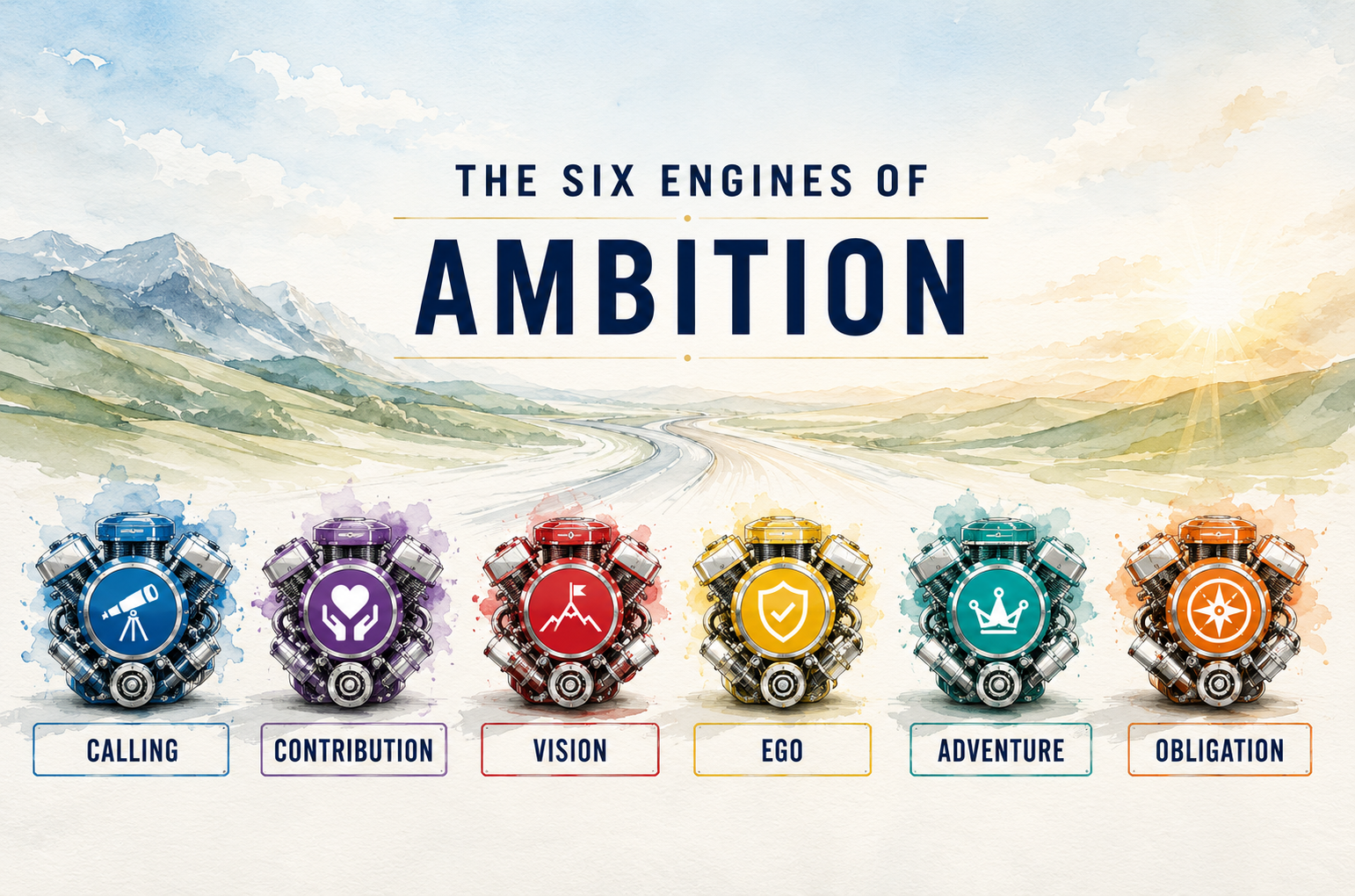
When we begin examining our internal drivers, something interesting happens. We don’t lose our drive. In some cases, the opposite happens, and the drive becomes more powerful because it’s no longer fueled by pressure or fear. Instead, it starts drawing energy from curiosity, contribution, and purpose. The engine remains strong, but the fuel source changes.


YOUR COACHING CHALLENGE

Today's challenge requires about 20 minutes of reflection, so grab your journal and favorite pen, and find a quiet place where you can relax into this practice. Take a moment to reflect on your own striving tendencies, and allow yourself to be genuinely curious about what might be driving it.

Step 1: Identify a current goal. Choose something you're actively pursuing right now. Perhaps it's a promotion, a project, a business milestone, or a personal achievement that really matters to you.

Step 2: Examine the emotional energy behind that goal. Ask yourself what is truly motivating it. Notice whether the energy feels expansive, such as curiosity, purpose, contribution, or the excitement of building something meaningful.

Step 3: Look for a second layer of motivation beneath this. Ask yourself whether any part of the drive is connected to proving something about your worth, gaining approval, avoiding criticism, or quieting an internal voice that says you are not yet enough.

Step 4: Step back, review, and discover themes. Many leaders notice that their motivation contains more than one driver, and simply seeing those drivers clearly is often the beginning of greater freedom and choice.

Step 5: Use your new awareness to guide your choices. What adjustments might bring your striving back into alignment with the future you want to create? If the goal is fueled mostly by purpose and curiosity, then pursue it with renewed energy. But if you notice that insecurity or the need for approval is doing most of the driving, how could you approach the goal differently? What healthier boundaries do you need? How would you redefine success? What is the deeper reason this goal matters so much to you?

Ambition and insecurity often travel together, and recognizing that mixture is part of becoming a more conscious leader. There is no judgment required in that realization. Human beings are complex, and the forces that shape our drive rarely come from a single source.

What matters is awareness. When we understand the true engine behind our striving, we gain the freedom to decide whether that driver is still serving the future we want to create, or whether it is simply repeating an old story about our worth. 

That moment of clarity is often where the real shift begins. Striving doesn't disappear, but it becomes more intentional, more grounded, and more aligned with the life and leadership we actually want to build.

Reach out for a free exploratory Executive Coaching conversation at www.leslierohonczy.com.

FREEDOM ISN'T WHAT I THOUGHT IT WOULD BE: A Surprising Truth at This Stage of My Career

(LISTEN TO THE NARRATED AUDIOARTICLE VERSION)

Freedom has been a recurring theme in my life, long before I named it as my 2026 guiding word for the coming year. It’s felt less like something I was living, and more like something I was moving toward, an ideal future state that existed somewhere up the road, just slightly out of reach. I see it most clearly in my ongoing negotiation with that other slippery concept: time. Freedom and time are uneasy dance partners. When time feels compressed, freedom tends to shrink. When time is reclaimed, even in small ways, freedom expands.

Sometimes this shows up in the practical ways I try to keep my days from becoming overscheduled, through small, deliberate acts of resistance, and by blocking space in my calendar that’s just for me. I notice how quickly my energy refills when I resist the pull to say yes simply because I can, and give myself space for creativity.

Other times, the tension shows up less neatly. In moments when I technically have control over my schedule, but still feel rushed or obligated in some way, when the calendar is lighter, yet my mind is crowded, or when I realise that freedom isn’t just about having time to and for myself, but about how I inhabit that time.

Now, you and I may have different ideas about what freedom actually means. For me, freedom doesn’t mean escape; it’s an insistence on unrestrained breathing room. I can usually identify it by asking a question I’ve learned to keep close to my heart: what actually needs my attention, and what can be left alone? Freedom is my word for the year because this theme is still a work in progress, something I practise imperfectly in small, ordinary moments rather than claim as a finished state.

For years, I thought freedom would feel louder. More dramatic. Like a big reveal or bold pivot that would signal I’d finally figured things out. What I didn’t expect was how understated freedom often is, or how ordinary it looks from the outside, and how deeply relieved I feel on the inside when I’m in it.

Freedom is my word this year, not the aspirational kind you tape to a vision board with good intentions, but the lived, slightly messy, sometimes uncomfortable kind that shows up daily in real decisions, real boundaries, and real letting go. For me, this isn’t about tuning out or stepping back. It’s about choosing more deliberately what I step into, how I show up when I’m there, and what I intentionally choose not to carry.

WHEN FREEDOM MEANT PROVING SOMETHING

Earlier in my career, freedom meant proving something. More opportunity. More visibility. More momentum. Saying yes felt like oxygen. Saying no felt risky, even reckless.

Many leaders I work with are still living inside this version of freedom. It sounds like choice, but it feels like pressure. You’re technically free to choose yet emotionally tethered to expectations you didn’t consciously agree to, including your own.

The unspoken rule operates beneath our awareness: if you can do something well, you probably should. And if people want you, you should want that too. It’s rarely questioned, yet it trains us to override our own well-being in favour of usefulness, approval, and momentum.

That version of freedom is exhausting.

The hardest expectations to loosen aren’t external; they’re the ones that sound like common sense. “You should be further along by now.” “You should want more.” “You should capitalize on every opportunity.” “You shouldn’t waste your experience.” These are polite, well-intentioned expectations, often reinforced by praise. Letting go of them can feel oddly disloyal, as if you’re turning your back on the version of yourself who worked so hard to get here.

What I’m learning is that freedom sometimes looks like honouring that earlier version of myself, without continuing to let her drive the bus. She got me here, and I respect what it took to do that, but she doesn’t get to decide what actually deserves my energy now.

FREEDOM AS DISCERNMENT, NOT DISENGAGEMENT

There’s a fear that lurks below the waterline in most of us, and if you’re a seasoned leader, you’ll likely recognise it instantly. It sounds like this: “If I loosen my grip, will I lose relevance?” And this: “If I stop striving so hard, will I be left behind or disappear altogether?”

Freedom, at least the kind that lasts, isn’t about disengaging from meaningful work. It’s about engaging with it differently.

Discernment asks different questions than ambition does. Where ambition asks, “Can I do this?”, discernment pauses to ask, “Do I want to?” Ambition’s “Will this look good?” becomes, “Will this feel aligned six months from now?” And when ambition wonders, “Is this expected of me?”, discernment asks a more consequential question: “Is this mine to carry?”

This is where freedom gets practical. It shows up in calendars that breathe a little more, in work that feels chosen rather than endured, and in fewer performative yeses and more grounded nos that don’t require a long explanation.

WHAT FREEDOM LOOKS LIKE NOW

Freedom at this stage of my life and career isn’t something I perform. It’s felt internally first in my body, long before it ever shows up externally, in my visible choices. That distinction matters, especially for those of us who’ve spent years chasing freedom outside ourselves, as if external signals like more flexibility, more autonomy, better opportunities, or more control would arrive once the conditions were just right. What I’ve learned is that freedom doesn’t work that way. When it’s pursued solely as an external state, it remains elusive.

Freedom is an inside job first. It begins with how I relate to my time, my energy, and my sense of enough, long before it shows up in my calendar or my work. From there, it becomes visible. It shows up when I stop rushing to fill silence with answers, when I allow an idea to mature instead of rushing off with it prematurely, when I choose depth over reach, even when reach is tempting, and when I trust my own rhythm more than the algorithm. It also shows up when I no longer contort myself to be legible to everyone, and instead focus on being genuine with the right people. None of this is flashy, but it’s deeply consequential, because it changes how I experience my work and my life from the inside out.

If there’s any permission embedded here, it’s this: you’re allowed to want less noise, to refine rather than expand, and to redefine success in ways that make sense for your nervous system, not just your résumé. This isn’t about opting out or lowering the bar; it’s about opting in with clearer eyes.

Freedom, as I’m living it now, isn’t a finish line or an identity to perform. It’s a posture I return to, one that says I’m still engaged, still curious, still contributing, and no longer willing to confuse pressure with purpose. And that shift changes everything.

YOUR COACHING CHALLENGE

Awareness is often the first real experience of freedom: noticing where choice becomes available again, before anything external has changed. 

Over the next week, pay attention to moments where you feel a subtle sense of pressure rather than a clear sense of choice. This often shows up as a tightness in your body, a low-level urgency, a sense of obligation, or a reflexive yes before you’ve fully considered the scope of what’s being asked. Notice where you’re responding automatically, out of habit, expectation, or a desire to be useful, rather than from intention.

Choose one commitment, conversation, or expectation that catches your attention. Don’t change it yet; simply pause and notice it. Then spend a few minutes reflecting on these questions:

  1. What am I afraid might happen if I don’t say yes here?

  2. Which part of me is responding right now: habit, ambition, loyalty, fear, or discernment?

  3. If I were deciding in service of my freedom, rather than from a place of pressure, what would I choose?

You don’t need to act on your answers right away. This is not about fixing or optimizing. It’s about building awareness. And greater awareness is often where our experience of freedom begins.

Freedom doesn’t require a grand exit. Sometimes it begins with a truer, more grounded yes.

Reach out for a free exploratory Executive Coaching conversation at www.leslierohonczy.com.

WHAT'S YOUR 2026 WORD OF THE YEAR? Look Back to Leap Forward

(LISTEN TO THE NARRATED AUDIOARTICLE VERSION)

Another year-end, another full calendar, and a to-do list that somehow multiplied overnight. Between closing out projects, prepping for 2026 strategy sessions, and pretending you still enjoy Mariah Carey in November, it’s easy to barrel into the new year without pausing to think about what this one actually meant.

Reflection isn’t a luxury. It’s a leadership practice that sharpens awareness, strengthens perspective, and gives shape to what comes next. A proper year-end review connects the dots between what happened, why it mattered, and how you want to grow from it.

In my work with senior leaders, I’ve noticed a pattern: the most grounded, effective leaders are the ones who create space to look back before they leap forward. They don’t just plan the next year; they design it, informed by what they’ve learned.

So before the year fully slips away, take a breath, clear a bit of space, and use these three steps to bring focus, insight, and intention to the year ahead, with this updated version of one of last year’s most-read articles.


STEP 1: REFLECT ON YOUR YEAR

Set the stage for deep reflection: Find a quiet space where you won’t be interrupted. Bring something to capture your thoughts: a journal, tablet, or voice recorder. Give yourself at least an hour. No multitasking.

Think of your year as a chapter in your leadership story. In this first step, reflect on the themes that defined it, the standout moments, and what this chapter reveals about the way you lead.

Now, broaden your reflection by answering the questions in each of these four lenses:

  1. What worked? Where did you feel most in alignment, energized, creative, effective, or proud? What conditions made that possible? A senior VP client once discovered that her best results came not from working harder, but from delegating smarter. Her success story inspired a new talent-development framework for her division.

  2. What didn’t? This isn’t about blame; it’s about pattern recognition. What created friction? Which choices drained you or your team? Another client noticed that every January, he overloaded himself with projects that didn’t advance his long-term goals. His takeaway: “If it isn’t essential to my strategy, it’s a no.”

  3. What surprised you? Growth often hides in the unexpected. What moments tested or stretched you? What strengths surfaced under pressure that you hadn’t recognized before? One of my clients told me she was surprised by how well her team handled a crisis while she was away on vacation. It revealed the depth of trust she’d built and helped her see she didn’t need to control every detail for things to run smoothly.

  4. What will you leave behind? Progress requires subtraction as much as addition. What beliefs, habits, or commitments no longer serve you? What is ready to be retired so something better can take its place? A few years ago, I realized I was hanging on to an old assumption that productivity equaled value. Letting go of that mindset opened the door to more creative, higher-impact work and helped me redefine what progress really looks like.


STEP 2: CHOOSE YOUR WORD OF THE YEAR

After sifting through your reflections, distill what matters most into a single word: your North Star for the year ahead.

This word isn’t a goal. It’s a compass that anchors your decisions, priorities, and mindset when life gets noisy.

How to find it: Notice recurring themes in your reflection. Ask what feeling, value, or intention you want to embody next year. Pick a word that feels alive, not trendy but meaningful.

For one CFO client, balancing an intense workload with parenting, the word was Presence. It reminded her to show up fully wherever she was, whether in the boardroom or at the dinner table. Another client leading a manufacturing firm chose Innovate, inspired by a bold pilot that exceeded expectations and revealed the creative depth of his team.

Once you’ve chosen your word, make it visible. Write it on the first page of your planner, set it as your phone wallpaper, or put it somewhere you’ll see every day.

Need inspiration? Here’s a curated list of words leaders often choose, each carrying its own focus and significance:

Abundance: seeing opportunity rather than scarcity. Alignment: bringing goals, actions, and values into harmony. Authenticity: leading as your truest self. Balance: finding your rhythm between work and life. Bravery: taking intelligent risks and making bold calls. Clarity: communicating and deciding with precision. Collaboration: creating shared success instead of silos. Compassion: leading with humanity and understanding. Confidence: backing your judgment and your voice. Connection: building trust and relationships that matter. Creativity: thinking differently and experimenting often. Curiosity: staying open, asking questions, and learning relentlessly. Discipline: doing what matters even when it’s hard. Focus: protecting your attention from distraction. Freedom: simplifying commitments to create more space. Generosity: giving time, knowledge, or mentorship freely. Gratitude: finding joy and recognition in everyday wins. Growth: stretching beyond comfort zones. Impact: contributing something meaningful and lasting. Integrity: doing what’s right, not what’s easy. Joy: rediscovering lightness and energy in your work. Learning: staying a student of your own leadership. Presence: being fully engaged in every conversation. Resilience: staying steady through turbulence. Simplicity: cutting through clutter to what truly matters. Trust: building confidence in yourself and others. Vision: leading toward something bigger than today.


STEP 3: TURN INSIGHT INTO ACTION

Reflection without movement is just rumination. Here’s how to turn insight into traction:

  1. Turn lessons into systems. If you noticed overcommitment, build a “decision filter.” One of my clients now asks herself before saying yes: Will this move me closer to or further from my vision?

  2. Embed your word into habits. If your word is Balance, maybe it means no emails after 8 p.m. or saying yes only to projects that energize, not deplete. Whatever your word, find a way to live it through daily choices.

  3. Share it. Accountability creates traction. Share your word with a colleague, coach, or your team. I once worked with a leader who revealed her word, Transparency, to her staff and invited them to hold her to it. That act alone shifted her team’s communication culture.


WHY THIS MATTERS

Leadership isn’t only about achieving outcomes. It’s also about evolving. A year-end review helps you see the through-lines in your growth: the moments when your instincts were right, when you adapted, and when you learned something worth carrying forward.

When you understand where you’ve been, you lead yourself and others with greater clarity and conviction.

Before the December noise takes over, take that pause. Reflect. Choose your next chapter with intention.


YOUR COACHING CHALLENGE

Book a one-hour meeting with yourself. Use the reflection questions above, choose your Word of the Year, and then identify one concrete shift you’ll make in January that aligns with it. Reach out for a free exploratory Executive Coaching conversation at www.leslierohonczy.com.

And to all of you who’ve been reading my articles this year: thank you for being part of this growing community of leaders who reflect deeply, speak honestly, and stay courageous in their commitment to evolving with integrity. Thank you for your continued engagement, inspiration, and thoughtful messages that keep these conversations alive. Wishing you a peaceful holiday season, time to recharge, and a New Year filled with clarity, connection, and courage.

THE MIDLIFE PIVOT: Redefining Ambition in the Second Act

(LISTEN TO THE NARRATED AUDIOARTICLE VERSION)

I worked at the local newspaper in my 20s and 30s, and was hungry to make progress in my career. I wanted the office, the title, and the nameplate on the door that would surely tell me I had ‘arrived.’ When I finally got a hard-fought promotion and found myself in that crappy little clapboard office in the middle of the advertising department, I had sphincter-shifting moment of clarity: Was this what I had been working so long and hard for? This office with no window and no purpose? How could all of my striving, motivation, blood, sweat, and tears really have been about this?!

Years later, in my executive coaching work with leaders, I’ve heard similar stories from clients describing their moments of clarity: when the goals that once excited them no longer light them up. The visible symbols of success are still there of course, but for them, something feels off. The motivation that once fueled them now struggles to spark.

They’re not in crisis. They’re not even unhappy. They’re just… restless. In the spaces between deadlines and deliverables, a question begins to echo: Is this it?

If that sounds familiar, you’re not alone. More and more leaders are confronting what I call the midlife awareness pivot; the moment we realize that our ambition has changed its shape.


THE MYTH OF LINEAR SUCCESS

For most of our careers, we’re taught to think of success as a straight line: more responsibility, bigger budgets, progressive titles and offices on higher floors. It’s a climb, and each rung on the ladder is supposed to bring more satisfaction.

Except that often, it doesn’t.

I've worked with executive coaching clients at the mid-points of their careers, who had achieved what they set out to do, but who were feeling oddly disengaged. This often surprised or embarrassed them. Their resumes were impressive, but the goals that used to light them up didn't inspire them anymore. Their energy felt depleted, and they maintained some momentum because stopping felt dangerous.

If you can relate, know this: it isn’t a failure or a flaw; it’s evolution. You’ve simply outgrown your previous version of 'ambition'.

Economists David Blanchflower and Andrew Oswald (2008, Social Science & Medicine) documented what’s now called the U-shaped curve of happiness: career and life satisfaction tend to dip in midlife, not because we’ve done something wrong, but because our definition of fulfilment is catching up with who we’ve become. Harvard’s long-running Grant Study echoes this, showing that satisfaction tends to rebound later in life when people align work and purpose.

In other words: the problem isn’t the ladder. It’s that we’ve been climbing it without asking whether it’s still leaning against the right wall.


THE REAL ISSUE ISN’T BURNOUT, IT’S MEANING DEBT

Burnout is about exhaustion. But the emptiness we experience due to the erosion of purpose is what I call 'meaning debt': chasing goals without reflecting on what really matters to us.

Many leaders in their forties and fifties tell me they’re “fine.” Their teams perform, their calendars are full, and they keep checking the boxes. But inside, they feel an undercurrent of disconnection, like they’re performing competence instead of experiencing it.

That’s meaning debt. It builds up slowly over years of pursuing the next thing without asking why. The debt comes due when that next thing no longer satisfies.

One client put it beautifully: “I keep running faster toward goals that aren’t even mine anymore.”

The good news? Meaning debt can be repaid. And not through more exhaustive effort; but through reflection.


THE IDENTITY RECKONING

The midlife awareness pivot isn’t really a career crisis; it’s an identity recalibration. The traits that once made you successful, like drive, control, perfectionism, can eventually become the very things that hold you back. The identity you built to succeed in your thirties may no longer fit the person you’re becoming in your fifties.

It’s a bit like wearing a tailored suit from ten years ago: nice quality material, but a little too tight in all the wrong places. This is where the work of coaching becomes powerful. We peel back the professional persona to rediscover who’s underneath it. I often ask clients a simple but powerful question:

“Who are you, when you’re not performing the role of leader?”

That’s where they begin reconnecting to their -ness; the unique essence that makes them who they are, beyond their title or achievements.


REIMAGINING AMBITION

Ambition doesn’t disappear in midlife; it transforms. Early ambition is about proving ourselves. Mature ambition is about expressing ourselves. It moves from upward to inward, from climbing to contributing. This doesn’t mean giving up drive or downsizing dreams. It means aligning them with what actually matters now.

Some of my clients channel their experience into mentoring or teaching. Others pursue roles that focus on purpose-driven impact instead of prestige. A few take creative or entrepreneurial leaps they’d shelved for years. Their common thread? They’re no longer chasing validation. They’re pursuing vitality.

And the irony is that once they stop performing ambition, they become more inspiring than ever.


HOW COACHING HELPS LEADERS NAVIGATE THE PIVOT

The hardest part of the midlife awareness pivot is that you can’t think your way out of it; you have to feel your way through. That’s where executive coaching helps. Together, we slow the internal noise long enough to surface what’s truly shifting underneath. We unpack the tension between old success patterns and core values. We design small, practical experiments to explore what “the next chapter” might feel like before committing to larger changes.

Research supports this process. The International Coaching Federation (2023) reports that 80% of coaching clients experience improved self-confidence and 73% report better relationships. Harvard Business Review and McKinsey have both highlighted coaching as a key driver of leadership adaptability and purpose alignment at senior levels.

This isn’t about tearing down what you’ve built. It’s about renovating it to fit who you’ve become.


YOUR COACHING CHALLENGE: “WRITE YOUR FUTURE BIO”

If you’re feeling the restlessness of a midlife awareness pivot, try this:

  1. Imagine it’s five years from now. You’ve made the decisions that align with your truest self; your most important values; your authentic purpose.

  2. Now write the opening paragraph of your professional bio as if it were already true.
    What are you known for? What are you proud of? What have you stopped doing?

  3. Read it back slowly. Notice what lights you up as you speak it. That’s where the spark of your next ambition lives.

The midlife awareness pivot isn’t the end of ambition. It’s the moment it becomes yours again.


If you’re standing at your own crossroads and ready to explore what’s next, reach out for a free exploratory Executive Coaching conversation at www.leslierohonczy.com.

THE FEMALE EXODUS: Why Ambitious Women Are Walking Away

Leslie Rohonczy, IMC™, PCC, Executive Coach, Leadership Expert, Speaker, Author

Something strange is happening in leadership circles.

Talented, ambitious women, the ones who exceed their targets, who juggle the complexities, and make it all look seamless, are quietly stepping away. Not in protest. Not amid scandal. They’re just… done. One day, they’re leading strategy sessions; the next, they’re posting a warm ‘thank-you and goodbye’ on LinkedIn, as they head off into something “new.”

 And you may notice the quiet that usually follows. No raised eyebrows; no real post-mortem. Just another departure, tidily wrapped in gratitude and discretion. But these exits aren’t just personal choices. They’re signals.

 Across Canada, women in senior roles are opting out, not because they lack ambition, but because they’re tired of carrying it alone. They’re stepping back from leadership paths that reward over-functioning and downplay values.

 These departures aren’t dramatic - they’re deliberate. Thoughtful. Carefully curated. And under the polished, optimistic “grateful-for-the-opportunity” posts, something important is happening.


SOMETHING IS SHIFTING

 If it feels like more women are quietly disappearing from leadership pipelines, it’s because they are. According to McKinsey’s Women in the Workplace report (2024), women leaders are exiting their roles at the highest rate ever recorded. Grant Thornton reports that female CEOs in Canada dropped from 28 percent to 19 percent in just one year. A 2023 article in Forbes highlights how misaligned values, persistent bias, and burnout are causing women to step away before they even reach the top.

Yet these stories often go untold. Why? Because most of these women leave well. No drama. No takedowns. Just a respectful goodbye and a professional fade to black.


WHY THEY WALK

Burnout doesn’t always come with a breakdown. Often, it looks like a woman who still shows up, still performs, still keeps the wheels turning, but feels like she’s holding everything together with invisible thread.

She’s the one who gets it done. The one who absorbs the emotional load, smooths the conflict, mentors the junior staff, remembers the context, and catches what others drop. She’s indispensable, until she’s depleted. And when she finally says, “I can’t keep doing this,” it’s not because she’s weak. It’s because she’s done the mental math and realised the cost.

Sometimes there’s a defining moment: the promotion that goes to someone else, the boardroom idea she raised that’s applauded when someone else repeats it. But more often, it’s an accumulation; a slow wearing down. One woman I coach described it as “death by a thousand cuts.” Another said, “I don’t like who I become when I’m working so hard just to be heard.”

More and more women are starting to question whether leadership, as it currently stands, is worth the trade-offs. Whether the relentless pace, the narrow metrics of success, and the unspoken expectations are aligned with the life they want to live.

Many are concluding they’re not.


THE COST OF EXITING GRACEFULLY

Because women are trained to leave respectfully, to minimise disruption, to protect relationships, to make things easier for those left behind, their departures rarely spark reflection.

People assume they left for balance, or family, or something new. But in fact, they didn’t leave to slow down. They left because they weren’t seen. Or because they were asked to stretch further and give more, without the authority or recognition that would make it sustainable.

And when they leave quietly, the system stays the same.


WHAT COACHING CAN OFFER

Executive coaching creates the space to think clearly and make deliberate choices. Some women use coaching to stay on their own terms, by setting new boundaries, recalibrating how they lead, and reconnecting to their purpose. Others realise it’s time to move on, not in defeat, but with clarity and intention. For them, it’s not just ‘what’s next,’ but ‘what’s true for me now?’

Coaching also helps leaders inside organisations to spot the signs that someone is considering an exit. It helps to surface invisible friction points and patterns that never make it into engagement data or exit interviews.


IF YOU’RE READING THIS AND WONDERING…

Maybe you’ve had that quiet internal conversation too: “Am I just tired, or am I ready for something else? Do I still believe in what I’m building here, or am I just holding it together out of habit? If I took away the guilt, would I choose this for myself?”

These are deep, reflective questions that go right to the centre of how we lead, and who we are while doing so.

We need to talk about the exodus, not in whispers, but out loud. We’re not just losing great women; we’re losing the future they could shape if organisations make room for their full leadership presence, not just their performance.

WHEN THE LADDER BREAKS: Four Pillars of Career Transition

Turning Turbulence Into Opportunity

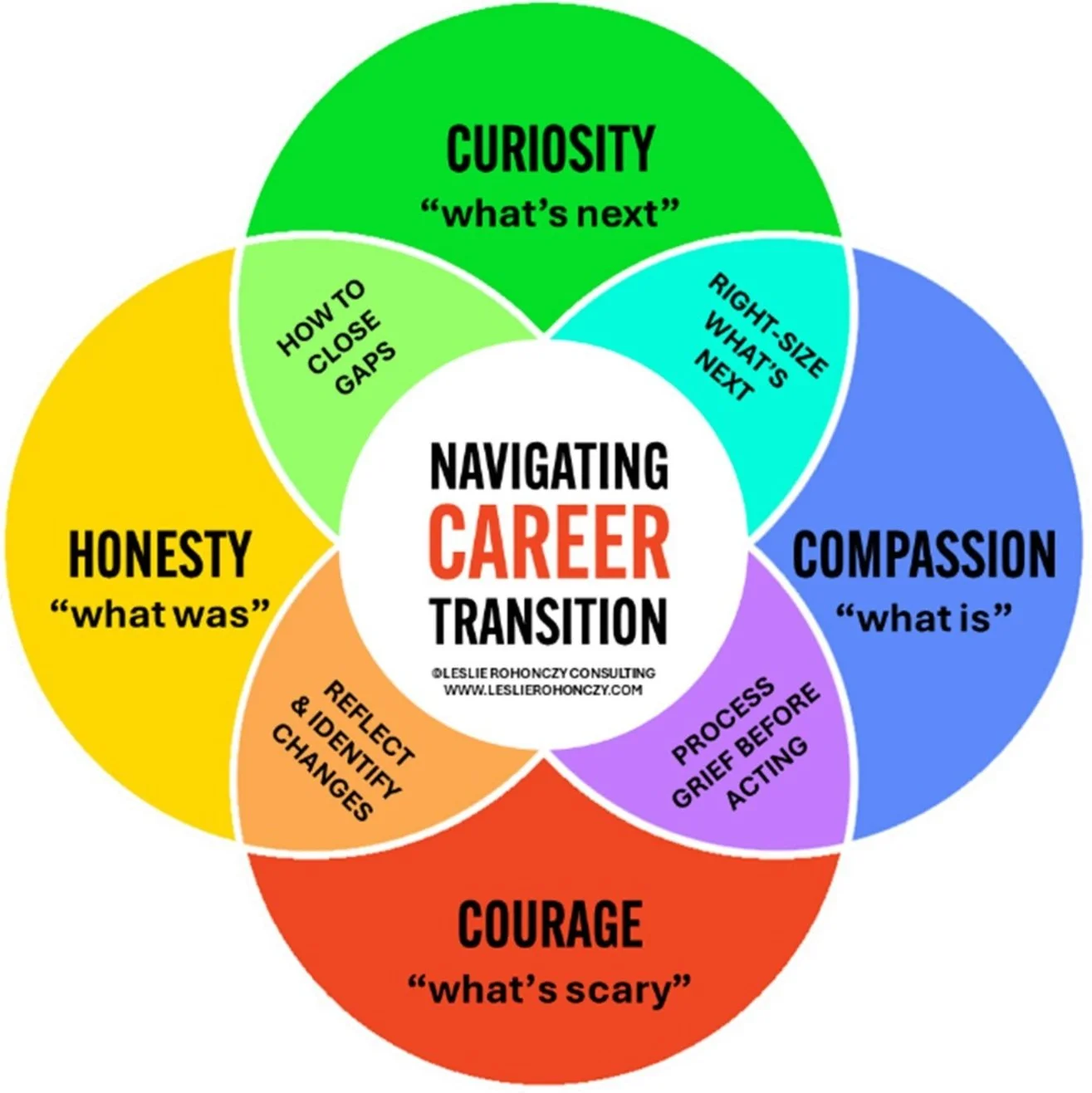
Career transitions are among the most challenging moments in our professional journey. Whether we’re stepping into a new role, considering a significant pivot, or facing the unexpected disruption of being let go, the emotional and practical demands can feel overwhelming. And on top of all that, the uncertainty of “what is,” the grief of “what was,” and the fear of “what’s scary” often collide, leaving us unsure how to move forward into “what’s next”.

This is why I created the Career Transition Model. Grounded in four core qualities – Curiosity, Compassion, Courage, and Honesty – this framework provides a structured, human-centered approach to navigating the complexities of career change. By focusing on each section of this model, we can transform a tumultuous experience into an opportunity for clarity, growth, and meaningful next steps.

Let’s explore the model in depth and uncover the benefits of focusing on each element in the transition.

1. COMPASSION: Accepting "What Is"

This is a tough time – it’s time to be gentle with yourself. When faced with career disruption, it’s natural to feel a range of emotions: grief, frustration, shame, or even anger. Compassion invites us to sit with these feelings without judgment. Instead of rushing to act or denying our emotions, this stage encourages us to:

• Acknowledge and honor what we’re feeling.

• Give ourselves the grace to process our grief or disappointment.

• Treat ourselves with the same kindness and understanding we would extend to a friend.

Compassion is about being present with our reality, no matter how uncomfortable it may feel. It’s the foundation for healing and ensures that our next steps come from a grounded and intentional place. Compassion creates space for emotional processing and clarity, reduces self-criticism, promotes self-acceptance, and prevents burnout by prioritizing emotional well-being.

2. HONESTY: Reflecting on "What Was"

Transitions are an opportunity to reflect on the past with clarity and honesty. This doesn’t mean dwelling on what went wrong, but rather assessing what worked and what didn’t in our previous role or career, so that we can identify limiting beliefs, behaviour patterns, strengths to be leveraged, and areas for growth to close gaps. It required us to ask ourselves tough but valuable questions like: “What lessons can I carry forward?” “What was I good at that I want to do more of?” “What gaps do I need to address?”

Honesty with ourselves – or what I like to call ‘accurate self-assessment’ – requires us to reflect on our past performance and engagement, so that we can move forward with a deeper understanding of what we need in order to thrive in our next chapter. This level of honestly with ourselves is a key step in the process because it promotes self-awareness and growth, provides clarity on what’s truly important to us, helps us identify gaps to be closed, and aligns our next steps with our values.

3. COURAGE: Facing "What’s Scary"

Fear often accompanies career transitions. The fear of failure, rejection, or making the wrong decision can feel paralyzing. Courage is about acknowledging our fears, leaning into them, and taking action that helps us overcome them. It’s about asking ourselves: “What am I afraid will happen?”, “What risks am I willing to take to move forward?” “What do I need to have / feel / believe in order to face this uncertainty with resilience?” “What’s one small step I can take today to address my biggest fear?”

Courage doesn’t mean eliminating fear; it means not letting fear dictate our choices. By taking small, intentional steps, we build momentum and confidence, even in the face of uncertainty. Acting with courage empowers us to take action despite our fear, builds resilience and confidence over time, and helps us confront challenges head-on, rather than avoiding them.

4. CURIOSITY: Exploring "What’s Next"

Curiosity invites us to lean into the unknown with a sense of openness and possibility. Rather than viewing this transition solely as a loss, curiosity encourages us to ask, “What opportunities might this open up for me?” “What have I always wanted to explore but haven’t had the chance to?” “What skills or passions can I leverage in new ways?”

This mindset shift allows us to see beyond the immediate turbulence and imagine our ideal state, and the potential of what could be. Curiosity is not about having all the answers – it’s about giving ourselves permission to wonder and explore, and cultivating the courage to dream without the pressure of immediate certainty. Maintaining our curiosity through this process encourages creative thinking and new possibilities, helps us shift from a reactive to a proactive mindset, and opens doors to opportunities we might not have considered before.

THE POWER OF INTEGRATION: The Intersections of the Model

Here’s where the Career Transition Model gets exciting: the intersections between these four qualities take us deeper, where meaningful action and transformation happen:

COMPASSION + COURAGE = Process your grief and other uncomfortable emotions before acting.

COURAGE + HONESTY = Self-reflect and identify the changes you want to make.

HONESTY + CURIOSITY = Consider how you will close the gaps you’ve identified, and what you’ll need in your next role.

CURIOSITY + COMPASSION = Combine expansive thinking with self-compassion as you dream boldly, and right-size what’s next.

WHY COACHING MATTERS DURING CAREER TRANSITIONS

It can be challenging to navigate career transitions alone. Working with an Executive Coach to help guide you in navigating the Career Transition Model can provide a deeply transformative, supportive, and human-centered program.

Executive coaching provides:

• A safe, judgment-free space to explore your emotions and aspirations.

• Tailored strategies and support to help you stay focused and grounded.

• Practical tools and accountability to move forward with confidence.

If you’re navigating a career transition, coaching can help turn uncertainty into clarity and fear into opportunity. Whether you’re an executive seeking career guidance, or an HR professional looking to support an exiting employee, this model and coaching approach can make a transformative difference.

Career transitions are rarely easy, but they don’t have to define us. By focusing on Curiosity, Compassion, Courage, and Honesty, we can navigate this time with resilience, intention, and hope. The Career Transition Model is a roadmap through the turbulence, helping you emerge stronger, wiser, and ready for what’s next.

If you’re ready to take the next step or want to offer meaningful support toy our team, let’s connect.

For more information on executive coaching or to explore how this model can support you or your team, contact me at www.leslierohonczy.com.

#CareerTransition #ExecutiveCoaching #LeadershipDevelopment #GrowthMindset #HRSupport


LOOK BACK TO MOVE FORWARD: 3 Steps to Define Your Year Ahead

by Leslie Rohonczy, Executive Coach, IMC, PCC | ©2024 | www.leslierohonczy.com

We’re approaching the end of November, and before you know it, this year will be over. If you’re like many executives and leaders I work with, the past eleven months have likely been a whirlwind of decisions, problem-solving, and strategic pivots.

Now, as the year draws to a close, this cacophony of demands are competing loudly for our attention: year-end deadlines, deliverables, and objectives, holiday plans, and a persistent pressure to think ahead. It can feel overwhelming, much like the relentless blanket of tinny holiday music playing everywhere this time of year.

It’s so easy to get lost in this din, but what if we took a powerful pause? What if we step back from the hustle of deliverables and the noise of social expectations, to reflect on the year we’ve just experienced? Reflection isn’t just a feel-good exercise; it’s a leadership tool that turns hindsight into insight. This single act of pausing to reflect could be a game-changer for the road ahead.

As high-performing leaders know that impactful forward momentum often starts with purposeful reflection. In my executive coaching practice, I encourage clients to conduct an annual ‘Year in Review’ practice. This process goes beyond tallying wins and losses; it’s a focused exploration of the intentions you set at the start of the year, the journey you’ve been on (both professionally and personally), the lessons learned from their experiences, and where they want to go in the future. It’s about uncovering patterns – positive and negative, identifying and challenging limiting beliefs, clarifying priorities, and laying the foundation for intentional growth.

The timing for this exercise is perfect. Starting your reflection in early December gives you the space to recalibrate before diving into the new year. So, let’s hit the pause button for a moment. Before you dive headfirst into planning what’s next, take a moment to ask yourself two critical questions: How did I get here? And where do I want to go next?

STEP 1: Reflect on Your Year

Think of your life as a book, with each year representing a new chapter. This is your opportunity to review the chapters that have already been written, to uncover recurring themes, to see how this year’s chapter fits into your overall story, and to decide how you want the next chapter to unfold.

Start by setting the stage for your review:

  • Find a quiet space where you won’t be interrupted.

  • Bring tools that help you capture your thoughts: a journal, digital notebook, or voice recorder app.

  • Set aside at least an hour for this process to ensure depth and focus.

Now, dive into these reflection prompts:

1. What worked?

Look back at the moments when you felt aligned, accomplished, brave, energized, or proud. What decisions, habits, or relationships contributed to those successes? One of my clients, am SVP at an insurance company, discovered that her most impactful projects came from effective delegation. Not only did this alleviate her capacity challenges, but it also created a career development opportunity for an up-and-coming Director. This insight became a catalyst for how they would revamp their talent development system the following year.

2. What didn’t work?

This isn’t about self-criticism—it’s about curiosity. What efforts didn’t pan out, and why? Where did things feel off-track? What unproductive or unintended results emerged? A client once shared how, through this reflection practice, he realized that at the beginning of every year, he would overcommit himself in Q1 by taking on too many projects that didn’t align with his long-term goals. Once he identified this pattern, it allowed him to shift his approach: he committed to saying “no” more often in the future, making the mental space for him to be more discerning with what he said “yes” to.

3. What surprised you?

It’s often the unexpected moments - both positive and challenging - that shape us the most. Did you navigate a crisis with grace and strength you didn’t know you had? Did you make spontaneous decisions that led to amazing outcomes? Were you surprised at what opportunities opened up as a result of trusting your instincts?

4. What will you leave behind?

Growth requires creating space for what truly matters, which often means letting go of what no longer serves you. Is it a limiting belief? An unproductive habit? Or perhaps a role or commitment that no longer aligns with your values? As you reflect, remember to think of your life as a book: How will you clear the page to write a meaningful next chapter?

STEP 2: Choosing Your Word of the Year

Once you’ve sifted through your reflections, it’s time to look ahead with clarity. One simple but profound way to focus your intentions is by choosing a Word of the Year.

This word acts as your North Star—a guiding principle that helps you make decisions, prioritize, and stay grounded in what matters most. It’s less about setting rigid goals and more about defining the energy, mindset, or intention you want to carry into the new year.

How to Choose Your Word

1. Look for themes in your reflection.

What patterns emerged from your review? If you noticed a need for better boundaries, perhaps your word is No. If your highlights revolved around creativity, your word might be Innovate. The CEO of a national manufacturing company told me about a bold experiment he tried last year: launching a pilot program to test same-day delivery in select locations. The program required cross-departmental collaboration, quick problem-solving, and innovative thinking - qualities he loved seeing in action. To his surprise, the program not only exceeded revenue projections but also revealed untapped talent and creativity within his team. He realized that these results were born from taking calculated risks and empowering his team to innovate. He set a clear intention for the next year: to prioritize initiatives that foster collaboration and bold experimentation. As a result, he intends to scale up the business next year while keeping his team engaged and motivated.

2. Think about your aspirations.

What would make 2025 feel successful - not just professionally, but personally as well? One client, a CFO balancing high stakes work with parenting, chose the word Presence to remind herself to stay engaged in the moment, whether at the office or the dinner table.

3. Make it personal and inspiring.

Avoid words that feel trendy or vague. Your word should resonate deeply with you. Once you’ve chosen your word, give it a place of honor. One of my clients wrote hers on the first page of her planner. Another set it as a weekly calendar reminder. And another created a colourful painting of her word to hang in her office. These small acts keep the intention front and center.

Here are a few examples of words and the themes they can represent. Remember that your word should be deeply meaningful to you, so if you don’t see one that really resonates for you, find a word that does.

  • Abundance: Focusing on opportunities, growth, creating a mindset of plenty rather than scarcity.

  • Alignment: Ensuring your actions, values, and goals are in harmony.

  • Authenticity: Leading with your true self, building trust, encouraging openness.

  • Balance: Managing work, life, and personal well-being with greater harmony.

  • Clarity: Clear vision, focused decision-making, and transparent communication.

  • Collaboration: Working more closely with others, creating synergies, building stronger teams.

  • Confidence: Strengthening self-belief, taking decisive action, trusting your judgment.

  • Connection: Building deeper relationships with your team, peers, clients, family.

  • Courage: Taking bold risks, making tough decisions, stepping out of your comfort zone.

  • Empowerment: Giving yourself and others the tools, authority, and confidence to take initiative.

  • Focus: Prioritizing what matters most, eliminating distractions, staying on track.

  • Freedom: Gaining autonomy in your decisions, actions, lifestyle choices.

  • Generosity: Giving more of your time, knowledge, or resources to support others.

  • Gratitude: Fostering appreciation for both big wins and small victories, finding joy in everyday moments.

  • Growth: Personal development, business expansion, learning, career development.

  • Impact: Making meaningful contributions, both professionally and personally, that leave a lasting legacy.

  • Inclusion: Fostering an environment where all voices are heard, valued, and respected, promoting diversity and equity in decision-making, ensuring equal opportunities for all.

  • Innovation: Introducing new ideas, processes, technologies that drive change.

  • Integrity: Staying true to your values, being authentic, holding yourself accountable.

  • Joy: Finding fulfillment and pleasure in both work and personal life.

  • Mastery: Committing to honing your skills, becoming an expert, excelling in your field.

  • Mindfulness: Staying present, reducing stress, cultivating awareness in every aspect of your life.

  • Patience: Cultivating the ability to wait, listen, allow things to unfold at their own pace.

  • Presence: Being fully engaged in the moment, enhancing focus, being mindful in your interactions.

  • Purpose: Deepening your understanding of what truly drives you and aligning your actions with your mission.

  • Resilience: Bouncing back from challenges, maintaining strength in tough times, staying adaptable.

  • Service: Helping others, adding value to your community, creating a positive influence.

  • Simplicity: Streamlining processes, reducing clutter, focusing on what truly matters.

  • Sustainability: Prioritizing long-term health, work-life balance, eco-friendly practices in your personal and professional life.

  • Transformation: Embracing change, personal reinvention, leading transformative projects or teams.

  • Vision: Creating a compelling future, setting ambitious goals, inspiring others.

STEP 3: Bridging Reflection and Action

Reflection and intention-setting are valuable on their own, but their true power lies in translating them into action. Here are a few ways to bring the process to life:

1. Turn your lessons into strategies: For example, if you noticed a pattern of over-committing, create a filter you can use for saying “yes” in the future. One of my clients asks herself, “Will this move me closer to, or further away from my vision?” before agreeing to new projects.

2. Anchor your word in your habits: Let’s say your word is Balance. What specific changes will help you live that word? Perhaps it’s blocking off time for self-care or limiting after-hours emails. Or looking for as many examples of balance in your life as you can find – what we go looking for, we usually find.

3. Share your word: Accountability is a game-changer. Share your word with a coach, mentor, trusted friend, or family member. One leader I worked with even shared hers with her entire team, framing it as a shared commitment to living the value of Transparency.

WHY THIS MATTERS

Leadership is about more than just driving results - it’s about intentional growth. Taking time for a Year in Review and choosing a Word of the Year isn’t just a reflective exercise; it’s a powerful leadership development practice.

When you understand where you’ve been and where you want to go, you can lead yourself - and others - with clarity, purpose, and confidence.

As the saying goes, “The best way to predict the future is to create it.” Before the December cacophony takes over, pause to reflect on your story so far, so you can be intentional about the next chapter you’re about to write.

YOUR TURN

Ready to give this a try? Schedule some reflection time before the new year. And when you’ve chosen your Word of the Year, I’d love to hear it, so message me!

Here’s to closing this year with insight, and to writing the next one with intention and greater awareness. Onward to your next great chapter!

THE TRUTH ABOUT SUCCESSFUL INTERVIEWS: 3 Messages from an Executive Coach

by Leslie Rohonczy, Executive Coach, IMC, PCC | ©2024 | www.leslierohonczy.com


In the realm of job interviews, there’s a common misconception that candidates must meticulously craft themselves into the ‘perfect’ mould, fitting every criterion outlined by the prospective employer.

 In fact, you may have heard about research[1] highlighted in a Forbes article, that found men exhibit confidence when they meet 60% of the criteria, whereas women typically wait until they've ticked off every item on the list. This means that men tend to apply for a job when they meet approximately 60% of the listed qualifications. In comparison, women often won’t even apply unless they fulfill 100% of the requirements. It's frequently interpreted as evidence of a confidence gap between genders. And prevailing and well-intentioned advice often focuses on encouraging women to cultivate greater self-confidence in their abilities.

 While striving to present the best version of ourselves is undoubtedly crucial during job searches, it's equally essential to remember that interviews are a two-way street, where compatibility, values, and mutual interest play pivotal roles.


Message 1: You're The Unicorn

As an executive coach, I often witness individuals grappling with nerves and insecurities as they prepare for the interview process. Their fears are typically that each of their imperfections (real or imagined) will be ferreted out and scrutinized under the interview microscope. But here’s the reality check: interviewers are not on a crusade to find your flaws; nor are they eagerly scouring your every word, ready to pounce on any misstep. In fact, they're fervently hoping that you are the elusive unicorn; that magical candidate who embodies the values, skills, and fit they’ve been seeking. Could that unicorn be you?

 How might this shift in perspective change the way you actually show up in an interview? Rather than tiptoeing cautiously, laden with self-doubt, and minimizing ourselves, what would be possible if we embraced the opportunity to let our authentic selves shine? Allowing this shift in perspective creates increased confidence, and that, coupled with genuine enthusiasm, can often outweigh an inauthentic, meticulously polished ‘persona’ delivering a rehearsed script. Remember, they invited you because they believe in your potential – now, it’s your chance to show them that their intuition was right.


Message 2: It's About You Too

When we find ourselves swirling in the fervent desire to impress, it's easy to overlook a crucial aspect: our own preferences, values, and aspirations. While the company assesses your suitability, it's equally important (if not more important) for you to gauge whether the role – and the company – aligns with your employer expectations, career goals, and personal values. Don’t settle for being a round peg in a square hole; instead, actively explore whether the company culture, growth opportunities, and job responsibilities resonate with your vision for your future self. And if you don’t have a vision for your future self, create one by reflecting on what kinds of things you’d like to do every day, the type of people you want to do those things with, the cultural elements you’d enjoy being part of, the development opportunities that will help you shine, and the meaning you want to derive from your daily contributions.

 There are free websites that use employee reviews to measure employers’ culture, leadership, values, pay and benefits, among other factors (eg: GlassDoor, ZipRecruiter, LinkedIn Job Search). And LinkedIn is a great way to search out and connect with individuals who work for the company you’re interested in. Invite them to chat about their employee experience, and what they enjoy most about working there. And based on the things you learn about the company’s culture and values, you can then determine whether this would be a long-term fit with your own needs and values. And if you decide to proceed to the interview stage, mention those individuals in your interview. It’s a great way to demonstrate that you’ve done your homework, and are motivated to join the team.


Message 3: Ten Questions

To facilitate this important exploration of fit, culture, and values, here are ten questions you can pose during interviews:

  1. Can you tell me about the company’s culture and values?

  2. How do the day-to-day responsibilities of this role link to the company’s vision and mission?

  3. What qualities do successful employees in this position typically possess?

  4. How does the company foster collaboration and teamwork?

  5. Can you share examples of recent projects or initiatives the team has undertaken?

  6. What opportunities for growth and advancement exist within the organization?

  7. How does the company support professional development and learning?

  8. What challenges and opportunities do you foresee for the team in the upcoming year?

  9. How does the company prioritize work-life balance and employee well-being?

  10. Can you describe the onboarding process for new hires?


By posing these questions, you not only gain valuable insights into the company but also demonstrate your proactive approach and commitment to making an informed decision.

 The art of interviewing transcends the mere presentation of skills and qualifications; it’s a nuanced dance between showcasing your potential and evaluating compatibility. So, step into the interview room with confidence, as their coveted unicorn, while also keeping a discerning eye on whether the role aligns with your aspirations. After all, the ultimate goal is not just to secure a job. You are about to embark on a fulfilling journey of career development, growth and self-discovery.


[1] Original research from Hewlett Packard, as shared in Lean In, The Confidence Code, Forbes, Harvard Business Review, and numerous articles, 2014.

WOOHOO CAREER MOMENTS: Embracing the Power of Courage

 by Leslie Rohonczy, Executive Coach, IMC, PCC | ©2024 | www.leslierohonczy.com


Last week, two coaching conversations left me cheering with joy, and celebrating the courage and determination of two remarkable individuals.

As an executive coach, I have the privilege of witnessing the leadership development journeys of clients who find themselves at a crossroads, wondering how to advance their careers or navigate difficult work environments. And whether they’re looking for strategies to get promoted, or for ways to protect themselves in a toxic culture (or for help in making the difficult decision to leave), the journey towards career fulfillment demands courage.

Recently, I had the pleasure of celebrating with a coaching client who, after months of deep dives into leadership EQ and coaching, bravely addressed a gap identified by her leader. At the beginning of our coaching session, she proudly announced that she had gotten the promotion to a leadership role she’d been working so hard for! I was so excited, a resounding "WOOHOO!" flew out of my mouth!

That same afternoon, I had a very different conversation. It was a heartfelt coaching chat with a senior leader, who shared that she’d finally found the courage to leave her toxic work environment. She spoke with such brave resolve about her pivotal decision, and I was truly inspired by her. And, you guessed it, another resounding "WOOHOO!"

To be clear, I’m not a habitual “WOOHOO-er”. But I had the same reaction to these two very different situations because I was so thrilled by their courage.

Coaching clients invest in their own growth and development with the willingness to take a courageous look at their gaps, assumptions, aspirations, strengths, and shortcomings. They embrace and explore the gift of feedback. They identify and work hard for what they most want from their career. They set boundaries, and then enforce them when those boundaries are crossed. They bravely make a change when opportunity comes calling their name. And they make empowering decisions like these two examples, putting themselves well on the path to healthier, fulfilling, personal and professional growth opportunities!


Unlocking Your "WOOHOO" Moment:

There will be many triumphs, rough patches, and transformations throughout our careers, and no matter whether we’re trying to secure a long-awaited promotion, or to navigate a change in pursuit of greater fulfillment, our courage and resilience will be the cornerstones of our success.

Through personalized guidance and support, coaching programs are tailored to address individual unique needs, personalities, and aspirations. Imagine what might be possible for you if you invested in honing your essential leadership skills, growing your emotional intelligence, and mastering the art of effective communication. From cultivating resilience in the face of adversity to fostering a growth mindset that fuels innovation, coaching equips you with the tools and mindset to overcome obstacles and seize opportunities. By investing in executive coaching, you are investing in your future success, unlocking new possibilities for advancement, fulfillment, and leadership excellence.

If you’re navigating a career decision, or coaching someone who is, here are 5 aspects of the career journey with questions to help you reflect on your own courageous career aspirations (hot tip for leaders: you can use these questions to coach your employees during career development discussions):

1.      DEFINE CAREER SUCCESS

  • What is your definition of ‘career success’? How does this definition support you? And how might it limit you?

  • Imagine your ideal work environment where you feel most fulfilled and energized. What values and culture would it embody, and how does this differ from your current situation?

  • Reflect on the values, priorities, and culture dynamics in your current workplace. How do they align with your personal values, priorities, and working style preferences?

2.      ADDRESS GAPS

  • What feedback have you received in your current role about an area for growth or improvement?

  • How are you leveraging this feedback to propel your career forward?

  • What strengths do you possess that can help you address your gaps, and how will you leverage them?

3.      DECISION-MAKING

  • If you’re facing a challenging career decision, what factors are influencing your choice?

  • What outcomes are you hoping to achieve?

  • What decision would your ‘head’ make? Your ‘heart’? Your ‘gut’? How does each perspective inform or influence your decision?

4.      TAKING ACTION

  • What would you do if you felt more ‘brave’? What’s holding you back from doing that?

  • What do you need to see/hear/feel/do, in order to take more courageous action? What steps can you take today, this week, and this month?

  • Who could help you build the professional skills and experience you need, including stretch assignments or additional training opportunities?

  • Reflecting on your long-term career aspirations, how can you align your actions today with your future goals?

5.      COURAGEOUS MINDSET

  • Considering the importance of a courageous mindset in career choices, when navigating career decisions and transitions, how will you cultivate and maintain your resilience in the face of uncertainty or setbacks?

  • What personal reward will you give yourself for your bravery?

  • What self-compassion messages will you give yourself when you feel uncomfortable, or when things don’t go the way you hoped they would?


If you want to pursue your own ‘WOOHOO” career moment, visit www.leslierohonczy.com to learn more about how my executive coaching and leadership development services can help propel you towards success.

MASTER YOUR CAREER SEARCH WITH 8 POWERFUL QUESTIONS

by Leslie Rohonczy, Executive Coach, IMC, PCC | ©2024 | www.leslierohonczy.com

In the fast-paced and competitive landscape of the current job market, standing out from the crowd is crucial. Here’s a powerful coaching practice that can give your career search the edge it needs.

Let’s explore career searching from four different perspectives, each represented by the Integral Theory quadrants. Grab your pen and journal, and spend some quality time with yourself, reflecting on the following powerful questions, as you embark on a journey of self-discovery and strategic planning.

VALUES-DRIVEN PURPOSE

This first quadrant focuses on what’s ‘inside you’: your sense of purpose, the values that you hold firmly, and your unique perspective on yourself and the world around you. Delving into your internal values and understanding the driving forces behind your career aspirations can provide a solid foundation. By aligning your career goals with your values, you'll not only find more fulfillment, but you’ll also present a genuine and authentic version of yourself to potential employers. From this values perspective, take a moment to ponder:

  1. What personal core values drive my career aspirations?

  2. What specifically draws me to a target role or company?


PEOPLE & RELATIONSHIPS

Building meaningful connections is a key aspect of any successful career search. Identifying and overcoming barriers to networking while strategically leveraging your existing support network can open doors to opportunities you may not have considered. With the relationships perspective in mind, answer these thought-provoking questions:

  1. What limiting beliefs, opinions, or feelings about networking can typically hold me back from reaching out to others?

  2. How might I leverage my biggest fans differently in my job search?


SYSTEMS & DETAILS

Having an efficient, organized process, an effective strategy, and tools to measure progress are all essential components of a successful career search. Assessing and adapting your approach based on measurable metrics can enhance your effectiveness, ensuring that your efforts yield tangible results. thinking about your formal and informal systems, reflect on:

  1. What do I need to adapt to be more efficient, targeted, or proactive in my networking, applications, and follow-ups?

  2. How will I measure the effectiveness of my career efforts?


ACTIONS & DOING

Finally, let's explore the 'Action' quadrant. Setting clear goals and taking actionable steps is the cornerstone of any successful career journey. By breaking down your goals into manageable actions and timelines, you'll create a roadmap for success and maintain momentum throughout your search. Reflect on your action orientation, and how you’re getting into action, with these questions:

  1. What career goals and targets have you set for yourself?

  2. What specific actions do you need to take today? This week? This month?


Exploring these eight reflection questions provides a holistic approach to your career search, helping you be more able to articulate your values, build relationships, create effective systems, and take strategic actions.

Wishing you great success in your career search – may your path be fulfilling and prosperous!

PERSONAL MOTIVATION FOR LEADERSHIP

by Leslie Rohonczy, Executive Coach, IMC, PCC | ©2024 | www.leslierohonczy.com

PRACTICE OBJECTIVE

To explore your personal motivation for seeking a leadership position;

To acknowledge and grow awareness of the strengths and limitations these motivations may represent in this next career move.


OVERVIEW

Why do you want this leadership role? You may be considering a career move from individual contribution into a leadership role. Or you may already be a leader who wants to advance to the next level of leadership in your career. You have the ambition and drive but may not be aware of what’s driving this striving. It may be helpful to understand your motivations at a deeper level.


When asked why they want to become a leader (or VP, executive, or board member), most people give one of two standard answers: “I want to make a difference’ or, ‘I want to help people grow and succeed’. Both of these are honorable and admirable intentions, of course. And they’re also table stakes: the ‘must-have’ essentials of leadership. But what about YOU? What is it that you want for yourself from this new leadership role? It’s equally important to know your own personal motivations before you take on a leadership role.


INSTRUCTIONS

This coaching practice will help you understand the underlying motivations, and what might help you be successful at that new level. Grab your journal and complete the following statements – but

here’s the catch: you must answer them from your OWN perspective, NOT on behalf of someone else.

“When I’m a leader…  I’ll feel…

  I’ll be…

  I’ll get…

  I’ll know…

  I’ll believe…

  I’ll do…

  I’ll see myself…


REFLECTION QUESTIONS

  1. What theme(s) do you notice about your statements?

  2. How might each theme show up in you as you strive for this leadership role (how they might support you, or how they may get in your way)?

  3. What will you adjust in order to be successful in this new role (eg: grow EQ awareness, build specific skills, dial up or down certain behaviours, challenge limiting beliefs)?

WHAT'S YOUR PLAN??

BUILDING YOUR CAREER PATH

by Leslie Rohonczy, Executive Coach, IMC, PCC | ©2023 | www.leslierohonczy.com

Taking ownership of our career means setting a clear vision, unpacking our true motivation for that vision, developing a plan that we can work daily, periodically looking at progress against our goals and adjusting, staying resilient and committed, and seeking support and advice from trusted mentors who are further along the path that we want to travel. 

There’s a famous quote from Albert Einstein that says, “Strive not to be a success, but rather to be of value.” I like this quote because it speaks to the mindset shift that is required away from the self-orientation of “What can I get for myself” (more money, better perks, fancy title, etc.) to thinking about the value that we can bring to the organization that will pay our salary. Our motivation in seeking career development is the key that either can unlock our success or keep us locked in our current holding patterns.

If you’re looking to find more motivation or inspiration for your career development, think about why you wanted your current job in the first place. What attracted you most to it? What are you losing out on if you stay in this role? You might also experiment with setting some new goals and looking at what potential benefits they may bring you. As you ideate, try to stay positive, without allowing any “yabut” thinking in to stink up your vision (“yeah, but…I’m not good at public speaking”, “yeah, but…it’ll take too long to figure out”, “yeah, but…I tried something similar ten years ago and failed.”)

As James Clear said in his best-selling book Atomic Habits, “you do not rise to the level of your goals; you fall to the level of your systems.” In the career context, our goal is the desired outcome, and the system is the collection of actions and daily habits we use to make it happen. Here are a few ideas to get you started.

  • DREAM IT: picture yourself in this ideal future state: how will you behave, talk, dress, sit? What kinds of things will you be doing every day? What people or systems will you interact with? What personal values will guide you through your day?

  • LOOK BACK: what kind of work did you find most satisfying and why? What past experiences or training do you consider to be strengths? What kind of work made you unhappy in the past? Who has been helpful to you and how?

  • LOOK NOW: what value, impact, experience, or skills do you offer? What gives you the most satisfaction in your current role? What would you like more of, or less of, in your role?

  • LOOK AHEAD: What do you hope to learn? What is in your way of attaining this future state? How will you navigate the barriers in your way? What is already in place to help you?

  • NAME YOUR GOAL: say it out loud. Write it down. Get used to letting it roll off your tongue. Tell others.

  • SCALE YOUR GOAL: big dreams are great, but don’t forget to set realistic sub-goals to help you get there.

  • LEVERAGE YOUR NETWORK: ask a friend, your leader, or another colleague to introduce you to people who can help you move closer to your career goal. Find a mentor. Hire a coach.

  • EXPLORE MULTIPLE CHANNELS: there are many ways to connect with others. Book a career discussion with your Human Resources advisor. Send your resume and cover letter to a recruiter in a target organization. Be brave and leverage unplanned opportunities, like bumping into someone at the coffee shop, or asking a peer for feedback after your presentation.

  • MAKE IT A HABIT: how will you hold yourself accountable for taking small steps every day toward your ideal career? How will you reward yourself for this consistent effort? How could you be even bolder?

  • TRACK YOUR PROGRESS: what criteria or measurable milestones will you use to know you’re moving in the right direction? What adjustments do you need to make? What will you most need to hear when the going gets tough?


Leslie Rohonczy is a certified Integral Master Coach™ who brings more than 30 years of business & leadership experience to her coaching practice. Leslie is also a talented composer, recording artist, and vocal & performance coach. Leslie’s coaching informs her music, and her coaching-inspired music helps to enrich her coaching program design. Leslie has released seven original albums containing coaching-inspired music and lyrics, that are featured in Leslie’s book, Coaching Life: Navigating Life’s Most Common Coaching Topics, available on https://www.amazon.ca/dp/B0BXN7F5TZ