HOW WE EVOLVE

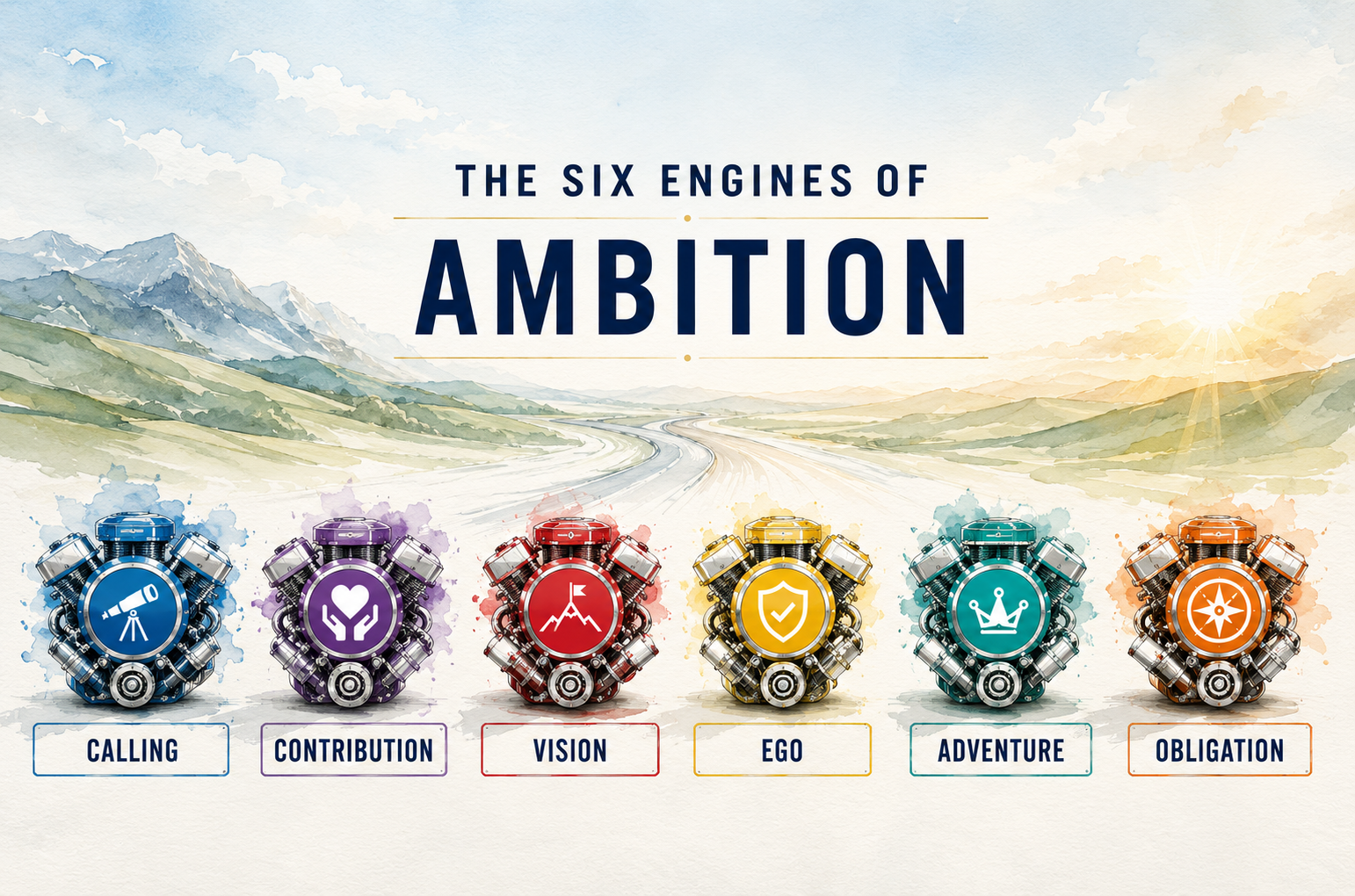
THE SIX ENGINES OF AMBITION: Do You Know Your Ambition Profile?

by Leslie Rohonczy, IMC, PCC, Executive Coach & Author

(LISTEN TO NARRATED AUDIOARTICLE VERSION)

If you're like most ambitious leaders, you probably know where you want to go. And also like many leaders, you may never have stopped to ask yourself what's pulling you there.

Promotion conversations usually revolve around readiness. Do you have the experience? Have you demonstrated executive presence? Can you think strategically? Are you ready to lead at the next level? These are important questions, and organizations should absolutely be asking them. They're just not the questions that intrigue me most.

When a client tells me they're hoping to become a Vice President, a C-suite executive, or even to make the move into their first leadership role, I'm curious about something else: "What is it about that role that's so appealing to you?"

At first, the answer is usually broad, and typically, "I want to make a difference." It's a perfectly reasonable answer. It just isn't the whole answer.

As we continue the conversation, something fascinating almost always emerges. Two leaders can be pursuing the same promotion for completely different reasons. One is captivated by the opportunity to shape the organization's future. Another lights up when talking about developing people. A third is excited by the challenge of operating at a completely different level. Someone else feels a responsibility to step forward because they know they can help. From the outside, they appear to be travelling the same road. Under the hood, though, they're powered by very different engines.

After seeing this pattern again and again over the years, I began sketching what eventually became the Six Engines of Ambition model. These engines represent the motivations that create the horsepower behind our ambition. We all have all six within us, but each contributes a different amount of power. That mix is unique to each person, and it often shifts as our careers evolve.

Before reading further, resist the temptation to decide which engine you are. That's a bit like asking which instrument matters most in an orchestra. Almost nobody is powered by a single engine. Instead, notice which descriptions resonate most strongly with you. You're not looking for one answer; you're discovering the mix of engines in your profile.

Calling is the engine of purpose. If this is one of your strongest engines, the organization's mission matters deeply to you. You're less attracted to leadership itself than to the opportunity to advance something you genuinely believe deserves your energy. Ask yourself what excites you most about the next promotion. If your answer begins with the organization's purpose rather than your own career, then your Calling Engine is probably doing a lot of the work. Its shadow appears when the mission becomes so intertwined with your identity that disagreement starts feeling personal.

Contribution is the engine of service. These leaders gain enormous satisfaction from making other people's lives better. They enjoy coaching, mentoring, removing obstacles, and creating environments where others can thrive. They're often the people who leave a meeting thinking less about how they performed and more about whether everyone else left feeling heard, supported, or inspired. Their shadow is over-functioning. Helping gradually becomes rescuing, and before long, they're carrying responsibilities that belong to someone else.

Vision is fueled by possibility. These leaders naturally look over the horizon. They become energized imagining what the organization could become three, five or ten years from now. They enjoy building, transforming, and creating. If you find yourself becoming impatient with conversations that never seem to move beyond today's operational issues, the Vision Engine may be one of your dominant drivers. Its shadow appears when tomorrow becomes so exciting that today starts feeling like an inconvenience.

Adventure is the engine of growth. Some people see uncertainty and instinctively think, that sounds interesting. New challenges, unfamiliar situations, and bigger problems energize them rather than intimidate them. Every promotion is another chance to discover what they're capable of. Their shadow appears when climbing becomes more rewarding than contributing, leaving them constantly searching for the next mountain before fully appreciating the one they're already standing on.

Obligation is fueled by responsibility. I've coached many leaders who never set out to become senior executives. They simply looked around, saw a need, and concluded that someone had to step forward. They care deeply about doing the right thing and are often the people organizations depend on during difficult times. If you've ever caught yourself thinking, If I don't do this, who will?, there's a good chance the Obligation Engine is one of your strongest drivers. Its shadow is becoming indispensable. Delegation becomes difficult because being the dependable one has become part of your identity.

Ego is the engine most people are reluctant to acknowledge. There is often a degree of shame attached to admitting it's one of our drivers because we associate ego with being egotistical or self-aggrandizing. I don't believe that's true. Recognition matters. Achievement matters. Titles matter. Human beings have always cared about status, and healthy ambition has fueled extraordinary careers. There's nothing inherently wrong with wanting to accomplish something significant or being proud when others recognize your contribution. The shadow appears only when the title becomes more important than the work, or when your sense of self becomes defined by the title on your business card.

One of the things I find most fascinating is that these engines rarely stay in the same proportions throughout a career. I coached a newly promoted manager early in my coaching career. About fifteen years later he called me again because he was trying to decide whether to pursue an executive role. On paper, it looked like the obvious next step. He had the experience, the credibility, and the support of his organization. Yet something just didn't feel quite right.

As we explored what was creating the hesitation, he said, "I don't actually want the title. I want the chance to shape where we're going." That moment changed the conversation. Until then, he believed he was pursuing a promotion. What he eventually discovered was that, unlike fifteen years earlier, he was now being driven by the Vision Engine. Once he understood that, he also realized there were several ways to influence the organization's future, only one of which involved the executive role he'd been focused on.

I've watched similar discoveries unfold many times. Leaders realize they've been driven primarily by the Contribution Engine without ever recognizing it. Others discover that their Obligation Engine has been making career decisions for years. Some come to appreciate their Ego Engine for giving them the confidence to pursue opportunities they might otherwise have avoided, while realizing it no longer needed to be their dominant engine. The engines themselves aren't the problem. The problem is allowing them to operate without ever noticing which one is doing most of the driving.

The goal isn't simply to identify your ambition engine; it's to understand your Ambition Profile. Once you do, career decisions become clearer, and you begin recognizing why certain opportunities immediately excite you while others, despite offering more money or prestige, leave you feeling meh. That's when you stop measuring your ambition against someone else's and begin making choices that are genuinely aligned with your own motivations.

Your next promotion may change your title. But understanding your Ambition Profile may change your career.


YOUR COACHING CHALLENGE

BUILD YOUR AMBITION PROFILE: Spend some time with the Six Ambition Engines definitions above, and estimate your current profile by assigning a percentage to each one. You may have a sense of your strongest, and your weakest engines – fill those in first. Don't answer based on who you aspire to become. Base your answers on the choices you've consistently made in your career. Your total should equal 100%.

  • Calling: _____%

  • Contribution: _____%

  • Vision: _____%

  • Adventure: _____%

  • Obligation: _____%

  • Ego: _____%

Now ask yourself three questions:

  1. Which ambition engine has generated most of the horsepower that got me where I am today?

  2. Which engine may be revving higher than it should be?

  3. Over the next five years, which engine do I want fueling this next chapter?

Your answers may reinforce the career path you're already on, or they may point you in an entirely different direction. Either way, you'll gain insights into yourself that many ambitious leaders never stop to examine.


HOW OLD IS THE PERSON STEERING YOUR CAREER? Your Destination Was Chosen by Someone Who No Longer Exists

Leslie Rohonczy, IMC, PCC, Executive Coach & Author

 (LISTEN TO NARRATED AUDIOARTICLE VERSION)

The first few years of my adult life were the striving years. Striving to make ends meet, striving to get noticed in my career, among a sea of other young professionals who always seemed to be better at standing out from the crowd than I was; striving for a promotion to the next level, without ever really asking myself why a title was my end game; striving to feel my own worth, when I didn’t feel at all worthy.

And when I finally got that hard-fought promotion, and found myself in that shitty little clapboard office in the middle of the advertising department at our local newspaper, I had a sphincter-shifting moment of clarity: “Was THIS what I had been working so long and hard for? This office with no window and no purpose? How could all of my striving, motivation, blood, sweat, and tears really have been about THIS?!”

That experience, and that question, changed my career. The promotion was exactly what I'd wanted, which was precisely the problem. I'd spent years chasing a destination chosen by a version of me who no longer existed.

At the time, I couldn't have explained what was happening. I just knew something felt profoundly off. Looking back now, I realize it was the first time I'd noticed that somewhere between the striving and the arriving, it was me that had changed, not the destination.

That experience isn't unique to me. I've heard versions of this experience in many of my executive coaching conversations. The offices are usually much nicer than mine was, and the titles on the business card are more impressive, but eventually the same uncomfortable question appears: Now what? Or sometimes: Is this really all there is?

Life reshapes us while we are busy building our careers. The destination we chose at twenty-eight no longer fits the person we've become at forty-eight, but we may not see it if we don't pause long enough to notice the mismatch.

A few weeks ago, I found myself watching a YouTube video of a single sculler crossing a perfectly calm lake. There was something mesmerizing about how the boat cut through the glassy water. Every stroke looked powerful yet effortless, as it glided across the water with absolute purpose.

I find rowing kind of a strange way to travel. The boat moves confidently forward while the rower faces the opposite direction. Rowers can clearly see where they've been. They can study the wake they've left behind, and can appreciate every kilometer they've already travelled. The one thing they can't actually see is where they're going.

Hey, that also describes many leadership careers! Early in our careers we choose a direction that makes complete sense at the time. We pursue promotions, bigger teams with more span of control, financial security, influence, recognition, and the opportunity to prove ourselves. We want to make our parents proud, build something meaningful, provide for our families, or finally settle that relentless inner voice insisting we're still not enough.

There is nothing wrong with any of those motivations. In fact, they often provide exactly the fuel we need during those demanding early years. But life has a habit of changing us while we're busy rowing.

Successes often turn out to be less satisfying than we imagined. We experience illness, burnout, unexpected opportunities, disappointments, and moments of clarity we never saw coming. And over time, our definition of success begins to evolve. Status starts giving way to significance. Recognition becomes less important than contribution. Freedom matters more than prestige.

The person holding the oars today isn't the same person who first climbed into the boat and set the direction. Yet many of us continue rowing toward the same destination simply because that's where we pointed the boat years ago.

One of my favourite coaching questions catches people completely off guard: How old is the person currently steering your career?

Sometimes it's the twenty-five-year-old you who's desperate to prove she belongs. Or the young father determined to build financial security for his new family. Sometimes it's the ambitious new executive convinced that one more promotion will finally deliver the satisfaction they've been chasing.

That younger version of ourselves deserves enormous respect. They worked hard, took risks, made sacrifices, and created opportunities that today's version of us benefits from every single day. But they couldn't possibly have known who we would become. They didn't know which experiences would shape us, what losses we would endure, what relationships would change us, or how dramatically our understanding of a meaningful life would evolve.

So why are they still deciding where we're headed?

I think this is where many can get stuck. It might feel like lost ambition after decades of investment and building up our expertise, relationships, credibility, and identity. Changing direction can begin to feel like admitting those investments were mistakes. They weren't. They just brought us to the place where we're finally experienced enough to ask a better question.

Instead of asking, “Can I get there?” the question becomes, “Do I still want 'there'?”

That may be one of the hardest career questions we'll ever ask ourselves because the answer often asks us to loosen our grip on a destination we've carried for years; one that feels like our encoded mission, because we've been chasing it so long.

One of the greatest gifts coaching has ever given me is permission to pause before pushing forward. We're conditioned to believe that success comes from rowing harder. Sometimes it does. But sometimes, the wisest thing a rower can do is lift the oars from the water, let the boat glide, and take some time to turn around and really study their trajectory.

Only then can you answer the question, "does this destination still belong to the person I am today?" I encourage leaders to ask themselves uncomfortable questions as part of the process. Questions like, "If you were choosing your career today, would you choose the same destination?" "Which ambitions genuinely belong to you, and which belong to a younger version of yourself?" "What are you continuing simply because you've already invested so much?" "What gives you energy today that barely mattered ten years ago?" "If nobody else's expectations mattered, where would you point the boat?"

Sometimes the answers are deeply reassuring. You discover you're exactly where you're meant to be, and you begin rowing again with conviction because your destination has been consciously chosen by the person you are today, and not inherited from someone you used to be.

Other times the answers lead somewhere entirely different: a new awareness, a different role, a revised definition of success, a shift in priorities, or a career that finally reflects the person you've become instead of the person you once were.

Neither outcome means your younger self got it wrong. That version of you did exactly what they were supposed to do: they got you this far. But at some point, every leader deserves to ask a simple question: Who is this person holding the oars now?

The younger version of you chose a destination with the wisdom they had at the time. You don't owe them blind obedience. You owe them gratitude.

Now it's your turn to decide where the boat goes next.


YOUR COACHING CHALLENGE

This week, spend ten uninterrupted minutes with a blank sheet of paper. Across the top, write this question: How old is the person currently steering my career?

Don't answer it too quickly. Think about the ambitions you're pursuing right now, the goals you're sacrificing for, the opportunities you're saying yes to, and the ones you're turning down.

Then ask yourself: If I were starting my career today, with everything I've learned about myself over the past twenty years, would I still choose this destination?

If the answer is yes, you've just reaffirmed that you're rowing with purpose. If the answer is no, don't panic. You don't have to change direction tomorrow. You simply need to acknowledge that the person holding the oars today deserves a voice in deciding where your boat goes next.

LEADERSHIP ALTITUDE: Are You a Helicopter, Jet, or Starship?

(LISTEN TO NARRATED AUDIOARTICLE VERSION)

I talk a lot about altitude with my executive coaching clients. One conversation in particular was with a senior leader who sat down across from me and said, "I'm working ridiculous hours, I'm constantly busy, and yet it feels like I'm falling further behind every week."

What struck me wasn't the workload itself, but the contradiction. Things were ticking along well, her team was delivering, and her dashboard showed everything was under control. But she spent most of her days bouncing from issue to issue, rarely finishing what she had planned to accomplish before the next urgent matter popped up. Because she was dependable and responsive, decisions, problems, requests, and approvals continually found their way to her. And every day, she felt like she was climbing up the down escalator.

As we unpacked her reality, we noticed a pattern emerging. There was a common thread at play: decisions flowed through her; problems landed on her desk; questions had to be answered by her. Her team depended on her for direction, approvals, information, and problem-solving, leaving her days consumed by operational details, responding to issues, and helping people navigate obstacles.

Of course, these are all important activities, to be sure. It might be tempting to think that she was not delegating well, or that she was a workaholic, but the real issue turned out to be her leadership altitude. She was spending most of her time operating at a Manager altitude, instead of the more strategic Vice-President altitude. In essence, she hadn't adjusted her altitude with her new responsibilities and span of control. That conversation stayed with me because I've seen countless versions of it throughout my years of executive coaching: leaders unaware they are flying at the wrong altitude.


THE ALTITUDE GAP

One of the most common, and most challenging, leadership transitions a leader can make is the shift from managing day-to-day operations and individual contributors, to leading other leaders, systems, functions, and strategy.

As leaders move through organizations, the horizon line they're responsible for monitoring expands. They become accountable for larger systems, more people, greater complexity, and decisions whose consequences may not appear for years. But many leaders continue operating at the altitude that made them successful in their previous role.

The behaviours that help someone become an outstanding Supervisor differ from those required to become an outstanding Director. The strengths that help someone succeed as a Director may eventually become limitations as they move into Vice-President, Executive, and C-suite leadership. That's why so many talented leaders feel overwhelmed. They're trying to lead a large organization while spending most of their time solving low-altitude problems.

Over the years, I've developed metaphors for leadership using three aircraft: the Helicopter, the Jet, and the Starship. Each operates at a different altitude and provides a different perspective. And each becomes increasingly important as a leader's scope of responsibility expands.


THE HELICOPTER

Imagine your leadership as a helicopter hovering a few hundred feet above the ground. You're no longer standing in the middle of the action, but you're still close enough to see what's happening on the ground. You can spot bottlenecks, notice tension between teams, identify missed handoffs, and observe where work is getting stuck.

This is the altitude of operational leadership, where leaders coach people, remove obstacles, allocate resources, clarify priorities, and help teams navigate challenges. Helicopter altitude keeps leaders connected to reality because they can still see the work as it unfolds.

Most of us spend a significant portion of our early leadership careers here. Supervisors, Managers, Team Leads, Project Managers, and frontline leaders often need to operate predominantly at this altitude because their success depends on helping people execute effectively to produce results.

The challenge is that Helicopter altitude feels productive. You can see a problem and solve it. You can answer a question and help someone move forward. You can remove a roadblock and watch progress happen almost immediately. The feedback is instant, and that sense of usefulness can become habitual.

Over time, some leaders become so accustomed to solving problems that they unknowingly train everyone around them to bring problems to them. Decisions, accountability, and responsibility all begin to migrate upward. And before long, the leader knows everything that's happening this week and very little about what needs to happen three months or three years from now.

I've worked with executives whose calendars looked like emergency dispatch units. Every issue found its way to them, minor conflicts required their involvement, and difficult decision somehow became their responsibility. They were admired, trusted, hardworking... and exhausted.


THE JET

As leaders move into larger and more complex roles, another shift begins to happen. The work itself becomes less visible. At first, it can feel uncomfortable, especially if you've built their careers on being knowledgeable, responsive, and closely connected to the work. Climbing higher often means giving up some of that visibility.

A Director overseeing six teams can't possibly keep track of every conversation, customer issue, project challenge, or interpersonal conflict occurring across their organization. And a Vice-President, responsible for several other leaders, hundreds of employees, and complex organizations, certainly can't.

What emerges in its place is something different: noticing patterns. Instead of seeing a single employee struggling, leaders begin noticing recurring turnover across a department. Instead of focusing on one delayed project, they begin recognizing a resource allocation issue affecting multiple teams. Individual events still matter, but they become clues pointing toward something larger, rather than signals to jump into action and solve them.

This is Jet altitude. The horizon expands dramatically. Details become harder to see (as they must), but the broader landscape becomes clearer. Leaders begin examining how departments interact, where priorities collide, what external conditions will likely impact their business, how information flows through the organization, and which systems are producing the outcomes they see.

The questions change as well. Rather than asking, "How do we solve this problem?" leaders begin asking, "Why does this problem keep appearing?" Rather than focusing on individual performance, they start paying attention to the systems and structure, processes, communication channels, incentives, governance, and culture.

Many leaders arrive at positions that require Jet altitude long before they become comfortable operating there. They continue solving issues one at a time, when the real opportunity is to improve the system creating those issues in the first place.

Jet altitude comes with its own traps, however. Leaders can become so fascinated by the system of strategy, frameworks, organizational design, and planning that they lose touch with the people living inside it. Most of us have experienced a strategic initiative that looked brilliant in a boardroom and bewildering everywhere else. Reality has a way of exposing details that weren't visible from 40,000 feet.


THE STARSHIP

The further leaders advance, the more another question begins to emerge. The focus shifts from "What's happening?" and "Why is it happening?" to a different question altogether: "What will happen next?" This is where Starship altitude becomes necessary.

Imagine looking back at Earth from space. Cities fade from view. Roads become invisible. Eventually, even national borders lose their meaning. Our perspective changes completely.

At Starship altitude, we stop focusing primarily on operations and organizational systems. Our attention shifts toward forces that may shape the organization for years, and sometimes decades, into the future.

We begin asking different kinds of questions: What technological shifts are reshaping the industry? How will demographics change the workforce? What customer expectations are emerging? What assumptions do we hold today that future leaders may laugh at? What must this organization become if it hopes to remain relevant ten or twenty years from now?

This is the altitude of enterprise leadership. It's where leaders wrestle with the big, bold questions of purpose, direction, positioning, legacy, and long-term relevance. They are less concerned with certainty, and more with understanding what version of the future may be emerging and how today's decisions might improve the organization's chances of thriving within them.

Starship altitude is partly about learning to notice what others overlook. Tomorrow rarely arrives all at once. The clues are usually visible long before the disruption becomes obvious, but they can be easy to miss when your attention is consumed by today's challenges.

Starship altitude has risks of its own. We've all encountered leaders who seem permanently stationed in orbit. They speak passionately about the next decade while their teams are struggling with problems that have existed for the last two years. Their vision may be compelling, but their connection to present-day reality becomes increasingly thin.

Organizations need leaders who can imagine the future, but they also need leaders who understand the realities of today.


WHEN SUCCESS BECOMES A LIABILITY

Promotions can create an unexpected problem: the behaviours that helped us earn a promotion to the next level of leadership frequently become the very behaviours that limit us afterwards.

The Manager who built a reputation for being responsive becomes the Vice-President who can't stop getting involved. The Director who became successful through personal expertise struggles to delegate decisions. The executive who built a career by solving problems continues solving them long after the role requires system-level thinking instead.

That's why leadership transitions can feel surprisingly uncomfortable. The issue is rarely intelligence, capability, commitment, or work ethic. It's altitude. The role requires one perspective while the leader continues operating from another.

That's exactly what was happening with the Vice-President I mentioned earlier. She was struggling because her responsibilities had evolved, but her altitude had not. Once she began spending less time solving operational issues and more time leading at the altitude her role demanded, something interesting happened. Her calendar became less crowded; her teams became more capable; her decisions became more strategic. And she finally stopped feeling like she was climbing the down escalator. What a relief!


YOUR COACHING CHALLENGE

The Altitude Audit: Set aside 10 minutes and reflect on the past two weeks. First, ask yourself:

  • Have I been spending most of my time at Helicopter altitude, focused on tasks, issues, and execution?

  • Have I been operating primarily at Jet altitude, focused on systems, priorities, and cross-functional outcomes?

  • Have I been spending meaningful time at Starship altitude, scanning the horizon and thinking about the future?

Now ask a second question: What altitude does my role actually require most often?

Notice any gap between where you've been spending your time and where your leadership responsibilities require you to be. Then reflect on:

  • What keeps pulling me toward my current altitude?

  • What leadership challenges might be connected to this gap?

  • What important signals, opportunities, or risks might I be missing?

  • What is one thing I could do this week to operate at the altitude my role requires?

Many leadership challenges are not capability problems; they're altitude problems. Sometimes the most important growth a leader can make is learning to see a different horizon.

If you're curious about how your own leadership altitude may be helping or limiting your effectiveness, I'd love to help you explore it. Reach out for a free exploratory executive coaching conversation at www.leslierohonczy.com.

OUR CAREER-LIMITING ADDICTION TO CERTAINTY: Why Some Leadership Decisions Stay Stuck

(LISTEN TO NARRATED AUDIOARTICLE VERSION)

Are you waiting for information you can’t possibly obtain? I don't mean that you're looking in the wrong place. I’m talking about information you’re waiting for that literally does not yet exist.

That may sound strange, but I see it regularly in my executive coaching work with leaders. The decision might involve any number of challenging scenarios: a strategic shift, a career move, a difficult conversation, an investment in a new opportunity. The details vary, but the pattern is remarkably consistent: a leader wants more information, clearer insight, and greater confidence that the decision will work out as they intend. On the surface, that sounds sensible. And most of us would prefer thoughtful leaders to impulsive ones.

The challenge, however, is one of diminishing returns: some decisions eventually reach a point where additional thinking stops producing additional clarity. The facts have been gathered, the options have been explored, trusted people have offered their perspectives, and the risks are reasonably well understood. But there it sits, parked, waiting for... what?

In my executive coaching work with leaders, I've noticed that people rarely get stuck because they haven't thought enough. By the time they're talking to me, they've usually considered their situation from every conceivable angle. They've researched, talked it through with trusted colleagues, slept on it, revisited it, and probably had the conversation with themselves a dozen times.

But something often goes unnoticed: the quest for information that belongs to a future chapter of the story. They assume that if they think a little deeper, analyze a little harder, or wait a little longer, the missing piece will eventually appear. Sometimes it does, and sometimes the information they're looking for can only emerge after action begins.

I was reminded of this recently while speaking with a client who was considering a significant career move. She had done her homework thoroughly. She understood the opportunity, the risks, and the trade-offs involved. She had spoken with people she respected and spent considerable time reflecting on the decision. At one point, she made a joke about it and said she was waiting for the universe to send her a registered letter confirming she was making the right choice. The image made us both smile because it captured the situation, and her wiring, perfectly. (Sometimes, clients come up with the perfect metaphor on their own.)

She wasn't avoiding the decision or being careless. She had simply reached the point where further analysis was unlikely to produce anything meaningfully new. The information she wanted was on the other side of the decision, the result of experiencing it firsthand.

Many leadership decisions eventually arrive at this point. More analysis feels productive because analysis has served us well throughout our careers. Gathering information is often the right response to uncertainty. The difficulty comes when we continue gathering long after we've exhausted what the current chapter can teach us.

Ronald Heifetz's work on Adaptive Leadership offers a useful distinction here. Technical problems can often be solved through expertise and existing knowledge. Adaptive challenges are different. They require learning, experimentation, and movement into territory where important answers emerge only after action has begun.

Senior leaders encounter these challenges constantly. Markets change. Technologies reshape industries. Customer expectations evolve. Business models that once seemed stable begin to shift. In situations like these, leaders often keep searching for information that nobody has access to yet. Not the board. Not the consultants. Not the person with twenty years of industry experience.

Reality is frustrating that way. It tends to hold onto certain information until somebody actually does something. Leaders who would never describe themselves as risk-averse can find themselves waiting for reassurance that cannot be obtained ahead of time. The decision remains under review, another meeting gets scheduled, another discussion takes place, and the future remains politely on hold.

Meanwhile, reality keeps moving. Competitors make decisions, employees draw conclusions, and opportunities evolve. More importantly, new information appears when somebody tests an idea, enters a market, has a conversation, launches a project, accepts a role, or declines one. Action reveals things that analysis cannot.

That's why people who move sometimes appear to have better information than everyone else. In many cases, they created it. I’m not advising recklessness or abandoning thoughtful analysis. Good leaders should examine assumptions, consider consequences, and seek wise counsel. The challenge is recognising when analysis has delivered everything it can reasonably provide. Many important leadership decisions don't begin with certainty. They begin with a willingness to learn.

My client eventually made her move. What struck me afterwards wasn't whether the decision worked out. It was how little new information appeared between the moment she felt stuck and the moment she finally acted. The certainty she had been waiting for never arrived. What arrived was the next chapter of information. Once she stepped into the experience, she began learning things that had been impossible to know beforehand. Those insights had never been available to her while she was standing still.

That realization has stayed with me because it applies to far more than career decisions. Some of the information we want most is unavailable until we begin moving toward it.

YOUR COACHING CHALLENGE

  • Think about a decision you've been carrying for a while.

  • Write down the information you believe you still need before acting. Then write down what information could only become available after you take action.

  • As you compare the two lists, notice whether you've been waiting for information that genuinely exists or information that belongs to a future chapter of the story.

  • If certainty never arrives, what decision would you make based on what you already know?

  • Sit with that question for a few minutes and notice what emerges.

Reach out for a free exploratory Executive Coaching conversation at www.leslierohonczy.com.

YOU DON'T NEED TO BE LESS HUMAN TO BECOME MORE STRATEGIC: Growing into Senior Leadership Without Losing Yourself

Leslie Rohonczy, IMC, PCC, Executive Coach & Author

 (LISTEN TO NARRATED AUDIOARTICLE VERSION)

I don’t often write about the end of a coaching engagement. Usually, the stories I share in these Leadership articles come from the beginning, when a leader is naming the thing that isn’t working, or from the messy middle, where self-awareness is rising, old habits are getting exposed, and trying on different ways of leading can feel awkward, vulnerable, and occasionally a bit like wearing someone else’s shoes. The ending is different. It's where you find out what actually changed.

I recently wrapped up a coaching program with a senior leader I’ve had the genuine pleasure of working with over several months. Near the end of our conversation, she named something that many leaders I've coached have wrestled with. She reflected on how much of her early career success had come from being deeply involved, highly responsive, emotionally available, and someone people could count on without hesitation. She built strong teams, led in a highly hands-on, relational way, and noticed what others missed.

She said, “What I’m realizing is that the strengths that helped me succeed as a Manager and Director still matter, but how I express them has to change as I grow into a more senior role.”

That landed, because I have heard versions of this tension many times in coaching conversations. A leader gets promoted because they are capable, dependable, thoughtful, and trusted. They build a reputation by being the person who gets things done, notices what others miss, responds quickly, supports their people, and carries a lot without complaint. Then, somewhere along the way, the feedback changes. Suddenly, they are being told to be more strategic, to lead at a higher level, to stay out of the operational weeds, or to focus less on execution and more on enterprise thinking.

And what many deeply relational leaders hear in that feedback is something far more unsettling. "Does that mean I need to stop caring so much? Be less available? Become one of those polished executives who have mastered the art of sounding profound while saying almost nothing at all?"

It can create a genuine identity wobble because, for many leaders, especially high performers, the behaviours that built their early success were quite intentional. They became trusted because they were emotionally present for their people. They became promotable because they were dependable and productive. They earned influence because people experienced them as thoughtful, caring, and deeply committed. So when leadership growth requires change, it can create a real fear that the people around you may experience you as less caring, less accessible, or somehow less 'you'. Becoming more strategic can feel unsettlingly close to becoming less recognisable to yourself.

My client said something else in our closing conversation that I suspect will resonate with more than a few people. We were talking about confidence in the context of external validation, positive feedback, visible signs of success, and being seen as capable. She said, “Even just becoming aware of that has shifted my thinking.” Because once you notice that your confidence has been partly outsourced to the reactions of others, you begin to reclaim some authorship over it.

She also described a deeply human aspect of this coaching work: we build insight and self-awareness, and our confidence can feel steady for weeks, until something comes along that throws us off balance, and we find ourselves slipping back into old habits of thinking and reacting. That’s normal. Greater self-awareness does not mean those moments disappear forever. It means we recognize them faster. With practice, the distance between being triggered and catching ourselves in our 'old way' gets shorter and shorter. We still have the occasional wobble. We just recover quicker.

I see this pattern so often in coaching with leaders growing into more senior leadership roles. Many eventually discover that some of their most valued strengths become 'over-strengths' at more senior levels. Responsiveness can become reflexive order-taking, where the instinct to be helpful overrides the discipline to assess whether the ask actually belongs at your altitude. Inclusiveness can become over-consulting, where the desire to bring people along starts slowing decision-making long after sufficient input has been gathered. Ownership can become over-functioning, where personal accountability turns into doing work that should be delegated, because trusting others feels riskier than stepping in yourself. Emotional generosity can become protective insulation, where the instinct to care protects people from meaningful accountability, hard truths, and the consequences that would ultimately help them grow.

Those qualities are not inherently problematic. The challenge is that leadership context changes, and with it, what the role actually requires. Many of the skills that help someone thrive as a manager aren't the same ones required for senior or executive leaders to be successful. If you remain endlessly accessible, when do you think? If every decision requires broad consensus, when do you decide? If you keep solving problems your team should be solving, how do they grow? And if your calendar looks like a losing game of executive Tetris, where exactly is strategic leadership supposed to happen?

This is where many leaders give me the hairy eyeball, because this developmental ask can feel emotionally confusing, as the internal questions sound like: "Am I becoming colder? Am I losing what made me effective? Am I becoming less authentic?"

In my experience, the leaders who successfully navigate this transition don't become less human as they grow, but they do become more discerning. They get clearer about where their time creates the most value, become more intentional with their energy and attention, stop equating constant 'doing' with leadership contribution, and learn that protecting thinking time is part of the role, not an indulgence. They also become more willing to disappoint someone in the short term if the longer-term decision serves the broader organization. That is leadership maturity in action.

Let me put on the gender lens for a minute. For many women, there can be extra complexity layered into this transition. I say this thoughtfully, not as a sweeping generalization. Many women have spent years being socially rewarded for being accommodating, relational, highly capable, emotionally tuned in, and endlessly dependable. Add perfectionism, caregiving conditioning, or internalized pressure to be both competent and likeable, and this transition can carry extra emotional texture. And that means the leadership identity work can sometimes be more nuanced for women.

What I have consistently seen in leaders who navigate this transition well is something I deeply respect. They don't harden or become emotionally beige, and they don't confuse detachment with sophistication. They keep their humanity, while becoming much more deliberate about where that humanity gets expressed.

Before we wrapped up, my client said something that captured this beautifully: “It’s really about becoming more aware of where I put my energy and time. The things that helped me succeed still matter. But how I do them has just evolved.” That is leadership growth. Learning how to lead in a way that matches the altitude of the role, without losing the parts of yourself that made people want to follow your lead in the first place.


YOUR COACHING CHALLENGE

For the next two weeks, become a curious observer of your own leadership habits.

Pay attention to moments where you instinctively step in, respond immediately, over-consult, solve a problem that arguably belongs to someone else, say yes when your calendar is already gasping for oxygen, or stay deeply involved in work that may no longer require your altitude.

The goal is not to change anything immediately. The goal is to notice. Catch yourself in real time and ask: Is this a strength serving the current role, or a legacy habit from an earlier chapter of leadership?

At the end of your observation period, spend some time reflecting on these questions:

  1. Which behaviour(s) showed up most often?

  2. Which of these once served you well, and how?

  3. What leadership need were these behaviours originally helping you meet: competence, control, belonging, approval, usefulness, certainty, or something else?

  4. Which of these habits now creates drag, exhaustion, bottlenecks, or unintended consequences for you and/or others?

  5. Where might your team, your peers, or your organization need something different from you now?

  6. What is one small experiment you could try that would better match the altitude of your current role?

If you're a leader navigating this leadership transition and want to grow your strategic impact without losing the humanity that helps people trust you, reach out for a free exploratory Executive Coaching conversation at www.leslierohonczy.com

FEEDBACK ISN’T YOUR PROBLEM (But Your Relationship to Feedback Might Be)

By Leslie Rohonczy, IMC™, PCC

Executive Coach | Leadership Development Expert | Author | Speaker | ©2026 | www.leslierohonczy.com

(LISTEN TO NARRATED AUDIOARTICLE VERSION)

Most leaders believe they’re open to feedback… right up until the moment they hear something they don’t like. But it’s what happens next that reveals our relationship to it.

I remember sitting across from a senior leader who told me he was "very open to feedback". He wasn’t posturing; he meant it. He regularly asked for input, encouraged it, and even thanked people for it. Technically, he was doing all the right things, right up until that critical moment.

His peer offered him feedback about a client meeting they attended together. Within seconds of hearing her observations, he stepped in with all the context: a bit of background, a quick clarification, a touch of justification, a hint of over-explaining, even a suggestion that she had misread his intentions; then a gentle repositioning of what he meant versus what actually happened. It was a lot. He was articulate, calm, and had been completely effective at shutting the whole thing down. His peer didn't argue or push back, and the conversation just wrapped itself up. From his perspective, it was a good exchange. From hers, it wasn’t worth pushing any further - or doing in the future.

This is where the real issue lies: we each have our own special relationship to feedback, a unique pattern of reactions that show up in the first few seconds after we hear it. That relationship determines whether the conversation opens up or closes down. While we’re looking for clear, useful input, our team and colleagues are asking themselves how much of this is actually safe to say.

Amy Edmondson’s research at Harvard Business School has shown that when people sense even a small interpersonal risk, they adjust by softening their message, rounding off the edges, and removing the parts that might upset or land poorly. The feedback doesn’t disappear, but it loses its teeth, sometimes becoming so neutral and mushy that it's unrecognizable - and unusable as a result.

There’s another layer that shows up before feedback is even given: the way most leaders ask for feedback makes it harder to offer anything useful. “Is there anything I could do differently?” sounds generous, but it leaves the other person with too much space and not enough direction. The brain stalls. There’s nothing concrete to grab onto.

Now compare that to, “What’s one thing I could do differently in our next client meeting?” That question gives the other person somewhere to start. It’s specific, focused, and much easier to answer. This small shift can create a big difference.

Now layer that with what happens after the feedback lands, because this is where our relationship to feedback shows up in full colour. We rarely receive feedback as 'neutral data'. Most often, we see it as someone's interpretation of something they saw us say or do. It brushes up against our identity, competence, and reputation, and it pokes the part of us that wants to be seen as credible, valued, and in control. That means we're not just hearing the feedback; we're reacting to what we think it says about us as a person.

Our brains are wired to react fast. Research in social neuroscience by Matthew Lieberman at UCLA shows that perceived social threats, including criticism, can activate the same neural pathways as physical pain. Think about that: our brains interpret both as pain! So the urge to explain, clarify, or straighten the record isn’t a personality flaw; it's a hard-wired reflex. The issue shows up when we're not aware that the reflex has taken us over.

Our teams watch those micro-moments closely. They notice how long we stay with a hard comment, whether we get curious or defensive, and whether the conversation opens up or closes down. Over time, they adjust and bring us the version of feedback that keeps things moving, avoids friction, and sounds useful without creating risk.

And just like that, our access to deeper insights about ourselves narrows. Meetings still happen, conversations still feel productive, and we still believe we’re open to feedback. We just don’t realize how much of it never makes it to us.

Think about the last time someone offered you feedback. What did you do in the first few seconds after you heard it? Was there something that didn’t sit well? Was your instinct to move to resolve it? Did you stay open and curious with it? Did you explain? Did you have the urge to tidy the moment, or did you let it breathe? These are some common reactions to feedback in the moment. What's yours typically?

One leader I worked with ran a simple experiment. Every time he received feedback, he had to ask one more question about their observation. Not a deep dive series of questions that would feel like an interrogation, just one genuine question intended to help him understand what the other person was seeing. At first, it felt awkward and slower than his usual pace, and he worried it made him look unsure.

What actually happened was different. People started giving more details without being asked, offering examples, and staying in genuine conversation longer. The feedback became sharper and more useful because his stance in the moment had changed.

This is where stance matters. In feedback conversations, our job as the receiver is simple (but not easy): receive the feedback, thank the person for offering it, ask a clarifying question if something isn’t clear, and then reflect. Not defend; not explain; reflect. That reflection is where we close blind spots and gaps we can’t see on our own, and it’s the part most of us skip because it can be uncomfortable.

Nothing about the feedback itself had changed. His relationship to it had. We don’t need to agree with every piece of feedback we receive, and we don’t need to suppress our reactions. We do need to notice them and resist acting on them too quickly. Staying in the moment a little longer and asking a genuine question changes what becomes available to us. It also changes how people experience us, and that ultimately determines whether they will tell us what we need to hear.

YOUR COACHING CHALLENGE

Think about the last piece of feedback that stayed with you; the one that lingered, and felt genuinely uncomfortable. What happened in your head in the first few seconds?

Now imagine that moment again, but this time, you take on a deliberate stance as the receiver.

First, receive it fully. No interruption, no correction, no facial gymnastics. Just take it in without judgment or defense.

Second, acknowledge the person. Not just a quick “thanks,” but a genuine appreciation for both the perspective and the courage it took to offer it. Feedback, especially upward or sideways, feels risky. When we recognize that, we create the psychological safety for honesty in the future.

Third, get curious. Ask one question that helps you understand what they saw, heard, or experienced. Stay out of defending your intent and lean into understanding their reality. For example: “Can you say a bit more about what you noticed in that moment?” or “What impact did that have for you?”

Then, thank them for their feedback.

Lastly, and this is the part most people miss: reflect. Take time after the conversation to sit with it. Consider what might be true, even if it’s only partially true. Look for patterns, examples, and evidence of what others might be seeing that you’re not.

Reflect on these questions:

  • What part of this feedback felt most uncomfortable, and why?

  • What story did I start telling myself about what this means about me?

  • What pieces might be valid here, even if I don’t fully agree?

  • Where have I seen a version of this before?

  • If I took this seriously, what would I experiment with doing differently?

After your reflection, take some time to close the loop. Let the person know what you took from the conversation and what you’re thinking about doing with their feedback. This builds trust and reinforces that their voice matters.

Try this once this week. Not perfectly, just deliberately. That’s where the shift starts.

If this surfaced a blind spot, or you want to deepen your relationship to feedback, reach out for a free exploratory Executive Coaching conversation at www.leslierohonczy.com.

YOU’VE MADE YOURSELF THE SYSTEM: The Ego Payoff of Control

By Leslie Rohonczy, IMC™, PCC

Executive Coach | Leadership Development Expert | Author | Speaker | ©2026 | www.leslierohonczy.com

(LISTEN TO THE NARRATED VERSION)

 Leaders, have you ever had that moment where you pause, look around, and realize, “It’s all on me”…? You’re involved in everything, every decision, every escalation, every aspect of the work from strategy to execution. You send late-night messages that start with “Hey, quick question...” You carry the weight, you solve the problems, and you keep the whole machine running.

But if you listen closely, underneath what can start to feel like a kind of performative martyrdom, you might notice a sense of pride in being the one who holds it all together; the one who’s central, necessary, irreplaceable.

We don’t typically acknowledge this uncomfortable fact; hell, we’re often not even aware that it’s what’s driving us. Others might look at us and think, “Wow, that’s commitment.” But from the inside, it’s something deeper. Think about it: if it’s truly all on you, then either the system is broken, or you’ve made yourself the system.


IT FEELS LIKE LEADERSHIP, BUT...

So many of the leaders I coach tell me they haven’t been able to get away for a real break. There’s always something too important, too fragile, or too dependent on them.

The one that really stays with me was a woman who hadn’t taken a proper vacation in nine years. Her team leaned on her constantly, she was the implicit leader of her peer group, and her actual leader repeatedly rewarded her for being “indispensable.”

Nine years without a real break. In one session, after walking through yet another week of being pulled into everything, I asked her: "What do you get out of being needed like this?" She paused for a long time before answering, then she said, “I know that I matter.” Oof! Right in the feels!

It took real courage to say it out loud, to see how something in her was driving her behaviour, and even her identity.


THE SECRET PAYOFF

When you've set up the system so that everything must run through you, you receive constant reinforcement as the one who people turn to, the one who knows what’s going on, and the one who can fix things when they break. That creates a powerful internal reward that goes far beyond external validation.

Behavioural psychology says that we repeat behaviours that are rewarded, especially when the reward is tied to how we see ourselves. The feeling of being relevant, necessary, and relied upon isn’t trivial. It anchors identity.

So when a leader says "I need to delegate more", but then doesn’t follow through, I don’t assume it's a skill gap. I get curious, and invite them to get curious along with me, about the payoff they haven’t named yet. More often than not, that payoff is about keeping them at the center of a system that needs them to function, and reinforcing the belief that they need to stay at the center to remain relevant. It’s as if they believe they won't matter if they’re not involved in every decision and every thread, which helps to explain why letting go feels risky and why control feels so important to them.


CONTROL DISGUISED AS COMMITMENT

Now that we're digging deep, here’s another layer that’s even harder to see: carrying everything is about control. If work runs through you, you can see it, shape it, and intervene before it goes sideways. That reduces uncertainty, which matters more than most of us are willing to admit.

And the pattern reinforces and amplifies itself over time. You stay involved to reduce risk, your team stays dependent because you’re involved, and you feel even more responsible because they depend on you. Eventually, this stops being a leadership approach and becomes a closed system in the exact shape of you, with everything designed to run through you.


THE EGO TRAP

There’s a sharper edge to this that’s worth naming. Believing that it’s all up to you can carry a subtle (sometimes not-so-subtle) form of ego-centricity. It’s not just that you believe it, it’s that you’ve positioned yourself as the center through which everything has to move. Maybe it wasn’t intentional, and it may not look like arrogance in the obvious sense, but there’s a deeply held belief that things won’t function without you at the center.

It sounds responsible and committed, but when leaders place themselves at the center of every outcome, and hold that belief, even unconsciously, it will crowd out the capability of others. There’s little room for different approaches or shared ownership. Over time, it sends a message to the team that says, “I’ve got this...,” which people eventually hear as, “...and that's because I think you don’t.” It's not your intention, of course, but that's the impact nonetheless.

One of the reasons this pattern is so hard to shift is because it’s tied to how leaders see their relevance, their role, their value, and their responsibility.


STAND DOWN, HERO

Many leaders built their careers on being the person who steps in and saves the day, because they see problems faster than others, connect the dots, and move things forward. That ability is often rewarded early and often. Then they get promoted, and the rules change.

At more senior levels, the role is no longer to be the hero. The role is to build a team that doesn’t need one. And that shift is far more difficult than it sounds, because it requires us to let things wobble, to watch others struggle, and to resist stepping in when we can clearly see the answer.

For a leader whose identity is built on being capable and reliable, that can feel like negligence rather than growth. So they keep stepping in, and over time, they find themselves carrying more than they can sustain.


HIDDEN COSTS

This pattern doesn’t just lead to burnout. When everything runs through you, your team stops thinking at the same level. It doesn't just feel like everything runs through you; it actually does. Decisions bottleneck, ownership becomes unclear, and frustration builds. You begin to feel like you’re carrying people, while they begin to feel that they aren’t trusted.

There’s also a structural limit that shows up over time. As your role becomes more complex, your capacity won’t scale if you stay the central hub for everything. You don’t just feel like a bottleneck, you become one, even though your intention is to support the system. Here's a marker for a high-performing leader: they can step away for a good stretch (say the length of a proper vacation), and the team still functions well and achieves their objectives. If performance drops because decisions stall or everything waits for you, you know the system is built around you. And at senior levels, that doesn’t just create strain, it caps your career trajectory, because leaders who can’t step out without things slowing down or collapsing are difficult to move up.

Some leaders don’t fully want to let go of this pattern because it serves something important: it reinforces identity, creates a sense of value, and offers a level of control that feels stabilizing.

If that pattern were to change, a different question would emerge: If you’re not the one holding everything together, then who are you as a leader?


SHIFTING THE ROLE

Leaders who move through this don’t suddenly disengage. They become more deliberate about where they show up and why. The work isn’t just to take things off their plate; it’s to redesign the system so it doesn’t rely on them in the same way.

And a powerful upside: when you step back in the right places, your people step forward. They make decisions, test ideas, and start to question “the way we do it here” instead of waiting for your answer or permission. That’s where capability actually grows, not in perfectly executed instructions, but in imperfect attempts they own. If everything continues to run through you, your team adapts by bringing problems, not proposals, and waiting to be told rather than thinking it through. When you shift your role, you change that pattern and create space for judgment and challenge, and for different ways of doing things to emerge.

They begin to ask themselves more precise questions like, "What truly requires my involvement?" "Where am I stepping in out of habit rather than necessity?" "What am I preventing my team from learning?"

They also develop something that doesn’t get talked about enough in leadership development: tolerance. Tolerance for ambiguity, for imperfect execution, and for outcomes that don’t match exactly how they would have done it. Tolerance (what some might call grace) is what allows leadership to scale beyond the limits of one person.


YOUR COACHING CHALLENGE

Take a clear look at your current load, not just what you’re carrying, but how it got there. Approach this as an intentional practice, not a quick reflection.

STEP 1: MAP YOUR CURRENT LOAD Write down the key decisions, problems, and responsibilities that regularly flow through you.

STEP 2: IDENTIFY THE PATTERN For each item, ask yourself: Where does this genuinely require my involvement? Where am I stepping in because it feels uncomfortable not to? What do I get, emotionally, from being the one who carries this?

STEP 3: NAME THE PAYOFF Be honest here. What does being needed give you? Relevance, control, certainty, recognition? If you don’t name it, you can’t shift it.

STEP 4: EXPERIMENT WITH PULLING BACK Choose one or two areas where you can intentionally step back by about ten percent. Be specific about what you will stop doing, delay, or redirect.

STEP 5: BUILD TOLERANCE As you step back, notice what shows up. Discomfort, anxiety, the urge to jump back in. Don’t fix it immediately. Stay with it. This is where the real work is.

STEP 6: OBSERVE THE SYSTEM Watch what happens when you’re not in the middle. Do others step forward? Do things wobble? Do new ideas emerge? This is data, not a verdict.

The goal of this practice isn’t perfection. It’s awareness and experimentation. What you notice here will tell you more about your leadership than any framework ever will.

And if you want to make some leadership shifts in a practical, grounded way, reach out for a free exploratory Executive Coaching conversation at www.leslierohonczy.com.

IS THIS YOUR 'TRAPEZE MOMENT'? Release the Death Grip On Your Current Bar

By Leslie Rohonczy, IMC™, PCC

Executive Coach | Leadership Development Expert | Author | Speaker | ©2026 | www.leslierohonczy.com


Most of us can picture the glamour and excitement of a trapeze act: the elegant swing, the release and heart-pounding flight through the air, the satisfying grab onto the new trapeze bar, followed by thundering applause. But hold the phone… what about that awkward, slightly terrifying bit in between? The part where the flyer has released their grip on the trapeze bar and, for what feels like forever, is suspended in open air with no connection to anything solid. It’s a hold-your-breath, hope-your-timing-is-good, please-let-this-work kind of moment.

It can feel safer to keep swinging on the same bar we already know. Real change shows up in that split second when we decide to let go and hurtle through the air toward something we can’t yet grab.

If we’ve ever found ourselves staring at our work and thinking, “I can’t keep doing this,” while also having no tidy answer for what comes next, we’re likely there. It doesn’t arrive with fireworks or a perfectly drafted resignation letter. It tends to show up in far less cinematic ways, more like a persistent signal that something no longer fits, like a favourite jacket that used to fit perfectly and now sits just a bit off, no matter how many times we try to adjust it.


WHEN EVERYTHING LOOKS FINE BUT ISN'T

I was coaching a leader recently who had built a strong and credible career over many years. If we were looking for someone who was steady, thoughtful, dependable, respected, capable, and a great people person, he’d be at the top of the list.

From the outside, everything looked… fine. Solid, even. No crisis to solve; no burning platform. No one tapping him on the shoulder saying, “You know what, now would be a great time to blow all this up and see what happens.”

Internally, though, the story was different. He knew, deep down in that ‘knowing place’ we all have, that he needed a change. But the problem was that he couldn’t clearly articulate what he wanted next. There was no neat plan or polished narrative about a bold new chapter. What he did have was a growing awareness that his current situation no longer fit him in the way it once had, and that awareness was only going to become more inconvenient and uncomfortable. So he stayed, gripping tightly to something that had stopped feeling right.

We tend to celebrate decisive moves, promotions, and bold pivots that look great in hindsight. We applaud the hero’s journey once the arc is clear and the ending makes sense. What we tend to skip over is the long, ambiguous stretch in between, when we know it’s time for something different but can’t yet name what that something is without sounding like we’re just making sh*t up as we go.

For many of us, when we find ourselves in that space, we do what we’ve always done well: we use our big brains to analyze and rationalize, believing that we can think our way out of our discomfort. We reflect, analyze, crunch the data, gather perspectives, read articles like this one, and generate insight after insight. It feels productive, and to be fair, it can be helpful as a starting point, but it isn’t a plan of action. Then we pause, often for reasons that sound responsible and strategic in the moment. We wait for a clearer signal, collect a bit more data, and tell ourselves timing matters. All of that can be true, and it also gives us a very comfortable place to remain when things feel uncertain.

Over time, a pattern starts to take shape. Insight leads to hesitation. Hesitation leads to retreat. Retreat leads back to reflection. Around and around we go, often with more sophisticated language each time and less actual movement.


INSIGHT IS CHEAP. EMBODIMENT IS EXPENSIVE

Insight is cheap. Acting on it is what costs us the most, in time, resources, energy, and focus. Think about it this way: we can generate insight by having a conversation, writing a journal entry, or taking a reflective moment to process. These insight-generation acts give us language, perspective, and the sense that we’re getting somewhere, and bonus, it doesn’t require us to change anything yet. What costs us is the moment we decide to act on what we already know to be true.

It might show up as saying the thing we’ve been rehearsing in our heads for months, stepping away from a role we’ve outgrown, or loosening our grip on an identity that no longer fits. These are familiar comforts, and they keep our hands firmly wrapped around the current trapeze bar. And this is where we tend to stall, not because we don’t understand what’s happening, but because acting on that understanding has consequences.


THE MYTH OF READINESS

There’s a psychological layer worth naming. Research in behavioural economics, including the work of Daniel Kahneman, shows that we experience potential losses more strongly than equivalent gains. Leaving a familiar role or identity can feel like a real loss, even though it doesn't fit anymore, and even when we can see the possibility of a new trapeze bar dangling up ahead. From that perspective, staying can feel entirely reasonable. It will also keep us exactly where we are.

Then readiness enters the picture. We assume that at some point in the future, we’ll feel clear, certain, and fully prepared to make a big move. In practice, that feeling rarely shows up in advance. More often, we move first, and then tell ourselves, “I guess I was ready after all.” At the time, it feels more like uncertainty, discomfort, and a slightly unsettling level of exposure, paired with a decision to move anyway.

Which brings us back to the trapeze metaphor, and to a line from a song I wrote called Trapeze, inspired by this exact moment:

Reaching out into the mist you close your eyes

That’s when you discover you can fly

 That’s the reality of it. We don’t reach the next bar by stretching harder while holding on to our current one. The transition becomes possible when we release our grip, even though the next bar isn’t yet in our hands.


THE COST OF STAYING

First, let's look at what we are holding onto. Maybe it's a role that we’ve mastered, a reputation we’ve earned, or an identity that’s been reinforced over years. All that effort, discipline, and contribution we put in over time is precisely what can take up the exact space we'll need to reach for something new. The longer we hold the old bar, the harder it becomes to loosen our grip and engage with what comes next; not because the opportunity disappears, but because our hands are already full.

When clarity is missing, we often try to create it before we move, as if the perfect plan will make everything obvious. In moments like this, honesty tends to be more useful. Honesty about what no longer fits, even if we can’t yet name what would fit better. Honesty about what we’re tolerating, and why. Honesty about what we’re concerned about losing if we let go. Honesty about that whisper of yearning for something different for ourselves.


YOUR COACHING CHALLENGE

Find a quiet place where you won't be disturbed for about 20 minutes. Take a few deep breaths, allow yourself to relax, and fully arrive to this practice.

Listen to the recording of Trapeze here: https://youtu.be/6q_4Tj4nbqg (you can follow along with the lyrics below the video.)

Now consider your own career and what might be calling you toward a new bar. Answer the following questions in your journal:

  • Where are you feeling that pull of something that’s asking more of you right now, even if it’s not fully formed?

  • What has started to feel too small, too tight, or simply no longer yours?

  • When you imagine letting go, what part of that feels energizing, and what part of that feels uncertain or exposed?

  • What are you holding onto that still works, and what does it give you that makes it hard to release?

  • And what could you loosen your grip on (not necessarily a total release), that could help you take a first step in that direction?

If you're experiencing this in-between moment, or are hurtling through that untethered space between bars, this is exactly the kind of transition I can help you navigate in executive coaching. If you'd like to build your capacity to leap while things are still unfolding, reach out for a free exploratory Executive Coaching conversation at www.leslierohonczy.com.

WHAT’S DRIVING YOUR STRIVING? The High Cost of Relentless Achievement

(LISTEN TO THE NARRATED AUDIOARTICLE VERSION)

The first few years of my adult life were the striving years. I worked hard... very hard. I chased credentials, opportunities, accomplishments, experiences, titles, recognition. If there was a ladder nearby, I was halfway up it. If there wasn’t, I would build one.

From the outside, it looked like I was productive, ambitious, and disciplined; the kind of person that people describe as 'driven,' and in some ways, that was accurate. I had energy, curiosity, and a willingness to work hard.

Inside, though, something else was going on. Beneath the ambition was a voice that I hadn’t yet learned to question. It carried a simple message that kept showing up in my thinking: 'you’re not enough'. That belief became the fuel behind my striving behaviour, even though I didn’t recognize it at the time.

Striving became the strategy I used to soothe the 'not good enough' feelings. Adding another achievement felt like a solution. Another milestone appeared, then another goal reached, and surely the next one would finally be the moment when I felt capable, complete, and secure. But that imagined moment of relief never quite materialized, and the finish line just seemed to push further away every time I got close to it.

Some high performers recognize this pattern once they slow down long enough to examine it, because what appears to be ambition on the surface is often something quite different underneath.


THE STRIVING TRAP

There's no doubt that ambition can be healthy. It can push us to learn, create, contribute, and improve. It’s often fueled by curiosity and purpose, and it can produce remarkable outcomes when it’s aligned with meaning.

Striving, however, is often fueled by something else entirely: fear. It could be fear of failure, fear of being exposed, and fear of not measuring up to some invisible standard that lives inside our heads. And sometimes the driver runs even deeper: a belief formed long ago that our worth can only be earned through achievement. I had an executive coaching client who uncovered the limiting belief that if she wasn't working herself to the point of exhaustion, she didn't deserve to relax or be joyful. What she eventually realized was that her exhaustion wasn’t the problem; it was the proof that, as long as she was depleted, she had earned the right to feel okay about herself. The exhaustion wasn’t just about the work anymore; it had become the evidence of her worth.

Researcher Brené Brown has written extensively about the relationship between shame, worthiness, and perfectionism. She describes perfectionism not as a healthy pursuit of excellence, but as a strategy people use to avoid criticism and judgment. In that sense, perfectionism isn’t really about doing great work. It’s about protecting ourselves from feeling inadequate. And that's an incredibly important distinction.


THE INVISIBLE DRIVERS OF RELENTLESS ACHIEVEMENT

Over the years, I’ve coached hundreds of leaders, many operating at the highest levels of their organizations. From the outside, these leaders often appear confident, accomplished, and highly capable. Their colleagues admire them, their teams rely on them, and their organizations reward them.

Once the coaching conversation begins, however, the internal story often begins to emerge, and a more complicated picture comes into view. Some leaders grew up in families where achievement was the price of approval. Others learned early that praise appeared mainly when they performed well. Some internalized the message that being valuable meant being exceptional. These experiences don’t disappear when someone becomes an executive. They simply follow them into the boardroom.

Those early lessons become powerful internal engines. Add perfectionism into the mix, and you get a drive that rarely switches off. The leader becomes productive, respected, and admired. At the same time, the internal experience can feel like a treadmill that keeps accelerating.

I came across some interesting research about the distinction between work engagement and workaholism (Wilmar Schaufeli & Arnold Bakker, 2008; Clark, Michel, Zhdanova, Pui, & Baltes, 2016), which shows that when people are driven by internal pressure rather than genuine engagement with their work, the long-term results are often less positive than expected. Studies examining compulsive work patterns have linked them to emotional exhaustion, stress, and reduced well-being, even among highly successful professionals.

In other words, relentless achievement carries a hidden cost that leaders only begin to see once they pause long enough to examine the forces driving their striving behaviour.


WHEN SUCCESS DOESN’T FEEL LIKE SUCCESS

One of the most revealing moments in coaching often happens after a major success; perhaps a promotion, a major project delivered, or a milestone that took years to reach.

We would expect to feel a level of achievement or celebration. What some leaders feel instead is relief. That reaction can feel surprising, yet what happens in that moment is that the internal critic finally goes silent. We proved something. We cleared the bar that had been looming over us. Then, before long, the voice returns and introduces the next challenge, asking the inevitable question that follows on the heels of every achievement: what comes next?

This is one of the clearest signs that striving is being driven by insecurity. The finish line keeps moving. Not because we lack discipline or ambition, but because the real goal was never the achievement itself. The real goal was feeling worthy, and no external accomplishment can permanently answer that question.


AMBITION WITH AWARENESS

Many remarkable things in the world have been built by ambitious people. Innovation, progress, and creativity often come from individuals who are willing to pursue bold ideas and difficult goals. The important distinction lies in the motivation behind the drive, because the source of that motivation determines whether ambition expands possibility or ultimately traps a leader on a moving treadmill of achievement.

Ambition says that we want to build something meaningful or explore what’s possible. Striving, driven by insecurity, says that we need to prove something about ourselves so that we can feel acceptable. Ambition expands possibility. Striving often narrows it.

When we begin examining our internal drivers, something interesting happens. We don’t lose our drive. In some cases, the opposite happens, and the drive becomes more powerful because it’s no longer fueled by pressure or fear. Instead, it starts drawing energy from curiosity, contribution, and purpose. The engine remains strong, but the fuel source changes.


YOUR COACHING CHALLENGE

Today's challenge requires about 20 minutes of reflection, so grab your journal and favorite pen, and find a quiet place where you can relax into this practice. Take a moment to reflect on your own striving tendencies, and allow yourself to be genuinely curious about what might be driving it.

Step 1: Identify a current goal. Choose something you're actively pursuing right now. Perhaps it's a promotion, a project, a business milestone, or a personal achievement that really matters to you.

Step 2: Examine the emotional energy behind that goal. Ask yourself what is truly motivating it. Notice whether the energy feels expansive, such as curiosity, purpose, contribution, or the excitement of building something meaningful.

Step 3: Look for a second layer of motivation beneath this. Ask yourself whether any part of the drive is connected to proving something about your worth, gaining approval, avoiding criticism, or quieting an internal voice that says you are not yet enough.

Step 4: Step back, review, and discover themes. Many leaders notice that their motivation contains more than one driver, and simply seeing those drivers clearly is often the beginning of greater freedom and choice.

Step 5: Use your new awareness to guide your choices. What adjustments might bring your striving back into alignment with the future you want to create? If the goal is fueled mostly by purpose and curiosity, then pursue it with renewed energy. But if you notice that insecurity or the need for approval is doing most of the driving, how could you approach the goal differently? What healthier boundaries do you need? How would you redefine success? What is the deeper reason this goal matters so much to you?

Ambition and insecurity often travel together, and recognizing that mixture is part of becoming a more conscious leader. There is no judgment required in that realization. Human beings are complex, and the forces that shape our drive rarely come from a single source.

What matters is awareness. When we understand the true engine behind our striving, we gain the freedom to decide whether that driver is still serving the future we want to create, or whether it is simply repeating an old story about our worth. 

That moment of clarity is often where the real shift begins. Striving doesn't disappear, but it becomes more intentional, more grounded, and more aligned with the life and leadership we actually want to build.

Reach out for a free exploratory Executive Coaching conversation at www.leslierohonczy.com.

'ME-FIRST' CULTURE AT WORK: The Demise of ‘WE’ in the Age of ‘ME’

(LISTEN TO THE NARRATED AUDIOARTICLE VERSION)

Last year, I sat in on a senior leadership meeting that felt less like a strategy session and more like an orchestra rehearsal gone wrong. It felt chaotic! Everyone was playing their hearts out, and no one was listening. Each leader came armed with their slides, metrics, updates, entrenched points of view, and well-rehearsed arguments. Every function was defending its priorities. Everyone was articulate, intelligent, passionate, and striving to be 'seen'. There was no shared tempo; no collective score, and no one stepping back to ask, “What is best for the collective? What does the whole need?”

I have been noticing this pattern for years, in coaching sessions, in corporate events, and across media feeds: a steady tilt toward self-protection and self-promotion over shared purpose. Call it ambition if you like, but it feels like something deeper to me. The rise of a “me-first” workplace has been building for a long time.

HOW DID WE GET HERE?

Over the past three decades, Western societies have undergone a measurable shift toward hyper-individualism. Sociologist Robert Putnam wrote about the decline in civic participation and social capital in his book, Bowling Alone, showing how community involvement, from clubs to volunteerism, steadily decreased across North America. The patterns he identified in the 1990s have only intensified.

Journalist Sebastian Junger explored a related theme in his book Tribe: On Homecoming and Belonging, which is one of my favourite books about how we are stronger together. Drawing on history, anthropology, and his reporting on war veterans, Junger points out that humans are wired for tight-knit interdependence, and that modern Western society has weakened many of the shared hardships and collective bonds that once gave people a sense of meaning. When belonging erodes, people don't simply become more independent; they often become more anxious, more isolated, and more likely to build their identity around status rather than contribution. That observation has profound implications for workplace culture.

Technology is also reshaping how we construct identity. Sherry Turkle’s work at MIT points to how digital platforms nudge us to 'perform ourselves' rather than fully engage with others authentically. Algorithms reward visibility and amplification. Attention, likes and follows become currency, and we learn to chase it.

Add to this the rise of monetized identity, influencer culture, and personal brand as career insurance in unstable labour markets. LinkedIn profiles become highlight reels, Instagram turns daily life into curated narratives, and the gig economy encourages workers to market themselves continuously. In many Western democracies, competitive market thinking has gradually pushed the language of individual rights to the forefront, with no room for conversations about shared responsibility.

Layer in performance-at-all-costs organizational environments, where individual metrics, dashboards, and promotion systems reward personal achievement far more visibly than collective contribution.

None of these forces are malicious. They evolved gradually, and responded to real economic and technological shifts. But together, they've shifted our centre of gravity. As a culture, we've elevated individual identity above shared responsibility and obligation. We've optimized for recognition over reciprocity, and it's showing up at work.

WHERE THE DRIFT BECOMES VISIBLE

We see this slide into soloist mode appears inside organizations, in leaders who protect their function instead of tending to the enterprise as a whole. Or when personal brand building starts to consume more energy than team building. “Not my job” thinking creeps into conversations. We celebrate the hero who stayed late to save the day, but overlook the disciplined and collective coordination that would have prevented the crisis in the first place. Performance conversations begin to feel like personal threats rather than shared calibration. Visibility edges out contribution, and underneath much of it sits our old pal, anxiety.

Research on social comparison theory by psychologist Leon Festinger, and later extended in contemporary social media studies, shows that constant exposure to curated success increases comparison behaviour. And comparison fuels insecurity, which narrows the focus toward self-protection. When leaders feel perpetually evaluated, they protect reputation. When employees feel constantly compared, they guard status. When attention narrows to self-preservation, collective awareness declines.

Belonging research consistently shows that strong social connection predicts wellbeing and performance. When connection weakens, anxiety increases. And when anxiety increases, collaboration suffers. It becomes a reinforcing loop. More comparison, more self-focus, less collective trust, and more anxiety.

We are social pack animals, and evolutionary psychology is clear on this point. Human survival historically depended on cooperation, shared labour, and mutual protection. “Every person for themselves” has never been a sustainable survival strategy. And yet culturally, here we are.

WHY THIS MATTERS FOR ORGANIZATIONAL PERFORMANCE

If you look at Edelman’s annual Trust Barometer, you’ll see just how shaky institutional trust has become across Western democracies, including here in Canada. Trust is not abstract; it's a performance variable. When trust declines, decision-making slows, innovation drops, and defensive behaviours increase.

McKinsey has done some interesting research using their Organizational Health Index which shows that companies scoring highest on shared direction and collective accountability are significantly more likely to outperform their peers financially.

When leaders optimize for personal recognition over shared outcomes, there are always telltale signs. See if any of these sound familiar: silo protection increases, succession planning weakens, cross-functional friction grows, innovation slows as risk becomes reputational, and burnout rises as individuals feel they must constantly prove their value.

Think back to that leadership meeting that felt like a rehearsal gone wrong. A real orchestra is disciplined, coordinated in their desire to create something collectively, and anchored in a shared purpose. Musicians spend years learning not just how to play, but how to listen. They watch the conductor. They track subtle shifts in dynamics, and soften when another section carries the melody. They know when their role is to lead and when their role is to support. And everyone is playing from the same score.

When that discipline disappears, and each musician pushes for the spotlight, the result is chaotic noise. Volume replaces harmony, timing fractures, and the piece loses its shape. In organizations, the same thing happens in the absence of shared intent and collective restraint. Having a team of strong soloists doesn't create better performance; it creates distortion.

THE CULTURAL WAKE-UP CALL

This 'me-first' culture we're witnessing reflects a broader cultural current that's been building for years. As leaders, we decide which behaviours get reinforced, so if we reward individual heroics over collective stewardship, we accelerate the drift. Corporate incentives tied to individual performance often create counterproductive behaviours, damage relationships and create burnout in their wake. Why would we want to reward the amplification of personal brand more than enterprise contribution?

When we prioritize what is individually visible over what advances a shared objective, we make our values unmistakable: in effect, our metrics and incentives teach people that personal exposure matters more than collective impact. Left unchecked, that lesson becomes the culture.

This reaches far beyond workplace harmony. Organizations that can't coordinate beyond individual ambition struggle and even collapse when conditions tighten. And most leaders I work with can feel that tightening in their bones. The margin for error is thinner, decisions travel faster, and reputational consequences land harder. You can feel it in your calendar, in your inbox, in the pace of change your teams are absorbing. This moment in time demands that we think beyond ourselves and act for the good of the whole.

Prioritizing the collective good is key to institutional resilience, and yet, much of our development energy still tilts toward individual visibility and positioning. Far less attention goes to teaching leaders how to share power, hold tension, or step back so the whole can move forward.

A corporate culture that prizes the soloist over the symphony eventually forgets how to play together. And as complexity accelerates around us, losing that collective capacity carries real consequences for trust and performance. A room full of screeching soloists creates one hell of a cacophonous noise. But beautiful music happens when every player focuses on contributing to the collective whole.

YOUR COACHING CHALLENGE: 30-MINUTE LEADERSHIP DISCUSSION GUIDE

Share this article with your peers and leader, and put it on the agenda for your next weekly meeting. Use the handy discussion guide below to have a conversation about how this shows up in your organization, and how you might address some of the challenges that come along with it.

Facilitation Guidance
• Allocate 30 minutes for the discussion, and frame it as a curious, blame-free exploration of the topic
• Encourage candour without defensiveness
• Capture patterns and themes, not names

PART 1: OBSERVATION

  1. Where do we see “me-first” behaviour inside our own organization?

  2. What behaviours are we currently rewarding that may unintentionally reinforce individual over collective thinking?

  3. Where do we see personal brand overtaking enterprise stewardship?

PART 2: IMPACT
4. How is this affecting cross-functional trust?
5. Where has anxiety or reputational fear limited collaboration?
6. What is the cost to performance when we protect our own metrics rather than the shared outcome?

PART 3: SELF-EXAMINATION
7. In what ways might I personally be reinforcing individual recognition over shared responsibility?
8. What would it look like for our team to operate more like an orchestra and less like competing soloists?

If you see any of the following behaviours, gently guide participants back to the discussion objectives:

  • Leaders defending territory more than strategy

  • Reluctance to share credit

  • Hesitation to challenge peers for fear of optics

  • Metrics optimized locally but not globally

  • High visibility, low cohesion

Close the discussion by asking: What is one behaviour we will experiment with and consciously shift over the next quarter, to strengthen the “we”?

If you or your leadership team want help in facilitating these important cultural conversations in your organization, reach out for a free exploratory conversation at www.leslierohonczy.com.