HOW WE WORK

NAVIGATING TRUMP’S TRADE WAR: Grounded Strategies for Canadian Executives

Leslie Rohonczy, IMC™, PCC, Executive Coach, Leadership Expert, Speaker, Author

In a move driven by short-term political interests, Donald Trump’s latest round of tariffs targeting Canada, Mexico, and China has thrown our economic landscape into turmoil. As markets react, Canadian businesses are bracing for uncertainty and rethinking their strategies for resilience.

But Donald Trump’s trade war isn’t just a policy decision – it’s a disruption sending shockwaves through global markets. Canadian leaders now face an era where economic and political uncertainty isn’t just a possibility; it’s a daily reality. Supply chains are disrupted, key industries face instability, and businesses are left wondering how to adapt in a climate of unpredictability.

This fundamental shift in the way global trade and leadership operate is creating ripple effects of protectionist policies, retaliatory tariffs, and market instability that not only impacts corporate strategy, but also the livelihoods of Canadian families (Canada announces robust tariff package in response to unjustified US tariffs, 2025.

As an executive leader, you may find yourself wondering: How do I navigate this turmoil while maintaining stability for my organization and my team? The good news? You’re not alone. And you have more choices than you may realize.

THE NEW REALITY: CHALLENGES FACING CANADIAN EXECUTIVES

Change isn’t just coming – it’s already here. Many Canadian leaders find themselves:

  • Grappling with career transitions and shifting roles as industries restructure in response to new tariffs and market instability, particularly in manufacturing, agriculture, and natural resources (Canadian factory PMI tumbles as tariff uncertainty hits sentiment, 2025.)

  • Struggling to keep employees engaged amid uncertainty, as fear of job losses and financial strain grows – especially in trade-dependent regions like Ontario, Alberta, and British Columbia.

  • Managing organizational change with limited clarity on the path forward due to fluctuating trade agreements and unpredictable policy shifts, including Canada’s ongoing negotiations within USMCA (United States-Mexico-Canada Agreement).

  • Facing decision fatigue, making high-stakes choices daily about cost-cutting, diversifying markets, supply chain adjustments, and workforce management in response to the impact of tariffs on steel, aluminum, and automotive exports.

At the same time, leaders must balance financial sustainability, regulatory changes, and technological advancements that are reshaping industries at an unprecedented pace. The ability to stay grounded, agile, and forward-thinking will determine who thrives in this new reality (PwC Canada CEO Survey: Adapting to economic uncertainty, 2025.)

STAYING GROUNDED AS THE GROUND SHIFTS

1. NAVIGATE WITH A STRONG INTERNAL COMPASS

Your past experiences – both successes and failures – are invaluable. Reflect on what worked, and what didn’t. Honest self-assessment allows you to see where your strengths lie and where growth is needed. Leadership resilience starts with self-awareness.

In the face of shifting trade policies, having a clear set of leadership principles can serve as your anchor AND your compass. Take time to revisit your core values. What principles have guided your best decisions in the past? Aligning your leadership with these values fosters consistency, even in turbulent times (see my previous article that covers key leadership strategies in Leading Through Economic Uncertainty.)

2. RETHINK GOALS: FROM SURVIVAL TO STRATEGY

The brain craves direction. Neuroscience tells us that goals tied to clear rewards become habits more easily. Whether you’re leading a transformation or stabilizing your company, frame objectives in a way that motivates both yourself and your team: are you moving toward opportunity (growth mindset) or away from risk (fixed mindset)? The distinction matters.

For example, instead of reacting to trade restrictions with fear-driven cuts, reframe your approach: How can we reposition our business to capitalize on new markets or emerging trade agreements? Set three levels of goals with this question in mind: 1) short-term (adjusting strategy for immediate shifts); 2) mid-term (exploring alternative suppliers or partnerships, particularly within Canada and Europe through CETA, and especially as Provincial trade barriers fall); and 3) long-term (future-proofing your business against similar disruptions by diversifying exports beyond the U.S.). This structure ensures that no matter how unstable the present feels, you always have a guiding vision.

3. COLLABORATE OR COLLAPSE: WHY TEAMWORK MATTERS MORE THAN EVER

Many organizations are still structured around outdated competitive silos. But high-performing leaders know that success is collective. Redefine success within your teams by rewarding collaboration. Shared goals breed stronger, more adaptable teams.

And think beyond your own structure and resources: in the wake of supply chain disruptions, many Canadian companies have turned to industry alliances and local partnerships to navigate the challenges. Consider implementing cross-functional teams that bring together diverse perspectives from operations, finance, and strategy, with external partners and industry advisors, to create solutions that benefit your organization and the whole industry. Look to government-supported initiatives such as Canada’s Trade Commissioner Service (TCS) and expertise from Canadian crown corporation Export Development Canada (EDC) for insights and funding options that can support businesses through this transition (Canada's big banks push for reforms in Ottawa to confront tariff risks - Reuters).

4. THE EMPATHY ADVANTAGE: LEADING WITH HUMANITY IN TURBULENT TIMES

People don’t just follow plans; they follow people. Employees are experiencing economic anxiety and are worried about job stability, rising costs, and business viability. Acknowledge their concerns. Adapt your communication to show that you understand their challenges. Trust is built in conversations, not in directives.

Regularly check in with your team – not just about work, but about their well-being. A simple “How are you managing these changes?” can open up valuable insights and strengthen trust. Transparency about company decisions in response to the trade war can also help alleviate uncertainty and prevent misinformation (See how Canadians are adapting in: Economic uncertainty has 83% of Canadians changing their financial habits, 2025.

HOW EXECUTIVE COACHING CAN FUTURE-PROOF YOUR LEADERSHIP

Even the best leaders need a space to step back, reflect, and refine their strategies. Executive coaching provides that, offering tailored guidance, accountability, and fresh perspectives. Through deep conversations, structured frameworks, and actionable strategies, executive coaching helps leaders:

  • Gain clarity in decision-making amid economic and trade instability.

  • Build confidence in leading through uncertainty and market shifts.

  • Strengthen their leadership EQ ‘super-power’: developing your emotional intelligence can guide employees through financial and operational stress.

  • Identify blind spots that may be limiting strategic thinking in crisis management.

Coaching isn’t about fixing what’s broken – it’s about elevating what already exists. Leaders who invest in their own development create stronger, more resilient organizations that can withstand geopolitical turbulence. (Discover how strong leadership is shaping the future in Celebrating visionary leadership at a critical moment for Canada, 2025).

THE CONVERSATION THAT COULD CHANGE EVERYTHING

You don’t have to navigate this alone. The strongest leaders are not those who stand alone – they are the ones who know when to seek support, challenge their perspectives, and adapt to change with purpose. If you’re ready to explore how executive coaching can help you lead with clarity, confidence, and resilience, let’s talk. Schedule a free discovery consultation to see how you can turn today’s uncertainty into tomorrow’s strength. Powerful coaching conversations can make all the difference.

TAMING THE LONE WOLVES: Transforming Cutthroat Competition into High-Performing Collaboration

Leslie Rohonczy, IMC™, PCC, Executive Coach, Leadership Expert, Speaker, Author

A Team That Should Be Winning (but isn’t)

You’ve worked your butt off to build your team. You interviewed multiple high-flyers, chose a select few who rose above the rest, and hired yourself a highly driven, results-oriented team of rock stars. They’re confident, competitive, and relentless in their pursuit of bold goals. Congratulations! On paper, it’s a recipe for record-breaking success.

And yet…

Month after month, instead of celebrating big wins, they miss their targets, and you’re spending your already-squeezed time playing referee in a never-ending cycle of infighting, back-channeling, posturing, and finger-pointing. You’re frustrated. Opportunities are slipping through the cracks. Turnover is up, which means you’ll have to go back out there again, in search of your next unicorn.

Sound familiar? You’re not alone.

Many teams suffer from a ‘lone wolf’ culture, where individuals operate as fiercely independent agents, more focused on personal wins than collective success. While competition can be a powerful motivator, unchecked rivalry can be fatal. When team members view each other as threats rather than allies, trust erodes, collaboration disappears, and opportunities are lost.

The good news? It doesn’t have to be this way. You can harness that competitive energy and channel it toward team-wide success.


Why Lone Wolf Cultures Persist

Before we dive into solutions, let’s look at why this problem exists in the first place. Lone wolf cultures often emerge because:

1. Incentive Structures That Reward Individual Wins: When promotions, bonuses, and recognition are tied exclusively to individual performance, team members naturally strive for personal success over team outcomes, and efforts to work together may be seen as a distraction or nuisance, rather than a strategic advantage. If leaders don’t actively reward collective achievements over personal achievements, the message you’re sending is clear: winning alone matters more than winning together. Over time, this breeds a cutthroat environment where employees guard their insights, resist collaborating and knowledge-sharing, and view colleagues as competitors rather than allies.

2. Lack of Shared Goals: When success is measured solely by individual KPIs, team members naturally prioritize their own objectives over the broader mission. Without well-defined team goals that require collaboration, individual priorities often clash, inefficiencies rise, and friction becomes inevitable. And don’t kid yourself into thinking that having a few collective goals is enough. If most of the leader’s is focus is on individual targets, employees chase personal wins, often at the expense of the organization’s success. It’s not intentional; it’s human nature. High-performing teams don’t just coexist; they work toward a shared vision that unites individual efforts into a cohesive, results-driven force.

3. Lack of Accountability: And, while we’re on the topic of KPIs and metrics, let’s also look at KBIs: key behavioural indicators. When accountability rests solely on the leader’s shoulders to hold employees accountable, team dynamics suffer. Without clear expectations for team members to hold each other accountable in a constructive way, small frustrations fester into major conflicts. Instead of open, solution-focused conversations, tensions simmer beneath the surface, fueling competition, blame, and disengagement.

4. Scarcity Mindset: When employees believe opportunities, recognition, or resources are in short supply, they default to a survival mode of competition. In environments where promotions are rare, leadership roles are limited, or high-value projects are assigned to a select few, employees can feel pressured to outshine rather than collaborate. This scarcity-driven competition often leads to posturing, hoarding information, withholding support, and prioritizing personal advantage over team cohesion. Without a culture that reinforces abundance (where success is not a zero-sum game), trust erodes and true collaboration becomes nearly impossible.

5. Poor Leadership Reinforcement: Even well-intentioned leaders can inadvertently fuel a lone-wolf culture by rewarding individual achievement over collective success. If company leaders consistently celebrate top performers without acknowledging the team effort behind them, they reinforce a mindset of ‘everyone for themselves.’ And leaders who fail to model collaboration (eg: making unilateral decisions, keeping information siloed, or playing favorites) send a message that teamwork is secondary to individual success. To foster a culture of cooperation, be intentional about how you recognize and reinforce behaviors that strengthen, rather than divide, the team.

6. Fear of Losing Control: Some employees see their expertise, knowledge, or unique skills as their competitive advantage – and resist helping each other succeed because sharing assets feels like a direct threat to their success. Whether it’s withholding key insights, avoiding feedback or mentorship, or resisting teamwork, individuals who fear losing their edge often isolate themselves, unintentionally weakening the team’s overall effectiveness. This fear-driven behavior not only stifles innovation; it also creates an unhealthy dynamic where personal protectionism overrides collective problem-solving. To break this cycle, organizations must emphasize psychological safety – where sharing expertise is seen as a strength, not a risk.


The Cost of a Lone Wolf Culture

A hyper-competitive, cutthroat environment might sound like a high-performance culture to some, but in reality, it can have severe consequences to your bottom line and corporate reputation. Teams that operate in silos often miss out on significant opportunities that are only possible through cross-functional collaboration. Without a cohesive approach, projects stagnate, innovation suffers, and major deals or game-changing breakthroughs slip through the cracks.

Beyond lost opportunities, think about what a slog it is to come to work every day in a culture of lone wolves. Individuals prioritize their own success over the team's; distrust grows along with a toxic work environment; constant infighting, backstabbing, showboating; lack of transparency; and an atmosphere of stress and resentment. No wonder burnout and turnover rates are higher in lone wolf teams. Leaders can find themselves caught in a never-ending cycle of conflict resolution and recruiting, rather than focusing their valuable time on strategic initiatives and growth.

A fragmented team also confuses your clients and stakeholders. When different team members present conflicting strategies or undermine each other, it affects the credibility of the whole team – and its leader. This inconsistency damages trust and can result in lost business and diminished reputation.

Ultimately, a lone wolf culture doesn’t just hinder individual performance, it can cripple an entire organization.


Breaking the Lone Wolf Mentality: Leadership Strategies for Change

Surprise! There’s no quick fix! If your team is stuck in a lone wolf mentality, changing it will require deliberate, overt, and consistent shifts over time: in mindset, structure, and leadership approach.

The first step is redefining success. Instead of measuring performance purely through individual KPIs (key performance indicators), establish shared team goals that reward collective achievements. Celebrating wins as a team fosters a sense of unity and reinforces the idea that success is not a zero-sum game. Leaders should publicly recognize collaborative efforts, highlighting how teamwork contributes to overall success.

BCE Inc., Canada's largest communications company, introduced a comprehensive recognition program in 2021 that celebrated achievements within departments and teams to acknowledge collaborative efforts and foster a culture where teamwork is integral to success. And Canadian athletic apparel and accessories giant Lululemon Athletica implemented a team-based cash bonus program to reward groups for reaching store-specific goals, incentivizing collective performance while strengthening team cohesion and aligning individual efforts with broader organizational objectives.

Beyond KPIs, include a set of KBIs in your performance dashboard: Key Behavioural Indicators. What behaviours will you watch for to let you know your team culture is healthy, employees are engaged, motivated, focused on the right things, and interpreting your strategy and objectives the way you intended? (Check out my ‘Coaching Minute’ video on Key Behavioural Indicators.)

Adjusting incentives and recognition structures is a crucial step in the strategy. Implementing team-based bonuses, peer-nominated awards for collaboration, and recognizing those who contribute to a project rather than just those who close the deal can reshape workplace dynamics. When employees see tangible rewards for working together, mentoring each other, and receiving straightforward feedback that helps them succeed, they become more inclined to share knowledge and resources.

Leadership also plays a pivotal role in shifting the team's mindset. The narrative must change from celebrating individual top performers to spotlighting collaborative successes. Be relentless in looking for ways to reinforce this message. Talk about it at cross-functional meetings, open forums for sharing strategies, and 1:1 coaching sessions focused on EQ growth and career development. As a leader, modeling this behavior by demonstrating your openness, cooperation, and a commitment to collective growth at every opportunity, helps your team adapt to the ‘new way we do things around here now'.

Cultivating a culture of trust is another essential element. Transparency is key – giving employees visibility into projects, expectations, decision-making processes – and even the performance ratings process – helps eliminate secrecy and encourages open dialogue. Group Coaching, Peer Coaching, and Mentorship programs can also bridge gaps between team members, fostering knowledge-sharing and reducing territorial behavior. Addressing conflicts quickly and constructively reinforces the expectation that undermining others will not be tolerated. Equip your employees with training, coaching, and frequent opportunities to practice the ideal team behaviours.

Healthy competition doesn’t have to be eliminated – it just needs to be reframed. Gamifying collaboration through contests that reward joint efforts, rotating leadership roles to prevent hoarding of responsibilities, and creating team challenges can maintain motivation while promoting unity. Providing training on the value of collective intelligence can further reinforce why working together is more powerful than operating alone.


What the Research Says About Collaborative Teams

A recent Harvard Business Review study found that companies with strong collaboration cultures outperform their competitors by 27% in revenue growth. Another study by the Corporate Leadership Council revealed that top-performing teams spend 50% more time sharing best practices than their lower-performing counterparts. And a 2022 study published in the Journal of Applied Psychology found that teams engaging in collaborative problem-solving exhibited a 20% increase in performance metrics compared to those working individually. A 2023 report by Deloitte highlighted that organizations fostering a culture of collaboration were five times more likely to experience high performance.

The message is clear: Teams that work together, win together.


Turning Lone Wolves into a Winning Pack

A fiercely competitive team may look strong on the surface, but if they’re constantly undermining each other, they’re losing more than they’re winning. The highest-performing teams aren’t just a collection of individual stars – they’re a well-oiled machine that balances competition with collaboration.

As a leader, your role isn’t just to drive numbers – it’s to build a sustainable, high-performing culture. That means shifting the narrative from ‘me vs. them’ to ‘us vs. the challenge.’ It means rewarding teamwork as much as individual success. And it means leading by example.

The lone wolf era is over. It’s time to build a pack that wins together.


Need Help Shifting Your Team Culture?

If your team is struggling with internal competition and missed targets, let’s talk. As an executive coach specializing in leadership development and team dynamics, I help leaders build high-performing team cultures that drive results. Schedule a consultation today at www.leslierohonczy.com.


LEADING THROUGH ECONOMIC UNCERTAINTY

Strengthening Our Canadian Leadership Mindset

LESLIE ROHONCZY, IMC™, PCC, Executive Leadership Coach | FEBRUARY 2025


I’ve noticed a shift in the focus of many of my executive coaching clients in the past several weeks. Because the global business and political landscape is evolving so rapidly, and even erratically at times, Canadian executives and senior leaders are wrestling with next-level economic uncertainty.

While this current crisis may feel familiar in some ways to the economic challenges that we experienced during the COVID-19 global health crisis a few years back, this is significantly different. During Covid, we faced a common threat that united industries and nations. Specifically, Canada and our U.S. counterparts were in the Covid battle together; brothers and sisters, fighting side by side as members of the same family; looking out for one another. Doesn’t it feel like that was light-years ago?

Our current economic pressures, shifting trade policies, political changes, and global instability demand a mindset shift so significant that it will define not just the future of our businesses, but the resilience of Canada’s economy itself. And while these changes bring risks, they also present tremendous opportunities: greater clarity, adaptability, and strength – as individual leaders, as Canadian organizations, and as a nation.

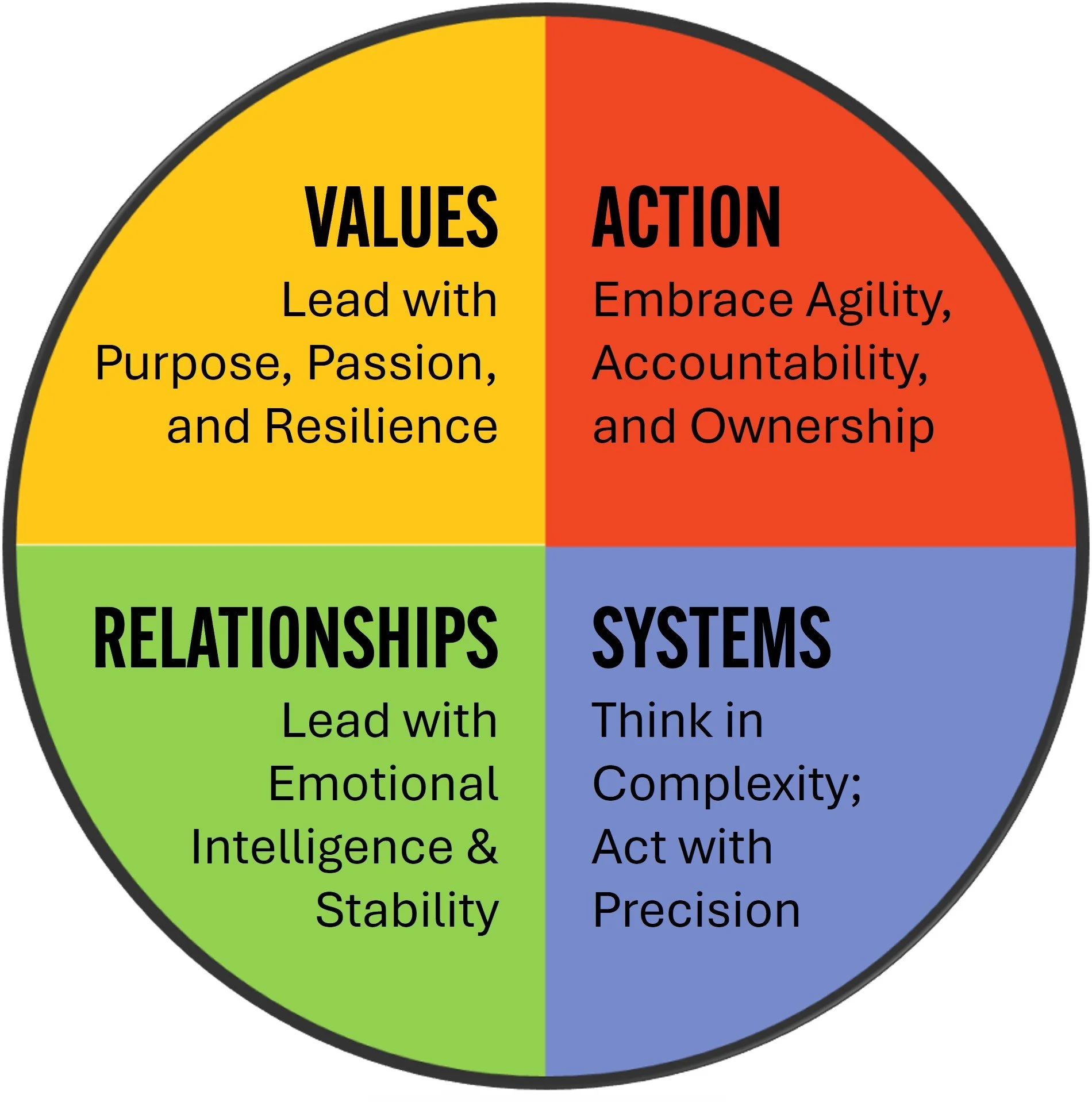
Using Ken Wilber’s Integral Theory as a framework, let’s look at leadership mindset across four critical perspectives of the Integral Quadrants model: Action, Systems, Relationships, and Values.

1. ACTION: Embracing Agility, Accountability, and Ownership

Uncertainty can be paralyzing, but it’s time for leaders to lean into action. The question isn’t if the landscape will change – it’s how fast and how well we adapt. We don’t have the luxury of waiting for complete clarity before we act.

Key Mindset Shifts:

  • Control the Controllable: Instead of fixating on external forces like tariffs or supply chain disruptions, focus on what you can control – efficiency, innovation, and strategic positioning.

  • Act Before You’re Ready: Take calculated risks and iterate quickly rather than waiting for perfect conditions.

  • Adopt a Learning Mentality: Every challenge presents an opportunity for reinvention. Embrace experimentation and learning to drive transformation. Try experimenting with reframing the challenge as a chance to develop local manufacturing partnerships, lobby for inter-provincial trade reforms, reduce reliance on foreign supply chains, and strengthen your industry.

Executive Coaching Reflection Questions:

  1. What assumptions about the future might be limiting my options, and how can I reframe them to uncover new opportunities?

  2. How will we challenge those assumptions to uncover new opportunities?

2. SYSTEMS: Thinking in Complexity, Acting with Precision

Uncertainty requires leaders to step back and see the broader system at play – political forces, economic trends, industry shifts – and make data-informed but decisive moves.

Key Mental Models:

  • Zoom Out, Then Zoom In: Toggle between macro and micro views. Analyze global trends but translate insights into specific, actionable decisions.

  • Decisiveness Over Perfection: Waiting for perfect data leads to stagnation. Instead, make high-probability bets based on emerging patterns.

  • Scenario Thinking as a Superpower: Plan for multiple outcomes to give you an edge when volatility strikes. For example, when you recognize that your traditional supply chains are fragile, experiment with AI-driven forecasting and diversifying supplier regions, to help you transform uncertainty into a competitive edge.

Executive Coaching Reflection Questions:

  1. How am I balancing immediate pressures with long-term strategic vision, when making decisions?

  2. What evidence, criteria, or data points do I typically rely on?

  3. What other information might I explore to gain a fuller perspective?

3. RELATIONSHIPS: Leading with Emotional Intelligence and Stability

Markets fluctuate, but people are the heart of your business. Whether it’s your employees, your customers, or your stakeholders, they are all navigating this uncertainty along with you, and this is your opportunity to provide calm, transparent, and values-driven guidance.

Key Leadership Attitudes:

  • Transparency Builds Trust: Uncertainty is unsettling, but withholding information is worse. Leaders who share challenges openly build credibility and loyalty. Be as transparent as you are able, without putting your team or company at risk.

  • Empathy Over Authority: Instead of just driving performance, seek to identify and understand the emotional toll of this uncertainty. From that vantage point, lead with humanity. Employees and customers are loyal to leaders and companies who care about their well-being.

  • Confidence Without False Promises: As employees and investors look to you for assurance, demonstrate your confidence while staying honest about challenges. If you’re facing supply shortages, lead with radical transparency – openly communicate challenges while directing the pivot to Canadian suppliers. This is likely to increase customer trust, build stronger employee engagement, and strengthen your reputation for integrity.

Executive Coaching Reflection Questions:

  1. How am I fostering trust and psychological safety within my leadership team and through my organization?

  2. Am I sharing with enough transparency, and how do I know what’s ‘enough’?

4. VALUES: Leading with Purpose and Resilience During Uncertainty

At its core, leadership is about more than just profitability – it’s about principles. In times of upheaval, strong leaders ground themselves in what truly matters.

Key Leadership Principles:

  • Commit to National Resilience: Investing in Canadian talent, manufacturing, and innovation isn’t just patriotic – it’s smart business.

  • Lead with Long-Term Ethics: In a crisis, the temptation is to focus on short-term survival. Strong, resilient leaders make decisions that align with their values and their company’s legacy.

  • Champion Collective Strength: Uncertainty is best navigated through partnership, not isolation. Industry collaboration strengthens national stability. Instead of outsourcing to the U.S., invest in a Canadian R&D hub – securing government incentives and attracting top talent to future-proof your company while reinforcing Canada’s innovation economy.

Executive Coaching Reflection Question:

  1. What are the foundational core values of my business?

  2. How are my decisions reinforcing my core values and long-term vision?

  3. What upcoming decisions may create pressure on my core values? How will I prepare mitigants for that?

Strengthening Leadership Mindset in Uncertain Times

While uncertainty is challenging, it is also an opportunity to refine and grow your leadership. By cultivating a mindset of adaptability, strategic thinking, emotional intelligence, and purpose-driven leadership, you can guide your business – and Canada – toward a more resilient future.

Want to strengthen your leadership resilience and impact in the face of uncertainty? Executive coaching is a powerful tool in developing the clarity, confidence, and strategic insight to thrive in an evolving landscape. Schedule a discovery call with Leslie Rohonczy today to explore how executive coaching can help you lead with confidence.

SUCCESSFUL MERGERS: How Coaching Transforms Change from the Inside Out

Corporate mergers are high-stakes, high-pressure events that can determine the trajectory of an organization for years to come. Yet, despite the billions spent on due diligence, integration planning, and cultural assessments, one critical factor remains underutilized: executive coaching. Research consistently shows that leadership development and coaching during mergers lead to better financial outcomes, smoother transitions, and stronger organizational alignment. So why do so many companies ignore this powerful tool when they need it most?

The High Cost of Overlooking Leadership Development in Mergers

Organizations often delay investing in leadership development and coaching during a merger due to the belief that there is "no time for coaching now." However, prioritizing executive coaching during a merger can actually save time and money, mitigate integration challenges, and enhance long-term success. Consider these research-backed insights:

Cost Reduction

  • Reduced Integration Costs: Poorly managed mergers can increase costs by 15-30% due to inefficiencies (EY, 2022). Leadership coaching helps teams anticipate challenges, resolve conflicts efficiently, and minimize redundancies (McKinsey, 2021).

  • Return on Investment (ROI): The ICF Global Coaching Study reports an average coaching ROI of 5.7 times the initial investment. PwC’s analysis indicates an ROI of seven times the cost of employing a coach.

  • Turnover Reduction: Misaligned cultures and uncertainty during mergers lead to higher turnover. Leadership coaching improves engagement, reducing turnover by up to 40% and saving replacement costs, which can be 1.5 to 2 times an employee’s annual salary (Harvard Business Review).

Efficiency Gains

  • Improved Productivity: According to the International Coach Federation (ICF), 70% of coaching clients report improved work performance, and 51% note enhanced team effectiveness.

  • Accelerated Decision-Making: Leaders receiving coaching are 86% more likely to make effective, timely decisions (Leadership Quarterly), preventing costly delays.

  • Faster Integration Timelines: Companies with strong leadership during mergers report up to 22% faster integration timelines (McKinsey, 2021).

  • Reduced Inefficiencies: Leadership alignment initiatives can reduce post-merger inefficiencies by 30% (Deloitte, 2022).

Change Management & Culture Integration

  • Increased Likelihood of Success: Research by Boston Consulting Group shows that coaching senior leaders boosts the probability of successful transformations by over 70%.

  • Stronger Stakeholder Confidence: Organizations demonstrating proactive leadership during mergers experience 20% higher stakeholder confidence (Boston Consulting Group, 2022).

  • Cultural Alignment: Up to 70% of mergers fail due to cultural incompatibility (Deloitte, 2020). Leadership coaching helps integrate differing corporate cultures, unifying teams toward a shared vision.

  • Higher Employee Retention: Companies prioritizing leadership coaching during mergers experience 40% higher employee retention rates (Boston Consulting Group, 2023).

Leadership Development: The Key to a Unified Strategy

  • Stronger Leadership Strategies: Mergers with aligned leadership are 33% more likely to achieve their objectives (PwC, 2022).

  • Better Team Performance: Executive coaching has been shown to increase team performance by 50%, fostering better communication and collaboration.

  • Collaboration Gains: Harvard Business Review (2021) found that executive coaching programs led to a 70% improvement in cross-functional team collaboration during mergers.

  • Increased Leadership Confidence: 95% of leaders report better utilization of new leadership behaviors after coaching, and 94% report increased confidence (International Coaching Federation).

  • Improved Integration Outcomes: Companies investing in leadership development during mergers see a 25% improvement in integration outcomes (McKinsey, 2023).

Research on Executive Coaching in Mergers

If you’re still skeptical about the power of coaching in mergers, consider these groundbreaking studies:

  • "Coming Together: A Grounded Theory Study of the Role of Coaching in the Mergers & Acquisitions Process" (2021) – Heiki Thomas & Jonathan Passmore found that coaching mitigates pressures and tensions, improving leadership, culture, and communication (CoachHub).

  • "Guiding Through Turbulent Times: Coaching During Merger and Acquisition" (2024) – This qualitative study highlights how coaching supports employees in coping with merger transitions (Taylor & Francis Online).

  • "Leadership Strategies for Improving Mergers and Acquisitions Performance" (2020) – Walden University research underscores the necessity of leadership development for post-merger integration success (Walden ScholarWorks).

  • "Why a Winning Leadership Team Matters for M&A Strategy" (2022) – Korn Ferry identifies leadership development as a key predictor of M&A success, reinforcing the need for executive coaching (Korn Ferry).

Make Coaching Your Competitive Advantage

Organizations that invest in executive coaching during mergers are better positioned to reduce costs, improve efficiency, and accelerate integration timelines. Coaching equips leaders with the skills to navigate complexity, drive performance, and inspire their teams through uncertainty.

The question isn't whether you can afford to invest in leadership coaching—it’s whether you can afford not to.

If your organization is navigating a merger or acquisition, and you’re looking to align, integrate, and thrive in this high-stakes transition, let’s connect. Book a discovery call today to explore how executive coaching can be your secret weapon for merger success.

FUTURE OF LEADERSHIP: Innovative Leadership Development

by Leslie Rohonczy, Executive Coach, IMC, PCC | ©2024 | www.leslierohonczy.com

Imagine that we lived in a world where traditional leadership skills are obsolete; replaced by a need for constant innovation, adaptability, and lifelong learning. In this scenario, the old playbook for leaders is no longer sufficient. Clearly, what got you here, won’t get you – and your organization – where you need to go.

The question isn't whether you're keeping up with the latest trends—it's whether you're anticipating the future and preparing for it today. Tomorrow’s effective leaders aren't just competent; they're curious, agile, emotionally intelligent, and relentlessly focused on personal and organizational growth.

Let’s explore some of the innovative leadership development methods that can help you ‘future-proof’ your skills and cultivate a culture of continuous learning within your organization.


Experiential Learning Beyond the Classroom

Experiential learning isn't just the latest leadership buzzword. It's a proven, innovative, and dynamic approach that puts leaders in real-world scenarios, enabling them to develop their leadership skills through direct experience.

Unlike traditional classroom settings that focus on downloading theory and information to students, experiential learning helps leaders learn by doing. Think of it as the difference between reading about the physics of balance required to ride a bike without falling, versus actually hopping on a two-wheeler and learning by feeling it for yourself. Sure, you can read all you want about balance, but until you can experience the physical sensation of it, with all the subtle adjustments and awareness required, it’s just theoretical, and not yet ‘in your bones’. 

For example, imagine taking part in a simulation where you’re leading a complex project launch. In this scenario, you must guide your cross-functional team through the entire project lifecycle, from initial planning to execution and post-launch evaluation. Team members come from different departments, each with their own priorities, challenges, methodologies, and processes. Your role as the leader is to navigate these dynamics, align the team's efforts, and ensure clear communication and decision-making for a successful project delivery.

Scenarios like these are powerful learning opportunities that let leaders experience delegation, conflict resolution, and motivational skills in real-time, and help embed nuanced learning and insights about managing diverse teams. Putting theory into practice in this way improves learning retention, raises self-awareness and skill levels, and is a great opportunity to evaluate your strengths and gaps.

Another example involves a "leadership rotation" where leaders switch roles with their peers, to lead a different division or function. Over a set period, they must lead their temporary teams to address specific challenges, like managing a product recall or launching a new customer loyalty program. This rotation not only provides a holistic view of the business, which helps grow these leaders to be ready for the next level of leadership but also challenges them to adapt their leadership style to different team dynamics and operational demands.


Coaching, Mentoring, and a Hybrid Model: The Best of Both Worlds

Coaching focuses on the "inner game" of leadership. Working with a coach, or holding peer coaching circles, can help leaders identify and overcome limiting beliefs, improve self-awareness, develop emotional intelligence and awareness of others’ ‘wiring’, adapt their style to different communication preferences, set boundaries, and hold others accountable.

Mentoring brings in practical, hands-on experience. Mentors are typically further down the road that the mentee is traveling. They share their experiences, providing real-world examples of what works and what doesn't, valuable insights about specific challenges, and advice and strategies based on their personal experiences. Sometimes mentors are less experienced, as in the case of ‘reverse mentoring’, where young employees mentor senior leaders about emerging culture and industry trends, and first-hand customer experience challenges.

Bring these two powerful concepts together, and you have a hybrid coaching and mentoring program that pairs a new executive with an experienced coach to work on growing their leadership EQ (emotional intelligence) while also having access to a mentor who has led similar projects and is willing to share their guidance. The beauty of this model is its versatility—it can be tailored to the specific needs of the leader, whether they require more focus on personal growth or practical business acumen (which may fluctuate over time).


Resilience and Agility: Thriving in Uncertainty

We hear a lot about ‘resilience’ and ‘agility’ in leadership books and articles, often in the context of coping with an increasingly volatile and unpredictable world. Think of this dynamic duo of skills as your leadership compass that helps you navigate the complexities of your business. Resilient leaders can withstand setbacks and adapt to new challenges, while agile leaders are quick to pivot and embrace change.

But resilience isn't just about bouncing back from adversity; it's about thriving while you’re knee-deep in challenge. It involves cultivating a positive mindset, practicing self-care, and maintaining a sense of purpose. A resilient leader views a ‘failed’ project not as a defeat but as a learning opportunity. She prefers to reframe the outcomes as ‘unintended results’ and explores all aspects of the engagement with curiosity, specifically to grow and improve her leadership skills, improve the process, and empower her team.

Agility, on the other hand, is about being flexible and open to new ideas. It's the ability to shift gears quickly in response to changing circumstances. Agile leaders are not bogged down by rigid plans; instead, they are comfortable with ambiguity and willing to experiment. This helps you quickly adapt to new technologies, crises, shifting business strategies, or emerging opportunities.

Leaders can cultivate these skills through practical exercises like scenario planning and resilience training workshops, peer coaching, and executive coaching. Scenario planning involves imagining various future scenarios and developing strategies for each. This exercise helps leaders think on their feet and prepare for the unexpected. Resilience training might include mindfulness practices, stress management techniques, and workshops on fixed and growth mindsets, and positive psychology.


Empathy and Virtual Presence: Leading from Afar

Empathy and virtual presence have become critical in the age of remote work. With teams often spread across different locations, leaders who find new ways to connect and communicate create engaged, successful teams. And that means empathy is more important than ever. The ability to understand and share the feelings of others helps leaders build trust, foster collaboration, and support teams' well-being.

In a virtual environment, empathy is expressed through active listening, open communication, and genuine interest in team members' experiences. For example, during video calls, leaders can ask about their team's well-being, show appreciation for their work, and acknowledge their challenges. This practice not only strengthens relationships; it also fosters a supportive and inclusive culture.

Practicing empathy also involves actively seeking feedback from team members and taking the time to understand their unique perspectives and concerns. This feedback loop is essential for continuously improving virtual leadership and ensuring the team feels heard and valued.

Being "present" even when not physically co-located is not only possible, it’s a core skill for leaders in the future. There are several ways to develop your leader presence and influence through digital platforms:

  • Set the tone for digital engagement by mastering and proficiently using collaboration platforms like Zoom, Microsoft Teams, or Slack yourself. When you embrace and model using these collaboration tools, and a myriad of others that surely will follow, you’ll streamline communication and improve engagement for your organization. It will also make you more accessible to your employees, a key factor in employee engagement.

  • And speaking on engagement, set clear expectations about engagement, communication, and transparency. Have a team discussion about how and when you expect team members to engage, define the service level agreements for responding to emails or messages, identify the preferred channels for urgent issues versus casual updates, and the level of transparency expected in communications.

  • Host virtual town halls regularly to communicate important updates, share organizational news, and connect with the team. These meetings provide a platform to address your entire organization, answer questions, and offer insights into the company's direction. They also allow employees to voice concerns, ask questions, and feel heard. Regular town halls help maintain transparency and keep everyone informed, reinforcing a sense of community and shared purpose.

  • Video updates from leaders can be a powerful way to communicate key messages, especially when they require a more personal touch, such as a briefing on company performance, reassurance during crisis management, key departure information, emerging opportunities, and new initiatives announcements. Leaders can use video to explain the reasoning behind certain decisions, with nuanced context that written communications might lack. This transparency in decision-making helps build trust, as employees can see the thought process and considerations that contributed to your decisions.

  • Spontaneous check-ins (I call them ‘J5’ meetings: ‘just five minutes’) are similar to the random encounters in hallways or lunchrooms when we’re in person. Try instant messaging an employee with a quick thank you for sending you an interesting article. Ping someone a birthday wish. Ask a question to help a colleague discover a new perspective. These casual, informal connections go a long way to building team engagement and cohesion.


Encouraging Lifelong Learning: Never Stop Growing

Leaders who commit to lifelong learning not only enhance their own capabilities but also set a powerful example for their teams. Start by creating a culture where it’s safe to be curious and experiment. Being transparent about your own learning journey means that you share links to great articles, insights from the books you’re reading, and takeaways from workshops, webinars, and online courses you enjoyed. This simple leadership move not only demystifies the learning process but also inspires others to invest in their development. And employees who attend industry conferences, participate in cross-departmental projects and pursue further skills development help to foster a culture of continuous improvement.

In the future, employees will look for ample learning opportunities as part of their employee experience, beyond the standard mandatory training programs. One effective approach is to provide access to online learning platforms like Coursera, LinkedIn Learning, or Udemy, where employees can explore courses on a wide range of topics at their own pace. This flexibility allows them to tailor their learning to specific interests and career goals. You might even arrange internal workshops and training led by industry experts or in-house career development and learning specialists.

And, while you’re establishing a learning culture in your organization, build in the expectation for employees and leaders to ‘teach back’ what they learned while attending seminars, workshops, conferences, or courses. Encouraging employees to share their expertise through lunch-and-learn sessions, blogs, or peer coaching builds the foundation for a knowledge-sharing culture, helps disseminate knowledge across the organization, and empowers employees to take ownership of their learning journey.


If you’re looking for innovative, diverse learning opportunities to help grow your leadership into the future, reach out to explore Executive Coaching and Leadership Development, at www.leslierohonczy.com.

BREAKING BUSY: Toxic Productivity and the Dark Side of Hustle Culture

by Leslie Rohonczy, Executive Coach, IMC, PCC | ©2024 | www.leslierohonczy.com

 In a world that glorifies hustle, many of us have fallen into the toxic productivity trap: the relentless drive to be constantly busy and accomplished, often at the expense of our well-being. This obsessive pursuit of success can become a destructive cycle, leaving us feeling guilty when we're not working, dissatisfied and exhausted when we are.

But what if there was a way to break free from the chains of toxic productivity? What if we could redefine success in a way that allowed us to mindfully embrace downtime, set boundaries, allow support, and hold ourselves with compassion?


The Productivity Pressure

For many, the pressure to be productive is a constant companion. It urges us on, driven by societal expectations, cultural norms, and the pervasive influence of social media that features perfect, shiny people in states of perpetual productivity. The underlying message is clear: to be valuable, we must be busy, accomplished, and continuously achieving.

I’ve wrestled with toxic productivity for most of my life. I remember always feeling ‘antsy’ in stillness and rarely let myself become truly bored. If boredom somehow snuck through my defense shields, I would twitch and whinge for awhile, and then try to find ways to self-sooth, usually through creative ideation (aka having a party in my head) just so that I would feel productive in some way. Of course, that’s been beneficial in some ways: for channeling creativity, innovation, and problem-solving, for example. But this kind of productivity also has a dark side: it’s been a relentless taskmaster that leaves no room for stillness; only a subtle (and sometimes not so subtle) gnawing feeling of guilt tied to the perception of laziness, or an anxious feeling that I’ve wasted precious time that could have been used more productively. And when I haven’t kept it in check, this constant drive has led to stress, overwhelm, and a sense of not being ‘enough’, no matter how much I achieved.

Even now, people frequently comment on my busyness and level of output. There’s no denying that a part of me that finds it energizing to list the ‘productive’ activities I love so much: executive coaching, team and leadership development sessions, mentoring coaches, making Coaching Minute videos, songwriting, recording and producing original music, rehearsals and live performances, teaching music, writing articles like this one, book events, painting and making jewellery. FUN!! And yet… there’s also considerable discomfort when I read it all in one sentence, because it reveals how deeply I’ve internalized the need to be constantly producing. The concept of 'rest' becomes intertwined with laziness, further fueling a toxic cycle of productivity, guilt and anxiety.

Perhaps this experience resonates for you, too.


The Personal Experience of Toxic Productivity

The internal conflict between the urge to 'do' and the need to 'be' is a common struggle. On one hand, there is a drive to meet deadlines, achieve goals, and maximize every moment. On the other, there’s a longing for peace, for time spent in the present without the looming shadow of the next task. This dichotomy can lead to significant mental and emotional distress. When we're not actively producing, we might feel a pervasive sense of worthlessness or fear that we're falling behind. This can manifest in various ways: stress, burnout, irritability, and physical health issues. When this happens, we know that our productivity has become toxic.

Toxic productivity can show up in different ways: you may seem to others to really have it all together, but you may secretly be battling a constant need to outperform your last achievement. Perhaps you come across as always on top of your game, but you are sacrificing your personal life and mental health to maintain that image. And as much as you’d like to think you’ve got it under control, toxic productivity is not a solitary experience. Many people around us, regardless of their background or profession, can be impacted by our toxic productivity, as they struggle with similar feelings.

The signs of toxic productivity include restlessness and difficulty relaxing, a constant need to be busy, resistance or discomfort with boredom, feeling guilty during downtime, and an inability to enjoy leisure activities without thinking you should be working or producing something useful.

Addressing toxic productivity requires a multifaceted approach. Here are some strategies to help break free from its grip:


Redefine Success

Success has long been equated with constant productivity and visible achievements. However, this narrow definition overlooks the importance of personal fulfillment and well-being as measures of true success. When we expand our understanding of what it means to lead a successful life, we recognize that a balanced integration of achievement with personal satisfaction, happiness, and health is what defines true success.

Consider my client, Laurie, a C-suite executive who, after years of non-stop work, realized she was deeply unhappy despite a long list of professional accomplishments. She began to redefine success by setting goals that included spending quality time with her family, travelling to bucket list destinations, pursuing hobbies, and prioritizing her mental health. As she shifted her focus, Laurie found that she felt more content and balanced in all aspects of her life. She was surprised to discover that her productivity didn't diminish, as she had expected it would; instead, it became more meaningful as it was aligned with her broader sense of purpose and values.

By redefining success, we begin to value moments of joy and relaxation as much as we value career milestones. Wouldn’t it be great if we could feel equally fulfilled by completing a 30-minute meditation as we would by signing a new client. Radical, I know! But this shift allows us to see downtime not as wasted time, but as essential to our overall success.

Redefining success can help mitigate the anxiety associated with feeling unproductive. When we no longer see productivity as the sole measure of our worth, we free ourselves from the constant pressure to perform. This liberation can lead to a healthier, more sustainable work and personal life.

Ultimately, redefining success is about creating a life that feels meaningful and fulfilling, beyond just the narrow definition and metrics of productivity. It encourages us to celebrate our achievements in all areas of life, including those that might not traditionally be recognized, such as personal growth, relationships, and self-care.


Set Boundaries

Boundaries are crucial for maintaining a healthy balance between our work and personal lives. Creating clear lines that separate work time from leisure time, ensuring that one does not encroach on the other, is essential for preventing burnout and preserving mental health.

Travis, the owner of an online marketing business, and self-proclaimed king of the side hustle, used to work around the clock, often sacrificing weekends and evenings to meet client demands. He was proud of the fact that he was a workaholic, and held it as a badge of honour, until he had a medical emergency that was stress-induced. Realizing the toll this was taking on his health and relationships, Travis knew he had to start setting some firm boundaries. He adjusted his pace and communicated his specific working hours to his clients. Outside of these hours, he focused on personal activities and rest. Travis feared he might lose clients by not being constantly available to them, however, to his surprise, most clients respected his boundaries, and his productivity improved significantly during his set working hours. He felt more energized and motivated, and his creativity flourished as he gave himself permission to recharge.

In addition to time-focused boundaries, there are others to experiment with, like creating the physical space for work that is separate from areas designated for relaxation. This can be challenging, especially for those working from home, but even small changes can make a big difference. For example, using a specific desk and chair for work, not having a cell phone beside his bed to charge, and avoiding bringing work-related activities into the family room or bedroom will help us reinforce the mental and physical distinction between work and personal time.

Boundaries are not just about limiting work hours; they also protect and generate specific, intentional time for rest and leisure. By setting boundaries, we prioritize our well-being and ensure that we have the necessary space to recharge. This practice can significantly reduce the feelings of guilt associated with downtime, as we come to see it as a vital part of our overall productivity, health, and self-care.


Practice Mindfulness

My client, Emma, found herself constantly anxious about work. She was a rising star who believed it was her extreme level of productivity that was fuelling her success. Emma longed to be in a steady, loving relationship, but there was just no room in her life for someone else. Emma realized she needed to make some changes, and she began by incorporating some mindfulness activities into her daily routine, beginning with a simple 4-minute breathing meditation (https://youtu.be/ZM3eYRODNbc) in the morning and evening. Over time, she added short meditation sessions and mindful walks during her lunch breaks. These practices helped her feel more grounded and less overwhelmed by her to-do list. And they also helped bring her more clarity and innovation ideas. Emma was thrilled to realize that she had become even more successful by producing less.

Mindfulness involves being fully present in the moment and accepting it without judgment. It can be a powerful tool to combat toxic productivity by helping us focus on the present rather than worrying about future tasks or dwelling on past performance. Mindfulness teaches us to observe our thoughts and feelings without getting caught up in them. For instance, when we notice the feeling of guilt about not working, we can acknowledge it without letting it dictate our actions. After all, this guilty feeling is just an emotion you’re experiencing in the moment, not a directive to take action. This perspective allows us to choose a more compassionate response to ourselves and our need for rest.

Mindfulness isn’t all about sitting cross-legged and chanting ‘ohmmm’ however. We can develop the ability to be mindful and fully present right there in the thick of it! Being fully present while we’re doing tasks can improve our focus and levels of output, lead to more efficient and effective work, and reduce the overall time spent on each task, which in turn, can create more space for relaxation and leisure activities without compromising our productivity. Mindfulness enhances overall quality of life by encouraging us to savour moments of joy and relaxation, making them more fulfilling.


Embrace Downtime

Despite how it may feel, downtime is not a luxury; it's a necessity. Periods of rest are essential for our mental, emotional, and physical well-being. Making time to recharge and enjoy life is a true measure of success, rather than a threat to our productivity.

David, the VP of a software engineering firm, used to feel guilty every time he took a break. He was driven by the belief that constant work was the only path to success. After experiencing some early signs of burnout, David wanted to change his approach, and began an executive coaching program focused on improving his work/life balance. The simple practice of scheduling regular breaks throughout his day had a profound effect on his wellbeing. David ran with the program, and re-dedicated his weekends to rest, family, and playing sports. Over time, he noticed a significant improvement in his energy levels, personal and professional relationships, and overall job satisfaction. David was promoted to CFO shortly after and vowed to maintain this healthy balance. His commitment to protecting downtime had an ancillary effect: because he was able to model healthier behaviours for his team, the engineering firm’s corporate culture, recruiting efforts, and employee retention improved as a result.

Embracing downtime means giving ourselves permission to rest. It involves recognizing that taking a break does not make us lazy; it makes us human. Rest helps our bodies and minds recover and refuels our energy. Engaging in hobbies, spending time in nature, reading, or simply doing nothing can be valuable ways to recharge and enhance our overall sense of well-being. When we view rest as a crucial part of our productivity cycle, we can value it just as much as the work. This shift in perspective can reduce feelings of guilt and anxiety associated with rest, leading to a healthier, more balanced approach to life. Incorporating regular downtime into our schedules can also improve our relationships. When we’re not constantly preoccupied with work, we can be more present with our loved ones, fostering deeper connections and a greater sense of support and fulfillment.


Seek Support

Seeking support is a vital step in addressing toxic productivity. It involves reaching out to friends, family, or mental health professionals to share our experiences and gain perspective. Support systems can provide encouragement, validation, and practical advice for managing the pressures of productivity.

Talking about our feelings can be incredibly liberating. When we share our struggles, we often find that others have experienced similar issues, which can reduce the sense of isolation. Friends and family can often contribute valuable insights and support that help us navigate the pressures of productivity more effectively.

And when friends and family aren’t enough, professional support, such as therapy or coaching, can also be valuable. Mental health professionals can help us identify unhealthy patterns and develop strategies to change them. They can provide tools for managing stress, setting boundaries, and practicing self-compassion.

Support groups can also offer a sense of community and shared experience. Being part of a group where others understand our struggles can be incredibly validating and empowering, as members share practical tips and encouragement for making positive changes.

Consider Maria, a marketing director at a highly successful agency who felt overwhelmed by her workload. During coaching discussions, we discovered that her anxiety response was far beyond the scope of what can be managed through coaching alone, so I encouraged her to seek out a therapist. Through therapy, Maria learned some critical coping strategies that helped her manage her significant anxiety, and through coaching, she learned to set and hold healthier boundaries. She also joined a support group for women who were facing similar challenges, which provided a sense of community and shared understanding. This three-pronged approach to support made a tremendous difference to Maria’s quality of life.

Seeking support can transform our relationship with productivity by helping us recognize that we don’t have to face these challenges alone. It can provide the reassurance and tools we need to prioritize our well-being and redefine our approach to work and rest.


Cultivate Self-Compassion

When we’re in the throes of toxic productivity, self-compassion rarely gets a seat at the table – striving and critical self-judgment take up all the space. But cultivating self-compassion is a powerful antidote to the toxic cycle: treating ourselves with the same kindness and understanding that we would offer to a friend means that we recognize and tolerate our imperfections and struggles, without the guilt-inducing layers of harsh judgment.

Take the example of James, a writer who often berated himself for not meeting aggressive, self-imposed deadlines. His inner critic was relentless, leaving him feeling inadequate, and leading to signs of burnout. After learning about self-compassion as part of his assigned coaching practices, James started speaking to himself differently; with kindness and compassion; with patience, acknowledging his efforts, even when he didn’t meet his goals. This shift in mindset helped him feel more at peace and less stressed.

Self-compassion involves recognizing that everyone makes mistakes and experiences setbacks. It’s about understanding that these moments are part of being human, not signs of failure. Cultivating self-compassion changes the way we view productivity. Instead of seeing it as a measure of our worth, we can see it simply as one aspect of our lives, which reduces the pressure to constantly perform and produce.

Ultimately, self-compassion can help us build a more positive relationship with ourselves. It encourages us to celebrate our efforts and achievements, no matter how small, to be gentle with ourselves when we fall short, and to examine our personal definition of success.

Remember, in the midst of all of the doing, it’s okay to just be. Embrace the present moment and embrace rest as a vital part of a successful, fulfilling and balanced life.
MICROMANAGER DETOX: The Career-Killing Habit You Need to Break Now

Leslie Rohonczy, IMC™, PCC, Executive Coach, Leadership Expert, Speaker, Author

In my work as an executive coach, I've encountered numerous leaders and teams who are grappling with the pitfalls of micromanagement. Recently, I worked with three different leaders whose micromanaging style highlighted the pervasive nature and detrimental effects of this derailing leadership behaviour.

 My first client, an ambitious manager, was bright, capable, experienced, and determined. After finding himself passed over repeatedly for a promotion, with no good explanation as to why, he was desperate. Despite  his stellar operational expertise and experience, the inability to relinquish control over minor operational details stifled his team's growth, created poor employee satisfaction scores, and undermined his leadership potential.

 The second client faced a different challenge. His micromanagement instinct stemmed from a deep-seated inability to trust his employees. This lack of trust wasn't due to any inherent untrustworthiness in his team; rather, it was his failure to invest time in building meaningful relationships with them. His need for control created a barrier that prevented the development of trust and intimacy so essential for high-functioning teams.

 The third client, a newly promoted senior leader, struggled under the weight of her own leader's micromanaging style. Despite her new executive role, my client’s boss continually overstepped into her sandbox, making decisions on her behalf, and undermining her authority in the presence of other executives. This not only made her feel untrusted and incapable, but also prevented her from growing into her new responsibilities and taking up her full leadership space with her team, peers, and the Board of Directors.

RECOGNIZING THE SIGNS OF MICROMANAGEMENT

 Micromanagement can create an unhealthy work environment by stifling employee growth, reducing productivity, and preventing individuals from performing at their best. By identifying micromanagement tendencies early, you can adopt healthier leadership practices before the situation deteriorates.

 Here are some signs that you might be micromanaging. As you read each one, ask yourself, “Do I do this?”

  1. Constant Oversight: You find yourself frequently checking in on your team's work, even when they haven't asked for feedback. You often involve yourself in minor project details that your team should handle independently. You notice that your hovering creates tension in your employees.

  2. Resistance To or Difficulty Delegating: You take on most responsibilities yourself, even when your team is fully capable. You are reluctant to delegate tasks, fearing they will fail without your direct involvement. You see how hard employees are working, and feel you’d be burdening them, so you do it yourself instead.

  3. Lack of Trust: You require employees to check in with you before making every decision, and you insist on approving all project deliverables before they proceed.

  4. Perfectionism: You have high standards and expect output from employees to be perfectly executed. You strive to control every aspect of your team's work. You feel anxious when tasks are not done exactly your way.

  5. Focus on Minor Details: You concentrate more on correcting insignificant details rather than focusing on strategic goals and opportunities, solving critical issues facing the team, or fostering employee development. Sometimes, you miss the big picture because you are focused on the minor details.

  6. Taking Over Tasks: When you spot a mistake, you prefer to fix it yourself instead of allowing the employee to correct it and learn from the experience. You insert yourself in certain tasks that you enjoy, even though your team is fully capable and expected to deliver on them.

  7. Discouraging Independence: You want to be informed about every move your team makes, no matter how trivial. You discourage independent thinking, new ways of working, or creative experimentation. You don’t appreciate it when employees express opinions that challenge your own.

  8. Overworking: Believing you are the most capable person for the job, you often work overtime to rectify others' mistakes and ensure everything is perfect. You can’t shut off work at the end of the day. You expect employees to respond to your emails in the evenings and on weekends.


If you're still uncertain about whether you're micromanaging, seek feedback from your employees. An anonymous survey can provide an honest assessment of your level of involvement. While this feedback may be hard to hear, it's essential to listen to your team's input and take action to address your micromanagement habits.


 MICROMANAGER SELF-ASSESSMENT TOOL

 Self-assessment can provide valuable insights into your management style and highlight areas for improvement. By reflecting on your behavior and assessing your tendencies, you can gauge the level of micromanagement that feels natural to you and determine how it affects your team.

 This self-diagnosis tool is designed to help you evaluate your management style objectively. Consider the following questions and rate yourself on a scale from 1 to 5, where 1 represents "hands-off" and 5 signifies "micromanager." Reflect on your typical behaviors and interactions with your team to get an accurate assessment.

 Remember, this exercise aims to foster self-awareness and promote healthy leadership practices.

  1. How often do you check in on your team’s progress?

    • (1: Occasionally, 3: Often, 5: Constantly)

  2. How comfortable are you with delegating important tasks?

    • (1: Very comfortable, 3: Somewhat comfortable, 5: Very uncomfortable)

  3. Do you feel the need to review and edit the work your team produces?

    • (1: Rarely, 3: Sometimes, 5: Almost always)

  4. How often do you provide detailed instructions on how to do tasks?

    • (1: Rarely, 3: Sometimes, 5: Regularly)

  5. How frequently do you override decisions made by your team?

    • (1: Seldom, 3: Sometimes, 5: Very frequently)

 INTERPRETING YOUR SCORE

After rating yourself, analyze your scores to understand your micromanagement tendencies better. High total scores (19-25) suggest that you are likely to have micromanaging behaviours, while lower scores (5-11) indicate a less controlling, more hands-off approach. Moderate scores (12-18) can suggest a balanced approach but may also hint at areas where you could improve your delegation and trust in your team.

 If you find that your scores are at the higher end of the scale, reflect on the potential reasons that are likely driving these behaviors. Are you struggling to trust your team's capabilities? Do you have a perfectionist streak that drives you to control every detail? Recognizing these patterns is the first step towards adopting a more empowering leadership style.

 To further refine your self-awareness, solicit feedback from your team in the form of an anonymous survey. This can provide you with insights into how your management style affects your employees. While this feedback may be difficult to hear, it’s a valuable tool for identifying areas where you can curb your micromanagement tendencies and develop a healthier, more productive work environment.


8 IMPACTS OF MICROMANAGING

The ‘habit’ of micromanagement can damage your team, organization, and career. Here are the eight major impacts of micromanagement:


IMPACT 1: LOSS OF CONTROL

Ironically, micromanagement often results in losing the very control you're trying to maintain. By relying solely on control as your management tool, you limit your flexibility and effectiveness. Instead of gaining control over your team and projects, you end up losing it, along with valuable time. Different management styles can be effective with different staff members, and excessively controlling behaviors will not only diminish your ability to adapt and communicate effectively as an effective leader; it will demotivate certain employees.

Takeaway: Over-relying on control narrows your management style, ultimately reducing your capacity to manage and communicate effectively.


IMPACT 2: LOSS OF TRUST

Micromanagement erodes trust between you and your team. When employees feel micromanaged, they view you not as a supportive leader but as a control freak. This leads to a breakdown of trust, which can drastically reduce productivity and can cause your best performers to leave. Trust is a two-way street; your team needs to trust you just as much as you trust them.

Takeaway: Micromanagement destroys trust, which affects employee engagement, output, and retention.


IMPACT 3: DEPENDENT EMPLOYEES

Micromanaged employees become overly dependent on your guidance and approval. This dependency stifles their confidence and initiative, making them less capable of performing tasks independently. This not only takes a toll on your time and energy as a leader, but it also wastes the unique skills and talents that each employee brings to the table. When employees are allowed to think independently, innovation and great achievements are possible.

Takeaway: Micromanagement fosters dependency, and radically diminishing the unique contributions and growth of your employees.


IMPACT 4: MANAGER & EMPLOYEE BURNOUT

As a leader who constantly oversees every detail of your team’s work, this exhausting and unsustainable level of micromanagement can quickly lead to burnout, affecting both your professional and personal life. Burnout can cause you to become disillusioned with your job, potentially leading to departure from your role (voluntary or not!) and can also lead to wider disengagement and stress across your team as a result. Employees who feel micromanaged often experience low morale and reduced job satisfaction, leading to burnout and disengagement.

Takeaway: Micromanagement not only harms your employees but also poses a significant risk to your own mental and physical health.


IMPACT 5: HIGH TURNOVER OF STAFF

Most people find micromanagement unbearable and will eventually leave. You may feel that you have valid reasons for the urge to micromanage your employees (ego, insecurity, or inexperience, for example). But none of these justifies the misery of this particular employee experience, not to mention the high turnover rates it causes. Constantly having to train new staff is costly, and disrupts team momentum and morale, resulting in the loss of skilled employees and a decline in overall team performance. It can also make it difficult to attract top talent, as word spreads about the controlling work environment.

Takeaway: Micromanagement leads to high staff turnover, costing your organization valuable talent and stability.


IMPACT 6: LACK OF AUTONOMY

Micromanagement strips employees of their autonomy, which is one of the basic human needs. This loss of autonomy creates a drop in motivation and can lead employees to do only the bare minimum. When employees feel they lack control over their work, they become disengaged and are unlikely to go beyond what is demanded of them. Conversely, granting autonomy empowers employees, fostering pride, engagement, and initiative in their work.

Takeaway: Lack of autonomy stifles employee growth and motivation, preventing them from taking ownership of their work.


IMPACT 7: LACK OF INNOVATION

One of the most significant dangers of micromanagement is the suppression of creativity and innovation. Your employees are closest to the work, and that means they often have incredibly valuable insights into your customers’ needs, potential innovations and products to meet those needs, and how to improve processes to make work more efficient. By micromanaging, you stifle their ability to innovate and take risks, which can halt progress and prevent good ideas from surfacing.

Takeaway: Micromanagement crushes innovation, hindering progress, and limits the potential for creative solutions.


IMPACT 8: THE BOTTOM LINE: Stifled creativity and innovation, low autonomy and trust, decreased productivity and inefficiencies, and high turnover due to micromanagement will directly affect your bottom line and can result in missed opportunities because employees may be hesitant to take initiative.

Takeaway: There’s a quantifiable measure of the impact of micromanagement: drop in revenue, innovation, efficiency, employee satisfaction and retention.


THE STRATEGIC SHIFT FOR HIGH-LEVEL LEADERS

As leaders advance in their careers, it becomes increasingly important to shift from a focus on day-to-day operations to a more strategic perspective. This transition is vital for several reasons:

  • Long-Term Vision: Higher-level leaders need to focus on the long-term goals and vision of the organization. This requires stepping back from the minutiae to see the bigger picture, and creating an inspiring connection between those big, bold goals and the workers who will help the company achieve them.

  • Empowering Teams: By stepping away from the details, leaders can empower their teams to take ownership and responsibility for their work. This fosters a culture of trust and autonomy – two elements of high-performing teams.

  • Innovative Thinking: Strategic leaders are better positioned to drive innovation and change, identify trends, anticipate challenges, and develop solutions that align with the organization’s goals. Micromanaging leaders are missing this strategic aspect of the role.


RECOMMENDATIONS FOR OVERCOMING THE MICROMANAGEMENT INSTINCT

 Now that you've identified your micromanagement tendencies, it's crucial to take proactive steps to shift towards a more empowering management style. Here are ten actionable recommendations, supplemented with insights from Gallup research and best practices:


Nurture Trusting Relationships: Building trust within your team is essential for fostering autonomy and productivity. Trust empowers employees to take ownership of their work and move projects forward without constant oversight. Providing constructive feedback reinforces this trust and encourages a growth-oriented mindset.

 Perfect Isn’t Perfect: Acknowledge that perfectionism often drives micromanagement and inhibits innovation. Understand that there are multiple paths to success, and minor details are not always critical. Encourage experimentation and embrace failure (I prefer to call it ‘unintended results’) as opportunities for growth and learning.

 Encourage Learning and Experimentation: Give your team the autonomy to experiment and innovate. Adopt a fail-forward mindset, where mistakes are viewed as valuable learning experiences. Provide guidance and support, intervening only when necessary to address recurring issues.

 Set Expectations: Establish clear expectations for your team upfront, including project objectives, timelines, and success metrics. Clear communication reduces the need for micromanagement by ensuring everyone understands their roles, responsibilities, and deliverables.

 Delegate Like a Boss: Effective delegation is crucial for empowering your team and freeing up your time for strategic priorities. Assign tasks based on individual strengths and development goals, providing necessary resources and authority. Remember, effective delegation generates higher revenue and boosts employee morale.

 Stay In Your Leadership Lane: Prioritize tasks that leverage your unique skills and expertise, such as goal-setting and strategic planning. Delegate operational tasks to your team, allowing them to take ownership of their roles and contribute to organizational success. Ensure decisions are made at the right level, and push decision-making accountability down whenever possible.

 Embrace Transparency: Utilize project management tools to monitor project progress without micromanaging. These tools provide visibility into individual tasks, enabling you to identify issues early and intervene as needed. Foster open communication about progress, challenges, and collaboration to build trust and accountability.

 Hire Well: Invest in hiring the right people for your team. Hiring individuals with the right skills and qualifications minimizes the need for micromanagement and fosters a culture of autonomy and accountability. Take the time to understand each employee's preferences and strengths to tailor your management approach accordingly.

 Seek Feedback from Your Team: Engage in open dialogue with your team to understand their preferred communication styles and preferences. Respect their opinions and perspectives and adjust your communication style to each individual. By actively listening to your team, you demonstrate trust and respect, and your commitment to growing strong relationships with each employee.

 Practice Self-Compassion: Recognize that transitioning from micromanagement to a hands-off leadership style is a journey that requires patience and self-compassion. Be open to self-observation, to learning from mistakes, and to continuously improving your leadership skills. Cultivate a growth mindset and celebrate progress, both for yourself and your team.


COACHING PRACTICES TO COMBAT MICROMANAGEMENT

  • Reflective Journaling: Keep a journal to reflect on your management behaviors and identify patterns. Note situations where you felt the urge to micromanage and explore what was driving that urge. Look for themes. Explore how your micromanaging reflex is about you, rather than about your employees or the tasks.

  • Mindfulness Practices: Engage in mindfulness exercises to stay present when your micromanager becomes activated by the thought of relinquishing control. This can help reduce the anxiety you feel and allow you to dial down the need to overcontrol.

  • Accountability Partner: Work with a coach who can help you understand your motivations, and help you build the muscles to hold yourself accountable, by providing valuable perspectives, observations and objective feedback about your leadership approach.

  • Training and Development: Invest in leadership training programs that emphasize delegation, trust-building, and strategic thinking.

TOPOGRAPHY OF LEADERSHIP: The Hidden Landscape Beyond Roadmaps

by Leslie Rohonczy, Executive Coach, IMC, PCC | ©2024 | www.leslierohonczy.com

Navigating the vast landscape of leadership requires more than just a roadmap. Don’t get me wrong: roadmaps are essential to leadership – showing us the layout of well-traveled highways (eg: established strategic goals, clear objectives, and robust processes to deliver on them), residential streets (eg: organizational structure, employee and team development, team culture, and the systems that support them), and points of interest along the way (eg: refocusing the team to respond to external market forces, inspiring employees to experiment with product innovation, forming a new strategic partnership, and crisis management). Yay for roadmaps! But they don’t give us a fulsome picture of the entire leadership landscape.

To lead well, we must understand the topography of leadership and its nuances, beyond the familiar super-highways and existing structures. It’s time to hop off the beaten path and explore what else is out there.

Throughout your leadership journey, you’ll be required to navigate some diverse terrain: strategic visioning; tactical planning; risk mitigation; business and technology transformations; crisis management; collaborative innovation; hiring, development, and retention of employees; and growing an inclusive culture of accountability, to name a few.

Using the leadership topography metaphor, let’s explore the landscape of essential skills and insights leaders need for success in each locale.


SCALING STRATEGY MOUNTAIN: Gaining the Panoramic View

It may seem like a daunting journey, but strategic leadership lies at the summit of Strategy Mountain. Here, leaders gain a panoramic view of the landscape, and from this vantage point, can see a vast horizon, set a clear vision, and chart the course for a sustainable future. They anticipate challenges, make bold decisions, and collaborate with key stakeholders and employees to understand their purpose and how they deliver on that purpose to customers.

Strategic leaders know this journey is critical to the success and sustainability of their businesses. They make time for it in busy calendars, gather necessary resources and information, and determine the route of ascent. They pay attention to the timing of the climb and know how often to revisit it, and who to invite on the journey.

To successfully scale Strategy Mountain:

  1. Craft a compelling vision for the company that you want to be in 10-20 years. This vision should inspire and motivate employees and leaders, satisfy the board and shareholders, and delight customers. When it’s used well (and not just trotted out once a year as a tick box activity), this aspirational, future state vision will be the north star from which to ‘reverse-engineer’ all tactical plans.

  2. Align resources effectively to support the strategic goals and pause or close projects that don’t align with your strategy. Non-aligned projects (often pet projects or outdated initiatives that don’t directly support the strategic objectives) can steal valuable resources and attention from what’s strategically most important.

  3. Encourage bold decision-making while mitigating risks. This is the time to be bold, and bravely challenge your organization to stretch in new ways, beyond what is currently possible. And just like preparing to climb a mountain, the boldness of this strategy adventure requires attention to the associated risks and how they can be tempered with thorough risk assessment and safety mitigants.

  4. Cultivate collaboration with key stakeholders and team members in the strategic planning process. Their perspectives are valuable inputs to developing your strategy, and this collaborative approach fosters buy-in and alignment. Strategy done in a vacuum of senior leaders, without the benefit of front-line employees’ perspective, the customer’s perspective, or the competitors’ perspective, is like throwing darts in the dark.

  5. Regularly revisit and adapt the strategic plan as needed. (And it’s likely needed more often than once a year!) Instead, use it as a business alignment lens, to ensure that tactics, branding, project management, program design, resourcing, and every other part of your business is traveling in the right direction, at the right speed, with the right resources.


STEPPING INTO TACTICAL VALLEY: Where the Rubber Meets the Road

Tactical leadership is about aligning and equipping resources to deliver on strategic objectives. Typically, it’s middle managers who spend the most time and attention in Tactical Valley. It’s about empowering employees with decision-making power as a learning opportunity (and having their backs on their decisions, even when you would have chosen differently); and supporting your team when the going gets tough. It requires resilience to endure setbacks; and empathy to support employees; it also requires leadership agility to maneuver through this rough, low-lying terrain without becoming stuck in the mud of execution.

When a more senior level of leadership is called to step in, it’s usually because a significant challenge has arisen, a strategic shift is needed, or the team must rally in the face of adversity. Sometimes, senior leaders notice their teams struggling, and want to help them navigate obstacles and challenges at the ground level, so they instinctively hop into the trenches where the work is being done. Sometimes this works, but more often, it creates challenges (eg: the perception of micromanaging, and the seeming lack of trust you have in their ability to figure it out as a team). It’s important to team health and employee engagement to have empowered employees and leaders who feel ownership of their work and skills development.

When entering Tactical Valley:

  1. Know when to empower and support others and when to step in (and it may be less often than you think). Particularly for senior leaders, balance hands-on involvement with delegation of decisions and oversight. This will empower your team members, create leadership and employee development opportunities, and demonstrate your trust in the team to deliver.

  2. Provide empathetic support and guidance to team members, to help them feel safe to express their concerns and speak truth to power; to experiment with innovation and learn; to challenge the status quo with new thinking; and to freely contribute authentic perspectives without fear of judgment.

  3. Monitor the execution of tactical plans, to ensure all tactics being worked on are on the strategic path and that no unaligned projects are diverting essential resources.

  4. Lead by example to foster a culture of accountability and execution excellence. And when you end up with ‘unintended results’ (a nicer way to say ‘failed projects’), avoid blame. Instead, demonstrate your curiosity about what valuable lessons can be applied next time. Modeling resilience in the face of setbacks can help employees build their resilience muscles, too.


NAVIGATING ADAPTIVE RIVER: Riding the Currents of Change

Sometimes it may feel like the Adaptive River of Change is threatening to flood its banks (and often, it does!) As you navigate the high water of change, adaptive leadership helps you steer your team through turbulent, ever-shifting currents, embracing change and innovation along the way. By remaining flexible, you can adjust the course as needed, and build the resilience your team needs to weather storms.

This also requires you to build and leverage your leadership super-power: emotional intelligence (EQ).  Adaptive leadership is about riding the currents of change, staying agile while the ground shifts underfoot, navigating the complex interpersonal dynamics that come with change, and inspiring others to embrace innovation, even (or especially) amidst the strong undertow of uncertainty.

When navigating the Adaptive River of Change:

  1. Develop and leverage your emotional intelligence to help you and your organization navigate the interpersonal dynamics that come with large-scale change. Go beyond the all-to-common corporate value of ‘our people are our biggest asset’, and get to know how those people are wired, what their concerns are, what inspires them, and how you might reframe aspects of the change to help them feel seen and heard as the change moves forward.

  2. Transparently and authentically communicate both the ‘current state’ you’re moving away from and why, and the aspirational ‘future state’ you’re moving towards and why, to foster understanding, trust, and alignment. Leverage town hall meetings, team and project discussions, employee one-on-ones, collaboration platforms, leader videos, etc. to ensure a shared understanding.

  3. Challenge the instinct to protect the ‘current state’ and invite innovation and creativity amidst the uncertainty. Great innovations and ideas often emerge from these swirling waters of change, so

  4. Remain agile and flexible in how you respond to changing circumstances. Employees take cues from their leaders and will watch how you navigate change and follow your lead. Model a healthy, balanced, and productive approach to change for them.

  5. Build resilience within the team to weather turbulent times by investing in key support systems: change management, team development, leadership development and coaching, culture and employee experience.


BRAVING THE DESERT OF CRISIS: Leading Through Adversity

In the arid Desert of Crisis, leaders must summon their courage and resilience, to endure the harsh conditions. Crisis leadership demands a calm and anchored stance, transparent and efficient decision-making, personal and organizational resilience, attention to self-care, and clear communication systems amid the chaos.

It also requires a culture of psychological safety within your organization that encourages open communication and support during crises. Leaders who can maintain balance under pressure, rally their teams around a common purpose, and navigate treacherous and uncertain terrain know that crisis leadership is about leading from the front lines by empowering and instilling confidence in others and by guiding the organization through the sandstorm.

When braving the Desert of Crisis:

1.      Maintain a calm, clear, and connected stance to instill confidence during a crisis. Employees will follow your lead and feel more reassured by this grounded presence. Techniques like a coaching program, journaling reflection, and meditation are great ways to help you feel grounded.

2.      Prioritize and model self-care. It’ll help you sustain personal and organizational resilience, by establishing boundaries to protect things like time for rest, physical activity, and email response times. This one small move has great potential, not only for your well-being but also for setting an example of self-care for employees.

3.      Amidst the chaos, empower and rally the team around a common direction. Communicate clearly, effectively, and frequently. Make transparent and timely decisions to guide the organization, and share your thinking behind your decisions, not just the decision itself, to help the organization understand and adapt.

4.      Seek support from trusted colleagues, an executive coach, a mentor, or your professional network, in the form of advice, reassurance, and different perspectives to strengthen your resilience


ENTERING COLLABORATION FOREST: Cultivating Healthy Ecosystems

Leaders who cultivate an ecosystem of teamwork and inclusivity in the lush Collaboration Forest empower teams, foster a culture of trust and respect, and leverage the diverse perspectives of employees and peers. Collaboration is, by its very nature, a group adventure, not a solo journey, and requires a relentless nurturing of relationships, clear communication, and continuous alignment. Collaborative leadership is about fostering a sense of belonging, embracing diversity, and harnessing collective wisdom and creativity.

As you make your way through Collaboration Forest:

1.      Nurture relationships and trust among team members by creating opportunities for them to connect through team-building events, team development activities, town halls, and employee conferences. Foster a culture of transparency by creating opportunities for open dialogue and feedback exchanges within their teams, encouraging constructive input and active listening. And when you get the feedback that you asked for, do something with it.

2.      Embrace diversity of thought, backgrounds, and experience, by encouraging team members to share their ideas and opinions without fear of judgment. These fresh ideas and insights can drive innovation and problem-solving.

3.      Ensure collaboration goals are clearly defined and communicated across teams. Encourage knowledge sharing and cross-functional collaboration by creating opportunities for team members to share their expertise, research, ideas, and opinions, to cross-pollinate innovation.


USING YOUR UNIQUE TOPOGRAPHICAL MAP: Navigating with Confidence

As we’ve seen in this topographical journey, effective leadership requires a nuanced understanding of the terrain and skills required to navigate each area with confidence, clarity, and agility. As you continue on your leadership journey, engage in continuous learning, embrace change, and leverage the hell out of your curiosity.  


KEY TAKEAWAYS:

  • Identify the specific geographic area you’re in, including specific challenges and opportunities of each locale, and reflect on what leadership approaches will best suit the demands of that specific environment. Continuously assess your readiness and leadership capabilities in each specific landmark, and frequently ask: “Am I at the right place, at the right time, with the right people, to navigate this leadership terrain?”, then adjust if your answer is anything but ‘yes’.

  • Notice which areas of the Leadership Topography Map you spend most of your time in, which you long to travel to more often, and which areas you tend to avoid. Challenge yourself to explore a wider leadership terrain than is your habit or comfort zone.

  • Speaking of habits, grow your self-awareness and develop the habit of reflection. Seek feedback and mentoring to enhance your awareness, leadership skills, and capabilities. Reach out for executive coaching support when you need to develop a new muscle. Put what you learn into action, experimenting, reflecting, and adjusting as you go.

LEADERSHIP STYLES

by Leslie Rohonczy, Executive Coach, IMC, PCC | ©2024 | www.leslierohonczy.com 

 Here are descriptions for six distinct leadership styles that you have likely seen in action. Some of these styles are best practices, and some should die off as the dinosaurs they are. Leaders will likely toggle between these seven styles over their careers, depending on the situation. As you read the descriptions, see if any names come to mind, based on your own career.


ALL STICK, NO CARROT

This is a short-horizon leadership style with the primary objective of achieving immediate compliance. This leader gives directives rather than direction, by telling employees what to do and how to do it. They expect immediate, unquestioning compliance, and micro-manage tightly to maintain control. This style is ideal for the battalion commander under siege in a military conflict, who must ensure that every soldier comes home alive. Of course, business challenges are rarely life-and-death, but some leaders still believe this is what good leadership looks like. Their feedback is corrective, often brutal, with little recognition of what employees do right, and they wield threats of negative consequences for non-compliance. Turnover is typically high as employees endure this leader only until they can get the hell out. And that hits the bottom line with higher recruitment and training costs.


VISION & STANDARDS

This style of leadership provides inspirational long-horizon vision and inspires employees by connecting them with the ‘why’ behind that vision. Vision and Standards leaders chart the course and are usually powerful storytellers whose passion for their vision is contagious. They invite employees to share their perspective on the vision and they set clear standards of performance for how their organization will move forward towards their visionary objectives. Vision and Standards leaders use a balance of positive and constructive feedback as a motivation tool. Employees rarely leave leaders who can inspire them.


ALL CARROT, NO STICK

This leadership style seeks harmony on the team and is focused on building and recognizing positive interactions. These leaders place a lot of importance on employees’ personal needs, providing recognition, and boosting employee morale. While that sounds great on the surface, beware of the downside: these leaders sometimes settle for ‘adequate’ performance because they avoid providing corrective feedback that could help employees grow and propel the business towards their goals faster. Not only does it promote artificial harmony, but by avoiding productive conflict, the team misses out on diverse thinking, challenging assumptions, building conflict resolution skills, and creating authentic team cohesion. Employees leave this type of leader not because they’re being mistreated, but because they perceive their leader is not investing in their own growth and development or not treating everyone fairly because they are too soft on nonperforming employees.


TASK MASTER

This leadership style has a task-focused short-term horizon, with the goal of getting the maximum amount done, and done perfectly. There are similarities with the ‘All Stick No Carrot’ type, but the difference is that Task Masters require employees to spend significant time and resources to provide a rationale every step of the way, and they withdraw responsibility and support when employees fail to meet their exacting standards. This leader enjoys leading by example – but not in a good way: they set their own bar unreasonably high, and then admonish their employees for ‘poor performance’. They avoid delegation, often leaping in to rescue a project or situation with detailed task-based instructions. The Task Master leader typically has little empathy and will only focus on collaborating at the task level, where they work in the weeds, rather than on business strategy and values. This leadership style can create high absenteeism, continuous employee turnover, burn-out, and medical stress leaves.


M.I.A.

This ‘missing-in-action’ leadership style is so hands-off that they become virtually invisible to their employees. Some M.I.A. leaders prefer to spend their time on their own pet projects; others are so focused on themselves that they spend most of their time positioning themselves with their peers and leaders, to the detriment of their teams; still others are afraid to be perceived as directive or micromanaging, preferring to let their employees lead. This style of leadership can be a great growth opportunity for the right employee to lead an initiative, but the direction and wellbeing of an entire team requires leadership presence. In all three of these scenarios, they are abdicating their leadership responsibilities for oversight of their teams in some way. The M.I.A leadership style often creates confusion, silos, lack of collaboration, overlaps and conflict, capacity challenges, and disengagement.


LEADER-COACH

The goal of this ‘gold standard’ long-term leadership style is the growth and professional development of employees and peers. Leader-Coaches help grow employees’ awareness of their unique strengths and limiting weaknesses, and work with them to establish long-term developmental goals. They seek the participation of their people in the process of leadership by trusting their employees to interpret and develop appropriate direction – both for themselves and for the organization – and they welcome diverse perspectives in decision-making. They seek commitment and create new, innovative ideas. They also look for opportunities to achieve alignment, as they listen to concerns and feedback from employees. By focusing on the holistic growth of the individual human (note I didn’t say ‘worker’), they provide ongoing feedback and support to help their employees be all they can be. They may even loosen current performance standards to help employees develop into a new role (and sometimes that new role is not even on their own team), because it’s the best thing for the employee. For them, the tradeoff is worth it. The Leader-Coach style creates empowerment, transparency, engagement, productivity, knowledge-sharing, and the space for employees to show up authentically. Sometimes, the downside is slower outputs while employees are learning, but the return on that investment is exponential.


PRACTICE: LEADERSHIP STYLE REFLECTION

  1. Based on the descriptions above, which leadership style is your ‘center of gravity’; your go-to preferred style? If you typically toggle between two, list them both.

  2. How does your predominant style affect your employees’ experience of your leadership? Answer this question from each individual employee’s point of view.

  3. Employees typically have three questions on their minds when meeting with their leader: 1) do you care about me? 2) can you help me? and 3) can I trust you? How might your employees evaluate you on these three aspects?

  4. What other styles might you experiment with to grow as a leader and help your team achieve success, and what styles might you dial down as you experiment?

  5. How will you track, reflect on, and measure your progress on these experiments?


If you’re curious to explore more about your leadership style, contact me for a free coaching consultation. I’d love to help you grow your leadership skills.

www.leslierohonczy.com | 613-863-8347 | leslierohonczy@live.com

PERSONAL MOTIVATION FOR LEADERSHIP

by Leslie Rohonczy, Executive Coach, IMC, PCC | ©2024 | www.leslierohonczy.com

PRACTICE OBJECTIVE

•To explore your personal motivation for seeking a leadership position;

•To acknowledge and grow awareness of the strengths and limitations these motivations may represent in this next career move.


OVERVIEW

Why do you want this leadership role? You may be considering a career move from individual contribution into a leadership role. Or you may already be a leader who wants to advance to the next level of leadership in your career. You have the ambition and drive but may not be aware of what’s driving this striving. It may be helpful to understand your motivations at a deeper level.


When asked why they want to become a leader (or VP, executive, or board member), most people give one of two standard answers: “I want to make a difference’ or, ‘I want to help people grow and succeed’. Both of these are honorable and admirable intentions, of course. And they’re also table stakes: the ‘must-have’ essentials of leadership. But what about YOU? What is it that you want for yourself from this new leadership role? It’s equally important to know your own personal motivations before you take on a leadership role.


INSTRUCTIONS

This coaching practice will help you understand the underlying motivations, and what might help you be successful at that new level. Grab your journal and complete the following statements – but

here’s the catch: you must answer them from your OWN perspective, NOT on behalf of someone else.

“When I’m a leader…  I’ll feel…

  I’ll be…

  I’ll get…

  I’ll know…

  I’ll believe…

  I’ll do…

  I’ll see myself…


REFLECTION QUESTIONS

  1. What theme(s) do you notice about your statements?

  2. How might each theme show up in you as you strive for this leadership role (how they might support you, or how they may get in your way)?

  3. What will you adjust in order to be successful in this new role (eg: grow EQ awareness, build specific skills, dial up or down certain behaviours, challenge limiting beliefs)?