
THE GREAT MEETING REBELLION: Breaking Free from Calendar Captivity

If your calendar feels like it belongs to everyone but you, you are not alone. Most of us are trapped in ‘calendar captivity’: meeting after meeting, hour after hour, leaving no oxygen for strategy, reflection, spontaneous co-creation with others, or leadership development. But take heart; cracks are forming in this culture of calendar worship, and the great meeting rebellion has begun!


AN EVERYDAY OBSERVATION

I was recently standing in line at Bridgehead waiting for my tea, when I overheard two men comparing notes about who had more meetings that week. Clearly, it was a competition! They were bragging about whose calendar was more dense, as if a suffocating schedule and meeting fatigue were badges of honour, or the way to prove their value and importance. What a crock. Ever wonder how we got to the point that our working culture has normalised busyness as a way to demonstrate our significance or importance, even when it adds no value? Let’s look at the data.


THE DATA BEHIND IT

  • Microsoft’s Work Trend Index shows meeting time has tripled since 2020.

  • Harvard Business School found that 71% of managers consider meetings inefficient.

  • And a global survey of knowledge workers by Atlassian, the Australian software company behind Jira, Confluence, and Trello, found that employees lose about 31 hours per month to unproductive meetings and communication.


THE NEUROSCIENCE OF MEETING OVERLOAD

Neuroscience also helps explain why endless meetings feel so exhausting. Our brains are not designed to shift focus dozens of times a day, nor to make decisions without breaks or downtime. When calendars are packed with back-to-back meetings, there are several predictable effects that can show up in our brains:

  • Decision fatigue: Each meeting requires choices, and the prefrontal cortex tires quickly. Later in the day, people tend to make more default or shallow decisions. Leadership experts such as Dr. David Rock of the NeuroLeadership Institute recommend scheduling your most important decisions for the morning, when mental energy is highest.

  • Directed attention fatigue: Constantly forcing focus drains the part of the brain that helps us manage attention and regulate emotions. When it is overtaxed, our ability to listen generously and respond thoughtfully decreases, which is why people become more irritable, less empathetic, and quicker to snap during back-to-back meetings.

  • Default mode network: This brain network switches on when we are not focused on a specific task, such as when daydreaming, walking, showering, running, or letting our minds wander. It is critical for creativity, reflection, and for connecting disparate ideas. When calendars are overpacked, the default mode network doesn’t have the chance to activate, which means we lose the mental space where many of our best insights would normally emerge.


PUBLIC EXAMPLES OF PUSHBACK

Shopify made headlines in 2023 by introducing a ‘calendar purge’ in early 2023, cancelling many recurring meetings with more than two people, enforcing a meeting-free day (Wednesdays), and limiting large gatherings. I don’t know if that policy is still in place (perhaps someone from Spotify can chime in below), but at the time, the changes yielded a measurable drop in meeting overload, and it got people talking about meeting necessity.

Deloitte Canada’s hybrid work-research shows employees increasingly value flexibility and well-being, and many describe strain from coordination overload and excessive meetings. Leaders are responding with bold resets: no-meeting days, mandatory agendas, decision-only rules.


WHAT THE REBELLION LOOKS LIKE

Leaders who have begun to push back against calendar overload are not doing it with small tweaks. They are redesigning how time is used, putting in place clear rules and experiments that challenge the default culture of ‘meetings first.’ The rebellion is not about eliminating every meeting; rather, it’s about treating each one as a costly investment of attention that must earn its place on the calendar.

Here are some of the strategies that are gaining traction:

YOUR COACHING CHALLENGE

Reclaim the Calendar

Doing:
For the next two weeks, conduct a personal calendar audit. Label every meeting as one of three types:

  • A = Action (a decision or choice needs to be made)

  • C = Check-in (information-only updates needed)

  • T = Transfer (asynchronous: share documents, Slack, or AI-generated notes).

Cancel or reframe at least one meeting in each category. For example, shift an information meeting into a written update, or shorten a decision meeting by clarifying the decision before it begins.


What to Notice:

  • When a meeting is labelled as Action, did it truly lead to a clear decision or next step?

  • For Check-in meetings, did the conversation actually create alignment, or could the same update have been delivered another way?

  • For Transfer items, what happened when I moved them out of the calendar and into a written or asynchronous channel?

  • How did my focus, energy, or availability shift as I applied the ACT filter across my schedule?


Reflection Questions:

  1. Which meetings truly belonged in the Action category, and which ones slipped in without a real decision attached?

  2. How much value did my Check-in meetings add, and where did I see opportunities to streamline or shorten them?

  3. What did I learn about the effectiveness of moving Transfer items into asynchronous channels?

  4. How did applying ACT change my sense of control over my calendar?

  5. If I made ACT a habit across my team, how might it shift the culture of meetings in my organisation?

 The most radical leadership act of 2025 may be refusing to waste your professional life in bad meetings.


Reach out for a free exploratory Executive Coaching conversation at www.leslierohonczy.com.

SILENT DEALBREAKERS: Invisible Habits That Kill Your Leadership Brand

You can deliver flawless results and still stall your career. You can ace the big presentation and still erode trust. You can check every box on the leadership competency list and still be overlooked. Why? Because invisible habits can quietly chip away at your credibility, until they become silent dealbreakers.


A STORY CLOSE TO HOME

Years ago, I was the Director of IT Strategy at one of Canada’s Crown corporations. One of my peers, who I considered a good friend, pulled me aside after I presented to the executive team and said, “Leslie, do you realise you often end your thoughts with, ‘Does that make sense?’ It’s killing your credibility a little bit each time.” I was so surprised! I had no idea I was doing it. To me, it just seemed like a friendly, humble way to check in, but in reality, it was diluting my voice, and making it sound like I was doubting myself, or worse, doubting my audience’s ability to follow along.

Within weeks of paying attention to that little phrase and what was driving it, I was able to drop the habit. Mostly. (Full disclosure, it still creeps into my conversations now and then... does that make sense?) And something unexpected happened as a result: I noticed others leaning in more, opening up to me in new ways, asking me to expand on my points, trusting me with their difficult issues.


THE PERCEPTION GAP

Tasha Eurich’s research in Harvard Business Review found that while 95% of people believe they are self-aware, only about 10–15% actually are (HBR, 2018). In fact, many leaders significantly overestimate how positively they are perceived by their peers, and more than half of us assume we are coming across stronger than we are. This perception gap is where silent dealbreakers thrive.

We have perception gaps because people often feel uncomfortable pointing out our weaknesses or blind spots. It’s not often that someone and has our back enough to tell us, “Hey, your hedging language is eroding trust.” Instead, they keep that valuable information to themselves, affecting their perception of us, and that’s going to have an impact: a peer stops inviting you into early-stage brainstorming because they sense hesitation; a direct report chooses not to share an innovative idea with you because they’re unsure how you’ll respond; a board member wonders why you don’t speak with more conviction; a client feels less trust in you with the bigger piece of their business.

This pattern is rarely named. But you will feel the consequences later; the missed opportunities, the roles or projects that quietly go to someone else, the sense that your influence is not growing at the pace it should.


THE BRAIN’S ROLE IN MICRO-MOMENTS

Since I’m a neuroscience factoid junkie, let’s unpack a few principles to understand how our brain signals can betray us, what silent signals it monitors, and why small habits matter so much.

  • Mirror neurons: These fire when we observe behaviour in others. If you appear disengaged, colleagues unconsciously mirror it, and the whole room’s energy drops.

  • Amygdala sensitivity: The amygdala, our threat-detection system, is highly attuned to incongruence. If you promise something and then fail to follow through, others’ trust circuits register it as a red flag.

  • Prefrontal fatigue: Our prefrontal cortex tires quickly, especially under stress. That’s when we slip into filler language, avoidance, or multitasking. Others notice these lapses, even when we’re unaware of them.

  • Oxytocin and trust: Oxytocin is a chemical released in our brains and bodies during positive, consistent social interactions. It supports bonding, reliability, and connection. When our behaviour feels inconsistent or unpredictable, the social signals that trigger oxytocin are disrupted, and people feel less inclined to trust us deeply.

These insights matter because they explain why small, often invisible behaviours carry so much weight. Your brain’s signals are constantly broadcasting cues about presence, reliability, and congruence, and everyone else’s brains are tuned to receive them. That’s why the micro-moments you think no one notices can shape the story people tell about your leadership. Understanding what drives those signals gives you the power to recalibrate them intentionally, before they become silent dealbreakers.


A WATCH LIST OF INVISIBLE HABITS

Here are a few examples of the most common silent dealbreakers I see in coaching leaders:

  • Hedging language: “I might be wrong, but…” (which is similar to my old ‘Does that make sense’ line). It was said by a senior VP in a merger meeting. His team later stopped fighting for his ideas because he didn’t sound confident in them.

  • Dropping commitments: A Director who routinely promised to “circle back tomorrow” but rarely did. Her reliability rating tanked with the other Directors in her group, even though she saw herself as responsive.

  • Unintentional interrupting: An executive who habitually cut people off mid-sentence thought he was helping the conversation to move along faster (his communication style preference). His team described him as dismissive and over-bearing.

  • Being physically present but mentally elsewhere: A leader in a hybrid meeting who often answered text messages while her team presented their project updates. Employees stopped tracking their progress, which created an unnecessary risk to the team’s key projects. “Why bother, if she is not listening?”

  • Inconsistent tone: A VP who alternated between being approachable one week and grumpy the next. People stopped confiding in him because they never knew which version they would get, and his unpredictability felt risky.


CULTURAL RESEARCH

Gallup’s State of the Global Workplace 2023 found that employees are nearly four times more likely to be engaged when leaders consistently follow through on their promises. Consistency, even in small commitments like returning a call when promised, matters more than grand gestures.

And it turns out that reliability is a stronger predictor of engagement than charisma or vision. A Deloitte Insights survey on trust in leadership (2022) reported that 79% of employees who viewed their leaders as reliable also rated their organisations as “highly engaging places to work.”

Research from the Center for Creative Leadership has also shown that leaders who demonstrate behavioural consistency are rated significantly higher in effectiveness by both peers and direct reports. Those small patterns, like showing up prepared, or keeping one’s word, compound into reputational capital.

Put together, the message is clear that organisations reward leaders who eliminate silent dealbreakers. Reliability is not just a personal virtue; it is cultural currency.


YOUR COACHING CHALLENGE

Spot Your Silent Dealbreakers

Doing:
For the next week, ask two trusted colleagues to observe you in meetings and interactions. Invite them to share one or two small habits that might unintentionally dilute your credibility (hedging language, inconsistent tone, multitasking, etc.). Choose one of these habits and commit to experimenting with it for seven days.

What to Notice:

  • How often does the habit show up when you are under stress or pressed for time?

  • What changes in the energy of the room when you catch yourself and shift?

  • Do colleagues respond differently when you deliver a point with clarity instead of hedging, or when you follow through consistently?

Reflection Questions:

  1. Which micro-habit surfaced most often this week, and do you notice any themes or patterns?

  2. What impact did you observe in others’ responses when you shifted it?

  3. How did it feel internally to hold yourself differently?

  4. What would it take to make this shift sustainable?

  5. Which other micro-habit might be worth experimenting with next?

This practice is not about eliminating every habit at once. It is about raising awareness and testing whether small, consistent shifts create visible changes in how others experience you.

 Your leadership brand is not built in keynotes or strategy decks. It is built in micro-moments. The question is, are your moments compounding your credibility or eroding it?

If you’re interested in executive coaching to help you address your silent deal-breakers, reach out for a free exploratory conversation at www.leslierohonczy.com.

I BELONG HERE: Build Confidence by Shifting from 'Guest' To 'Host'

Your heart is racing, your palms are clammy, and all the right words seem to be missing in action. Sitting at a table full of senior leaders, waiting for your turn to speak, you feel like a guest at a fancy party: not quite dressed for the occasion, unsure if anyone knows your name, polite and tentative, careful not to spill the wine. All the while, that familiar whisper rises inside you: Do I belong here?

We all know this moment. I’ve coached many executives and senior leaders who’ve felt it too. The irony is that it shows up most often when we’ve already earned our seat: we got the promotion, the board role, the invitation to join the executive table. What's with that?

The bad news: that whisper may never fully go away.
The good news: you get to decide how to respond to it.


FROM GUEST TO HOST

That feeling of belonging doesn’t come from a title, a business card, or a corner office. It’s shaped by your stance at the table, built through the contributions you make once you’re there. Ask yourself in those moments: "Am I showing up as a guest, or as a host?"

I used these powerful metaphors with an executive I coached, who was recently promoted to the Executive team, and who was working on building her confidence. In her first few months, she rarely spoke up. She waited to be asked for her input, believing that restraint would signal professionalism. Instead, her peers interpreted her silence as disengagement or aloofness.

Things began to shift when she started observing herself in action, specifically looking for how she was showing up as a guest, and then intentionally stepping into the role of a host. A guest is tentative, waiting to be invited, careful not to impose. Guests are polite and reactive, hoping not to stand out for the wrong reasons. By contrast, a host sets the tone, sparks conversation, and takes responsibility for creating an experience where everyone feels included. When she began preparing a few thoughtful contributions before executive meetings, she was no longer just occupying a seat. She was shaping the conversation and beginning the shift from guest energy to host energy, and towards her aspirational future state as an executive.


THE CURRENCY OF CONTRIBUTION

Think about the difference between passively taking a seat and actively shaping the table. Holding back, being overly careful about overstepping, or waiting for an invitation can keep us small and safe, but it also keeps us from having real influence.

Leaders who thrive step into their host energy. They don’t just sit at the table, they set it. They frame the conversation, draw others in, and make sure the best ideas get amplified. Hosting isn’t about control, it’s about responsibility. Hosts don’t wait to be asked, they create the conditions where others can flourish.

And here’s the twist: once you step into host energy, belonging stops being only about you. You start generating it for others. When you model confidence, welcome diverse voices, courageously challenge, and guide dialogue with intention, you create a ripple effect of belonging that strengthens the entire room.


FROM WHISPER TO BELONGING

That whisper of “Do I belong here?” probably won’t disappear. But the answer doesn’t come from waiting for reassurance or hoping someone else will validate you. It comes from practice: showing up prepared, contributing consistently, and daring to claim your space. Each time you step into host energy rather than guest energy, you strengthen your confidence and reshape the dynamic around you.

Your confidence will grow in the doing: it's forged when you speak even with shaky hands, when you extend an invitation for others to contribute, when you steady the table instead of waiting for someone else to do it. Those small choices compound into presence, credibility, and trust.

Every time you do, you reinforce a deeper truth: you don’t just belong here. You are actively shaping what “here” becomes for everyone at the table.


YOUR COACHING CHALLENGE

At your next high-stakes meeting, pause and ask yourself: Am I showing up like a guest, or a host?

  • If you’re sitting quietly, waiting for the right moment, experiment with contributing earlier: offer an insight, frame a key question, invite opinions, or connect threads others haven’t linked.

  • If you usually focus only on your own points, try curating: draw someone else in, amplify a quieter voice, or summarize the room’s emerging consensus.

Notice how these shifts not only change your own sense of belonging but also elevate the experience of everyone at the table.

Because having the confidence to belong isn’t a gift; it’s a practice. And when you practice it well, you won’t just whisper “I belong here.” You’ll embody it and set an example that invites others to do the same.


Reach out for a free exploratory conversation at www.leslierohonczy.com.

WHEN TYPE BECOMES STEREOTYPE: The Problem with Over-Generalized Labels

“I start tuning out when type becomes stereotype.” That line came from my fellow Integral Master Coach, Michael Lamberti, during a recent exchange we had on LinkedIn, and I haven’t stopped thinking about it. In his post, Michael noted that some psychometrics teachers make irresponsible generalizations about their tools. And he’s right. I attended a workshop where a teacher told us that a certain personality type only had half of their emotions to work with. It made me roll my eyes so hard I could see my brain.

Personality frameworks and psychometric tools can be game-changing in leadership development, but when type turns into stereotype, we stop seeing the human being in front of us. It’s like mistaking a rough sketch for a finished painting. And when frameworks are distilled down too far, they risk becoming little more than an over-generalized sketch of the individual.

I’ve seen it happen in my work with teams, too. Someone reads their Enneagram Type 7 description to the group, and everyone around them assumes they must be the extroverted life of the party. A leader is tagged as an Insights “Cool Blue,” so the unspoken expectation is that they’ll be meticulous, logical, and great at budgets. Or someone is identified as a Myers-Briggs 'ENTJ,' and the stereotype is that they’ll automatically be a bold, take-charge executive. The problem is that these shorthand labels can blind us to a richer sense of a person's wiring: their values, communication preferences, decision-making styles, quirks, blind spots, limiting beliefs, assumptions, and untapped strengths. When we collapse someone down to the boilerplate description of a single 'type', we miss the richer, more complex portrait right in front of us.


THE DANGER OF ONE-DIMENSIONAL LABELS

Psychometric tools have enormous value. I use them frequently in designing coaching programs to meet my clients where they are, and to help me calibrate our live 1:1 coaching sessions. These tools can shine a light on how we process information, what motivates us, and how we’re wired under stress. But even when we make use of all the rich and robust aspects of a single psychometric model, it still offers just one window into a person. To see someone fully, we need to look through multiple lenses, each revealing different aspects of who they are and how they show up.

The danger comes when we let that single lens define the person. A DISC “C” detail-oriented leader may not actually be strong at planning or follow-through. An “influencing” style might not guarantee charisma or natural leadership. Labelling in this way becomes lazy shorthand and robs us of the deeper nuances of the real, evolving human sitting across from us. This is often how stereotypes are born: each of these psychometric tools has robust depth, with multiple layers of nuance and insight, but when people only memorize or repeat the surface-level summary, the richness is lost, and a flat stereotype takes its place.

This isn’t a new problem. Research on personality assessments has long cautioned against treating results as static or predictors of success. These tools reveal tendencies and preferences, not absolutes. And yet, I still hear leaders in meetings say things like: “Oh, she’s an Insights Yellow, she’ll love this project,” or “He’s an Enneagram 9, so conflict will always be hard for him,” or “Her Myers-Briggs ‘I’ is too high to be successful in that role.” That’s not development; that’s stereotyping.


WHY A DASHBOARD IS BETTER THAN A SINGLE GAUGE

Think about the dashboard in your car. When going on a road trip, you wouldn’t rely only on the speedometer and ignore the fuel gauge, oil pressure, or engine lights. Understanding people (and ourselves) also requires us to pay attention to a dashboard of indicators.

Here’s what that looks like in practice:

  • Psychometrics give you a single lens on patterns and preferences.

  • Feedback (formal and informal) gives you an external lens.

  • Self-observation exercises looking for patterns and behaviours adds a third.

  • Context and environment matter too; how someone shows up can shift depending on culture, stress, and team dynamics.

  • Values and motivators offer another gauge, revealing what drives someone beneath the surface.

  • Experimentation shows you what happens when you try something new, then reflect on the gap between what you expected and what actually happened.

  • Coaching conversations, 360s, and stretch assignments each add data points to your dashboard.

The more gauges you can read, the more accurate your navigation becomes. Lean on just one, and you may think you’re cruising along safely, while in reality you’re going to run out of fuel in 20 kilometers.


MICHAEL LAMBERTI ON THE ENNEAGRAM

This is where I circle back to Michael’s terrific work with the Enneagram, a tool that, when used to its full depth, can surface profound insights about motivation and growth edges. It’s one of the most accurate and robust psychometric tools out there. But his caution is the same as mine: reducing people to stereotypes does them a tremendous disservice. If you’re curious to go deeper into the Enneagram and its applications for leadership, I encourage you to check out Michael Lamberti’s offerings on Substack and LinkedIn. He’s an excellent resource.


SO WHAT SHOULD LEADERS DO?

If you’re a leader using psychometric results to guide development, here’s my invitation:

  • Treat assessments as conversation starters, not finish lines.

  • Resist the urge to let a label explain away deeper nuances or complexity.

  • Stay curious about contradictions: the “introvert” who loves public speaking, the “detail person” who thrives in chaos.

Your team is made up of multi-layered, surprising, sometimes contradictory human beings. Honour that complexity. When type becomes stereotype, you stop seeing potential. But when type is just one gauge on a broader dashboard, you get a far truer picture of the leader – and the person – in front of you.

And when it comes to your own development, choose a coach who works with multiple lenses. A one-dimensional coaching approach will give you a single rough sketch of yourself, which may or may not be useful. The most effective coaches bring in a variety of perspectives and lenses. In Integral Coaching, for example, we look through six interwoven lenses and more than 20 sub-lenses that explore different dimensions of a client’s way of being. Executive coaching then adds further angles such as live observation, feedback, and triangulation with the client’s leader, reflection on developmental objectives, and real-world experimentation. Together, this layered approach offers a far more complete picture of who someone is and how they can grow.


YOUR COACHING CHALLENGE

This week, make it a practice to notice when you or others fall into shorthand labelling. Each time you hear someone say, “She’s a Yellow,” or “He’s so Type 8,” pause and treat it as a piece of data – but not the whole story. Your challenge is to experiment with the mindset that ‘people are layered, dynamic, and evolving’ in your daily interactions.

Here’s how:

  1. Observe one colleague through the lens you normally use, and label them. For example, my go-to lens is the Enneagram, so I would choose a person, and label them with what I think is their Ennea-type (E7w6).

  2. Now, look at that colleague through at least three different lenses (eg: their behaviour under stress, their underlying motivators, their communication style, their values, their interpersonal skills, the cultural or team context they’re operating within, their internal mindset or state, and the systems or structures influencing them). These additional perspectives reflect the inner world, outer behaviour, relationships, and environment, all shaping who someone is and how they show up.

  3. Journal a brief reflection: What were the built-in assumptions you made when you first typed them? What additional insights came when you looked again through additional lenses? Where did your assumptions limit your ability to see them fully before?

  4. Next, try a small experiment in a conversation with this person: frame a question that draws out the very differences you noticed in your reflection. For example, if you assumed they were detail-oriented but discovered they are more motivated by big picture impact, ask what outcomes feel most meaningful to them. If you assumed they avoid conflict but saw signs of strongly held values under pressure, ask what principles guide them when the stakes are high. Pay attention to how their answers confirm, challenge, or expand your assumptions, and consider how you might adjust your approach to meet them where they actually are, rather than where you thought they were.

People are never one-dimensional. They are shaped by inner states, observable behaviours, relationships, and environments. When you consciously widen your view, you start to see the whole layered painting rather than just the roughly sketched outline.

If you’d like support building your own dashboard of lenses and experimenting with them in real life, reach out for a free exploratory conversation at www.leslierohonczy.com. I’d love to be your coach.

WHEN CANDOUR BACKFIRES: The Risk of Being “Too Real” At Work

Every leader knows that knot-in-the-stomach feeling before saying something tough. You spot a flaw in the strategy your boss is championing. You need to tell a high performer that their style is alienating the team. Or you’re about to voice the only dissenting view in a room full of nodding heads. These moments test your courage. And they test your skill. Because candour can land like a gift or a gut punch.


WHEN CANDOUR CLOSES DOORS

I once worked with a talented, passionate woman who proudly called herself a “straight-talker.” Her feedback was always honest and never sugar-coated and many colleagues, including me, valued her candour, even if it was sometimes hard to hear. She genuinely believed that being blunt built trust. The problem? Over time, some of her colleagues started describing her as prickly, demanding, and impossible to please. She had strong ideas about what needed to change, but no one wanted to listen. Her accuracy wasn’t the problem. Her delivery was.

That’s what happens when candour is used like a blunt instrument. We think we’re being authentic, but what others hear is harshness or judgment. Instead of opening doors, it slams them shut.

Bravery and bluntness aren’t the same thing. Saying the tough thing in its rawest form isn’t courageous, it’s lazy, and it often triggers defensiveness, sidelining the very point we’re trying to make. When people feel attacked, their stress response kicks in: cortisol spikes, reasoning plummets, and they literally can’t process what we’re saying. The harder we push, the more they resist. Real bravery is being intentional and skilful, delivering the hard truth in ways that keep people open long enough to be able to take it in.

Harvard’s Professor of Leadership Amy Edmondson has shown through her groundbreaking research on psychological safety that people can only absorb tough feedback when they feel safe in the relationship. Neuroscience confirms this: when people feel threatened, cortisol floods the system and reasoning goes offline. Practical tools like the SBI model (Situation–Behaviour–Impact) help ground feedback in specifics, while Kim Scott’s Radical Candor highlights that true candour means challenging directly while caring personally. Used together, these insights show that candour done well strikes a balance that keeps people open rather than defensive.

I once worked with a senior leader at a Canadian non-profit who needed to push back on her board chair’s aggressive expansion plans. Her instinct was to challenge him directly at the next Board meeting, but she understood that would likely create resistance. Instead, she framed her intent around protecting the organisation’s reputation, backed her points with financial data, and raised her deeper leadership concerns privately. The conversation led to a more sustainable plan. No fireworks, no fallout, just progress.

Candour only works if the other person stays open. That means paying attention to how, when, and where you say it. Here are a few ways to do that:

  • Frame your intent. Signal why you’re raising the issue. “I want to flag something that could help us avoid risk.” That shifts you from critic to ally, putting you on the same side of the table, looking at the problem together.

  • Ground in specifics. Vague feedback invites defensiveness. Concrete examples invite reflection.

  • Ask questions. They turn confrontation into collaboration. “What do you think was happening there?” lands differently than “You always interrupt.”

  • Pick your stage wisely. Some truths belong in private, not in front of a crowd. If your feedback could cause embarrassment or touches on personal behaviours, it should be delivered one-on-one rather than in a group setting.

  • Choose timing with care. At the end of a long day, or during a challenging event, even valid feedback can feel like an attack.

  • Balance candour with care. Acknowledge strengths or intentions alongside the tough message.

  • Check your motive. Are you trying to help, or just venting? Only the first one builds trust.

  • Watch non-verbals. Notice body language and tone to gauge how your message is landing. And don’t assume you’re right. Check in and ask.


WHEN “TOO REAL” IS JUST SELF-INDULGENT

We’ve all heard someone brush off someone’s reaction to their harsh comments with, “I’m just being real.” At first, that sounds admirable. Who doesn’t want authenticity? But “being real” can quickly become careless. If your candour leaves people bruised, blindsided, or frustrated, that’s not candour. That’s self-indulgence. Dumping unfiltered thoughts might clear your conscience, but it won’t build trust.

Real candour is relational in that it makes your message useful for the person receiving it. That means choosing words that invite reflection, balancing critique with acknowledgement of strengths, and checking if the timing will allow the other person to take it in fully. Without this calibration step, “just being real” is just offloading.


TWO SIDES OF THE CANDOUR COIN

One senior leader I coached was working on taking up her full leadership space in her new role on the executive team. She realized that she needed to give her peers feedback that their aversion to risk was stifling innovation. “We’ve always done it this way” had become the default mindset, and any fresh ideas from below were met with suspicion or dismissed as too ‘out there’.

Her instinct at first was to stay quiet, to avoid being labelled as disruptive or reckless. Instead, we focused on carefully preparing her for this crucial conversation. During the executive committee meeting, she clarified her motives and framed her candour as being in service of the organisation’s growth. She highlighted specific missed opportunities and tied them to the organisation’s own goals around customer growth. Because she chose her timing and messaging wisely, her peers stayed open. What could have been dismissed as contrarian turned into a real conversation about risk-friendly, test-and-learn innovation pilots.

Another executive client faced the opposite issue. He had a reputation for sharp wit and “telling it like it is.” His communication style got laughs, but it also made colleagues become guarded around him, nervous at the prospect of becoming his next punchline.

Over time, he realised that his humour was a shield for his own insecurity about being challenged. Jokes let him stay one step ahead of others and avoid vulnerability. Once he understood that pattern, he experimented with softening his delivery, clarifying his intent, and creating space for others to respond. By taking the risk of being more open, he shifted from sarcastic critic to trusted challenger, and his candour started to build, rather than break, relationships.


YOUR COACHING CHALLENGE

Candour is essential for trust, culture, and performance. Without it, leaders become echo chambers. With it, they spark growth, accountability, and innovation. The risk lies in mistaking candour for a licence to say whatever you want, without considering how it will land with others.

Here’s a quick practice that combines courage with care:

  1. Identify your audience. Ask yourself: Is this the right audience, and the right moment for them?

  2. Check your motive. Are you speaking to help the other person grow, or to clear your own frustration?

  3. Frame your intent. Start with why you are raising it, so the other person knows your purpose is constructive.

  4. Ground in specifics. Share clear examples of what you saw or heard and describe the impact.

  5. Balance with care. Acknowledge a strength or positive intent alongside your challenge.

  6. Ask, don’t tell. Invite reflection with a question that keeps the door open.

  7. Pair challenge with care. As you raise the hard message, make it clear you respect and value them, and you genuinely care about them.

  8. Reflect and revise. Notice what happens: do people lean in and open into conversation, or shut down and disengage? The difference will tell you how skilfully you’ve used candour.

Candour is a leadership skill that can build trust and momentum when used with care, or that can erode relationships when used carelessly. Mastering the art of speaking truth to power with the right amount of candour can be a real career booster when done well. If you want to strengthen your ability to deliver tough truths in ways that keep people open and engaged, executive coaching can help. Reach out for a free exploratory conversation at www.leslierohonczy.com to learn how coaching can support your leadership growth.

THE KNOWING-DOING GAP: When Insight Does Not Create Impact

In my coaching work, I meet many leaders who already have loads of insight. In fact, can’t count the number of times a client has said to me, “I know what I should be doing… I’m just not doing it.” They’ll even rattle off (cue ominous music) “the list”: delegate more, ask better questions, listen to understand, stop over-functioning, have the tough conversation, get out of the weeds, make time for strategy.

They can talk about these things eloquently. They’ve attended the workshops, read the books, or journaled about it on a retreat. But when Monday morning rolls around and their calendars fill with the usual urgent meetings, all that knowing and good intentions get choked out by old habits and urgent priorities. And when one of those priorities starts flaming, it’s hard to remember what we ‘know’ but haven’t quite ‘embodied’ yet. And for many leaders, that’s where progress stalls.

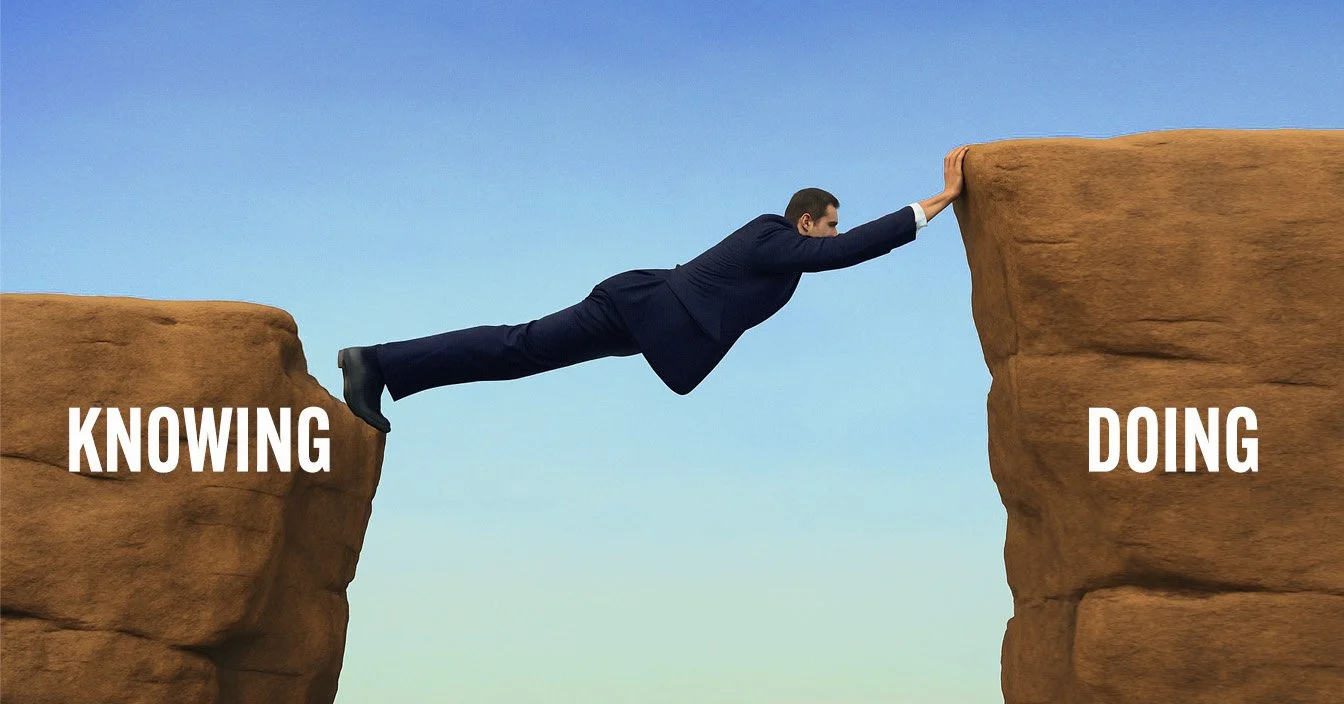
The struggle to turn knowing into consistent behavioural change is real. Researchers Jeffrey Pfeffer and Robert Sutton at Stanford call this the knowing–doing gap – the persistent tendency for organizations and individuals to know what to do, but failing to act on it.


WHY KNOWING IS NOT ENOUGH

Pfeffer and Sutton’s research showed that the problem isn’t knowledge, it’s follow-through. Leaders nod along in agreement during training, then return to business as usual.

Neuroscience helps explain why. Aha moments have been linked to activity in our reward circuits, which helps to explain why it feels so good when we have an insight. That spike of reward makes us feel like something has shifted, but unless it’s paired with concrete practice, the idea remains an “interesting thought” rather than becoming encoded in us as a new behaviour.

In other words, insight is the spark, but repetition is the fuel.


DANIEL’S STORY: FROM INSIGHT TO IMPACT

My client Daniel had been in his VP role for 3 years. During a triangulation meeting at the kick-off of our coaching program, Daniel’s leader told me that he was a brilliant strategist, and deeply respected, but she worried about his pacing because he often seemed exhausted. At our next session, I asked Daniel about that comment, and he told me, “I know I should be delegating more, but when the stakes are high, it just feels faster if I do it myself.” His team had stopped bringing him fully formed solutions because they knew he’d jump in and fix things anyway, so why bother?

We didn’t start with a grand delegation overhaul. Instead, Daniel chose one recurring meeting (a weekly project status update from his team) and agreed to limit his contributions to clarifying questions only. No problem-solving, no swooping in to rescue, no taking the wheel because ‘his way’ was the ‘right way’. Just genuinely curious questions intended to help his team think more deeply about their progress.

The first week of experimenting was painful. “I bit my tongue so hard I thought it might bleed”, he told me in our next session. His team knew something felt different, but didn’t know quite what to make of this different version of Daniel. They presented their updates, looked at him for answers, and the silence made him squirmy – his people too. But he sat in the discomfort of it and managed to stay quiet.

By the third week, something shifted: one of his directors spoke up with a decision Daniel would normally have made. Another shared a bold idea that improved the way they did project oversight. Daniel told me later, “They weren’t perfect, but they were better than I expected them to be. And that’s when I realized that I’ve been underestimating them.”

Shortly after, the team was running the meeting without him stepping in at all. Delegation didn’t happen because Daniel suddenly “knew” he should. It happened because he behaved differently. Daniel had chosen one small, visible experiment and stuck with it long enough for this ‘new way’ to become ‘the way’.


THE TRAP OF “GOOD INTENTIONS”

For many leaders, reflection feels like progress, but without action, it isn’t enough. Sure, after a new aha moment, we can sometimes translate “knowing better” into “doing better.” But other times, awareness shakes us to the core, because we can see the gap clearly, yet have no idea how to close it.

Research from Harvard Business School (Gino & Pisano, 2014) shows that reflection paired with practice improves performance, while reflection on its own rarely shifts behaviour.

“I’ve been thinking about how I need to have that tough conversation.”
“I’ve been meaning to make more time for strategy.”
“I know I should stop filling silences in meetings.”

Thinking about it feels productive. But teams only experience behaviours, not intentions. If you intend to empower yet keep jumping in with answers, your impact is still disempowerment, no matter what you “know.”


BRIDGING THE GAP: WHAT WORKS

Here are four evidence-backed moves that help close the knowing–doing gap:

1. Tiny Experiments
Start small. Insights stick more reliably when translated into if–then plans and repeated practice. Instead of “be a better listener,” try “count to three before responding.” Instead of “do more strategy,” try “schedule 30 minutes every Friday to explore one strategic idea.”

2. Make It Visible
When people track and publicly share progress, they follow through more often. Tell someone what you’re experimenting with: your team, your coach, your peer, and invite feedback.

3. Tight Review Loops
Don’t wait a quarter to reflect. End the day with a simple check-in: Did I run the experiment? What happened? What behaviour do I need to adjust? What will I try tomorrow? Research shows short, structured reviews enhance learning and later performance.

4. Look For and Celebrate the Micro-Wins
Momentum matters. When you notice even a small improvement, pat yourself on the back. It helps you build the confidence to keep experimenting.


Leadership credibility isn’t built only on what you know. It’s built on what people see you do when it counts. So keep seeking out insights and then dare to act on them, letting those actions quietly reshape how you show up. The ripple effects will be visible in your team long before you may even notice them yourself.

Have you been sitting on an insight that hasn’t yet made its way into action? If you’re ready to close your own knowing–doing gap, you don’t have to figure it out alone. If you’re ready to explore, experiment, practice, and see real, lasting results, I’d love to be your coach. Let’s connect at www.leslierohonczy.com.

MENTOR, COACH, TEACHER, OR ADVOCATE: Choose Your Ally Wisely

My first career mentor was a petite powerhouse of a woman named Marie-Lyne. She didn’t hand me a checklist or a script. She encouraged me to get curious about my ‘wiring’, and what makes me tick. She saw my potential before I did. And she held up a mirror that changed how I saw myself and the people I was leading. That single experience transformed my leadership, and it taught me a lesson I return to often: the ally you choose doesn’t just matter; it can shape the leader you become and even change the course of your career.

I know this won’t come as a shock, but not all help is created equal. And if you’ve ever mixed up the role of a mentor with a coach, or a teacher with an advocate, you’re not alone. The lines can blur easily, so let’s get clear on who’s who in the zoo and what they do.


THE MENTOR: WISDOM ON LOAN

Mentors are the wise guides who share their lived experience. They’ve walked further down the road you’re on, and they can shine a light on what’s ahead, to help you see the potholes and boulders. The best mentors share their experiences navigating them by giving you their perspective on what worked for them, what didn’t, and what to watch out for.

Mentors can be inside your organization, offering insight into the culture, hidden rules, and landmines, or outside your company, bringing a broader industry or leadership perspective. Either way, the mentoring relationship is usually long-term and fluid, often lasting years.

Context: Let’s say you’re getting ready to deliver your first board presentation, and you’re nervous. A great mentor can tell you about when they were learning how to present in high-stakes situations, and the techniques they used to structure their presentation, and to calm their nerves.

Best moment to seek a mentor: when you’re at an inflection point in your career and need stories and context from someone who has already wrestled with the decisions you’re facing.


THE COACH: YOUR UNBIASED MIRROR

Coaching is different from mentoring in that the Coach doesn’t give you their experience or answers; they help you find your own. A qualified coach has a deep understanding of human development, and they use exploratory techniques like deep listening and powerful questions to create a safe, non-judgmental, structured space where you can unpack patterns, blind spots, and assumptions that no longer serve you, and experiment with new ways of approaching your coaching topic.

Where mentors lean on their experience, coaches focus on the process of self-exploration, awareness-building, and identifying limiting beliefs. Coaching is structured, with a well-defined topic, a clear aspirational future state, specific developmental goals, regularly scheduled sessions, and measurable outcomes. Unlike mentors or sponsors, a coach isn’t judging your performance or lobbying for your promotion. They walk alongside you, helping you bridge the gap between how you’re approaching your topic now and the vision you’re aiming for.

Context: One of my executive coaching clients explained our relationship to their leader this way: “My coach doesn’t give me advice. She gives me better questions than I was asking myself.” That’s the essence of coaching. In our board presentation example, a good coach will help you explore the limiting belief that triggers your nerves, and to develop techniques that quiet your inner critic in the moment.

Best moment to seek a coach: when you have a specific topic that you need to address, to shift not only what you’re doing but how you’re showing up.


THE TEACHER: BUILDING NEW KNOWLEDGE

When you have a knowledge gap, you need instruction. Teachers, trainers, and facilitators give you structured knowledge, practical tools, frameworks, techniques, and practice, so you can build your skills and capability.

Context: When you’re learning to deliver a board presentation, a teacher can show you the mechanics: how to structure slides, how to pace your delivery, how to manage Q&A. It’s skill-building, plain and simple.

Best moment to seek a teacher: when your gap is tactical and you need proven methods to close it quickly.


THE ADVOCATE: YOUR VOICE IN THE ROOM

Advocates, often called sponsors, open doors. They’re the senior leaders who mention your name when promotions or assignments are being discussed. They stake their reputation on your potential, and they make introductions that change the trajectory of your career.

Here’s the catch: you might not even know you HAVE a sponsor. You don’t usually choose an advocate the way you choose a mentor or coach. They choose you, based on what they’ve seen and the trust you’ve built. You can’t force it, but you can improve the odds by doing excellent work, making your contributions visible, and cultivating relationships with leaders who have influence.

Context: Your sponsor may have been tracking your progress for years, and when a board seat or a major assignment comes up, they’re the one who puts your name forward.

Best moment to seek an advocate: when you’re ready for the next level and need someone with power to clear the path.

A SIMPLE DIAGNOSTIC

Most leaders will need all four types of allies at different times in their career journeys. The mistake isn’t choosing the wrong ally once. It’s assuming one ally can fill every role forever.

So when you’re wondering “Who do I need right now?”, ask yourself:

  • Do I need stories from lived experience? Mentors give hindsight.

  • Do I need clarity and self-awareness? Coaches offer foresight and development.

  • Do I need tactical skills? Teachers help you build skills.

  • Do I need doors opened? Earn the trust of an advocate who can create access.

Marie-Lyne was the first person to show me how powerful the right ally can be. Over the years, I’ve had the privilege of learning from some wonderful mentors, coaches, teachers, and advocates. Their impact reminds me daily that the right support, offered at the right time, can transform a leader’s path.

If you’re at a crossroads and wondering what kind of support you need next, I’d be glad to have that conversation. And if it turns out that executive coaching is the ally you’re looking for, I’d love to explore how we can work together to help you move forward with confidence.

TELLING WOMEN TO 'JUST SPEAK UP': The Problem with Performative Confidence

“You just need to speak up more.”

That’s the feedback my coaching client received from someone on the executive team. She’s a brilliant woman, promoted six months ago, building her team, and is delivering consistent results. Her response? “Speak up more? I’m going hoarse trying to be heard.” 

This is what lazy feedback sounds like. It lands with a thud and no instruction manual. It’s like being told to ‘just play better’ – without knowing which game you’re in, what the rules are, or who’s even keeping score. And yet, women still show up, adapt, and perform. That’s not a confidence gap – that’s a context gap. 


CONFIDENCE ISN’T A CHARACTER TRAIT 

Often, signs of wobbly confidence are treated like a personal failing, or like something women need to ‘fix.’ But that’s not how confidence works. Confidence is a response to context. It’s not that women lack confidence. It’s that they’ve learned there is a cost to displaying it. 

Research from Yale, McKinsey, and Catalyst confirms what many women already know in their bones because they’ve lived it: when we assert ourselves, advocate for our work, or step confidently into leadership space, we’re often judged more critically than our male peers. In cultures like these, success doesn’t automatically follow confidence; it follows calibration. Women learn to weigh every word, tone, and gesture to reduce the potential risk of backlash.

Women don’t dial themselves down out of fear; they do it because experience has taught them how the room tends to respond. We see it every time our ideas are restated by others and only then are taken seriously; when we’re interrupted mid-sentence in a way our male peers aren’t; or when we’re judged as abrasive for using the same tone that makes a man “decisive”. 


THE CREDIBILITY-COMPETENCE TIGHTROPE 

Here’s the impossible equation women are expected to solve: Be warm AND authoritative. Approachable AND assertive. Powerful but NOT pushy. Focus too much on competence, and you’re labelled cold. Lead with approachability, and you’re often underestimated. 

This dynamic, often called the “competence-likability trade-off,” shows up consistently in executive coaching conversations. Sheryl Sandberg described it in her acclaimed book ‘Lean In’ as one of the core tensions women face in leadership. While this pattern is especially well-documented for women, it also affects racialized leaders, neurodiverse professionals, and anyone whose communication style doesn’t match the dominant leadership norms that reward confidence only when it looks and sounds a certain way. 

It creates a constant pressure to perform, but only within a narrow set of rules. “Be confident, but not cocky. Speak up, but don’t overshadow. Be authentic, but only in ways that feel familiar and safe to others.” Telling women to "just project more confidence" doesn’t fix that tension. At best, this advice is unhelpful. At worst, it quietly holds women responsible for navigating a system that still penalises them for showing up fully. 


THE REAL COST OF PERFORMATIVE CONFIDENCE 

I’ve coached hundreds of women who had mastered the ‘act’: the composed tone, carefully measured eye contact, impeccable posture, firm handshake, and polished executive presence. They’d done everything ‘right’. And still, many felt invisible, disconnected from their own voice, and bone-tired from keeping up the performance. 

Performative confidence doesn’t empower – it depletes. 

Grounded confidence feels different. It’s anchored in purpose, emotional congruence, and what I call your ‘ness’: the distinctive wiring that makes you uniquely you. This isn’t about acting. It’s about aligning. We don’t need more women adapting to a narrow version of leadership. We need more workplaces that create the conditions for authentic confidence to thrive. 


SO WHAT ACTUALLY HELPS? 

Here’s what I’ve learned from almost two decades of coaching: 

  1. Confidence grows in context, not in isolation. Instead of asking, “Why doesn’t she speak up?”, ask, “What makes this environment unsafe for her to contribute fully?”

  2. Visibility is relational. Confidence doesn’t live inside one person. It grows in rooms where people are invited in, where their contributions are amplified, and where feedback fuels growth, not fear.

  3. Self-awareness beats self-promotion. Encouraging women to double down on their authentic leadership identity – their ‘ness’ – is far more powerful than any tips on vocal tone or standing tall.

  4. The real work is rewiring the system. Instead of ‘fixing’ women with one-size-fits-all advice, we need to take a closer look at the systems and cultures that still reward confidence in some forms – and penalise it in others. The question isn’t “How do we help women show up more confidently?” It’s “What needs to shift so their confidence can actually land?” 


READY FOR A CHANGE? 

If you're a woman in leadership, you don’t need to fake anything, or turn up the volume, or fit into someone else’s version of presence. You need the space to ground yourself in your wiring, your values, your way of leading. And if you're a leader or ally who wants to support that, the shift starts with curiosity, not critique.  

Try asking:

  • What messages do we send about who gets to speak up, and how are those messages being communicated, implicitly or explicitly?

  • How is confidence interpreted differently depending on who’s expressing it, and who’s listening?

  • In what ways does our culture invite real presence, and when might we be unintentionally rewarding performative behaviours instead?

  • What might shift or become possible if we broadened our definition of executive presence to include a wider range of authentic leadership styles?

Confidence isn’t something women are missing. It’s something that’s often misinterpreted, undervalued, or penalised, depending on who’s expressing it and how closely they match the ‘acceptable’ template. 

If you're a woman in leadership ready to trade performative behaviours for authentic presence, let's talk. Executive coaching can help you reconnect with your voice, your values, and a leadership style that doesn’t require you to shrink or shape-shift. 

And if you're a leader or ally working to foster a more inclusive leadership culture, coaching can help you examine how confidence is encouraged, interpreted, and rewarded in your organisation – and what may need to evolve.

MICRO-YES LEADERSHIP: How Small Agreements Build Big Momentum

Some of the most pivotal leadership decisions are invisible. They aren’t made in boardrooms; they’re made during side chats, hallway run-ins, and Teams threads where no one is keeping score. Influence isn’t earned in a single moment. It’s built in fragments. This article is about that invisible work.

Micro-Yes Leadership is the practice I created for intentionally building momentum through small, cumulative agreements. Not the sweeping yes at the end of the strategy deck. But the little yeses that come long before: the raised eyebrows of curiosity, the half-nods in hallway conversations, the "I hadn't thought of it that way" a-ha moments during early stakeholder chats. It's the art of collecting permission, trust, and alignment in bits and pieces, long before the big meeting even happens.

 It's not persuasion. It's not consensus-seeking. It's influence, scaled down to human size.


WHY MICRO-YES LEADERSHIP MATTERS

In most organizations, change doesn’t happen by declaration. It happens through relationship. It happens because someone felt seen. Because someone felt safe. Because the idea wasn’t dropped on them cold.

Micro-Yeses are like trail markers. They let you know someone is still with you, even if they’re not ready for the whole hike yet.

When a leader overlooks these smaller moments, they often end up surprised when their brilliant pitch lands with a thud. "But the strategy was solid," they say. Maybe so. But alignment isn't an event. It is a process.


WHAT MICRO-YES LEADERS DO DIFFERENTLY

Micro-Yes Leaders listen for subtle cues: curiosity, hesitation, invitation. They notice when someone is warming to an idea, even if they're not ready to say yes just yet. They don't rush the moment; they honour it.

They create the space and time needed for engagement before commitment. They test ideas gently, adapt their language, and check for readiness. They understand that "yes" has many flavours: "Yes, I hear you." "Yes, I trust you." "Yes, I’ll keep thinking about it." 

Micro-Yes Leaders don't bulldoze their vision through the organization. They build it with others, one conversation at a time.


HOW TO BUILD YOUR OWN MICRO-YES PRACTICE

Start by shifting how you define progress. Instead of measuring influence by the number of decisions made, start tracking the number of meaningful engagements. Who asked you a thoughtful question? Who stayed behind after the meeting to clarify something? Who referenced your idea a week later in a different setting?

Here are a few micro-practices you can experiment with that build momentum:

  • Pre-socialize the idea. Share early thinking with a few trusted voices before bringing it to a larger group. Let them react. Adapt based on what you learn.

  • Ask for input, not agreement. "How does this land with you?" goes further than "Do you agree?"

  • Name the trail markers. Say, "It sounds like you're not on board yet, but you're open to exploring." That creates space for evolving commitment.

  • Celebrate the half-yes. Recognize movement, even if it’s not a full endorsement.


THE REAL WIN

Micro-Yes Leadership isn't about manipulation or slow-walking people into things. It's about building trust, and recognizing that real influence is built in informal moments that can feel quiet, impromptu, and unimportant at the time. Until they're not.

If you're waiting for the 'big meeting' to make your case, you might be too late. The decision has often already been made in fragments, in hallways, and in those micro-yes moments you didn’t see. But when you know what to look for, you start to notice how influence actually works: quietly, relationally, and while in motion. You may be amazed at the opportunities you find to shape momentum in small ways that stick.

So look hard. Listen closely. And start where great leadership always starts: with one person, one conversation, and one well-earned yes.

RADICAL SELF-COMPASSION: How High-Achieving Leaders Tame Their Inner Dialog

You’ve got the title, the credentials, and the career wins. And still, a voice in your head whispers, “Not good enough.”

 You’re not alone. I hear some version of this almost daily from the brilliant, high-performing leaders I coach. They’ve led multi-million-dollar transformations, delivered record-breaking quarters, built respected teams, and still feel like they’re faking it.

 Not all the time, of course. But sometimes, in the quiet moments. Or in the Boardroom. Or when getting unexpected feedback. I’ve often said that this harsh inner dialog seems to exist in epidemic proportions. Leadership is hard enough; being your own worst critic makes it exponentially harder.

 Let's look at some of the dangerous myths we find in leadership cultures about the harsh messaging we inflict on ourselves. See if you have any of these limiting beliefs:

  1. If I stop being hard on myself, I’ll lose my edge.

  2. Self-compassion is indulgent or weak.

  3. Without my inner drill sergeant barking in my head, I won’t perform as well.

 These myths need to be retired pronto, because self-compassion is a leadership advantage, not a weakness.


YOUR INNER DIALOG

Most of us have an internal narrative that runs in the background, until that uncomfortable moment when we're feeling vulnerable, and it leaps onto center stage. It's usually the result of a limiting belief that’s been rolling around inside of us (perhaps unexamined), influencing how we perceive ourselves and others. 

 Your inner dialog might sound like “You should’ve known that.” Or “They’re going to figure out you’re not as good as they thought you were.” This persistent mental commentary typically has an uncomfortably pointed message and zero nuance, all delivered via shame, comparison, and second-guessing. And while it might feel like this is a key part of how you protect yourself from failure or humiliation, what it’s really doing is just keeping you small.

 If you’ve ever held back a comment in a senior meeting, over-prepared out of fear of looking incompetent, or felt like a fraud despite plenty of positive feedback to the contrary, you’re familiar with this inner dialog.


HOW INNER DIALOG HIJACKS YOUR LEADERSHIP

For many leaders, the inner dialog gets louder as they climb higher, where the risks are greater, and the expectations are higher.

 Here’s what I often see with my coaching clients:

  • Perfectionism posing as excellence: You rework the presentation ten times, not because it’s not good, but because that narrative says it’s never good enough.

  • Silencing yourself in the room: You hold back bold ideas because that limiting belief says, “Say that, and you’ll look foolish.”

  • Over-functioning for approval: You carry too much for your team. You hustle for validation instead of leading from a centred, grounded stance.

  • Withholding feedback: You avoid tough conversations because you tell yourself that you're not experienced enough to deliver them well.

 And as if that weren't compelling enough, know this: your inner dialog isn't just harsh; it’s contagious. As leaders, when we operate from self-judgment, we unintentionally create cultures where others do the same.


THE RADICAL SELF-COMPASSION ANTIDOTE

I use the word “radical” deliberately. Not because it’s trendy, but because it feels radical to treat ourselves with compassion in a world that trains us to be relentlessly hard on ourselves.

 To be clear, self-compassion isn’t self-pity. And it’s not letting yourself off the hook. It’s the quiet discipline of truthfully acknowledging your intentions, your effort, and your limits, and leading yourself the way you’d lead someone you deeply respect.

 Dr. Kristin Neff, Associate Professor of Educational Psychology at the University of Texas at Austin and pioneer in the field of self-compassion research, defines self-compassion with three elements:

  1. Mindfulness: noticing when you’re struggling

  2. Common humanity: remembering that imperfection is part of being human

  3. Self-kindness: responding to your mistakes with understanding instead of judgment

 And the data backs it up. Leaders who practice self-compassion are more resilient, more adaptable, and more likely to take bold risks because they aren’t afraid that a mistake will destroy their credibility.


PRACTICES TO DIAL DOWN THE DIALOG

When you catch yourself in the grip of a limiting belief or a harsh inner dialog, try this practice:

 1. Identify the Message.
Write down your inner dialog’s message, exactly as you hear it. Use the same tone and words that arise in you. For example, "You haven't prepared enough, and now the Board is going to see how incompetent you really are." This simple act of writing down the message creates needed distance and clarity.

2. Rewrite the Script.

Reframe the harsh message with one that is more positive and less judgmental. For example, “I might mess up. And I’ll recover. I’ve done it before.”
“I’ve prepared for this. I’ve earned my seat at this table.”

3. Switch the Lens.

Consider, “If a colleague or friend said this about themselves, what would I say?”
Now, say that to yourself.

4. Bring in the Body.
Unclench your jaw. Soften your shoulders. Ground your feet. Take some deep breaths all the way to the bottom of your lungs. These micro-shifts signal safety to your nervous system and help reduce your uncomfortable emotions.

5. Remember Who You Are.
You don’t have to become someone else to lead powerfully. You need to become more you. Lead from the place of authenticity: your values, wiring, and presence.


WHAT THIS MEANS FOR YOUR LEADERSHIP

When we practice self-compassion, we don’t lower the bar, we raise it. We stop wasting energy in a constant war with ourselves. We show up bolder. We recover faster. We create psychological safety by modelling it. And we give the people around us permission to do the same.

 You don’t have to bully yourself into better performance. You don’t need to wait until you feel 'worthy' to speak up. And you certainly don’t have to silence your doubts or needs to be taken seriously.

 There’s a better way. If you’re ready to explore how to identify limiting beliefs that are getting in your way, let’s talk. It might be the most radical (and effective) move you make this year.