THE INVISIBLE RULEBOOK: What Women Should Know About the Politics of Visibility

Leslie Rohonczy, IMC™, PCC, Executive Coach, Leadership Expert, Speaker, Author

A few months ago, I had a free exploratory conversation with a senior leader who was looking for an executive coach. She was smart, strategic, and deeply respected by her team. But her frustration was real. “I’m doing everything I’ve been told to do,” she said. “I work hard, I deliver results, I’m easy to work with. And... someone else keeps getting the spotlight.”

If you’re a career-oriented woman, you’ve likely had some version of that conversation with yourself. Or with a friend, or a coach. And it’s not your imagination. You can do everything right, exceed expectations, lead with integrity, even deliver exceptional results, and still watch someone else get the promotion, the credit, the opportunity, or the decision-making authority.

As women, we likely have been told to speak up more. And to speak less. To be assertive. But not intimidating. To show confidence. But not too much confidence, or we'll be seen as arrogant. And most of all, to trust that the results will speak for themselves and our hard work will be rewarded. But results don’t speak; people do. And the people who tend to be heard, seen, and promoted are the ones who’ve learned to navigate the invisible rules of power and influence. They’ve figured out how 'visibility politics' works, when it’s most useful, when it’s risky, and how quickly it can be used against them.


THE MYTH OF MERITOCRACY: HARD WORK ISN’T ENOUGH

There’s a deeply ingrained narrative that if you just put your head down and focus on doing good work, good things will follow. But at the senior leadership level, performance is only one part of the equation. The rest is about power dynamics, relationships, sponsorship, perception, and visibility: do people know who you are, associate your name with strategic value, and see you as someone who belongs in the next-level room?

The traditional old-school leadership pipeline wasn’t designed with women’s experiences, responsibilities, or communication styles in mind. So it’s no wonder that playing by the old rules doesn’t always get us in the game.

Does this feel unfair? Of course it does, because it is! But acknowledging this doesn’t mean we accept it; it means we stop pretending it doesn’t exist. This simple move gives women a clearer picture of the landscape they’re operating in, so they can make some strategic choices about the power dynamics they’re navigating.

What I see too often are brilliant women opting out of the political layer of leadership because it feels manipulative and inauthentic. They just don’t want to play the game. But opting out doesn’t make the game go away. It just means someone else is influencing the outcome.

I'm not suggesting you become someone you’re not, of course. But what about becoming more familiar with how power flows and how to work with it, without compromising your values?


EXECUTIVE INFLUENCE ISN’T LOUD. IT’S STRATEGIC

Executive presence isn’t just about the content of your messages in meetings. It’s also about how you carry yourself, how you build trust, challenge others, and how you calibrate your message for the room you’re in.

Real influence happens through three key channels:

  • TRUST: People believe in your judgment and character because you consistently demonstrate credibility, reliability, and a deep commitment to your work and values. You follow through on your promises, own your decisions, and show up with integrity, even when it’s difficult. That kind of consistency builds trust over time.

  • ALIGNMENT: You understand and speak to what matters most to others and to the mission of the company. While others may get caught up in details, urgency, or distractions, you’re able to zoom out, see the bigger picture, and help others make meaningful connections between priorities, strategy, and outcomes.

  • VISIBILITY: Your work, presence, and voice are known, valued, and repeated in the right rooms. And others carry your message forward even when you’re not in the room. You are seen as influential and strategic, even in your absence. Visibility is not the same as exposure. Women are often visible in the sense of being busy, productive, and praised, but exposure is about being seen by the right people, in the right context, connected to the right conversations.

This isn’t about self-promotion. It’s about strategic participation: knowing when to lean in, when to amplify others, when to ask the hard question, and when to plant a seed and let it grow.


HEALTHY POLITICS VS. TOXIC POWER PLAYS

Let’s define some terms. Office politics, at its best, is just the art of working with people, navigating competing priorities, influencing decisions, and building alliances.

Toxic politics, on the other hand, thrives in environments where trust is low and ‘playing the game’ is rewarded. And unfortunately, when women step into influential roles in these toxic cultures, they often face double standards or are labelled as ‘too much.’

Women are often asked to take on support roles and to help smooth conflict, in order to keep teams functioning, but these roles rarely get rewarded. Meanwhile, access to off-the-record conversations or informal sponsors often happens in places they don’t have access to, or are not invited.

So is the system flawed? Hellya it is. But waiting for the system to change isn’t a viable career strategy. Learning how to work within it, authentically, wisely, and strategically, is a leadership imperative.


WHO GETS CREDIT, WHO GETS HEARD, AND WHO GETS SEEN

One of the most frustrating dynamics I hear from the women leaders I coach is this: they share an idea in a meeting, and no one responds. Ten minutes later, a man repeats it, and suddenly, it’s a brilliant idea.

This is not your imagination. Multiple studies show that men are more likely to be given credit, airtime, and perceived authority, even when women bring equal or better ideas to the table. By the way, this happens to racialized leaders, too. And it’s a double-whammy if you’re a woman of colour.

So what can you do?

  • Take up your full space. Not just physically, but vocally and energetically. Speak early. Speak with intention. Don’t qualify your points with “I could be wrong but…” or “just my two cents…” Those seemingly humble and deferential qualifiers are credibility-killers.

  • Own your ideas. If someone piggybacks off your contribution without acknowledging you, follow up with: “I’m glad that point resonated. Building on what I shared earlier, here’s how I think we could move it forward…”

  • Leverage your allies. Front-load where you can by previewing your ideas with trusted colleagues who can reinforce and validate your input in the room.


HOW COACHING HELPS

Learning to navigate visibility, without apology, performance anxiety, or burnout, is not something most of us were taught. But it can be practiced, built, and even enjoyed.

Many women I coach don’t realize how often they’re unconsciously opting out of influence, minimizing their contributions, avoiding strategic visibility, or underestimating their political capital.

Coaching helps surface these blind spots and offers real-time practice to help you speak with more conviction, hold your power in a room, ask for sponsorship without apology, and decode the invisible rules that are specific to your workplace, all without betraying your values.

In coaching sessions, we work on presence, mindset, on the micro-moves that shift perception. And most importantly, we work on what feels authentic, because influence is not about being louder; it’s about being clear, intentional, and visible in the moments that matter.

Ready to stop waiting to be noticed and start leading on purpose? Reach out for a free exploratory conversation at www.leslierohonczy.com. You don’t need to change who you are to lead powerfully. You just need to stop sitting on the sidelines of your own influence.

WHAT’S ‘RIGHT’ WITH YOUR LEADERSHIP: Focusing on 'What’s Strong', Not ‘What’s Wrong'

Leslie Rohonczy, IMC™, PCC, Executive Coach, Leadership Expert, Speaker, Author

I read a comment recently on LinkedIn that hit me like a brick: “Every article I see is about what NOT to do.”

It's true! We spend a lot of time on this platform talking about what leaders need to improve: gaps to close, skills to develop, behaviours to fix, limiting beliefs to ferret out and overcome. I have read an endless stream of articles promising to help leaders improve all different aspects of their leadership skills. Hell, I've even written a pile of those articles!

It's not just LinkedIn; so many leadership posts, podcasts, and frameworks focus on what we’re doing wrong and how to do better. Now, I love a good stretch goal. But what if the secret to growing as a leader isn’t focusing solely on fixing what’s wrong, but it’s in noticing what’s right.

When we only ever start with what’s missing, we miss something important: the opportunity to build on what’s already strong, to get more of what’s already working. What’s already in you.

So, let’s try something different. Let’s take a short detour from the relentless pursuit of self-optimisation, and take a good, generous look at what’s already right. Not because you’ve “arrived”. But because that’s where the gold is.


WHAT IF YOUR STRENGTHS ARE HIDING IN PLAIN SIGHT?

Here’s something I’ve seen again and again in coaching sessions: people often don’t recognise their own brilliance. Why? Because it comes so naturally to them, they assume it’s nothing special.

I had a coaching client who was struggling to identify her leadership superpowers. “I’m just doing my job,” she said, genuinely baffled. But when I interviewed each person on her team, as part of a coaching observation program, they all talked about how deeply they felt seen and heard by her; how she was able to synthesize competing priorities into clear action steps; and how she made people feel calm in the midst of the chaos of change they were navigating.

When I pointed out that none of this made it onto her self-assessment, she started to see herself differently. It took some digging, but eventually she could acknowledge that while her leadership wasn't flashy, it was stabilising and quietly powerful; the kind of leadership that people trusted.

She hadn't realised that it was a strength because it didn’t feel 'hard'. When something feels easy, it’s easy to overlook. But often, that’s the sign that it’s one of your strengths.


THE EXPERIMENT: ‘REFLECT + RECOGNISE’ PRACTICE

Grab a pen, and let’s take five minutes and experiment with flipping this script.

Instead of asking what you need to fix, try these instead:

  • What have I done in the past month that felt satisfying or energizing?

  • When did I feel most like myself as a leader?

  • What feedback have I received that surprised me in a good way?

  • What comes easily to me that others find difficult?

  • Where have I had a positive impact recently, even if it wasn’t in my job description or span of control?

You might be surprised by what emerges. The goal here isn’t to build a brag list. It’s to surface the invisible strengths that are already part of your leadership fabric.


TURNING UP WHAT’S WORKING

There’s a place for closing gaps and learning new skills, of course. But if you want to grow your leadership skills quickly and sustainably, start by turning the dial up on what’s already resonating.

Ask yourself:

  • What’s one thing I do consistently well?

  • How might I use that strength in a new or more intentional way?

  • Where is that strength underused right now?

For example, if you're naturally great at drawing people into a shared purpose, how might you apply that gift to a new cross-functional initiative that’s been stalling? If your team always feels heard in 1:1s, but you’re less visible in larger meetings, what would it look like to bring that same presence to group settings?

This isn’t about perfection. It’s about intention and precision.


THE ‘BLIND SPOT’ OF YOUR OWN GENIUS

Here’s a simple coaching question that I’ve used hundreds of times:

“What do people often come to you for?”

Not what’s in your job description. Not what you think your value is. But what people actually seek you out for.

Sometimes the answer is strategic clarity, or empathy, or decisiveness, or storytelling. Sometimes it’s humour, or calmness under pressure, or the ability to translate ideas into action.

Whatever it is, that’s your gold. And once you know what it is, you can choose to lean into it even more deliberately.

You might even start to enjoy your leadership more.


FROM SELF-IMPROVEMENT TO SELF-RECOGNITION

The leadership development world doesn’t often say this out loud, but I’m going to: You’re probably doing better than you think.

And even if you have areas you want to grow, that growth becomes easier when it’s built on a foundation of confidence, awareness, and strength.

So take a breath. Notice what’s already working. And give yourself permission to get really good at more of that. Because sometimes the best way to grow is to notice what’s already working for you and others.


Would you like a powerful framework to uncover your own invisible strengths and learn how to use them more intentionally in your leadership? Reach out. That’s the kind of conversation I love to have.

THE FEMALE EXODUS: Why Ambitious Women Are Walking Away

Leslie Rohonczy, IMC™, PCC, Executive Coach, Leadership Expert, Speaker, Author

Something strange is happening in leadership circles.

Talented, ambitious women, the ones who exceed their targets, who juggle the complexities, and make it all look seamless, are quietly stepping away. Not in protest. Not amid scandal. They’re just… done. One day, they’re leading strategy sessions; the next, they’re posting a warm ‘thank-you and goodbye’ on LinkedIn, as they head off into something “new.”

 And you may notice the quiet that usually follows. No raised eyebrows; no real post-mortem. Just another departure, tidily wrapped in gratitude and discretion. But these exits aren’t just personal choices. They’re signals.

 Across Canada, women in senior roles are opting out, not because they lack ambition, but because they’re tired of carrying it alone. They’re stepping back from leadership paths that reward over-functioning and downplay values.

 These departures aren’t dramatic - they’re deliberate. Thoughtful. Carefully curated. And under the polished, optimistic “grateful-for-the-opportunity” posts, something important is happening.


SOMETHING IS SHIFTING

 If it feels like more women are quietly disappearing from leadership pipelines, it’s because they are. According to McKinsey’s Women in the Workplace report (2024), women leaders are exiting their roles at the highest rate ever recorded. Grant Thornton reports that female CEOs in Canada dropped from 28 percent to 19 percent in just one year. A 2023 article in Forbes highlights how misaligned values, persistent bias, and burnout are causing women to step away before they even reach the top.

Yet these stories often go untold. Why? Because most of these women leave well. No drama. No takedowns. Just a respectful goodbye and a professional fade to black.


WHY THEY WALK

Burnout doesn’t always come with a breakdown. Often, it looks like a woman who still shows up, still performs, still keeps the wheels turning, but feels like she’s holding everything together with invisible thread.

She’s the one who gets it done. The one who absorbs the emotional load, smooths the conflict, mentors the junior staff, remembers the context, and catches what others drop. She’s indispensable, until she’s depleted. And when she finally says, “I can’t keep doing this,” it’s not because she’s weak. It’s because she’s done the mental math and realised the cost.

Sometimes there’s a defining moment: the promotion that goes to someone else, the boardroom idea she raised that’s applauded when someone else repeats it. But more often, it’s an accumulation; a slow wearing down. One woman I coach described it as “death by a thousand cuts.” Another said, “I don’t like who I become when I’m working so hard just to be heard.”

More and more women are starting to question whether leadership, as it currently stands, is worth the trade-offs. Whether the relentless pace, the narrow metrics of success, and the unspoken expectations are aligned with the life they want to live.

Many are concluding they’re not.


THE COST OF EXITING GRACEFULLY

Because women are trained to leave respectfully, to minimise disruption, to protect relationships, to make things easier for those left behind, their departures rarely spark reflection.

People assume they left for balance, or family, or something new. But in fact, they didn’t leave to slow down. They left because they weren’t seen. Or because they were asked to stretch further and give more, without the authority or recognition that would make it sustainable.

And when they leave quietly, the system stays the same.


WHAT COACHING CAN OFFER

Executive coaching creates the space to think clearly and make deliberate choices. Some women use coaching to stay on their own terms, by setting new boundaries, recalibrating how they lead, and reconnecting to their purpose. Others realise it’s time to move on, not in defeat, but with clarity and intention. For them, it’s not just ‘what’s next,’ but ‘what’s true for me now?’

Coaching also helps leaders inside organisations to spot the signs that someone is considering an exit. It helps to surface invisible friction points and patterns that never make it into engagement data or exit interviews.


IF YOU’RE READING THIS AND WONDERING…

Maybe you’ve had that quiet internal conversation too: “Am I just tired, or am I ready for something else? Do I still believe in what I’m building here, or am I just holding it together out of habit? If I took away the guilt, would I choose this for myself?”

These are deep, reflective questions that go right to the centre of how we lead, and who we are while doing so.

We need to talk about the exodus, not in whispers, but out loud. We’re not just losing great women; we’re losing the future they could shape if organisations make room for their full leadership presence, not just their performance.

INFLUENCE MAPPING: A Tool for Strategic Career Growth  

Leslie Rohonczy, IMC™, PCC, Executive Coach, Leadership Expert, Speaker, Author

I started working with a senior leader a few months ago, and was excited to help him explore his coaching topic. He wanted to become a high-performing executive and strengthen trust with his peer group. His intention was clear and his commitment seemed high.

In one of our early sessions, I asked him to walk me through his key relationships; the people whose support, trust, and collaboration would be essential to his success. He paused, then said, “Well… I think I have good relationships with most people.”

It wasn’t a bad answer. But it was vague, which told me we’d struck a golden coaching opportunity. I walked him through a powerful tool I developed called the Influence Map. This deceptively simple visual tool helped us map out who mattered most, how much trust existed, whether the influence flowed one way or both, and what kind of emotional cost each relationship carried.

Within minutes, the picture was clear. He was pouring energy into a relationship that wasn’t strategic, avoiding a critical alliance because it felt hard, and underestimating how much invisible credibility he’d already earned in a few places where he’d assumed indifference. He realized that, when it came to strategic relationships, he didn’t need more effort; he needed more precision.

Influence mapping makes visible the invisible social ecosystem you’re leading in. And once you see it, you can lead inside it with far more intention and confidence.


 WHY INFLUENCE MAPPING MATTERS

Influence at the executive level doesn’t follow job titles or org charts. It moves through the channels of trust, clarity, alignment, and shared purpose. If you're trying to drive change, shape culture, or lead cross-functionally, you need more than positional authority. You need strategic influence.

 The Influence Map helps you:

  • Clarify who matters most to your success

  • Diagnose the quality and direction of those relationships

  • Get conscious about where you're spending too much or too little energy

  • Make behavioural choices that improve trust and impact

Many leaders don’t realise until they map it out that they’re overspending influence capital in the wrong places, under-investing in key allies, or coasting in relationships that are quietly draining their credibility.


HOW TO USE THE INFLUENCE MAP

STEP 1: IDENTIFY THE KEY PLAYERS
Using the Influence Map template, place your name in the centre. Then, in the surrounding circles, add the names of individuals who significantly impact your ability to succeed, grow, and lead effectively. Think beyond your immediate team: include your boss, cross-functional partners, direct reports, key external stakeholders, or influential board members. Influence is about proximity to power and perception, not just title.

 STEP 2: TAKE A RELATIONSHIP SNAPSHOT
For each individual, reflect on these four indicators:

  • Trust Level (Low, Medium, High): Is this relationship built on mutual trust?

  • Influence Flow (One-Way or Two-Way): Do you influence each other, or is the flow lopsided?

  • Current Currency: What do you bring to this relationship that earns you influence? Clarity? Calm? Creativity? Reliability? Insight?

  • Emotional Cost (Low, Medium, High): How much energy does this person require from you?

This step alone can surface powerful insights. I’ve seen clients realise that the person they’re working hardest to impress doesn’t actually influence the outcomes that matter most.

STEP 3: DEFINE YOUR STRATEGIC INTENT
Ask yourself:

  • What is the strategic purpose of this relationship?

  • What would make this connection more effective?

  • What’s one behavioural shift I could try to improve it?

Maybe it’s slowing your pace with a fast-moving peer. Or being more transparent with a cautious, trust-sensitive stakeholder. Or having clearer asks with someone who always offers support but rarely follows through.

 STEP 4: PRIORITISE YOUR INFLUENCE
Use simple symbols to code your map:

  • STAR = Needs your attention

  • CHECKMARK = Strong and stable

  • TRIANGLE = Draining without enough return

 Then ask:

  • Who are your allies and advocates?

  • Who represents active friction?

  • Where is there untapped opportunity?

Mapping this visually helps you spot patterns. Maybe all your strong relationships are downward, and you’ve neglected peer or upward influence. Or maybe one draining connection is hijacking your attention and causing unproductive spirals.


EXPLORE POWER DYNAMICS AND POLITICAL ACUMEN

Influence is relational, but it’s also political. Not in the Machiavellian sense, but in the sense of understanding where power lives and how decisions are made.

For each person on your map, ask:

  • What motivates or unsettles them?

  • How do they like to receive information?

  • How is power expressed in this relationship, and how do I tend to respond?

  • What other relationship could help me improve this one?

One client discovered that his most difficult cross-functional partner was deeply influenced by someone he hadn’t built a strong connection with – a surprising but powerful pivot point. Strengthening that second relationship softened the resistance in the first.


ACTION PLAN: WHERE TO START

Choose one relationship on your map that is costing you significant energy but yielding low influence or trust in return. Ask yourself:

  • What am I trying to get from this relationship?

  • Is that realistic, or am I overplaying it?

  • Could a shift to curious diplomacy help? Or is a strategic withdrawal more appropriate?

Influence is rarely about pushing harder. It’s about choosing where and how to invest, creating conditions where trust can take root, and where alignment becomes possible.


READY TO MAP YOUR INFLUENCE?

You don’t need to overhaul your entire relationship strategy overnight. But you do need to look at it. Influence is one of your most valuable leadership assets, and yet most executives don’t take the time to map, audit, or recalibrate it.

Try the Influence Map. Get curious. And if you want help unpacking the patterns or crafting a game plan to lead with more impact and less friction, let’s talk.

I coach senior leaders to build trust, navigate power dynamics, and lead with clarity, confidence, and connection. Reach out today to grow your leadership influence, at www.leslierohonczy.com.

THE CANADIAN ADVANTAGE: What the World Can Learn from Canadian Leadership

Leslie Rohonczy, IMC™, PCC, Executive Coach, Leadership Expert, Speaker, Author

Happy Canada Day, my fellow Canucks!

 It’s Canada Day, eh? If you’re anything like me, you’ve probably got a red shirt on today. Maybe you have a fondness for butter tarts and backyard barbecues, too. As a Canadian, you probably pitch in without being asked; thank the delivery driver; and hold the door for someone three steps behind you. And, like many Canadians, you likely carry the quiet conviction that you don’t need to chase the spotlight to make an impact.

So in tribute to Canada Day, I’d love to shine a light on what makes Canadian leadership so unique, and why our quieter, people-first style is a genuine advantage. This article isn’t just flag-waving (although I’m ferociously proud to be Canadian); it’s an invitation to take a fresh look at how we lead, why it works, and what the world could learn from our human-focused way of doing business.


THE QUIET POWER OF CANADIAN LEADERSHIP

Canadian leadership isn’t loud, brash, or headline-hungry, and that might just be its greatest strength. We’re not known for chest-thumping declarations or viral TED Talk mic drops. We’re not out there “crushing it” or reinventing the future in a flash of hype and hashtags.

We lead the way we live: thoughtfully, quietly, and preferably after a proper cup of coffee. And, under our modesty is a powerful leadership ethos that’s quietly driving some of the most stable, emotionally intelligent, and collaborative workplaces in the world. Maybe it’s time we started owning that, instead of whispering it into our double-doubles. Because we don’t have to be loud to be strong. We don’t need to mimic anyone else’s style to be influential. And we definitely don’t need to pretend to be someone we're not or put on a show to lead well.


LIVING NEXT DOOR TO THE STADIUM

Leading a Canadian company right next door to the U.S. can feel a bit like living beside the stadium on game night. The music’s pounding, the crowd is fired up, and it's a media spectacle of hyped commentators and TV cameras hunting for the next highlight reel. With all this energy and attention, it’s easy to feel like we should crank up our own volume to be noticed.

But Canadian leadership has never been about fighting for the front row or showing off to the halftime cameras. We’re focused on playing the long game with purpose. It’s about earning trust, and nurturing the kind of innovation that quietly changes the game.

We make space for diverse voices and build cultures that people actually want to stay in. We don’t bulldoze, we build; we don’t bluster or dominate the conversation; we ask better questions and then really listen. That’s not a flaw or a gap; that’s wisdom, and it’s what next-generation leadership looks like.


COLLABORATION IS OUR COMPETITIVE ADVANTAGE

Canadians are known for being good at teamwork, and I think it's because our culture has naturally wired us to collaborate. Not just the “check a box” version of teamwork, but the real kind that makes people feel like they matter, and that their voice counts.

Canadian leaders tend to prize collaboration over competition. We like to find common ground. We’re wired to build coalitions, to include, to invite people into the process instead of barreling through it alone. Of course, we’ve been doing this for years. It’s not new to us. But it’s just not usually something we brag about.


SO WHY DON’T WE TALK ABOUT IT MORE?

Because we’re Canadian, and we don’t like to blow our own horns. We’d rather let our results speak for themselves. That’s noble, and also, occasionally, too humble for our own good. The tricky part is, if you never say what makes you great, people might assume you don’t know it yourself.

 So let’s be clear. Canadian leadership is grounded, strategic, and emotionally intelligent. It’s collaborative, adaptable, and fiercely people-first. And it’s exactly what the world needs more of right now.

If you’re a Canadian leader who’s ever felt the pressure to show up differently, to crank up your charisma or dial down your humility, you’re not alone. But you don’t need to become someone else. You need to become more authentically you.


THIS CANADA DAY, STAND TALLER

Go ahead and fly the Maple Leaf with pride. Spell 'neighbourhood' with a 'u'. And say your favourite Canadian letter with pride, 'eh?' And also, take a minute to recognise your Canadian leadership. What makes us great is not that we're the loudest in the room, but that we make the room better by asking the tough questions, modelling our Canadian values, and building the trust needed for true collaboration. That’s not performative; it’s powerful. And that’s the kind of leadership the world needs more of, now more than ever.


If you’re ready to lead with more clarity, confidence, and impact, without turning into a caricature or abandoning your actual values, reach out for a free consultation about how executive coaching can help you build your next leadership chapter. Visit www.leslierohonczy.com to get started.

LEADING LEADERS FOR THE FIRST TIME? Your Old Leadership Playbook Just Expired

Leslie Rohonczy, IMC™, PCC, Executive Coach, Leadership Expert, Speaker, Author

You’ve just been promoted, and you're now leading other leaders. Congratulations!

There’s a moment that comes for every newly minted 'leader of leaders' that’s rarely discussed and seldom taught. Your calendar is fuller, your meetings are longer, and suddenly the job of leading that once felt so natural now feels... oddly slippery.

 You’re still a great leader. But something has shifted. You’ve moved from leading individual contributors to leading other leaders, and that changes everything. It messes with your rhythm, rewrites your role, and forces you to lead in ways that might feel unfamiliar, at least at first.

 Most organizations (even the progressive ones) still treat this promotion like an upward hop, rather than a leadership leap. They assume that the skills that got you here (coaching, prioritizing, and delivering results) will automatically translate to success at the next level.

 But if you're now managing people who manage people, let me be blunt: what got you the promotion is not what will make you successful in the new role.


THE JOB YOU HAD IS GONE.

Let’s name the real challenge: the stuff that made you feel competent, effective, and trusted, like knowing the details, solving problems, jumping in to fix things, can now get in the way.

 You can’t be the fixer anymore. That’s no longer your job. Now, your focus is to grow exceptional leaders who can drive results through their people, while creating the kind of culture others want to be part of.

 Let that land.

 Your value isn’t in knowing everything. It’s in building strong people leaders who can both deliver results and foster inspired, healthy, high-performing teams of their own. That requires a specific mindset shift, some new skills and self-awareness, and healthy doses of humility and self-restraint.


FIVE THINGS THAT MATTER MORE NOW

Based on years of research, coaching leaders and their teams, and delivering in-the-trenches leadership development training, here are five critical shifts for leading other leaders well:

 1. Coaching Matters More

This isn’t about performance feedback. It’s about capacity-building. You’re no longer coaching for technical skill or task execution; you’re coaching leaders to lead. That means helping them think strategically, build trust, hold others accountable, and develop their teams. It’s a different kind of conversation. And it’s the most powerful tool you have.

 2. Thinking Matters More

You’re no longer paid for how much you do; you’re paid for what you think about. This means carving out space for strategic reflection: What’s coming around the corner? What’s not being said? Where are we leaking energy? And yes, that means letting go of firefighting to make room for longer-range, proactive thinking.

 3. Your Example Matters More

If you’re still checking your team’s work, showing up to meetings you should have delegated, or reacting emotionally in a crisis, your managers are learning the wrong things. People don’t just listen to what you say, they watch what you model. What are you unconsciously teaching?

 4. Conversation Matters More

At this level, there are fewer updates and deeper dialogue. Your one-on-ones are coaching conversations, not status reports. Your team meetings build cross-functional trust, and break down silos. Ask more powerful questions; talk less. Create the space where both ideas and people can grow.

 5. Influence Matters More

At this level, your impact isn’t just vertical. It’s lateral and diagonal. How you show up with peers, the way you manage relationships across the organization, and how you model accountability will ripple outward. The power of your new position doesn’t come from proximity to the work; it comes from the strength of your insight and influence.


 COMMON PITFALLS (AND HOW TO AVOID THEM)

From my coaching work and years of delivering leadership development training, here are the five traps newly promoted leaders of leaders fall into most often, and what to do instead:

  • Doing Instead of Delegating: Ask yourself daily, “Should I be doing this, or coaching someone else to own it?”

  • Managing Individual Contributors Instead of Managers: Step back. Let your managers manage. You’re building capability, not substituting for it.

  • Under-Leveraging Your First Team: Treat your leadership team (your peer group) like a team, not a collection of silos. They are your 'first team' now, not your direct reports, and you can leverage the hell out of each other to help you all lead more effectively (see my article on the power of PEER COACHING CIRCLES here).

  • Staying Too Operational: In this new role, you're flying at a higher altitude now, which allows you to see further ahead, and take in a wider horizon line. So look up! Think system. Zoom out before you zoom in.

  • Hiring Mini-Me’s: Resist the urge to hire people who think and act like you. Diversity of style, thought, and experience makes your team stronger.


A QUICK CHECK-IN FOR NEW LEADERS OF LEADERS

  • Are you coaching leadership skills or correcting deliverables? If so, what's driving your need to stay in the weeds? What might help you raise your altitude?

  • Do you spend more time on strategy or task triage? How is your natural preference helping or hindering the people leaders reporting to you?

  • How are you creating a true leadership team, and not just a collection of people who report to you?

  • What behaviours will you intentionally model, to let your managers know what great leadership looks like?

  • How might you be helpful, without getting involved in the working level weeds?


 THE SELF-MANAGEMENT SHIFT

At the 'leading leaders' level, the biggest development gap isn’t skill; it’s self-management. It's learning to tolerate the discomfort of not knowing, not jumping in, and not being the hero. And it’s also the shift from delivering value to creating value. From knowing the answer to asking the better question.

That’s not just a promotion. That’s a transformation.

 If you're stepping into the new world of leading leaders, here's your invitation to recalibrate. If you're ready to grow your confidence, build your strategy muscles, and develop the leaders below you, reach out for a free consultation conversation. Let’s make sure you’re ready for one of the biggest mindset shifts you'll ever make in your leadership journey.

COLD DATA, WARM MEANING & ROI: Relevant Leadership in the AI Age

Leslie Rohonczy, IMC™, PCC, Executive Coach, Leadership Expert, Speaker, Author

The bots are coming! The bots are coming!

Actually, they're already here, and they're forever changing the very fabric of how we work. But if you’ve been wondering whether Artificial Intelligence might someday replace your role as a leader, let's look at what leadership truly calls for in this new machine-learning era. AI may change how we work, but the beating heart of leadership remains profoundly human.

As AI continues to transform how businesses operate, streamlining workflows, crunching complex data, and making rapid decisions, it’s easy to imagine that our human value could be diminishing. But if leaders want to remain relevant, there's one area to double down on, where machines still can’t compete: emotional intelligence.

Hey, good news! It turns out, being human is your competitive advantage.


COLD DATA MEETS WARM MEANING

AI excels at what we might call 'cold data': facts, figures, patterns, research, and probabilities, all processed at a speed that boggles the mind. This ability to process vast amounts of information, find efficiencies, and surface insights is immensely valuable, especially where timely decisions matter.

But leadership decisions don’t happen in a vacuum 

Leaders also rely on 'warm meaning': the emotionally rich, human context we pick up through connection with each other: tone, silence, body language, relationships, intuition, and trust. This isn’t abstract or fluffy woo-woo stuff; it’s grounded, perceptive intelligence.

Warm meaning is what tells you when your team is nearing burnout, when a conflict is quietly gaining momentum, or when someone’s underperformance is rooted in fear, not laziness. When leaders rely only on the available cold data, without tuning in to the emotional dynamics that shape behaviours, they're missing out on half of the critical information they could be using, the kind of information that doesn’t show up on a dashboard, but that shows up in people.

In leadership, 'warm meaning' is about how we connect, how we listen, and respond to the emotional reality around us. AI can inform you that productivity is dipping. But it won’t tell you that your top performer is quietly job-hunting after being passed over for a promotion.

High-impact leaders use both cold data to sharpen their decisions, and warm meaning to ensure they land in ways that inspire, motivate, align, and sustain. 

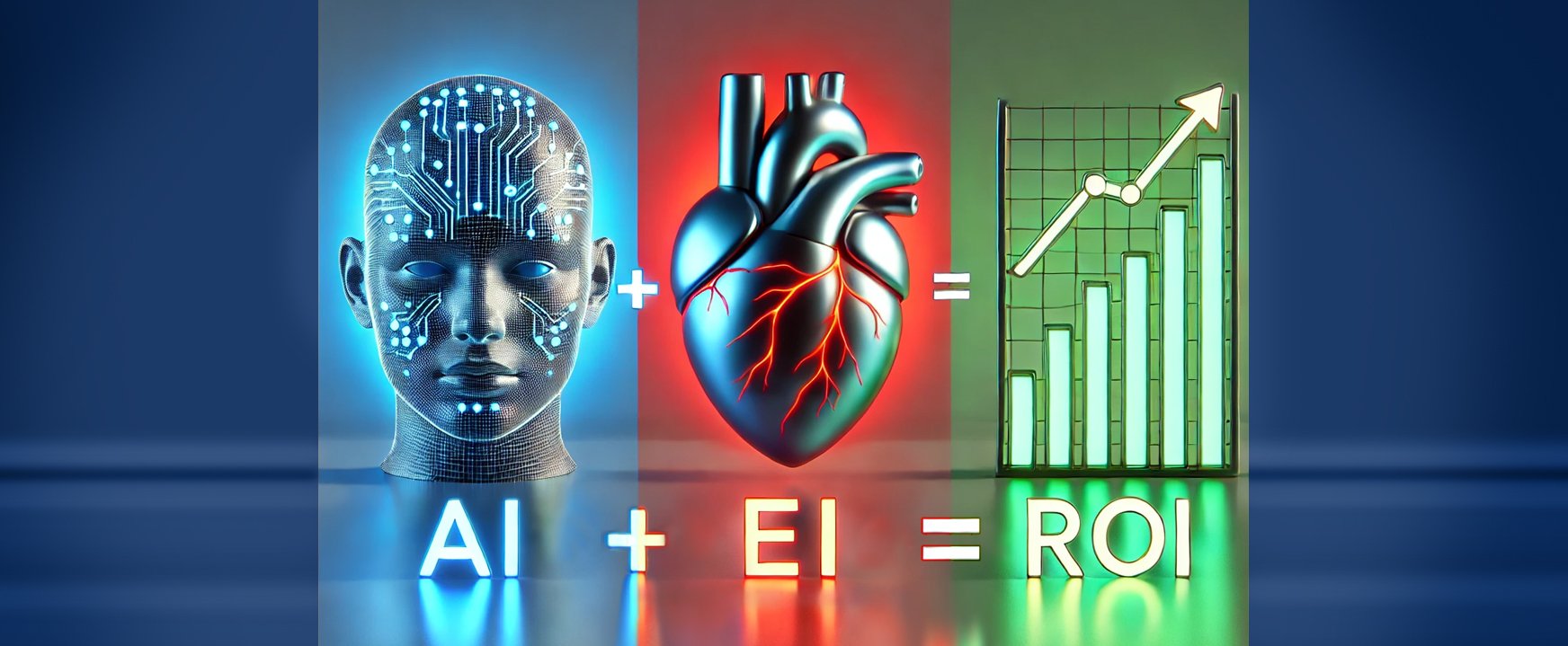
In fact, it’s not just about what you know – it’s about how wisely and humanely you apply it. Future-ready leaders are experimenting with a new equation: AI + EI = ROI. But more on this in a minute


WHY AI ISN’T YOUR ENEMY

I've talked to many leaders about how AI is impacting their teams, and their roles. Some are excited by the possibilities and are willing to embrace it. Others are fearful that they'll become irrelevant, replaced by this technology altogether. While there's no way to predict exactly how the future will unfold, one thing is already clear: AI isn’t the enemy; it’s a powerful ally that, when used well, enhances decision-making, accelerates innovation, and frees up capacity for higher-value work.

According to McKinsey’s 2023 Global Survey, 55% of organisations have adopted AI in at least one function, up from 20% just five years ago. That number will keep rising. Today’s AI tools are being used to:

  • Predict customer behaviour with remarkable accuracy

  • Personalise employee learning and development pathways

  • Improve hiring processes with less bias (when designed properly)

  • Monitor operational performance

  • Optimise pricing strategies based on real-time market data

  • Identify emerging market trends ahead of competitors

  • Streamline back-office operations such as scheduling, forecasting, and logistics

  • Assist with regulatory compliance by flagging anomalies and generating audit trails

  • Provide frontline customer support through natural language chatbots and virtual assistants


Here’s the part that makes me hopeful, even excited, for the future: the World Economic Forum has identified emotional intelligence as one of the top 10 skills of the future. I'm excited about this because, as machines take over routine tasks, the human differentiators – empathy, influence, relationship-building, and self-awareness – become more valuable, not less.


THE EMOTIONAL INTELLIGENCE EDGE

High-performing leaders make people feel seen; they pause before reacting, ask the question no one else thought to ask (or was brave enough to ask). They’re the ones who can read the tension in a room without a word being spoken, who notice when someone’s holding back, and who can name what others are skirting around. That’s emotional intelligence in motion, and in the mad scramble to hire the best and brightest, corporate recruiters look for leaders with high EQ, which is quickly becoming the most powerful differentiator that can set you apart from the pack. 

Daniel Goleman, who helped bring emotional intelligence into the leadership spotlight, found that nearly 90% of the difference between star performers and average ones comes down to EI – not technical expertise

And in 2020, a study published in Frontiers in Psychology found that leaders with high emotional intelligence had teams with significantly higher performance, well-being, and engagement scores.


AI + EI: THE NEW LEADERSHIP BALANCE

The future of leadership isn’t about becoming more robotic. It’s about becoming more human. It’s about blending AI’s cold precision with your own warm presence. Here’s how:

1.      Use AI to inform, not replace, your judgment. Let the data shape your understanding, but not override your wisdom. If AI says productivity is down, ask your team what’s going on before assuming laziness. Trust the numbers, but verify the narrative.

2.      Lead with emotional context. When making decisions with AI input, add the layer that only you can: what’s the emotional temperature of your team? How will this land with them? What invisible variables might be in play?

3.      Practice strategic empathy. Anticipate emotional responses and design your communication with care, especially during change, uncertainty, or conflict, to meet people where they are. Emotionally intelligent leaders don’t just feel for others; they act on that understanding.

4.      Build human-centred cultures in tech-driven environments. AI doesn’t build culture, people do. Use your emotional intelligence to create environments where curiosity, learning, feedback, and collaboration flourish, even when bots are doing half the work.

5.      Model emotional self-regulation. Leaders set the emotional tone. If you’re short-tempered or avoidant under pressure, your team will mirror that. Use self-awareness tools, mindfulness techniques, and coaching to manage your own triggers and stay grounded in tough moments.


One of my current coaching clients is a senior executive in the tech sector, with 7 regional teams in her span of control. She started using AI-powered dashboards to track team performance, and the data was clear: one region was underperforming. The 'cold data' conclusion? This was an under-performing team not focused on delivery. And the 'warm meaning' conclusion? She held skip-level one-on-one conversations with the Director, Team Leaders, and employees, and discovered that the region had lost two key members and was working overtime just to stay afloat. She shifted resources, offered her appreciation to the overwhelmed employees, put well-being supports in place, and helped reset expectations with upper management. Three months later, their performance surged, not because of the dashboard, but because of the human decisions that followed.


OUR HUMANITY WON'T BE AUTOMATED

So what does it actually look like when cold data and warm meaning work together in leadership? It comes down to a simple, but powerful formula: AI + EI = ROI: AI gives you insight, and EQ gives you impact.  

It’s one thing to know what’s happening across your systems, teams, and markets. It’s another to understand how those changes are felt, absorbed, and responded to by real people. While AI can highlight performance dips or flag process gaps, it takes emotionally intelligent leadership to uncover the why behind them, to challenge limiting beliefs that are driving less-than-ideal behaviours, and to navigate the human side of change. 

The return on investment in this equation isn’t just financial, although financial benefits are likely. ROI also shows up in stronger team engagement, faster adaptation to change, higher trust, better retention, and decisions that actually stick because people feel heard, involved, and supported. That’s the kind of return AI can’t fully generate on its own.  

Some AI tools are getting better at mimicking empathy or providing grief support scripts. But let’s not confuse simulation with understanding. Leaders still need to build trust, gauge emotional undercurrents, and respond in the moment to subtle cues that aren’t captured in any dataset. That’s not soft; that’s high-performing leadership. 

If you want to stay future-ready, don’t try to outthink the bots. They can’t lead people with wisdom, presence, and heart. But you can. And that becomes your leadership edge.

"I'M SO BUSY!" How Our Busyness Attachment Kills Trust & Impact

Leslie Rohonczy, IMC™, PCC, Executive Coach, Leadership Expert, Speaker, Author

“I’m just so busy.” We say it, hear it, and even wear it like a badge. But somewhere along the way, busy stopped being impressive – and started becoming a liability.

It’s time to challenge one of leadership’s most quietly damaging blind spots: the cult of busyness.

For years, “busy” has been shorthand for “important.” It signals hustle, responsibility, leadership weight. But there’s an uncomfortable truth beneath this 4-letter word: when busy becomes your default, your credibility takes the hit. Your team gets your leftovers. Strategy disappears. And trust is the first casualty.

Believe me, this is NOT a productivity article. Think of it more like a leadership reckoning. One that calls on high-performing, high-capacity professionals to stop hiding behind full calendars, and start showing up with full presence.

WHEN BUSY ISN’T BRAVE – IT’S BLIND

Many of the senior leaders I coach are smart, committed, and wildly capable. But they’re also often stuck, drowning in meetings, firefighting and problem-solving all day long, running from one obligation to the next with barely a breath in between. And when we dig into the research about this, something strange emerges: they often can’t remember what strategic work they actually did that week.

They’re not failing because they’re lazy. They’re failing because they’re too busy to lead. Here’s what that kind of busyness costs you:

  • Trust erosion: When your team sees you rushing, cancelling, or distracted, they stop bringing you their best. They assume you don’t have time for real conversation.

  • Tactical tunnel vision: Your attention is spent reacting, not shaping. Urgent wins. Important waits.

  • Missed influence moments: Strategic presence isn’t just about being in the room. It’s about how you show up. If your energy is thin and transactional, so is your impact.

  • Credibility creep: Leaders who are constantly busy but rarely available get labelled as unreliable, scattered, or avoidant – even if their intentions are solid.

The busyness bias tells you that filling your calendar is the same as fulfilling your role. It’s not.

A TIME ISSUE – OR A TRUTH ISSUE?

Let’s get clear: busyness isn’t always about workload or external pressure. More often, it’s an emotional decoy – a polished distraction that protects us from something deeper and more uncomfortable.

In coaching sessions, when I ask leaders what might be underneath their relentless pace, I often hear a pause. Then something raw emerges:

  • "If I’m not busy, am I still valuable?"

  • "If I slow down, will everything fall apart?"

  • "If I delegate, will people realise I’m not as indispensable as they think?"

Busyness can serve as armour. It shields us from vulnerability. It lets us avoid the hard work of confronting our worth, our fear of irrelevance, or our struggle with control. But here’s the truth: filling your calendar won’t fill the gap left by uncertainty, self-doubt, or the need for external validation.

This isn’t a time management issue. It’s a mindset and meaning issue. And until we start asking better questions about what our busyness is really doing for us, we can’t lead with full presence.

So let me ask you the real question: What is your busyness protecting you from?

  • “If I’m not busy, am I still valuable?”

  • “If I slow down, will everything fall apart?”

  • “If I delegate, will they realise they don’t need me?”

These are mindset issues, not time issues. And they’re incredibly common. We don’t just have a time management problem. We have a permission problem.

Permission to focus.

Permission to say no.

Permission to stop doing and start leading.

THE LEADERSHIP COST OF BUSY CULTURE

High-output cultures often reward busyness, but rarely examine its downstream impact.

Ask yourself:

  • Do I equate visibility with value?

  • Am I filling space or creating value?

  • Do my actions signal strategic focus – or survival mode?

Because here’s what’s really happening in most “too busy” leaders:

They’re reactive, not responsive. They move fast but think shallow. And over time, they erode the trust, creativity, and collaboration that leadership depends on.

SO, WHAT’S THE ALTERNATIVE?

What does it look like to unhook from busy – and step into something more powerful?

It looks like this:

  • A leader who blocks white space in their week to think, not just react.

  • A VP who finishes meetings early to give people breathing room.

  • An executive who says no with clarity, because strategy is about choosing.

And it sounds like this:

“Let’s revisit what matters most this quarter.”

“If I step back here, what does the team step into?”

“Where is my presence needed – not just my time?”

This isn’t about working less. It’s about leading more intentionally.

THREE PRACTICES TO BREAK THE BUSY BIAS

You don’t need a sabbatical. You need a reset. Here’s where to begin:

1. Audit Your Leadership Calendar

For one week, track your time. Label it: Operational? Relational? Strategic? Then ask yourself: What am I doing out of habit or fear? What am I avoiding? What am I missing? If your calendar doesn’t reflect your priorities, it’s time to renegotiate.

2. Notice the Story Underneath

Ask yourself: What am I afraid would happen if I weren’t so busy? What belief is driving your behaviour? Often, it’s about worth, fear of irrelevance, or discomfort with delegation. Awareness is the first step to choosing differently.

3. Create a Weekly White Space Ritual

Block 90 minutes each week to step out of the churn. No meetings. No messages. Just think, reflect, recalibrate. Ask: What does the organization need from me this week? What does my team need from me? Who haven’t I been fully present with?

BUSY ISN’T A BADGE. IT’S A BARRIER.

Let’s stop rewarding chronic overload like it’s leadership gold. Busyness isn’t your brand. Presence is. Trust doesn’t grow in chaos. Strategy doesn’t emerge from noise. And your influence doesn’t deepen when you’re double-booked and distracted. So the next time you’re tempted to lead with “I’m so busy,” try this instead:

“I’m focused on what matters most.”

“I have the space to think about that properly.”

“I’ve made time for this conversation because it’s important.”

Now that’s leadership impact.

Ready to Reclaim Your Strategic Presence?

If you’re ready to break free from busy and build a leadership brand based on clarity, trust, and presence – let’s talk. Executive coaching can help you rewire your leadership approach, redefine how you spend your time, and refocus your energy on what creates real impact.

Schedule a complimentary discovery session at www.leslierohonczy.com. Let’s stop being busy – and start being bold.

IN PURSUIT OF BETTER METRICS: Why KBIs (Key Behavioural Indicators) Matter More Than You Think

Leslie Rohonczy, IMC™, PCC, Executive Coach, Leadership Expert, Speaker, Author

Everyone loves a good performance dashboard – the glowing greens, the cautionary yellows, the urgent reds. We track revenue, sales targets, service levels, and customer retention like our business lives depend on it. But you can be hitting all your Key Performance Indicators (KPIs) and still have a toxic, disengaged, or dysfunctional team. Why? Because they measure outcomes. But KPIs don’t measure what creates them.


WHEN NUMBERS TELL HALF THE STORY

 A while back, a senior leader reached out, asking for help to shift the culture of his sales team. On paper, they looked like a dream team: quarterly targets crushed, major wins celebrated, and high fives all around. But just beneath the surface of those headline-grabbing KPIs, things were quietly falling apart. Trust had eroded, as the team operated in silos, each member focused on their own scoreboard. Collaboration had all but disappeared, with team members undercutting each other and poaching each others' deals. And two of their top performers had already walked out the door.

What was missing? Visible behavioural accountability.


KEY BEHAVIOURAL INDICATORS (KBIs)

How many KBIs should be on a leader’s scorecard? Ideally, no more than 3 to 5. That range strikes the right balance between focus and effectiveness. Behaviour change requires intention, and tracking too many indicators at once dilutes both attention and impact. A short list allows teams to align more easily, reinforces clarity, and ensures measurement is actionable – not just performative. Behavioural psychology research supports this: leaders are more likely to embed new habits when they work on a small set of consistent behaviours rather than trying to change too much at once. Choose the few KBIs that truly reflect your current strategy, leadership goals, or cultural priorities – and then reinforce them consistently.

If KPIs are the “what,” then KBIs are the “how.” KBIs track the behaviours that drive sustainable high performance – things like collaboration, accountability, emotional intelligence, feedback-seeking, curiosity, and trust-building.

A Key Behavioural Indicator is a clearly defined, observable behaviour that drives a desired outcome. It’s something you can see, name, and coach. It links directly to your strategic goals, not just in theory, but in practice.

Notice the pattern? KBIs aren’t vague character traits like “be collaborative" or "focus on accountability.” They are actions – micro-moves that signal culture, reinforce values, and drive strategy forward.

Start by identifying the observable behaviours that matter most to your strategy or high-level objectives. Then ask yourself:

  • What does it look like when someone is doing this well?

  • What does it look like when they’re not?

  • How can we observe or measure it (qualitatively or quantitatively)?

  • What actions will reinforce it – recognition, coaching, feedback, reflection?

Even simple tracking methods like peer observation grids, pulse surveys, or team retrospectives can surface valuable data.

For example:

  • In a high-accountability culture, someone doing this well might complete their own deliverables and check in on teammates to ensure alignment. High-performing teams show mutual support and shared ownership.

  • Someone not doing this well may avoid difficult conversations or stay silent in meetings. These behaviours often show up in low-trust environments and correlate with disengagement.

  • To observe it, try pulse surveys with prompts like “I feel safe raising concerns in team meetings,” or track feedback exchanges in retrospectives.

  • Reinforce it through peer recognition in meetings, group coaching debriefs, or leadership modeling. For instance, Microsoft’s “Growth Conversations” drove a 76% increase in meaningful manager-employee dialogue by reinforcing learning-focused behavioural habits.


To support your design process, here’s a list of high-impact KBIs that most leaders can start using immediately:

  • Shares feedback directly, constructively, and with compassion

  • Offers support to a peer without being asked

  • Admits a mistake and shares the lesson learned

  • Asks for input before making a team decision

  • Pushes back respectfully when something feels misaligned

  • Speaks up when timelines, quality, or morale are at risk

  • Recognises a colleague for their contribution in a public setting

  • Delegates stretch assignments with built-in feedback loops

  • Raises risks or early warning signs proactively

  • Speaks truth to power; willing to give the leader feedback

  • Actively listens without interrupting or steering the conversation

  • Seeks feedback from peers or direct reports

  • Encourages multiple perspectives in meetings

  • Invites a quieter team member into the conversation

  • Follows through on commitments without being chased

  • Shares bad news transparently with proposed next steps

  • Clarifies priorities when requests feel conflicting

  • Reflects on a tough interaction and brings insights back to the team

  • Practices presence in high-stakes or high-conflict discussions

  • Asks open-ended questions to promote solution-focused dialogue

  • Makes space for emotional responses without shutting them down


These behaviours are subtle, but powerful. And when woven into a team or organisation’s cultural fabric, they create the conditions for trust, innovation, and high performance.


READY TO CREATE YOUR OWN SET OF KBIs?

 Start with the observable behaviours that matter most to your strategy. Remember that a behaviour is something visible and specific (for example, 'acts as a team player' is pretty generic and open to wide interpretation; instead, try 'offers specific feedback to peers that helps improve performance'). You can also look at simple tracking methods like peer observation grids, pulse surveys, or team retrospectives to help you surface valuable data.

How many KBIs should be on a leader’s scorecard? Ideally, you should have no more than 3 to 5. That range strikes the right balance between focus and effectiveness. Behaviour change requires intention, and tracking too many indicators at once dilutes both attention and impact. A short list allows teams to align more easily, reinforces clarity, and ensures measurement is actionable – not just performative. Behavioural psychology research supports this: leaders are more likely to embed new habits when they work on a small set of consistent behaviours rather than trying to change too much at once. Choose the few KBIs that truly reflect your current strategy, leadership goals, or cultural priorities – and then reinforce them consistently.

Once you've defined a few KBIs, ask yourself these questions:

  • What does it look like when someone is doing this behaviour well? In a high-accountability culture, this could mean a team member who not only completes their own deliverables, but also checks in on teammates to ensure interdependencies are on track. High-performing teams consistently exhibit behaviours like mutual support and peer-to-peer ownership.

  • What does it look like when they’re not doing this behaviour well? It's equally important to define what behaviours we don't want. In low-trust environments, team members may defer to silence in meetings, avoid difficult conversations, or hesitate to raise risks – all behaviours that reduce innovation and team development. A disengaged team might say ‘yes’ to the leader in the room, but avoid meaningful follow-up or accountability between peers.

  • How can we observe or measure it (qualitatively or quantitatively)? Try short pulse surveys that ask, “In the past two weeks, I’ve received constructive feedback from a peer,” or “I feel safe raising difficult issues in team settings.” Look for patterns over time, and talk about the observed trends during team meetings.

  • What actions, systems, or learning activities will help to reinforce it (recognition, coaching, feedback, reflection)? Publicly recognise peer-accountability behaviours during team meetings. Use team coaching circles to collectively reflect on what helped (or hurt) the group’s dynamic in a recent project. Beginning in 2015, Microsoft adopted a regular ‘Growth Conversations’ framework as part of its performance management overhaul, which led to a whopping 76% improvement in manager-employee dialogue by shifting the focus from evaluation to ongoing development.


WHEN A TEAM CULTURE TURNED AROUND

One of my executive coaching clients was grappling with a culture of passive-aggression on her leadership team. Meetings were marked by polite agreement, but that surface harmony masked real avoidance. Critical issues went unspoken, tensions were redirected into side conversations, and ownership was minimal. The team was stuck in a loop of performative collaboration and declining results. Their stagnating KPIs were a direct reflection of the underlying behaviours.

We introduced a simple dashboard with five KBIs tied to her goals. My favourite one was “When I don't agree, I say why.” At first, the team said it felt awkward and a bit risky to behave differently. But as the leader started modelling the ideal behaviours she was expecting from the team, and reinforcing it with others, the change in their culture was obvious. After six months, collaboration scores were up by 32%, and project delivery improved significantly.


THE INVITATION

If your leadership metrics are missing something, if you’re chasing numbers without seeing the culture that fuels them; if you're seeing less-than-ideal behaviours you didn't expect, it might be time to add KBIs to your dashboard. Because performance isn’t just about what you do; it’s about how you show up while doing it. 

If your organisation is ready to make behaviour as measurable and meaningful as outcomes, let’s connect. I help leaders align their strategy with the impactful behaviours that will deliver it.

Visit www.leslierohonczy.com to book a free discovery call.

DOES EMOTION HAVE A PLACE IN LEADERSHIP? How High-Performing Leaders Use EQ

Leslie Rohonczy, IMC™, PCC, Executive Coach, Leadership Expert, Speaker, Author

A few days ago, my son-in-law, a psychology student, asked me a deceptively simple question as part of his research project: “How do you define emotion?” It stopped me in my tracks, not because I didn’t have an answer, but because I realised that, when anyone asks me about emotion, it's usually in the context of "how do I stop feeling these uncomfortable emotions, and get more of the feel-good ones?"

 We often use the word emotion, assuming that everyone knows what we mean. Yet most of us would struggle to pin down exactly what emotion is, especially in the context of leadership. I sat with his question for a moment, recognising that this was more than just a question for a student paper. It was a doorway into one of the most misunderstood aspects of being human, and one of the most underutilised leadership assets.

 Ask a thousand people what emotion is, and you’ll get a thousand different definitions. But here’s the one I gave my son-in-law, and it’s the one I’ve come to believe as an executive coach, after years of witnessing leaders, teams, and organizations grow and thrive because of what emotion makes visible.


Emotion is data. It is the body’s first response to a stimulus, often milliseconds before our conscious mind has time to interpret it. From a neuroscience perspective, our amygdala (the emotional processing centre) activates more quickly than our prefrontal cortex (our logic and analysis centre). In other words, emotion is faster than logic, louder than reason, and inconveniently immune to our efforts to suppress or ignore it. That can feel unsettling, particularly for those who pride themselves on rational decision-making and derive their leadership credibility from cognitive mastery.

 But emotion is also meaning. It’s how we register what matters. Whether it’s joy lighting us up, anger alerting us to a boundary, or fear waving a bright red flag, emotion helps us locate ourselves in the world, and in leadership, in real time.

 And yet, despite being one of the most common and trustworthy internal indicators we have, emotion has long been treated like a professional liability. Too unpredictable. Too messy. Too… human.


THE CULTURE OF EMOTIONAL SUPPRESSION

 Most of us were taught to manage emotion by suppressing it: Don’t take it personally. Don’t wear your heart on your sleeve. Don't be 'too much'. Don’t let them see you sweat. In other words: don’t feel. Or, at least, don’t show that you feel.

 We’ve been sold the myth that emotional neutrality equals professionalism; that stoicism is strength. But that approach often backfires because when leaders minimize emotion, they don’t actually regulate it, they repress it. And repressed emotion doesn’t disappear. Ever. It goes underground, festering, until it leaks out sideways, in sarcasm, defensiveness, and passive-aggressive emails, contributing to a culture of fear and silence. The result is disconnected leaders, disengaged teams, and decisions that lack empathy, context, and alignment.


EMOTION AS BUSINESS INTELLIGENCE

 Let’s reframe the story. Emotion isn’t just a personal experience; it’s a form of business intelligence, a critical input to high-quality decision-making, strategy, and leadership effectiveness.

 When we learn to tune into emotion with curiosity rather than judgment, we begin to access a deeper form of intelligence: emotional intelligence. But to make that shift, we first need to understand what emotion actually is from a scientific and leadership lens. Here are four key insights:

 1.      The body feels it first. Neuroscience confirms that the brain’s emotional system (particularly the amygdala) reacts to stimuli milliseconds before the logical prefrontal cortex kicks in. Researchers like Joseph LeDoux and Antonio Damasio have shown that bodily sensations and gut feelings often precede conscious awareness. So yes, your body does feel it before your brain can make sense of it.

2.      Emotions aren’t sent by a signal; they are the signal. While it's poetic to say emotions "send us a message," what’s actually happening is that emotions are the message. They are automatic responses designed to draw our attention to something important. Emotions arise to prepare us for action, not to confuse us. They're not disruptive, but they're not directions for action just yet.

3.      The story follows. Once the body responds, the brain interprets the emotional signal by constructing a narrative. This is how we make sense of the feeling: we assign it meaning based on past experiences, current context, and our personal wiring. Sometimes the story is accurate. Sometimes it isn’t. But it's always our brain’s best attempt to explain what we’re feeling based on what we already know.

4.      There’s a moment of choice, if we’re trained to notice it. Viktor Frankl famously wrote that between stimulus and response there is a space, and in that space lies our power to choose. While not everyone has easy access to this space automatically, research shows that self-awareness practices like mindfulness and coaching can expand it. Leaders who are trained to pause, reflect, and regulate their emotional response gain tremendous power to act with intention instead of reacting out of habit.

 When leaders learn to interpret emotion as data, in themselves and in others, they gain access to vital, often overlooked business signals: early warning signs of disengagement, shifts in culture, misalignment in values, or momentum behind innovation. When emotion and reason are aligned, we make sharper business decisions with greater clarity, integrity, and human impact. When we ignore one or the other, we miss half the picture.


THE LEADER’S ROLE: EMOTIONAL FLUENCY

So what does this mean for leadership, specifically? It means that the most effective leaders don’t try to suppress or avoid emotion; they learn to work with it intentionally and strategically, integrating it into their decision-making and leadership presence. They become emotionally fluent, able to recognise what they are feeling, accurately name it, and use that information wisely. But emotional fluency isn’t just about personal regulation; it’s also about leadership effectiveness in action.

 Emotionally fluent leaders use emotion in two essential ways:

1.      With Themselves: They notice what they’re feeling in real time, pause before reacting, and use those internal cues as insight into what matters most. For example, if a surge of frustration arises in a meeting, they pause to consider what boundary may have been crossed or what expectation may have been missed. Instead of ignoring or rationalising the feeling, they investigate it, from a calm and curious stance. This helps them lead with intention rather than impulse.

2.      With Others: Emotionally fluent leaders are attuned to emotional cues in their teams. They notice when morale dips, when someone’s energy shifts, or when a room suddenly goes quiet. They ask thoughtful questions like, “How did that decision land for you?” or “What are we not saying out loud right now?” They listen not just for content, but for emotional subtext. They know that emotional safety is a precondition for innovation, collaboration, and trust.

 This is the difference between reactivity and presence, between saying “I’m fine” with a clenched jaw, and pausing to say, “I’m frustrated by how this landed; let’s talk it through,” between powering through and quietly burning out.

 Emotionally fluent leaders don’t just model composure; they model the courage to feel, to acknowledge, to navigate complex human dynamics with openness and clarity. They create cultures where feelings are acknowledged, not feared; where feedback isn’t a threat, it’s an opportunity; and where humanity is not a weakness, but a leadership asset.

 And the impact is profound: trust increases, innovation grows, psychological safety expands, and teams become more cohesive and resilient because individuals feel seen, heard, and valued, not just for what they do, but for who they are as people.


THE COST OF EMOTIONAL ILLITERACY

 Let’s flip the script again. What happens when leaders don’t engage with or allow for the full range of human emotion?

 We see defensiveness instead of accountability, silence instead of honest feedback, leaders who bulldoze through meetings, wondering why no one speaks up, cultures that reward perfection over progress, and compliance over creativity and innovation. Do you notice any of these in your culture?

 That gap, or ‘leadership disconnect’, is what happens when a leader’s self-perception is out of step with how they’re actually experienced by others. And it often stems not from a lack of awareness, but from a resistance to the vulnerability required to acknowledge, express, and work with emotion, both in themselves and in those around them.


TURNING AWARENESS INTO ACTION

 So, how do we shift this and move from emotional avoidance to emotional fluency? We start by understanding that feeling is thinking. Emotional fluency isn’t just about managing discomfort. It’s also about amplifying insight from the moments when things feel aligned; when we’re proud, inspired, grateful, joyful, or at ease. These so-called positive emotions are often overlooked, but they hold vital clues about what’s working, what matters most, and what we want more of in our leadership.

 Take a minute right now to reflect on your leadership journey, where you've come from, and where you're going. Then use these questions to help translate emotional awareness into practical insight:

  • What emotion am I experiencing right now? Name it clearly. Is it frustration, anxiety, hope, pride? Here's a handy tool to help you identify your emotions: WHEEL OF EMOTIONS

  • Where do I feel it in my body? Notice the sensation. Is it tension in your shoulders, heaviness in your belly, a tight jaw, flutters in your chest, tingling on your scalp, or something else?

  • What is this emotion telling me? Is it pointing to a value being challenged, a boundary that was crossed, a need for reassurance, an opportunity to be explored, gratitude to be expressed, or something else?

  • What’s the story I’m telling myself about this situation, and is it true? Could there be a different interpretation, a limiting belief, or an assumption to challenge?

 Once we’ve created some space between the feeling and the action, we can choose the response that aligns with who we are, and the impact we want to have. Emotionally intelligent leadership is the ability to feel fully and respond wisely. We are emotional beings who think, not thinkers who happen to feel. And if we want to lead with clarity, connection, and courage, we treat emotion not as a liability but as the leadership superpower it truly is.