HOW WE WORK

THE CANADIAN ADVANTAGE: What the World Can Learn from Canadian Leadership

Leslie Rohonczy, IMC™, PCC, Executive Coach, Leadership Expert, Speaker, Author

Happy Canada Day, my fellow Canucks!

 It’s Canada Day, eh? If you’re anything like me, you’ve probably got a red shirt on today. Maybe you have a fondness for butter tarts and backyard barbecues, too. As a Canadian, you probably pitch in without being asked; thank the delivery driver; and hold the door for someone three steps behind you. And, like many Canadians, you likely carry the quiet conviction that you don’t need to chase the spotlight to make an impact.

So in tribute to Canada Day, I’d love to shine a light on what makes Canadian leadership so unique, and why our quieter, people-first style is a genuine advantage. This article isn’t just flag-waving (although I’m ferociously proud to be Canadian); it’s an invitation to take a fresh look at how we lead, why it works, and what the world could learn from our human-focused way of doing business.


THE QUIET POWER OF CANADIAN LEADERSHIP

Canadian leadership isn’t loud, brash, or headline-hungry, and that might just be its greatest strength. We’re not known for chest-thumping declarations or viral TED Talk mic drops. We’re not out there “crushing it” or reinventing the future in a flash of hype and hashtags.

We lead the way we live: thoughtfully, quietly, and preferably after a proper cup of coffee. And, under our modesty is a powerful leadership ethos that’s quietly driving some of the most stable, emotionally intelligent, and collaborative workplaces in the world. Maybe it’s time we started owning that, instead of whispering it into our double-doubles. Because we don’t have to be loud to be strong. We don’t need to mimic anyone else’s style to be influential. And we definitely don’t need to pretend to be someone we're not or put on a show to lead well.


LIVING NEXT DOOR TO THE STADIUM

Leading a Canadian company right next door to the U.S. can feel a bit like living beside the stadium on game night. The music’s pounding, the crowd is fired up, and it's a media spectacle of hyped commentators and TV cameras hunting for the next highlight reel. With all this energy and attention, it’s easy to feel like we should crank up our own volume to be noticed.

But Canadian leadership has never been about fighting for the front row or showing off to the halftime cameras. We’re focused on playing the long game with purpose. It’s about earning trust, and nurturing the kind of innovation that quietly changes the game.

We make space for diverse voices and build cultures that people actually want to stay in. We don’t bulldoze, we build; we don’t bluster or dominate the conversation; we ask better questions and then really listen. That’s not a flaw or a gap; that’s wisdom, and it’s what next-generation leadership looks like.


COLLABORATION IS OUR COMPETITIVE ADVANTAGE

Canadians are known for being good at teamwork, and I think it's because our culture has naturally wired us to collaborate. Not just the “check a box” version of teamwork, but the real kind that makes people feel like they matter, and that their voice counts.

Canadian leaders tend to prize collaboration over competition. We like to find common ground. We’re wired to build coalitions, to include, to invite people into the process instead of barreling through it alone. Of course, we’ve been doing this for years. It’s not new to us. But it’s just not usually something we brag about.


SO WHY DON’T WE TALK ABOUT IT MORE?

Because we’re Canadian, and we don’t like to blow our own horns. We’d rather let our results speak for themselves. That’s noble, and also, occasionally, too humble for our own good. The tricky part is, if you never say what makes you great, people might assume you don’t know it yourself.

 So let’s be clear. Canadian leadership is grounded, strategic, and emotionally intelligent. It’s collaborative, adaptable, and fiercely people-first. And it’s exactly what the world needs more of right now.

If you’re a Canadian leader who’s ever felt the pressure to show up differently, to crank up your charisma or dial down your humility, you’re not alone. But you don’t need to become someone else. You need to become more authentically you.


THIS CANADA DAY, STAND TALLER

Go ahead and fly the Maple Leaf with pride. Spell 'neighbourhood' with a 'u'. And say your favourite Canadian letter with pride, 'eh?' And also, take a minute to recognise your Canadian leadership. What makes us great is not that we're the loudest in the room, but that we make the room better by asking the tough questions, modelling our Canadian values, and building the trust needed for true collaboration. That’s not performative; it’s powerful. And that’s the kind of leadership the world needs more of, now more than ever.


If you’re ready to lead with more clarity, confidence, and impact, without turning into a caricature or abandoning your actual values, reach out for a free consultation about how executive coaching can help you build your next leadership chapter. Visit www.leslierohonczy.com to get started.

LEADING LEADERS FOR THE FIRST TIME? Your Old Leadership Playbook Just Expired

Leslie Rohonczy, IMC™, PCC, Executive Coach, Leadership Expert, Speaker, Author

You’ve just been promoted, and you're now leading other leaders. Congratulations!

There’s a moment that comes for every newly minted 'leader of leaders' that’s rarely discussed and seldom taught. Your calendar is fuller, your meetings are longer, and suddenly the job of leading that once felt so natural now feels... oddly slippery.

 You’re still a great leader. But something has shifted. You’ve moved from leading individual contributors to leading other leaders, and that changes everything. It messes with your rhythm, rewrites your role, and forces you to lead in ways that might feel unfamiliar, at least at first.

 Most organizations (even the progressive ones) still treat this promotion like an upward hop, rather than a leadership leap. They assume that the skills that got you here (coaching, prioritizing, and delivering results) will automatically translate to success at the next level.

 But if you're now managing people who manage people, let me be blunt: what got you the promotion is not what will make you successful in the new role.


THE JOB YOU HAD IS GONE.

Let’s name the real challenge: the stuff that made you feel competent, effective, and trusted, like knowing the details, solving problems, jumping in to fix things, can now get in the way.

 You can’t be the fixer anymore. That’s no longer your job. Now, your focus is to grow exceptional leaders who can drive results through their people, while creating the kind of culture others want to be part of.

 Let that land.

 Your value isn’t in knowing everything. It’s in building strong people leaders who can both deliver results and foster inspired, healthy, high-performing teams of their own. That requires a specific mindset shift, some new skills and self-awareness, and healthy doses of humility and self-restraint.


FIVE THINGS THAT MATTER MORE NOW

Based on years of research, coaching leaders and their teams, and delivering in-the-trenches leadership development training, here are five critical shifts for leading other leaders well:

 1. Coaching Matters More

This isn’t about performance feedback. It’s about capacity-building. You’re no longer coaching for technical skill or task execution; you’re coaching leaders to lead. That means helping them think strategically, build trust, hold others accountable, and develop their teams. It’s a different kind of conversation. And it’s the most powerful tool you have.

 2. Thinking Matters More

You’re no longer paid for how much you do; you’re paid for what you think about. This means carving out space for strategic reflection: What’s coming around the corner? What’s not being said? Where are we leaking energy? And yes, that means letting go of firefighting to make room for longer-range, proactive thinking.

 3. Your Example Matters More

If you’re still checking your team’s work, showing up to meetings you should have delegated, or reacting emotionally in a crisis, your managers are learning the wrong things. People don’t just listen to what you say, they watch what you model. What are you unconsciously teaching?

 4. Conversation Matters More

At this level, there are fewer updates and deeper dialogue. Your one-on-ones are coaching conversations, not status reports. Your team meetings build cross-functional trust, and break down silos. Ask more powerful questions; talk less. Create the space where both ideas and people can grow.

 5. Influence Matters More

At this level, your impact isn’t just vertical. It’s lateral and diagonal. How you show up with peers, the way you manage relationships across the organization, and how you model accountability will ripple outward. The power of your new position doesn’t come from proximity to the work; it comes from the strength of your insight and influence.


 COMMON PITFALLS (AND HOW TO AVOID THEM)

From my coaching work and years of delivering leadership development training, here are the five traps newly promoted leaders of leaders fall into most often, and what to do instead:

  • Doing Instead of Delegating: Ask yourself daily, “Should I be doing this, or coaching someone else to own it?”

  • Managing Individual Contributors Instead of Managers: Step back. Let your managers manage. You’re building capability, not substituting for it.

  • Under-Leveraging Your First Team: Treat your leadership team (your peer group) like a team, not a collection of silos. They are your 'first team' now, not your direct reports, and you can leverage the hell out of each other to help you all lead more effectively (see my article on the power of PEER COACHING CIRCLES here).

  • Staying Too Operational: In this new role, you're flying at a higher altitude now, which allows you to see further ahead, and take in a wider horizon line. So look up! Think system. Zoom out before you zoom in.

  • Hiring Mini-Me’s: Resist the urge to hire people who think and act like you. Diversity of style, thought, and experience makes your team stronger.


A QUICK CHECK-IN FOR NEW LEADERS OF LEADERS

  • Are you coaching leadership skills or correcting deliverables? If so, what's driving your need to stay in the weeds? What might help you raise your altitude?

  • Do you spend more time on strategy or task triage? How is your natural preference helping or hindering the people leaders reporting to you?

  • How are you creating a true leadership team, and not just a collection of people who report to you?

  • What behaviours will you intentionally model, to let your managers know what great leadership looks like?

  • How might you be helpful, without getting involved in the working level weeds?


 THE SELF-MANAGEMENT SHIFT

At the 'leading leaders' level, the biggest development gap isn’t skill; it’s self-management. It's learning to tolerate the discomfort of not knowing, not jumping in, and not being the hero. And it’s also the shift from delivering value to creating value. From knowing the answer to asking the better question.

That’s not just a promotion. That’s a transformation.

 If you're stepping into the new world of leading leaders, here's your invitation to recalibrate. If you're ready to grow your confidence, build your strategy muscles, and develop the leaders below you, reach out for a free consultation conversation. Let’s make sure you’re ready for one of the biggest mindset shifts you'll ever make in your leadership journey.

COLD DATA, WARM MEANING & ROI: Relevant Leadership in the AI Age

Leslie Rohonczy, IMC™, PCC, Executive Coach, Leadership Expert, Speaker, Author

The bots are coming! The bots are coming!

Actually, they're already here, and they're forever changing the very fabric of how we work. But if you’ve been wondering whether Artificial Intelligence might someday replace your role as a leader, let's look at what leadership truly calls for in this new machine-learning era. AI may change how we work, but the beating heart of leadership remains profoundly human.

As AI continues to transform how businesses operate, streamlining workflows, crunching complex data, and making rapid decisions, it’s easy to imagine that our human value could be diminishing. But if leaders want to remain relevant, there's one area to double down on, where machines still can’t compete: emotional intelligence.

Hey, good news! It turns out, being human is your competitive advantage.


COLD DATA MEETS WARM MEANING

AI excels at what we might call 'cold data': facts, figures, patterns, research, and probabilities, all processed at a speed that boggles the mind. This ability to process vast amounts of information, find efficiencies, and surface insights is immensely valuable, especially where timely decisions matter.

But leadership decisions don’t happen in a vacuum 

Leaders also rely on 'warm meaning': the emotionally rich, human context we pick up through connection with each other: tone, silence, body language, relationships, intuition, and trust. This isn’t abstract or fluffy woo-woo stuff; it’s grounded, perceptive intelligence.

Warm meaning is what tells you when your team is nearing burnout, when a conflict is quietly gaining momentum, or when someone’s underperformance is rooted in fear, not laziness. When leaders rely only on the available cold data, without tuning in to the emotional dynamics that shape behaviours, they're missing out on half of the critical information they could be using, the kind of information that doesn’t show up on a dashboard, but that shows up in people.

In leadership, 'warm meaning' is about how we connect, how we listen, and respond to the emotional reality around us. AI can inform you that productivity is dipping. But it won’t tell you that your top performer is quietly job-hunting after being passed over for a promotion.

High-impact leaders use both cold data to sharpen their decisions, and warm meaning to ensure they land in ways that inspire, motivate, align, and sustain. 

In fact, it’s not just about what you know – it’s about how wisely and humanely you apply it. Future-ready leaders are experimenting with a new equation: AI + EI = ROI. But more on this in a minute


WHY AI ISN’T YOUR ENEMY

I've talked to many leaders about how AI is impacting their teams, and their roles. Some are excited by the possibilities and are willing to embrace it. Others are fearful that they'll become irrelevant, replaced by this technology altogether. While there's no way to predict exactly how the future will unfold, one thing is already clear: AI isn’t the enemy; it’s a powerful ally that, when used well, enhances decision-making, accelerates innovation, and frees up capacity for higher-value work.

According to McKinsey’s 2023 Global Survey, 55% of organisations have adopted AI in at least one function, up from 20% just five years ago. That number will keep rising. Today’s AI tools are being used to:

  • Predict customer behaviour with remarkable accuracy

  • Personalise employee learning and development pathways

  • Improve hiring processes with less bias (when designed properly)

  • Monitor operational performance

  • Optimise pricing strategies based on real-time market data

  • Identify emerging market trends ahead of competitors

  • Streamline back-office operations such as scheduling, forecasting, and logistics

  • Assist with regulatory compliance by flagging anomalies and generating audit trails

  • Provide frontline customer support through natural language chatbots and virtual assistants


Here’s the part that makes me hopeful, even excited, for the future: the World Economic Forum has identified emotional intelligence as one of the top 10 skills of the future. I'm excited about this because, as machines take over routine tasks, the human differentiators – empathy, influence, relationship-building, and self-awareness – become more valuable, not less.


THE EMOTIONAL INTELLIGENCE EDGE

High-performing leaders make people feel seen; they pause before reacting, ask the question no one else thought to ask (or was brave enough to ask). They’re the ones who can read the tension in a room without a word being spoken, who notice when someone’s holding back, and who can name what others are skirting around. That’s emotional intelligence in motion, and in the mad scramble to hire the best and brightest, corporate recruiters look for leaders with high EQ, which is quickly becoming the most powerful differentiator that can set you apart from the pack. 

Daniel Goleman, who helped bring emotional intelligence into the leadership spotlight, found that nearly 90% of the difference between star performers and average ones comes down to EI – not technical expertise. 

And in 2020, a study published in Frontiers in Psychology found that leaders with high emotional intelligence had teams with significantly higher performance, well-being, and engagement scores.


AI + EI: THE NEW LEADERSHIP BALANCE

The future of leadership isn’t about becoming more robotic. It’s about becoming more human. It’s about blending AI’s cold precision with your own warm presence. Here’s how:

1.      Use AI to inform, not replace, your judgment. Let the data shape your understanding, but not override your wisdom. If AI says productivity is down, ask your team what’s going on before assuming laziness. Trust the numbers, but verify the narrative.

2.      Lead with emotional context. When making decisions with AI input, add the layer that only you can: what’s the emotional temperature of your team? How will this land with them? What invisible variables might be in play?

3.      Practice strategic empathy. Anticipate emotional responses and design your communication with care, especially during change, uncertainty, or conflict, to meet people where they are. Emotionally intelligent leaders don’t just feel for others; they act on that understanding.

4.      Build human-centred cultures in tech-driven environments. AI doesn’t build culture, people do. Use your emotional intelligence to create environments where curiosity, learning, feedback, and collaboration flourish, even when bots are doing half the work.

5.      Model emotional self-regulation. Leaders set the emotional tone. If you’re short-tempered or avoidant under pressure, your team will mirror that. Use self-awareness tools, mindfulness techniques, and coaching to manage your own triggers and stay grounded in tough moments.


One of my current coaching clients is a senior executive in the tech sector, with 7 regional teams in her span of control. She started using AI-powered dashboards to track team performance, and the data was clear: one region was underperforming. The 'cold data' conclusion? This was an under-performing team not focused on delivery. And the 'warm meaning' conclusion? She held skip-level one-on-one conversations with the Director, Team Leaders, and employees, and discovered that the region had lost two key members and was working overtime just to stay afloat. She shifted resources, offered her appreciation to the overwhelmed employees, put well-being supports in place, and helped reset expectations with upper management. Three months later, their performance surged, not because of the dashboard, but because of the human decisions that followed.


OUR HUMANITY WON'T BE AUTOMATED

So what does it actually look like when cold data and warm meaning work together in leadership? It comes down to a simple, but powerful formula: AI + EI = ROI: AI gives you insight, and EQ gives you impact.  

It’s one thing to know what’s happening across your systems, teams, and markets. It’s another to understand how those changes are felt, absorbed, and responded to by real people. While AI can highlight performance dips or flag process gaps, it takes emotionally intelligent leadership to uncover the why behind them, to challenge limiting beliefs that are driving less-than-ideal behaviours, and to navigate the human side of change. 

The return on investment in this equation isn’t just financial, although financial benefits are likely. ROI also shows up in stronger team engagement, faster adaptation to change, higher trust, better retention, and decisions that actually stick because people feel heard, involved, and supported. That’s the kind of return AI can’t fully generate on its own.  

Some AI tools are getting better at mimicking empathy or providing grief support scripts. But let’s not confuse simulation with understanding. Leaders still need to build trust, gauge emotional undercurrents, and respond in the moment to subtle cues that aren’t captured in any dataset. That’s not soft; that’s high-performing leadership. 

If you want to stay future-ready, don’t try to outthink the bots. They can’t lead people with wisdom, presence, and heart. But you can. And that becomes your leadership edge.

"I'M SO BUSY!" How Our Busyness Attachment Kills Trust & Impact

Leslie Rohonczy, IMC™, PCC, Executive Coach, Leadership Expert, Speaker, Author

“I’m just so busy.” We say it, hear it, and even wear it like a badge. But somewhere along the way, busy stopped being impressive – and started becoming a liability.

It’s time to challenge one of leadership’s most quietly damaging blind spots: the cult of busyness.

For years, “busy” has been shorthand for “important.” It signals hustle, responsibility, leadership weight. But there’s an uncomfortable truth beneath this 4-letter word: when busy becomes your default, your credibility takes the hit. Your team gets your leftovers. Strategy disappears. And trust is the first casualty.

Believe me, this is NOT a productivity article. Think of it more like a leadership reckoning. One that calls on high-performing, high-capacity professionals to stop hiding behind full calendars, and start showing up with full presence.

WHEN BUSY ISN’T BRAVE – IT’S BLIND

Many of the senior leaders I coach are smart, committed, and wildly capable. But they’re also often stuck, drowning in meetings, firefighting and problem-solving all day long, running from one obligation to the next with barely a breath in between. And when we dig into the research about this, something strange emerges: they often can’t remember what strategic work they actually did that week.

They’re not failing because they’re lazy. They’re failing because they’re too busy to lead. Here’s what that kind of busyness costs you:

  • Trust erosion: When your team sees you rushing, cancelling, or distracted, they stop bringing you their best. They assume you don’t have time for real conversation.

  • Tactical tunnel vision: Your attention is spent reacting, not shaping. Urgent wins. Important waits.

  • Missed influence moments: Strategic presence isn’t just about being in the room. It’s about how you show up. If your energy is thin and transactional, so is your impact.

  • Credibility creep: Leaders who are constantly busy but rarely available get labelled as unreliable, scattered, or avoidant – even if their intentions are solid.

The busyness bias tells you that filling your calendar is the same as fulfilling your role. It’s not.

A TIME ISSUE – OR A TRUTH ISSUE?

Let’s get clear: busyness isn’t always about workload or external pressure. More often, it’s an emotional decoy – a polished distraction that protects us from something deeper and more uncomfortable.

In coaching sessions, when I ask leaders what might be underneath their relentless pace, I often hear a pause. Then something raw emerges:

  • "If I’m not busy, am I still valuable?"

  • "If I slow down, will everything fall apart?"

  • "If I delegate, will people realise I’m not as indispensable as they think?"

Busyness can serve as armour. It shields us from vulnerability. It lets us avoid the hard work of confronting our worth, our fear of irrelevance, or our struggle with control. But here’s the truth: filling your calendar won’t fill the gap left by uncertainty, self-doubt, or the need for external validation.

This isn’t a time management issue. It’s a mindset and meaning issue. And until we start asking better questions about what our busyness is really doing for us, we can’t lead with full presence.

So let me ask you the real question: What is your busyness protecting you from?

  • “If I’m not busy, am I still valuable?”

  • “If I slow down, will everything fall apart?”

  • “If I delegate, will they realise they don’t need me?”

These are mindset issues, not time issues. And they’re incredibly common. We don’t just have a time management problem. We have a permission problem.

Permission to focus.

Permission to say no.

Permission to stop doing and start leading.

THE LEADERSHIP COST OF BUSY CULTURE

High-output cultures often reward busyness, but rarely examine its downstream impact.

Ask yourself:

  • Do I equate visibility with value?

  • Am I filling space or creating value?

  • Do my actions signal strategic focus – or survival mode?

Because here’s what’s really happening in most “too busy” leaders:

They’re reactive, not responsive. They move fast but think shallow. And over time, they erode the trust, creativity, and collaboration that leadership depends on.

SO, WHAT’S THE ALTERNATIVE?

What does it look like to unhook from busy – and step into something more powerful?

It looks like this:

  • A leader who blocks white space in their week to think, not just react.

  • A VP who finishes meetings early to give people breathing room.

  • An executive who says no with clarity, because strategy is about choosing.

And it sounds like this:

“Let’s revisit what matters most this quarter.”

“If I step back here, what does the team step into?”

“Where is my presence needed – not just my time?”

This isn’t about working less. It’s about leading more intentionally.

THREE PRACTICES TO BREAK THE BUSY BIAS

You don’t need a sabbatical. You need a reset. Here’s where to begin:

1. Audit Your Leadership Calendar

For one week, track your time. Label it: Operational? Relational? Strategic? Then ask yourself: What am I doing out of habit or fear? What am I avoiding? What am I missing? If your calendar doesn’t reflect your priorities, it’s time to renegotiate.

2. Notice the Story Underneath

Ask yourself: What am I afraid would happen if I weren’t so busy? What belief is driving your behaviour? Often, it’s about worth, fear of irrelevance, or discomfort with delegation. Awareness is the first step to choosing differently.

3. Create a Weekly White Space Ritual

Block 90 minutes each week to step out of the churn. No meetings. No messages. Just think, reflect, recalibrate. Ask: What does the organization need from me this week? What does my team need from me? Who haven’t I been fully present with?

BUSY ISN’T A BADGE. IT’S A BARRIER.

Let’s stop rewarding chronic overload like it’s leadership gold. Busyness isn’t your brand. Presence is. Trust doesn’t grow in chaos. Strategy doesn’t emerge from noise. And your influence doesn’t deepen when you’re double-booked and distracted. So the next time you’re tempted to lead with “I’m so busy,” try this instead:

“I’m focused on what matters most.”

“I have the space to think about that properly.”

“I’ve made time for this conversation because it’s important.”

Now that’s leadership impact.

Ready to Reclaim Your Strategic Presence?

If you’re ready to break free from busy and build a leadership brand based on clarity, trust, and presence – let’s talk. Executive coaching can help you rewire your leadership approach, redefine how you spend your time, and refocus your energy on what creates real impact.

Schedule a complimentary discovery session at www.leslierohonczy.com. Let’s stop being busy – and start being bold.

IN PURSUIT OF BETTER METRICS: Why KBIs (Key Behavioural Indicators) Matter More Than You Think

Leslie Rohonczy, IMC™, PCC, Executive Coach, Leadership Expert, Speaker, Author

Everyone loves a good performance dashboard – the glowing greens, the cautionary yellows, the urgent reds. We track revenue, sales targets, service levels, and customer retention like our business lives depend on it. But you can be hitting all your Key Performance Indicators (KPIs) and still have a toxic, disengaged, or dysfunctional team. Why? Because they measure outcomes. But KPIs don’t measure what creates them.


WHEN NUMBERS TELL HALF THE STORY

 A while back, a senior leader reached out, asking for help to shift the culture of his sales team. On paper, they looked like a dream team: quarterly targets crushed, major wins celebrated, and high fives all around. But just beneath the surface of those headline-grabbing KPIs, things were quietly falling apart. Trust had eroded, as the team operated in silos, each member focused on their own scoreboard. Collaboration had all but disappeared, with team members undercutting each other and poaching each others' deals. And two of their top performers had already walked out the door.

What was missing? Visible behavioural accountability.


KEY BEHAVIOURAL INDICATORS (KBIs)

How many KBIs should be on a leader’s scorecard? Ideally, no more than 3 to 5. That range strikes the right balance between focus and effectiveness. Behaviour change requires intention, and tracking too many indicators at once dilutes both attention and impact. A short list allows teams to align more easily, reinforces clarity, and ensures measurement is actionable – not just performative. Behavioural psychology research supports this: leaders are more likely to embed new habits when they work on a small set of consistent behaviours rather than trying to change too much at once. Choose the few KBIs that truly reflect your current strategy, leadership goals, or cultural priorities – and then reinforce them consistently.

If KPIs are the “what,” then KBIs are the “how.” KBIs track the behaviours that drive sustainable high performance – things like collaboration, accountability, emotional intelligence, feedback-seeking, curiosity, and trust-building.

A Key Behavioural Indicator is a clearly defined, observable behaviour that drives a desired outcome. It’s something you can see, name, and coach. It links directly to your strategic goals, not just in theory, but in practice.

Notice the pattern? KBIs aren’t vague character traits like “be collaborative" or "focus on accountability.” They are actions – micro-moves that signal culture, reinforce values, and drive strategy forward.

Start by identifying the observable behaviours that matter most to your strategy or high-level objectives. Then ask yourself:

  • What does it look like when someone is doing this well?

  • What does it look like when they’re not?

  • How can we observe or measure it (qualitatively or quantitatively)?

  • What actions will reinforce it – recognition, coaching, feedback, reflection?

Even simple tracking methods like peer observation grids, pulse surveys, or team retrospectives can surface valuable data.

For example:

  • In a high-accountability culture, someone doing this well might complete their own deliverables and check in on teammates to ensure alignment. High-performing teams show mutual support and shared ownership.

  • Someone not doing this well may avoid difficult conversations or stay silent in meetings. These behaviours often show up in low-trust environments and correlate with disengagement.

  • To observe it, try pulse surveys with prompts like “I feel safe raising concerns in team meetings,” or track feedback exchanges in retrospectives.

  • Reinforce it through peer recognition in meetings, group coaching debriefs, or leadership modeling. For instance, Microsoft’s “Growth Conversations” drove a 76% increase in meaningful manager-employee dialogue by reinforcing learning-focused behavioural habits.


To support your design process, here’s a list of high-impact KBIs that most leaders can start using immediately:

  • Shares feedback directly, constructively, and with compassion

  • Offers support to a peer without being asked

  • Admits a mistake and shares the lesson learned

  • Asks for input before making a team decision

  • Pushes back respectfully when something feels misaligned

  • Speaks up when timelines, quality, or morale are at risk

  • Recognises a colleague for their contribution in a public setting

  • Delegates stretch assignments with built-in feedback loops

  • Raises risks or early warning signs proactively

  • Speaks truth to power; willing to give the leader feedback

  • Actively listens without interrupting or steering the conversation

  • Seeks feedback from peers or direct reports

  • Encourages multiple perspectives in meetings

  • Invites a quieter team member into the conversation

  • Follows through on commitments without being chased

  • Shares bad news transparently with proposed next steps

  • Clarifies priorities when requests feel conflicting

  • Reflects on a tough interaction and brings insights back to the team

  • Practices presence in high-stakes or high-conflict discussions

  • Asks open-ended questions to promote solution-focused dialogue

  • Makes space for emotional responses without shutting them down


These behaviours are subtle, but powerful. And when woven into a team or organisation’s cultural fabric, they create the conditions for trust, innovation, and high performance.


READY TO CREATE YOUR OWN SET OF KBIs?

 Start with the observable behaviours that matter most to your strategy. Remember that a behaviour is something visible and specific (for example, 'acts as a team player' is pretty generic and open to wide interpretation; instead, try 'offers specific feedback to peers that helps improve performance'). You can also look at simple tracking methods like peer observation grids, pulse surveys, or team retrospectives to help you surface valuable data.

How many KBIs should be on a leader’s scorecard? Ideally, you should have no more than 3 to 5. That range strikes the right balance between focus and effectiveness. Behaviour change requires intention, and tracking too many indicators at once dilutes both attention and impact. A short list allows teams to align more easily, reinforces clarity, and ensures measurement is actionable – not just performative. Behavioural psychology research supports this: leaders are more likely to embed new habits when they work on a small set of consistent behaviours rather than trying to change too much at once. Choose the few KBIs that truly reflect your current strategy, leadership goals, or cultural priorities – and then reinforce them consistently.

Once you've defined a few KBIs, ask yourself these questions:

  • What does it look like when someone is doing this behaviour well? In a high-accountability culture, this could mean a team member who not only completes their own deliverables, but also checks in on teammates to ensure interdependencies are on track. High-performing teams consistently exhibit behaviours like mutual support and peer-to-peer ownership.

  • What does it look like when they’re not doing this behaviour well? It's equally important to define what behaviours we don't want. In low-trust environments, team members may defer to silence in meetings, avoid difficult conversations, or hesitate to raise risks – all behaviours that reduce innovation and team development. A disengaged team might say ‘yes’ to the leader in the room, but avoid meaningful follow-up or accountability between peers.

  • How can we observe or measure it (qualitatively or quantitatively)? Try short pulse surveys that ask, “In the past two weeks, I’ve received constructive feedback from a peer,” or “I feel safe raising difficult issues in team settings.” Look for patterns over time, and talk about the observed trends during team meetings.

  • What actions, systems, or learning activities will help to reinforce it (recognition, coaching, feedback, reflection)? Publicly recognise peer-accountability behaviours during team meetings. Use team coaching circles to collectively reflect on what helped (or hurt) the group’s dynamic in a recent project. Beginning in 2015, Microsoft adopted a regular ‘Growth Conversations’ framework as part of its performance management overhaul, which led to a whopping 76% improvement in manager-employee dialogue by shifting the focus from evaluation to ongoing development.


WHEN A TEAM CULTURE TURNED AROUND

One of my executive coaching clients was grappling with a culture of passive-aggression on her leadership team. Meetings were marked by polite agreement, but that surface harmony masked real avoidance. Critical issues went unspoken, tensions were redirected into side conversations, and ownership was minimal. The team was stuck in a loop of performative collaboration and declining results. Their stagnating KPIs were a direct reflection of the underlying behaviours.

We introduced a simple dashboard with five KBIs tied to her goals. My favourite one was “When I don't agree, I say why.” At first, the team said it felt awkward and a bit risky to behave differently. But as the leader started modelling the ideal behaviours she was expecting from the team, and reinforcing it with others, the change in their culture was obvious. After six months, collaboration scores were up by 32%, and project delivery improved significantly.


THE INVITATION

If your leadership metrics are missing something, if you’re chasing numbers without seeing the culture that fuels them; if you're seeing less-than-ideal behaviours you didn't expect, it might be time to add KBIs to your dashboard. Because performance isn’t just about what you do; it’s about how you show up while doing it. 

If your organisation is ready to make behaviour as measurable and meaningful as outcomes, let’s connect. I help leaders align their strategy with the impactful behaviours that will deliver it.

Visit www.leslierohonczy.com to book a free discovery call.

DOES EMOTION HAVE A PLACE IN LEADERSHIP? How High-Performing Leaders Use EQ

Leslie Rohonczy, IMC™, PCC, Executive Coach, Leadership Expert, Speaker, Author

A few days ago, my son-in-law, a psychology student, asked me a deceptively simple question as part of his research project: “How do you define emotion?” It stopped me in my tracks, not because I didn’t have an answer, but because I realised that, when anyone asks me about emotion, it's usually in the context of "how do I stop feeling these uncomfortable emotions, and get more of the feel-good ones?"

 We often use the word emotion, assuming that everyone knows what we mean. Yet most of us would struggle to pin down exactly what emotion is, especially in the context of leadership. I sat with his question for a moment, recognising that this was more than just a question for a student paper. It was a doorway into one of the most misunderstood aspects of being human, and one of the most underutilised leadership assets.

 Ask a thousand people what emotion is, and you’ll get a thousand different definitions. But here’s the one I gave my son-in-law, and it’s the one I’ve come to believe as an executive coach, after years of witnessing leaders, teams, and organizations grow and thrive because of what emotion makes visible.


Emotion is data. It is the body’s first response to a stimulus, often milliseconds before our conscious mind has time to interpret it. From a neuroscience perspective, our amygdala (the emotional processing centre) activates more quickly than our prefrontal cortex (our logic and analysis centre). In other words, emotion is faster than logic, louder than reason, and inconveniently immune to our efforts to suppress or ignore it. That can feel unsettling, particularly for those who pride themselves on rational decision-making and derive their leadership credibility from cognitive mastery.

 But emotion is also meaning. It’s how we register what matters. Whether it’s joy lighting us up, anger alerting us to a boundary, or fear waving a bright red flag, emotion helps us locate ourselves in the world, and in leadership, in real time.

 And yet, despite being one of the most common and trustworthy internal indicators we have, emotion has long been treated like a professional liability. Too unpredictable. Too messy. Too… human.


THE CULTURE OF EMOTIONAL SUPPRESSION

 Most of us were taught to manage emotion by suppressing it: Don’t take it personally. Don’t wear your heart on your sleeve. Don't be 'too much'. Don’t let them see you sweat. In other words: don’t feel. Or, at least, don’t show that you feel.

 We’ve been sold the myth that emotional neutrality equals professionalism; that stoicism is strength. But that approach often backfires because when leaders minimize emotion, they don’t actually regulate it, they repress it. And repressed emotion doesn’t disappear. Ever. It goes underground, festering, until it leaks out sideways, in sarcasm, defensiveness, and passive-aggressive emails, contributing to a culture of fear and silence. The result is disconnected leaders, disengaged teams, and decisions that lack empathy, context, and alignment.


EMOTION AS BUSINESS INTELLIGENCE

 Let’s reframe the story. Emotion isn’t just a personal experience; it’s a form of business intelligence, a critical input to high-quality decision-making, strategy, and leadership effectiveness.

 When we learn to tune into emotion with curiosity rather than judgment, we begin to access a deeper form of intelligence: emotional intelligence. But to make that shift, we first need to understand what emotion actually is from a scientific and leadership lens. Here are four key insights:

 1.      The body feels it first. Neuroscience confirms that the brain’s emotional system (particularly the amygdala) reacts to stimuli milliseconds before the logical prefrontal cortex kicks in. Researchers like Joseph LeDoux and Antonio Damasio have shown that bodily sensations and gut feelings often precede conscious awareness. So yes, your body does feel it before your brain can make sense of it.

2.      Emotions aren’t sent by a signal; they are the signal. While it's poetic to say emotions "send us a message," what’s actually happening is that emotions are the message. They are automatic responses designed to draw our attention to something important. Emotions arise to prepare us for action, not to confuse us. They're not disruptive, but they're not directions for action just yet.

3.      The story follows. Once the body responds, the brain interprets the emotional signal by constructing a narrative. This is how we make sense of the feeling: we assign it meaning based on past experiences, current context, and our personal wiring. Sometimes the story is accurate. Sometimes it isn’t. But it's always our brain’s best attempt to explain what we’re feeling based on what we already know.

4.      There’s a moment of choice, if we’re trained to notice it. Viktor Frankl famously wrote that between stimulus and response there is a space, and in that space lies our power to choose. While not everyone has easy access to this space automatically, research shows that self-awareness practices like mindfulness and coaching can expand it. Leaders who are trained to pause, reflect, and regulate their emotional response gain tremendous power to act with intention instead of reacting out of habit.

 When leaders learn to interpret emotion as data, in themselves and in others, they gain access to vital, often overlooked business signals: early warning signs of disengagement, shifts in culture, misalignment in values, or momentum behind innovation. When emotion and reason are aligned, we make sharper business decisions with greater clarity, integrity, and human impact. When we ignore one or the other, we miss half the picture.


THE LEADER’S ROLE: EMOTIONAL FLUENCY

So what does this mean for leadership, specifically? It means that the most effective leaders don’t try to suppress or avoid emotion; they learn to work with it intentionally and strategically, integrating it into their decision-making and leadership presence. They become emotionally fluent, able to recognise what they are feeling, accurately name it, and use that information wisely. But emotional fluency isn’t just about personal regulation; it’s also about leadership effectiveness in action.

 Emotionally fluent leaders use emotion in two essential ways:

1.      With Themselves: They notice what they’re feeling in real time, pause before reacting, and use those internal cues as insight into what matters most. For example, if a surge of frustration arises in a meeting, they pause to consider what boundary may have been crossed or what expectation may have been missed. Instead of ignoring or rationalising the feeling, they investigate it, from a calm and curious stance. This helps them lead with intention rather than impulse.

2.      With Others: Emotionally fluent leaders are attuned to emotional cues in their teams. They notice when morale dips, when someone’s energy shifts, or when a room suddenly goes quiet. They ask thoughtful questions like, “How did that decision land for you?” or “What are we not saying out loud right now?” They listen not just for content, but for emotional subtext. They know that emotional safety is a precondition for innovation, collaboration, and trust.

 This is the difference between reactivity and presence, between saying “I’m fine” with a clenched jaw, and pausing to say, “I’m frustrated by how this landed; let’s talk it through,” between powering through and quietly burning out.

 Emotionally fluent leaders don’t just model composure; they model the courage to feel, to acknowledge, to navigate complex human dynamics with openness and clarity. They create cultures where feelings are acknowledged, not feared; where feedback isn’t a threat, it’s an opportunity; and where humanity is not a weakness, but a leadership asset.

 And the impact is profound: trust increases, innovation grows, psychological safety expands, and teams become more cohesive and resilient because individuals feel seen, heard, and valued, not just for what they do, but for who they are as people.


THE COST OF EMOTIONAL ILLITERACY

 Let’s flip the script again. What happens when leaders don’t engage with or allow for the full range of human emotion?

 We see defensiveness instead of accountability, silence instead of honest feedback, leaders who bulldoze through meetings, wondering why no one speaks up, cultures that reward perfection over progress, and compliance over creativity and innovation. Do you notice any of these in your culture?

 That gap, or ‘leadership disconnect’, is what happens when a leader’s self-perception is out of step with how they’re actually experienced by others. And it often stems not from a lack of awareness, but from a resistance to the vulnerability required to acknowledge, express, and work with emotion, both in themselves and in those around them.


TURNING AWARENESS INTO ACTION

 So, how do we shift this and move from emotional avoidance to emotional fluency? We start by understanding that feeling is thinking. Emotional fluency isn’t just about managing discomfort. It’s also about amplifying insight from the moments when things feel aligned; when we’re proud, inspired, grateful, joyful, or at ease. These so-called positive emotions are often overlooked, but they hold vital clues about what’s working, what matters most, and what we want more of in our leadership.

 Take a minute right now to reflect on your leadership journey, where you've come from, and where you're going. Then use these questions to help translate emotional awareness into practical insight:

  • What emotion am I experiencing right now? Name it clearly. Is it frustration, anxiety, hope, pride? Here's a handy tool to help you identify your emotions: WHEEL OF EMOTIONS (updated 2026).

  • Where do I feel it in my body? Notice the sensation. Is it tension in your shoulders, heaviness in your belly, a tight jaw, flutters in your chest, tingling on your scalp, or something else?

  • What is this emotion telling me? Is it pointing to a value being challenged, a boundary that was crossed, a need for reassurance, an opportunity to be explored, gratitude to be expressed, or something else?

  • What’s the story I’m telling myself about this situation, and is it true? Could there be a different interpretation, a limiting belief, or an assumption to challenge?

 Once we’ve created some space between the feeling and the action, we can choose the response that aligns with who we are, and the impact we want to have. Emotionally intelligent leadership is the ability to feel fully and respond wisely. We are emotional beings who think, not thinkers who happen to feel. And if we want to lead with clarity, connection, and courage, we treat emotion not as a liability but as the leadership superpower it truly is.

THE UNSCRIPTED LEADER: When Over-Preparing is Under-Performing

Leslie Rohonczy, IMC™, PCC, Executive Coach, Leadership Expert, Speaker, Author


 You’ve done the prep. Nailed the slides. Practiced every line. But if you’re being honest, there’s still that low buzz of anxiety in your body, making you feel unsettled, as if you’re holding your breath, hoping nothing goes off-script.

 It makes sense. When the stakes are high, over-preparing feels like a smart move. But trying to control every variable can quietly choke off your impact. Leaders who script everything often miss the moments that matter most; those unscripted, human, real-time moments where connection, trust, and credibility are built.

 And the leadership landscape today is anything but predictable. We’re navigating this post-pandemic, post-election, mid-polarization, emerging recession time that impacts every aspect of our businesses: supply chains, staffing, climate, policy, trade, employee wellness, and shareholder value. Everything is in flux. Leaders are asked to make bold decisions with often blurry or incomplete information, and to communicate clearly and confidently amid constant change. It's a big ask to show up with poise when predictability has left the building.

 But the greatest pressure may not be coming from 'out there'. It’s likely an 'inside' job.

 Feeling the need to over-prepare, over-script, and rehearse every move to avoid being seen as anything less than polished is a common executive coaching topic. One client, a brilliant and capable executive, would script every communication, rehearse for days, and second-guess himself constantly. He wasn’t lacking competence; in fact, he was overflowing with skills, capability, and drive. But he was trapped by a perfectionist inner critic. Wired for achievement and image-conscious, the more he tried to get it right, the more disconnected and stressed he became.

 This is the moment we’re in: external turbulence colliding with an internal craving for control and validation. But here’s a little nugget to hold onto the next time you’re feeling the urge to over-prepare:

 Detouring into uncertainty doesn't take you off the path. It is the path.

 So, how do you lead without a script? How do you stay fully present and in your body, in the moment, and in relationships, when the certainty you usually rely on isn’t there? How do you keep your voice clear and grounded when the pressure is rising and the path ahead is anything but obvious?

 As an executive coach, I meet clients right at this crossroads. It’s not that they need more information; they’re already swimming in data. Through coaching, they develop integration; a clearer sense of who they are as leaders; a vision for how they want to lead; and a way to tap into their internal compass to help them explore new paths with genuine curiosity. Most of all, they learn how to trust that they will find the words, the insightful perspectives and ideas, the next step, and their confidence in the moment; not because it was rehearsed, but because it was real.


 What Over-Preparing Steals from You

It might feel like you're taking the responsible approach, and of course, some preparation is necessary! But too much of it can dull your leadership edge.

 Here’s what can get lost in the process due to over-preparation:

  • Spontaneity. Over-scripting blocks the kind of responsive, in-the-moment connection that builds trust.

  • Presence. If you're focused on remembering your lines, you're not actually in the moment with your people, and they can often (more often than you may realize) feel the distance.

  • Curiosity. Over-prepared leaders tend to stick to their script, rather than listening for new data or perspectives that might improve outcomes or understanding.

  • Authenticity. This might be the most important one of all. When everything is polished and pre-planned, the unique qualities that make you you often disappear. And in times of change, that's exactly what people want to follow: realness, not rehearsed perfection.

 In other words, over-preparing might feel safe, but it quietly erodes the very things that make your leadership impactful.

 Here’s what I’ve learned: Leading without a script requires three things that coaching builds powerfully over time:


1.      VOICE CLARITY: Knowing What You Stand For
In times of uncertainty, people don’t just need direction, they need anchoring. Coaching helps leaders articulate their core values, strengths, and leadership principles so they can speak from a place of alignment, not performance. When your inner clarity is strong, you don’t need a script. You just need to show up.

 One leader I coached said, "I kept looking for the 'right' message. What I needed was to say something true, not perfect." Once she found the courage to name what she did know, and what she didn’t, her team leaned in, not away.


2.      PRESENCE UNDER PRESSURE: Staying Regulated When Others Are Spinning
When tension is high, people look to leaders not just for answers, but for energy regulation. Coaching helps leaders understand their own emotional wiring, build tools for emotional regulation, and manage their inner state so they can model calm in the chaos.

 One VP I worked with love the coaching practice that she called her "One-Minute Reset", a quick breathing practice combined with a reset phrase that she used before tough town halls or uncertain board presentations. She stopped trying to deliver the perfect answer. She showed up grounded, and her credibility soared.


3.      STRATEGIC EXPERIMENTATION: Leading with Curiosity Instead of Control
Leaders often think their value comes from having the answers. But in today's environment, it's more valuable to ask the right questions. Coaching supports a mindset shift: from prediction to experimentation. From control to curiosity.

 Instead of locking into a brittle plan, great leaders run their leadership like an innovation lab. They test. They learn. They adjust. Coaching provides the space to reflect on what’s working, what’s not, and what to try next.


Leading Without a Script

Leading without a script isn’t the same as leading without a net. In fact, leading without a script might just be your next level of leadership development. It is certainly a call to deepen your self-awareness and build a stronger presence through bolder experimentation. In an era of uncertainty, the leaders who rise aren’t the ones who always have the perfectly polished answer. They’re the ones who keep showing up, grounded, human, and clear on who they are.

 Leadership without a script isn’t a sign of failure. It’s an invitation to lead with more clarity, more presence, and more courage than ever before. If you’re tired of performing and ready to lead from a place of confidence and real connection, Executive Coaching can help. Let's talk about how to develop your leadership to be less filtered, more comfortably unscripted, and authentically you. 

 Reach out for a free exploratory conversation at www.leslierohonczy.com.

LEADERSHIP BOUNDARIES: How Setting Them Helps You Lead Better

Leslie Rohonczy, IMC™, PCC, Executive Coach, Leadership Expert, Speaker, Author


If you had to write your current leadership job description, would it look more like a recipe for burnout? Deliver outstanding results. Develop every employee. Wow the board. Oh, and by the way, still have a personal life. No wonder so many leaders are overwhelmed. But real leadership isn't about doing more. It's about protecting the space to think, connect, and guide others wisely, and that starts with the boundaries you set… and keep.

I know... easier said than done. Let's dive in.


THE INVISIBLE BURDEN OF LEADERSHIP

If you’re a senior leader trying to do it all, you’re not alone. Many of my coaching clients describe their days as a blur of meetings, decisions, endless MSTeams conversations, strategy pivots, performance conversations, and late night emails before bed. They want to lead well, delegate decisions, grow their people, and focus on strategy. But the gravitational pull of "just getting it done" can be relentless.

I'm currently working with a senior leader who came to our coaching program showing classic signs of executive burnout: chronic sleep disruption, decision fatigue from being the go-to for every issue, and the heavy emotional load of being both the informal mentor and the motivational poster boy for the entire executive team. He was expected to guide his peers, champion innovation, and stay relentlessly positive for his employees. It wasn’t sustainable. And it wasn’t healthy and effective leadership, either.

When we explored his patterns, it became clear: he had no boundaries. We spent the next several sessions talking about how important it is for leaders to develop this skill, and how boundaries don’t restrict leadership; they enable it.


WHY LEADERS NEED BOUNDARIES

A healthy boundary isn’t a wall. It’s more like a fence with a gate; it lets you decide what you let in and what you keep out.

Without boundaries, your calendar fills with other people’s priorities. Your mind starts tuning into problems that don’t belong to you, like a radio stuck on someone else’s station. Before long, your leadership becomes reactive instead of strategic.

And neuroscience tells us that when your cognitive load is maxed out, your ability to think strategically and regulate your emotions drops like a stone. Without boundaries, even the most well-intentioned leaders lose their edge.


WHEN BOUNDARIES MATTER MOST

Lack of leadership boundaries are often visible to the naked eye (and to your colleagues) and show up in more ways than we realise. In fact, they often hide in plain sight, and can show up as:

  • Chronic overcommitment and unrealistic workloads

  • Micromanaging or difficulty delegating

  • People-pleasing and conflict avoidance

  • Constant urgency and inability to prioritise

  • Blurry role expectations or lack of clarity about who the decision-maker is

  • Emotional over-responsibility for others' stress or performance

These behaviours are clear signals that leadership boundaries have broken down. By naming the most common categories where boundaries fail, we can start to make clearer, more deliberate choices about what to reinforce, what to release, and what to reframe.

1. Decision-Making Boundaries: Not every decision should land on your desk. Get clear on what decisions belong to you, and what belongs at other levels. If your team is coming to you with every minor decision, you haven’t delegated – you’ve just distributed tasks.

2. Time and Attention Boundaries
Strategic thinking needs white space. Block it. Guard it. And stop glorifying back-to-back days as evidence of effectiveness. The best leaders protect time to think, reflect, and prepare.

3. Emotional Boundaries
Empathy is essential. But caring doesn’t mean carrying. Leaders who absorb everyone's stress eventually become the stressor. Learn to support without overidentifying.

4. Role Boundaries
Are you leading the work, or doing the work? The higher you go, the more your value lies in thinking, direction-setting, and people leadership. If you're still the fixer, you're limiting your team's growth and your own impact.


WHY SETTING BOUNDARIES FEELS SO HARD

While we're at it, let’s name the elephant: what often makes boundary-setting hard is the corporate culture itself. Many leaders work within management systems that reward over-functioning. Inside an over-achieving culture, people often wear their workaholism as a badge of honour ("Look at me! I'm SO busy!").

And as if that wasn't enough, leaders don’t just have to wrestle with their own beliefs about boundaries – they also face pushback from above. The boss who frowns at you for blocking thinking time in your calendar. The praise lavished onto the ones who work late or respond instantly; always 'on'. This creates a culture of conformity, where boundary-setting feels like rebellion or even dereliction of duty. 

When leaders are so steeped in this culture that they feel there's no choice but to grind themselves into the ground, what should they do?

  • Frame boundaries in terms of business impact. (“I block two hours a week to think deeply about our strategy. It helps me bring sharper insight to our executive meetings.”)

  • Find allies who are also hungry for a healthier way to lead, and have leadership culture conversations with each other. A rising tide lifts all boats.

  • Get curious about the nature of this culture you’re part of, and what's driving it. What stories are being told about what leadership should look like? Who benefits from that story staying in place?

Remember: your organisation may not change overnight, but your choice of boundaries can influence the system more than you think. Boundaries sound simple, but our resistance is real, because many leaders have limiting beliefs about setting them; that saying no means you're not a team player; that availability equals leadership; and that if they don’t do it, it won’t get done right.

These beliefs aren’t loyalty, and they are certainly not serving you or your organization. They’re over-functioning habits dressed up as commitment. And they cost us trust, team development, innovation, and time we’ll never get back.


THREE STRATEGIES TO BUILD STRONGER LEADERSHIP BOUNDARIES

If you're ready to experiment with boundaries but aren’t sure where to begin, here are three practical starting points.

1. Frame Boundaries as a Leadership Service
The next time you’re tempted to jump in and solve a problem, ask yourself: Am I helping them grow? Or am I rescuing them because it's faster? Boundaries create space for others to learn, decide, and lead.

2. Practice Micro-Scripts for Protecting Boundaries
Have a few simple phrases at the ready, to pull out when you need them:

  • “That decision belongs with you. What are you leaning toward?”

  • “I’m booked right now. Can we talk tomorrow when I can give you my full attention?”

  • “Let’s clarify where this decision lives on our team.”

  • "My capacity is full at the moment, but I can take that on next month."

Boundaries don’t have to be dramatic. They just need to be consistent.

3. Create a Boundary Map
Try this exercise:

  • List your current commitments.

  • Label them: Keep, Delegate, or Revisit.

  • Then ask: What boundary would protect and ensure my best contribution?

Small boundary shifts create big ripple effects. 

If you want to dig deeper, you can check out the resources in my previous articles. Each offers additional practices and insights that complement this one:


HERE'S YOUR INVITATION

Boundaries aren’t just a self-care practice. They’re a discipline of high-performing leadership. Your boundaries model what’s healthy for your team. And your organisation. (And yes, for your family, too.) Boundaries don't make you less available, they make you more impactful. 

So here's your invitation: define your role not by what you can handle, but by what only you should handle. Think of your leadership boundaries not as 'selfish', but as the highest form of respect: for your team, your mission, and yourself.

Want to explore how setting healthy leadership boundaries could transform your leadership impact? I offer a free discovery conversation to help you explore how executive coaching can strengthen your boundaries, resilience, and strategic leadership. Let's connect.

THE DELEGATION UPGRADE: What Most Over-Functioning Leaders Get Wrong (and a Free Tool!)

Leslie Rohonczy, IMC™, PCC, Executive Coach, Leadership Expert, Speaker, Author

APRIL 2025

You don’t need to delegate more. You need to delegate better. Here's a story that'll explain what I mean.

I was working with a senior VP coaching client and during a discussion about her capacity, we shifted our conversation to the topic of delegation. I told her I had noticed that she was quite proud of her ability to empower her team. “I’m great at delegation,” she told me. “I trust my people. I don’t micromanage.”

Having observed her in action over several weeks during her 1:1s and team meetings, I saw something different: her calendar was jammed with back-to-back meetings; she sent out directive emails at all hours; she regularly worked weekends to fix her team's mistakes, and to catch up on her own work. I also noticed the reaction of her employees, and the impact on her team. Her employees didn’t seem to be confident or engaged and were unwilling to take initiative.

That instinct to ‘do it all’ is called over-functioning – doing the thinking, making the decisions, doing the ‘doing’, then re-doing what was done to meet an unreasonably high standard – all the while believing you’ve 'handed it off'.

My client is not alone. Delegation, and over-functioning in particular, is a common leadership coaching topic. And it doesn’t always look like martyrdom or micromanagement – most of the time, it’s a well-intentioned leader jumping in to help, filling in the blanks, or fixing things behind the scenes. And sometimes, it happens because a leader simply loves the 'doing'. But that pattern comes at a cost – to the leader’s capacity, to the team’s development, and to the overall trust within the team.

If you’re doing all the thinking and troubleshooting, you’re unintentionally teaching your team not to.

Leaders often fall into one of two over-functioning patterns:

  • The Martyr: “It’s just easier if I do it myself.”

  • The Micromanager: “I know I handed it over, but the output isn’t perfect, so I’ll fix it.”

Both are understandable. Neither actually works long term. So let’s shift the conversation to explore what's driving that behaviour, below the surface.

DELEGATION ISN’T ABOUT 'LETTING GO' OR 'SETTLING'

Here’s a myth that most leaders have been taught: Delegation means taking something off your to-do list and handing it to someone else.

But delegation is much more than that. Real, purposeful delegation is an act of generosity and trust. It’s not just about removing a task from your plate – it’s about staying involved in the right ways.

Let’s look at three common – and very different – delegation missteps that illustrate the cost of getting it wrong.

The scenario: You ask an employee to lead a project review and create a status update to present to the executive team.

Misstep #1: Hand-Off and Hope: You forward the meeting invite and say, “You’re up. Good luck.” They scramble to prepare, unsure of what matters most to the audience or what success looks like. Their output misses the mark, and you end up rewriting the entire presentation the night before. The result? Frustration on both sides and an employee who feels overwhelmed rather than empowered. What’s missing: the leadership scaffolding of clarity, support, and trust.

Misstep #2: Polisher’s Pitfall: Your employee completes their review, creates the report, and sends it back to you. It’s thoughtful, accurate, and 95 percent there, but not quite how you would have done it. Instead of offering constructive feedback or coaching them to close the gap, you quietly rewrite the whole thing to get it “just right.” It may feel efficient in the moment, but the cost is invisible and cumulative: confidence erodes, trust thins, and motivation takes a hit. Over time, your people stop stretching and start playing small.

Misstep #3: Ego Editor: If you’ve ever thought, “I just want to make a few improvements, to put my mark on it”, your edits aren't about quality control – they're about identity and ego. Many leaders unintentionally use editing as a way to demonstrate their value, showcase expertise, or subtly reassert ownership. But the trade-off is that every time you rewrite instead of coach, you send the message that your team’s work isn’t good enough, or that your version is the only one that counts. What starts as helpful becomes harmful. Over time, initiative fades, people disengage, and the team learns that ‘done’ doesn’t mean ‘trusted.’

Now picture a different version of this same scenario: You spend ten minutes upfront with your employee, walking through the context, clarifying expectations, and defining success. When they deliver the work, you don’t rewrite it or put your personal stamp on it – instead, you offer thoughtful questions and clear, actionable feedback that helps them refine, adjust, and learn. You’re not hovering, rescuing, or reasserting your mark – you’re scaffolding. You’re guiding.

When you delegate well, powerful things happen:

  • You build trust.

  • Your employee gains confidence and capability.

  • Your leadership style evolves as you shift from doing to developing, from directing to empowering.

  • Delegation becomes less about task completion and more about capability-building and culture-shaping.

This kind of leadership isn’t about perfection. It’s about being okay with 90%, if it means your people are getting stronger, faster, and more confident. It’s about holding the line between quality and growth – and having the courage to let your team take real ownership, even if it’s not perfect. Because that’s what builds future-ready teams. That’s what scales leadership.

To be fair, most senior leaders were never formally taught how to delegate. They built their careers on being high performers – solving problems, delivering results, and executing with speed and precision. These strengths earned them promotions, but once they step into leadership, the very habits that made them successful can begin to backfire.

As a leader, your job is no longer to do the work yourself – it’s to get the work done through others. That means shifting from being the expert who executes to the leader who inspires and enables execution. It’s about creating the conditions where your team can stretch, learn, and deliver, effectively and consistently.

When leaders continue doing it all themselves, they don’t just slow things down – they inadvertently block growth, erode trust, and limit team potential. To lead well, delegation isn’t a luxury – it’s a leadership necessity.

THE EMPOWERED DELEGATION MAP: FIVE QUESTIONS THAT CAN CHANGE EVERYTHING

This simple tool can help you plan your delegation moments more thoughtfully. Whether you're assigning a project, handing over a recurring task, or reflecting on something that didn’t quite land – the Empowered Delegation Map invites you to get intentional.

Here are the four reflection questions:

1. What’s the desired outcome? Be specific. What needs to happen? By when? And why does it matter?

2. What context or guardrails make this safe to delegate? What do they need to know? What decisions are theirs to make? What boundaries matter?

3. What would learning look like – even if it’s imperfect? What’s the stretch zone? What are you willing to tolerate in service of their development?

4. What’s the cost if I keep doing this myself? What’s the impact on your energy, focus, or leadership credibility? And what growth opportunity are they missing?

5. What will I do differently, as a result of this reflection? What new move do you want to experiment with? When will you try this? With whom? What criteria will you use to determine your level of success at this new move?

Try walking through the Empowered Delegation Map in advance of a handoff conversation, or even in retrospect. You might be surprised by what gets revealed through this simple but powerful coaching practice.

BE THE LIGHTHOUSE, NOT THE LIFEGUARD

Effective leaders are like lighthouses. They don’t climb into the boat and start bailing water – they shine a focused beam of light for others to find the hole. They broaden their beam and give enough direction to help the team find their way through a challenging strait. They are steady, anchored, and visible, and they trust their people to navigate with increasing confidence.

The challenging part is that most of us were trained to jump in and prove our value by solving and doing. But empowered delegation means resisting that impulse. It means letting others fumble a bit, so they can build awareness, skill, and capability, and learn important lessons that help them develop. It means learning when to shine a focused beam on something specific – and when to widen the light to illuminate the broader path.

When leaders delegate with clarity and purpose, something powerful happens. Their team stops waiting for direction and starts thinking for themselves. They feel trusted, and they step up in response. Ownership grows. Capacity expands. Leaders begin to spend more time where they create the most value – on strategic priorities – and less time putting out fires.

And there’s a bonus ripple effect: when your direct reports experience empowered delegation, they start to model it too, and before you know it, you’ve helped shift the culture toward greater ownership and trust.

TRY THE DELEGATION MAP – AND SEE WHAT SHIFTS

If you’re ready to delegate in a way that supports your people, strengthens your leadership, and frees up your capacity, download the free Empowered Delegation Map and give it a try. Use it before your next 1:1, during team planning, or even to debrief a delegation moment that didn’t land quite the way you hoped.

You might be surprised by how much shifts – not just in your team, but in your own mindset and habits as a leader.

LEADERSHIP STRENGTH AT FULL VOLUME: The Strength vs Overstrength Paradox

Leslie Rohonczy, IMC™, PCC, Executive Coach, Leadership Expert, Speaker, Author

A senior leader walks into a team meeting (doesn’t that sound like the opening line to a joke!?), excited about his newly minted strategic vision, and confidently shares several decisions that he’s made. He offers a long list of ideas for reaction and execution, and he poses some powerful questions he wants answered. Each of these things is a quality leadership behaviour. So why does the room fall silent?

Chances are they’re not in awe; they’re overwhelmed.

This is a common occurrence in leadership, but it isn’t a villain story; it’s a visibility story – one that happens every day in organizations where well-intended leaders lean a little too far into their strengths. And the very qualities that earned them trust, promotions, and praise start to have the opposite effect.

This is the strength/over-strength paradox, and at its heart, it is a deceptively simple idea: a leadership strength, when overplayed, becomes a liability.

And yet, many leaders aren’t aware it’s happening until the damage is done. Why? Because they’re doing what’s always worked. Until it doesn’t.

WHY THIS MATTERS MORE THAN EVER

Trust in leadership is one of the strongest drivers of employee engagement and performance. And yet, in multiple global studies, more than half of employees say they don’t feel seen, heard, or understood by their leaders. That’s not just a gap – that’s a chasm! And in that chasm lurks the over-strength trap.

Think of your leadership as a soundboard in a recording studio. Every leadership attribute is an individual channel on the board:

  • strategic vision

  • decision-making

  • humility

  • communication

  • empathy

  • integrity

  • accountability

  • delegation

  • motivation

  • innovation

  • negotiation

  • change management

  • critical thinking

  • other (your unique leadership attributes)

When tuned just right, they create a harmonious mix. But push the fader too high on any one strength, and suddenly what was once inspiring becomes jarring. What was pleasing is now uncomfortable. What had been clear is now out of phase. And even though the other channels are set at the right volume, it can ruin the whole mix.

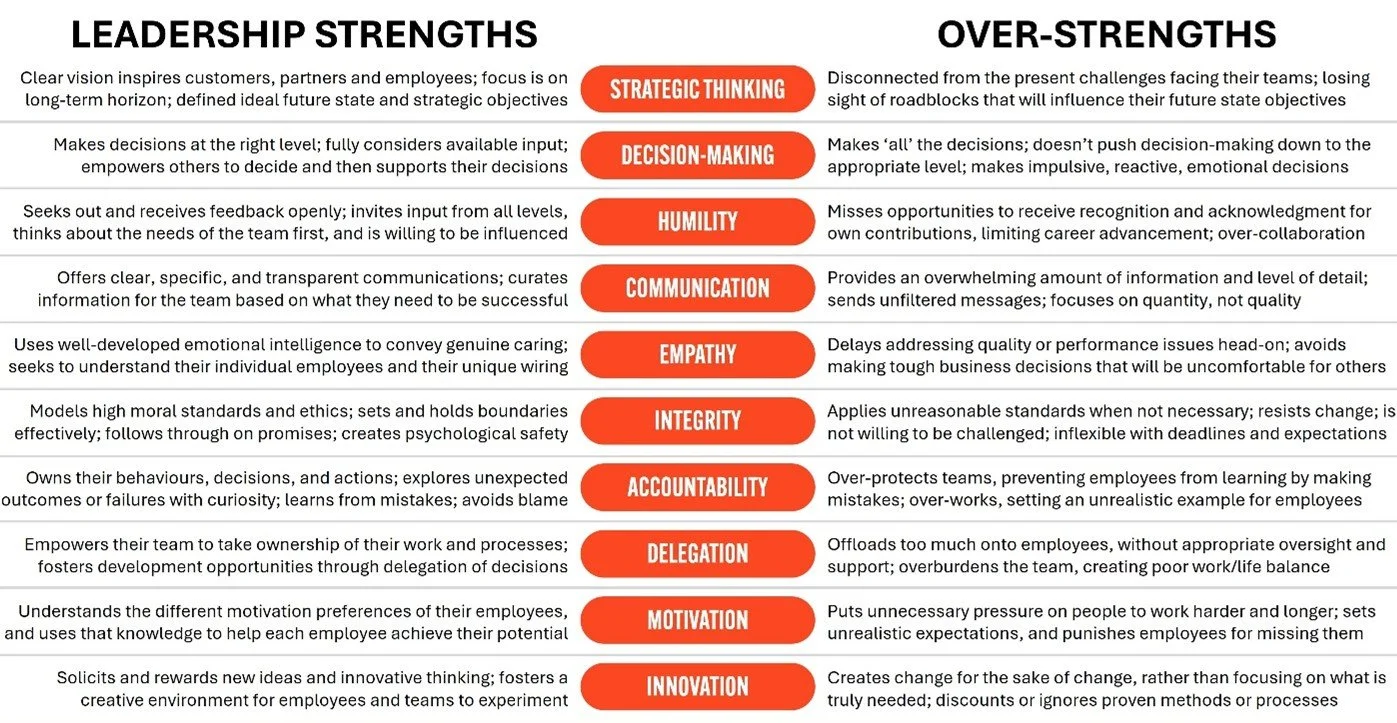
Let’s break it down using the graphic below, a snapshot of nine core leadership strengths (there are many others, some unique only to you!) Here’s what can happen when their volumes go unchecked.

STORIES FROM THE FRONT

Here’s where theory meets reality. These five short case studies are based on real coaching themes that have played out in boardrooms, team meetings, and one-on-ones. They showcase the human side of leadership; the moment where a well-meaning strength quietly shifts into overdrive, and the team dynamic shifts in response. If any of these stories feel familiar, you’re not alone – and you’re not off track. You’re just being invited to listen differently to your leadership ‘mix’, so you can make some adjustments, and tune your soundboard accordingly.

Case #1: The Strategic Visionary

Rajesh was known for his powerful strategic thinking. His colleagues described him as “the guy who could see around corners”. His head was typically five years ahead of the others on his team, who were still focused on Q1. His team was inspired... at first. But soon, they started feeling disconnected from the day-to-day realities. When asked what they needed to succeed, one team member quietly said, "I just need to know what I should be doing tomorrow." Rajesh had slipped into overstrength. His people felt abandoned in the present, trying to navigate the complexities on their own.

Case #2: The Empathetic Avoider

Marissa had developed a high level of emotional intelligence and compassion throughout her leadership career. Her people loved her warm personality; she was a great listener and genuinely seemed to care about them. She remembered birthdays, gave ‘free’ days off when they felt overwhelmed, and offered a soft shoulder to cry on when there was trouble at home. She also actively looked for developmental opportunities to offer each of her employees that would help them grow their careers. But when it came time to have hard conversations like missed deadlines, employee conflicts, or poor performance, she froze. Her empathy channel was so loud that it had drowned out her leadership accountability channel. She became avoidant, and slowly her team’s accountability eroded to the point that Marissa’s group developed a reputation for poor performance, which caused her top performers to look elsewhere, and made recruiting new employees difficult.

Case #3: The Humble Underdog

David was seen as a humble guy. He was always quick to credit his team for any successes and rarely took the spotlight. But over time, his unwillingness to take centre stage meant that he was invisible most of the time, which became a liability. Without the willingness to take up his full leadership space, the executive team couldn’t see his impact. David’s team, once proud of his modesty, started wondering if he lacked confidence in them – or in himself. It was an unnecessary distraction from the team’s mission and targets. Some became disengaged, while others tried to compensate by becoming more vocal (with uneven results). David’s humility had become an overstrength that muted his ability for bold influence, and his career stalled.

Case #4: The Delegating Ghost

Carla was an expert delegator. She understood delegation of authority thresholds and empowered her delegates to make decisions on her behalf and take action accordingly. She trusted her team and rarely micromanaged. But Carla wasn’t big on oversight. In fact, you could say she was allergic to it. Bored with mundane operational details, Carla preferred to live in the future, playing with strategic modelling and innovation trends. But without regular check-ins, guidance, and oversight, not only were projects veering off course and timelines slipping, but her people began to resent her, too. To her employees, Carla hadn’t delegated; she’d disappeared.

Case #5: The Motivational Machine

Jorge brought infectious energy to his leadership conversations. He was all about goal setting, giving recognition, and getting people fired up. His favourite expression was “push through”, something he often told employees when they raised concerns about their workload or capacity challenges. He was proud of how much his team could deliver, but as burnout crept in, his relentless positivity became exhausting. The team felt pressured to always perform at 110%, and some began hiding their struggles for fear of letting him down.

What once inspired them became a stress multiplier, and Jorge ended up with three employees on short-term stress leave.

All five of these leaders were doing what they thought was right. And they weren’t wrong. They just didn’t notice when their strengths started working against them.

BEST PRACTICES FOR BALANCING ACTS

So, how do you keep your soundboard balanced when the volume has crept up too high on one channel? How do you raise the volume on other channels to compensate? The following tips are some quick but powerful ways to ensure your leadership is landing the way you intend. These practices are grounded in real coaching tools and everyday leadership behaviours that can help you calibrate your leadership mix.

Make Feedback Normal, Not Formal

Build feedback into everyday conversation. The best leaders are curious, not just about ideas, outputs, metrics, and strategy, but about their own leadership impact. Ask: "What’s something I’m doing that’s getting in the way right now?"

Name Your Over-Strength

Introduce the strength/overstrength paradox concept to your team. Invite them to help you calibrate. It creates safety, builds trust, and diffuses the fear that giving feedback means they’re criticizing your character. Ask yourself: "Where might my team be seeing more of this strength than they need right now? What’s the unintended consequence I haven’t noticed yet?"

Coach the Strength Back to Centre

When a strength starts showing up too often or too intensely, it’s not about switching it off. It’s about adjusting the channel volume. Get back to the core purpose of the behaviour and check in on how it's being received. Ask yourself: "What’s the original intention here? What’s the ripple effect? What would ‘just enough’ look like?"

Use the 3-Point Leadership Lens

This quick tool helps leaders get out of autopilot and into alignment. Every time you lean on a strength, check:

  • is it aligned with the mission?

  • is it right for this moment?

  • is it working for the people?

What worked in the past may not land now, especially in times of change. Ask yourself: "Is this strength in service of the bigger picture – or is it just my default setting?"

Revisit Regularly

Strengths evolve. So should your leadership. Schedule quarterly self-check-ins, and invite an executive coach to help you explore your blind spots. Ask yourself: "What strengths have I been leaning on heavily this quarter? When I pause to consider whether they’re still fit for purpose, what do I notice?"

THE INVITATION

Leadership isn’t about turning every channel up to eleven. It’s about learning to engineer your soundboard. A little more clarity here, a little less volume there. Bringing in the bass line of strategy without drowning out the higher notes of empathy. The best leaders aren’t the loudest or smartest in the room. They’re the most attuned.

When your strength becomes someone else’s struggle – it’s time to rebalance. So here’s an opportunity to experiment: Be in relationship with your leadership strengths. Take the time to listen to each channel in relation to the other channels, and in relation to the overall mix. Notice what needs adjustment, what’s sitting just right in the mix, and what might need a gentle nudge back to centre.