WHAT'S YOUR PLAN??

BUILDING YOUR CAREER PATH

by Leslie Rohonczy, Executive Coach, IMC, PCC | ©2023 | www.leslierohonczy.com

Taking ownership of our career means setting a clear vision, unpacking our true motivation for that vision, developing a plan that we can work daily, periodically looking at progress against our goals and adjusting, staying resilient and committed, and seeking support and advice from trusted mentors who are further along the path that we want to travel. 

There’s a famous quote from Albert Einstein that says, “Strive not to be a success, but rather to be of value.” I like this quote because it speaks to the mindset shift that is required away from the self-orientation of “What can I get for myself” (more money, better perks, fancy title, etc.) to thinking about the value that we can bring to the organization that will pay our salary. Our motivation in seeking career development is the key that either can unlock our success or keep us locked in our current holding patterns.

If you’re looking to find more motivation or inspiration for your career development, think about why you wanted your current job in the first place. What attracted you most to it? What are you losing out on if you stay in this role? You might also experiment with setting some new goals and looking at what potential benefits they may bring you. As you ideate, try to stay positive, without allowing any “yabut” thinking in to stink up your vision (“yeah, but…I’m not good at public speaking”, “yeah, but…it’ll take too long to figure out”, “yeah, but…I tried something similar ten years ago and failed.”)

As James Clear said in his best-selling book Atomic Habits, “you do not rise to the level of your goals; you fall to the level of your systems.” In the career context, our goal is the desired outcome, and the system is the collection of actions and daily habits we use to make it happen. Here are a few ideas to get you started.

  • DREAM IT: picture yourself in this ideal future state: how will you behave, talk, dress, sit? What kinds of things will you be doing every day? What people or systems will you interact with? What personal values will guide you through your day?

  • LOOK BACK: what kind of work did you find most satisfying and why? What past experiences or training do you consider to be strengths? What kind of work made you unhappy in the past? Who has been helpful to you and how?

  • LOOK NOW: what value, impact, experience, or skills do you offer? What gives you the most satisfaction in your current role? What would you like more of, or less of, in your role?

  • LOOK AHEAD: What do you hope to learn? What is in your way of attaining this future state? How will you navigate the barriers in your way? What is already in place to help you?

  • NAME YOUR GOAL: say it out loud. Write it down. Get used to letting it roll off your tongue. Tell others.

  • SCALE YOUR GOAL: big dreams are great, but don’t forget to set realistic sub-goals to help you get there.

  • LEVERAGE YOUR NETWORK: ask a friend, your leader, or another colleague to introduce you to people who can help you move closer to your career goal. Find a mentor. Hire a coach.

  • EXPLORE MULTIPLE CHANNELS: there are many ways to connect with others. Book a career discussion with your Human Resources advisor. Send your resume and cover letter to a recruiter in a target organization. Be brave and leverage unplanned opportunities, like bumping into someone at the coffee shop, or asking a peer for feedback after your presentation.

  • MAKE IT A HABIT: how will you hold yourself accountable for taking small steps every day toward your ideal career? How will you reward yourself for this consistent effort? How could you be even bolder?

  • TRACK YOUR PROGRESS: what criteria or measurable milestones will you use to know you’re moving in the right direction? What adjustments do you need to make? What will you most need to hear when the going gets tough?


Leslie Rohonczy is a certified Integral Master Coach™ who brings more than 30 years of business & leadership experience to her coaching practice. Leslie is also a talented composer, recording artist, and vocal & performance coach. Leslie’s coaching informs her music, and her coaching-inspired music helps to enrich her coaching program design. Leslie has released seven original albums containing coaching-inspired music and lyrics, that are featured in Leslie’s book, Coaching Life: Navigating Life’s Most Common Coaching Topics, available on https://www.amazon.ca/dp/B0BXN7F5TZ

FIVE 'C'S OF TRUST

by Leslie Rohonczy, Executive Coach, IMC, PCC | ©2023 | www.leslierohonczy.com

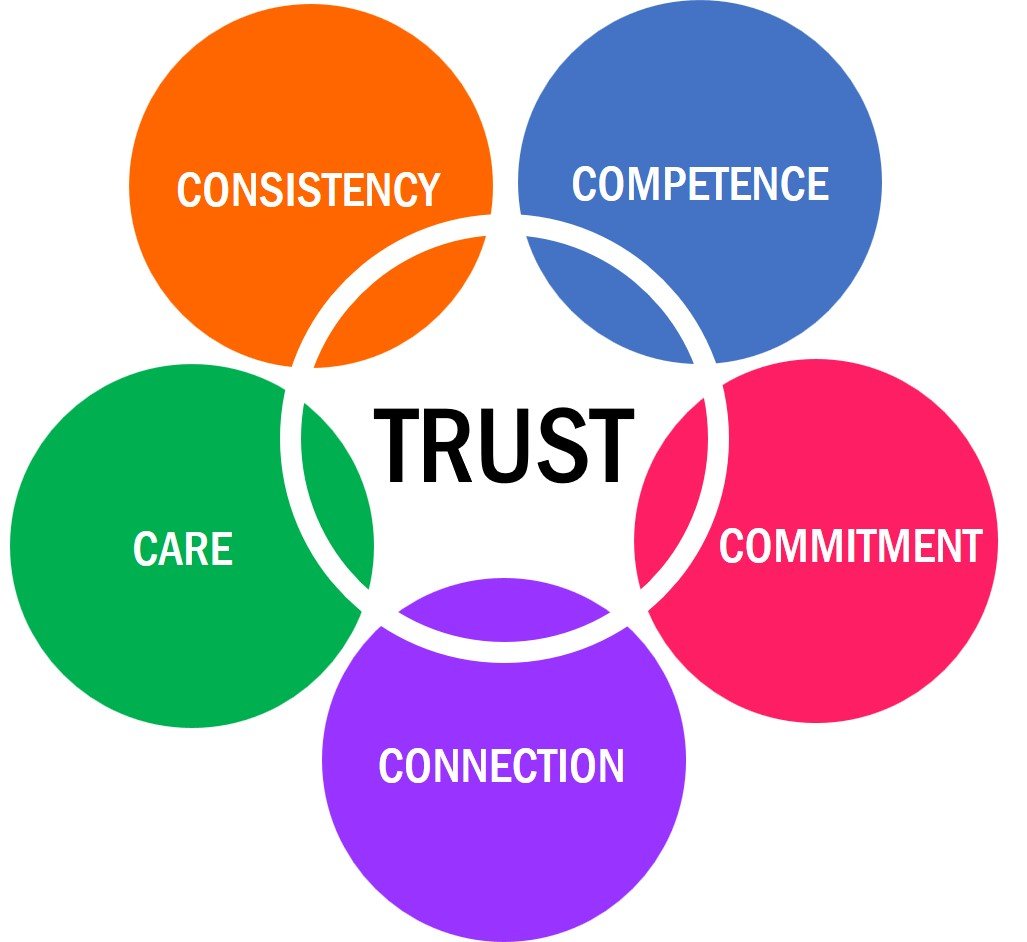
Vulnerability-based trust is the most powerful kind of trust we can cultivate; it means that we feel safe enough to reveal our vulnerability to someone else and know that they won’t use it against us.  Each of us pays attention to distinct aspects of trust, depending on our own unique wiring. As you read the following ‘Five C’ descriptions, see if you can sense your own primary trust attribute, and which one might be your lowest.

FIVE ‘C’S OF TRUST

Excerpt from ‘COACHING LIFE: Navigating Life’s Most Common Coaching Topics’, by Leslie Rohonczy

Amazon, 2023

CONSISTENCY: This aspect is all about reliability: doing what we say we will, and being intentional about our yeses and our nos. This consistency is observed in our actions, in how we hold ourselves accountable for our commitments and follow through by doing what we say we’ll do, when we say we’ll do it. When people learn that they can’t depend on us to keep our promises – no matter what great excuses we may have – it’s a trust-killer. We tend to judge others’ reliability in terms of time and quality. Slow to return emails? Cancel plans often? Break promises? Show up late to events? What message does our behavior send? We should never make promises we can’t keep, even if we’re just trying to calm a tricky situation.  We’ll build stronger trust with others if they know that we consistently follow through and do what we say we will.

COMPETENCE:  Others will be more concerned with our abilities, standards, and skills: when we know what we’re talking about, people believe that we are a credible source of information and insight. Our competence and credibility are a combination of how we present facts and theory, our skills and knowledge, and our ‘presence’ (the way we look, act, talk, and communicate). Humility is also a key aspect: when we pretend to know something that we actually don’t, and others see through our smoke and mirrors (as they often do), we become untrustworthy to them.

COMMITMENT: Some people will be more focused on the passion in our eyes as we deliver our message, so that they can connect to the deeper purpose that inspires us. Making our commitments visible helps us inspire the trust of others. It’s reassuring to see someone fully committed, because it lets us know that we can depend on them, especially when facing challenges. When our commitment is solid, we can engage in productive conflict that moves everyone forward. Some believe that trust creates harmony, when in fact, trust allows us to have productive conflict that won’t damage our relationship, and often strengthens our connections as a result.

CONNECTION: Speaking of connection, when we focus on creating close, open, and accepting connections, others feel comfortable talking to us about difficult things. People who are good at this aspect of trust walk their talk and are willing to get emotionally close to others. Building this connection requires us to be transparent about our thoughts and emotions. When we’re accepting and non-judgmental, people open up to us more easily because they trust that we won’t judge or criticize them. They feel seen and heard and can be themselves when they most need to.

CARE: Finally, to build vulnerability-based trust, we show that we’re concerned with the welfare of the other person, rather than pushing our own agenda solely for our benefit. Others may perceive us as self-interested if we care more about appearances, about getting our own way, about being liked or creating a favorable impression. Caring people are typically good listeners and genuinely want to understand others’ experiences and emotions. They have a desire to help and consistently show they care through their words and actions.

We each have a preferred aspect that we habitually start with, and so it’s important to understand that what engenders trust for one person might not resonate with another. For example, I look through the lens of consistency first: if you show up on time, keep your promises, and do what you say you’ll do, I trust you. It’s really that simple. But not everyone prioritizes consistency the same way. For example, consistency is the lowest one for my husband (a.k.a. ‘The Big Handsome’), who favors the Care aspect. He monitors for high self-orientation behaviors like someone putting their own needs or interests above the greater good and sees these as signals that they may not be trustworthy. If we can’t connect with someone enough to build trust, it may just be that they’re looking through a different lens than we are.

PRACTICE: PERSONAL TRUST MEASURES

Think about the last time you required someone to trust you. Perhaps it was related to the family budget, a new project at work, or a travel adventure. Find an example that you can evaluate in hindsight, and reflect of these questions:

1.       How did you demonstrate that you care?

2.       How did you attend to consistency?

3.       How did you establish your competence?

4.       How did you demonstrate your commitment?

5.       How did you build your connection?

Now, think about how the other person reacted. What trust aspect(s) do they seem to value most? What indicators do you observe that inform that opinion? How might you adjust your approach next time?

IMPACTFUL LEADERSHIP CH.E.C.K. LIST

By LESLIE ROHONCZY, Executive Coach (PCC), Integral Master Coach (IMC); Author of Coaching Life: Navigating Life’s Most Common Coaching Topics


Here’s an interesting lens through which to look at the role of a leader: the Impactful Leadership CH.E.C.K. List. These five high-performing leadership competencies can help employees become successful, and organizations achieve their strategic objectives.


CH  |  CHALLENGE WITH COMPASSION

Explore your own leadership assumptions and potential limiting beliefs: whose assumptions are they, and what’s driving them? How do you know they’re real? What evidence or proof can you find to confirm or disprove them?

What limiting belief prevents you from acting, or causes you to second-guess your decisions? Challenge processes and simplify how work gets done: are ‘old ways’ getting in the way of new growth and potential?

How might employees change the way they work to improve efficiency and effectiveness, customer experience, and their own employee engagement? How might you?

Increase the level of challenge, responsibility, and support: how might you offer employees more responsibility as a growth opportunity? What do you need to do differently during this growth opportunity, to support their learning? How can you support the decisions they make, without punishing mistakes during this learning opportunity?


E  |  EMPOWER WITH CLARITY

Be discerning about the important decisions that belong at your leadership level, and push decision-making down to appropriate lower levels where you can. If we’re positioned as the decision-maker for all things, we become the bottleneck that slows the team down, and our employees don’t learn the critical decision-making skills that will allows them to become decisive high performers.

Avoid overturning employee-made decisions wherever you can. One of the quickest ways to kill an employee’s trust and self-confidence is to first empower them to decide, and then to overturn it because it’s not how you’d have done it. Let them experiment and learn where possible (and it’s likely more possible than you may think) and hold them accountable for the outcomes in a positive, growth-minded way.

Facilitate the plan-do-check-adjust learning process (PDCA)  by asking employees to explain how they will plan their approach, then allow them room to enact that plan, and to check their own results and invite feedback from others, and finally, to adjust their approach based on their insights. Asking questions along the way helps employees synthesize their thinking as they go, and helps you track and stay connected to your team’s work.


C  |  COACH WITH COURAGE

One of the most top-of-mind topics for employees is their professional development and career progression. Spending time coaching employees on how to be successful builds trust and helps them feel supported. Investing in their growth is good business.

Have courageous conversations. Don’t shy away from providing observations and feedback about what could be holding them back. We need to provide clear feedback with purpose, to help employees succeed, and we need to be even more open to receiving their feedback! Courageous conversations are a two-way street.

Connect the dots for employees to help them understand the organization’s purpose, mission, vision, and values and how their work contributes to achieving the strategic direction and core mandate. Watch for ‘orphan’ work that the employee is doing and ask curious questions about how that work connects to the team’s objectives; stay open to the answers – they may be off-track, in which case you can redirect them; or they may be exploring a new opportunity that could bring much-needed innovation.

K  |  KNOWLEDGE SHARING

Develop your storytelling super-power. When we can share real examples from your experiences – without making yourself the ‘hero’ of the story – you can impart the learning that really resonates (humans learn best through stories, after all).

Model what it looks like to be a ‘continuous learner’, by regularly sharing new information and a-has with employees. Sharing your personal gaps and how you’re working to close them can reinforce to the people you lead that curiosity, learning, experimenting, failing, and sharing perspectives are normal and expected parts of your team culture.

Lean into humility and seek out feedback from employees on how to become a better leader-coach for their specific employee needs. When you ask, and then receive this feedback, you may notice the urge to defend or explain. Instead, explore what was unknown, or uncomfortable – that’s where the gold nuggets are for growth as leaders. Come back to employees after reflecting on their feedback, to share insights, and to thank them for creating this new awareness!


CHECK AND ADJUST

One of the fastest and most effective ways to change a behavior or build a new muscle is by observing yourself in action, reflecting on what you intended and what results you actually noticed, deciding what minor adjustments to make, then trying again. It should be a continuous cycle of noticing and improving, rather than a ‘one-and-done’ activity that checks a box.

In addition to your own ‘noticing’, it’s also a great practice to seek feedback from employees on how you’re showing up, and what adjustments they would recommend or appreciate.

Develop a system to help you track your progress: define what you’re working on in a single sentence (e.g.: growing trust with employees), and what observable indicators you’ll watch to tell you how your development is going (e.g.: employee opinion surveys; one-on-one employee meetings focused on development, not just output; reduction in conflict requiring your intervention).

BAG OF STONES Practice

By LESLIE ROHONCZY, Executive Coach (PCC), Integral Master Coach (IMC); Author of Coaching Life: Navigating Life’s Most Common Coaching Topics


PRACTICE: ‘BAG OF STONES’

When we experience overwhelm, it can feel like we’re carrying the weight of the world on our back. I wrote ‘Bag of Stones’ (see video below), as a powerful coaching practice to help us navigate our overwhelm and figure out how to lighten our load. Give this guided visualization a try, to help you identify what’s most important to you, what you no longer find useful, and what you can let go of. You’ll need a pen and your journal to answer the following questions:

Imagine you are a traveler walking along a path, and you’re wearing a large backpack. It’s uncomfortably heavy, and the longer you wear it, the more your back aches. You know it’s time to lighten your load, so you place it on the ground, open the top, and inside you discover three bags. The first one is made of the finest silk; the second is made of sturdy cotton, and the third is made of old burlap.

1.       You open the silk bag and discover that it contains riches beyond your wildest dreams: diamonds, rubies, and emeralds. These precious items represent the things that are most important in your life; things that fill you up and make you feel nourished, grounded, connected, and fulfilled. For me, these are my family, my music collaboration, and my creativity. What are your treasures? Name them, and then imagine repacking each precious item one at a time, pausing to deeply feel gratitude for each one before you place it back in the silk bag. Imagine placing the silk bag back into your backpack to bring along with you.

2.       You open the second bag and discover that it contains many smooth stones that have been polished by time. These represent the things that may have been useful in the past, but no longer serve you anymore. However, they may be valuable for somebody else who is not as far along the path as you are. For me, it was striving for career achievement. I’m done with this kind of striving, but it could be useful to someone at the beginning of their career who is trying to make their mark in the world. What stones are you ‘done’ with? Name them, and then visualize yourself leaving them at the side of the road to offer to another traveler. Visualize placing the empty cotton bag back in your backpack.

3.       You open the burlap bag, and discover it’s full of dirty, jagged rocks that represent your limiting beliefs, bad habits, unproductive behaviors, negative or painful experiences, self-judgment, and unhealthy relationships that you don’t need to carry around anymore. These rocks just create pain that distracts you from the true treasures in your life. What do your jagged rocks represent? Name each one, and then visualize throwing them over a nearby cliff, one by one. Place the empty burlap bag back in your backpack. Then strap this lighter backpack on your back and continue your journey, feeling a sense of lightness in your body and spirit.

Top Ten LEADERSHIP Truths

By LESLIE ROHONCZY, Executive Coach (PCC), Integral Master Coach (IMC); Author of Coaching Life: Navigating Life’s Most Common Coaching Topics

1. Become a leader for the right reasons

Make sure your main motivation is about developing others to be the best versions of themselves. Striving for a title is about you. Inspirational leadership is about serving your employees.

2. Speaking truth to power

The higher you rise in the leadership ranks; the less comfortable employees will be to tell you what they really think. Make it safe for them to tell you the truth, no matter how uncomfortable it may be to hear.

3. Get to know your leadership ‘presence’

How you show up really matters. Look for the ‘shining eyes’ in your people, as evidence that they are inspired and engaged. If you don’t see their engagement, ask yourself who YOU are being as a leader, that your employees are not engaged.

4. It’s not all up to you

Don’t expect yourself to have all the answers, or to be right every single time. Be humble and understand that you don’t have to make all the decisions, it’s not your job to make everyone happy, and you don’t need to be the smartest person in the room. It’s not all up to you.

5. Be authentic

It’s a lot easier to be your authentic self than to keep track of multiple versions of yourself curated for different audiences. People are much better at sniffing out a phony than we may realize. Walk your talk; share your values; be transparent about what you think and how you feel.

6. Grow your people

Leaders get their work done through others, so build your people, not your empire. Delegate assignments with the intention to develop someone; to give them profile and recognition; to let them prove something to themselves; to help them build a new skill and experience. Don’t delegate just to get more shit done.

7. Grow your leadership EQ

It will serve you, your employees, and your bottom line much better than your IQ ever will. Accept that you’re never done learning. Invest in, grow, and regularly update your leadership toolbox. And make the time to get to know the humans who work for you. They will teach you the most valuable leadership EQ lessons.

8. Create a psychologically safe environment

If there’s lack of trust on your team, you may have a ‘nice problem’: people not willing to challenge each other or to share their questions, failures, or ideas (a.k.a. cordial hypocrisy). Make your team a judgment-free zone where employees (and leaders) can be vulnerable, fail and learn, experiment, share authentic results, and mentor each other.

9. Get out of the weeds

This is especially important at higher levels of leadership. If you love the weeds, then do the weeds work and accept that leadership is probably not for you. And don’t confuse management (planning, organizing, supervising, controlling) with leadership (inspiring your people to contribute their best).

10. Lead by example – always

Modelling behaviors can inspire employees to embrace change, innovate, and improve. Modelling accountability can increase clarity, transparency, and engagement. Modelling self-care can help with employee wellbeing and retention.