LEADING THROUGH ECONOMIC UNCERTAINTY

Strengthening Our Canadian Leadership Mindset

LESLIE ROHONCZY, IMC™, PCC, Executive Leadership Coach | FEBRUARY 2025


I’ve noticed a shift in the focus of many of my executive coaching clients in the past several weeks. Because the global business and political landscape is evolving so rapidly, and even erratically at times, Canadian executives and senior leaders are wrestling with next-level economic uncertainty.

While this current crisis may feel familiar in some ways to the economic challenges that we experienced during the COVID-19 global health crisis a few years back, this is significantly different. During Covid, we faced a common threat that united industries and nations. Specifically, Canada and our U.S. counterparts were in the Covid battle together; brothers and sisters, fighting side by side as members of the same family; looking out for one another. Doesn’t it feel like that was light-years ago?

Our current economic pressures, shifting trade policies, political changes, and global instability demand a mindset shift so significant that it will define not just the future of our businesses, but the resilience of Canada’s economy itself. And while these changes bring risks, they also present tremendous opportunities: greater clarity, adaptability, and strength – as individual leaders, as Canadian organizations, and as a nation.

Using Ken Wilber’s Integral Theory as a framework, let’s look at leadership mindset across four critical perspectives of the Integral Quadrants model: Action, Systems, Relationships, and Values.

1. ACTION: Embracing Agility, Accountability, and Ownership

Uncertainty can be paralyzing, but it’s time for leaders to lean into action. The question isn’t if the landscape will change – it’s how fast and how well we adapt. We don’t have the luxury of waiting for complete clarity before we act.

Key Mindset Shifts:

  • Control the Controllable: Instead of fixating on external forces like tariffs or supply chain disruptions, focus on what you can control – efficiency, innovation, and strategic positioning.

  • Act Before You’re Ready: Take calculated risks and iterate quickly rather than waiting for perfect conditions.

  • Adopt a Learning Mentality: Every challenge presents an opportunity for reinvention. Embrace experimentation and learning to drive transformation. Try experimenting with reframing the challenge as a chance to develop local manufacturing partnerships, lobby for inter-provincial trade reforms, reduce reliance on foreign supply chains, and strengthen your industry.

Executive Coaching Reflection Questions:

  1. What assumptions about the future might be limiting my options, and how can I reframe them to uncover new opportunities?

  2. How will we challenge those assumptions to uncover new opportunities?

2. SYSTEMS: Thinking in Complexity, Acting with Precision

Uncertainty requires leaders to step back and see the broader system at play – political forces, economic trends, industry shifts – and make data-informed but decisive moves.

Key Mental Models:

  • Zoom Out, Then Zoom In: Toggle between macro and micro views. Analyze global trends but translate insights into specific, actionable decisions.

  • Decisiveness Over Perfection: Waiting for perfect data leads to stagnation. Instead, make high-probability bets based on emerging patterns.

  • Scenario Thinking as a Superpower: Plan for multiple outcomes to give you an edge when volatility strikes. For example, when you recognize that your traditional supply chains are fragile, experiment with AI-driven forecasting and diversifying supplier regions, to help you transform uncertainty into a competitive edge.

Executive Coaching Reflection Questions:

  1. How am I balancing immediate pressures with long-term strategic vision, when making decisions?

  2. What evidence, criteria, or data points do I typically rely on?

  3. What other information might I explore to gain a fuller perspective?

3. RELATIONSHIPS: Leading with Emotional Intelligence and Stability

Markets fluctuate, but people are the heart of your business. Whether it’s your employees, your customers, or your stakeholders, they are all navigating this uncertainty along with you, and this is your opportunity to provide calm, transparent, and values-driven guidance.

Key Leadership Attitudes:

  • Transparency Builds Trust: Uncertainty is unsettling, but withholding information is worse. Leaders who share challenges openly build credibility and loyalty. Be as transparent as you are able, without putting your team or company at risk.

  • Empathy Over Authority: Instead of just driving performance, seek to identify and understand the emotional toll of this uncertainty. From that vantage point, lead with humanity. Employees and customers are loyal to leaders and companies who care about their well-being.

  • Confidence Without False Promises: As employees and investors look to you for assurance, demonstrate your confidence while staying honest about challenges. If you’re facing supply shortages, lead with radical transparency – openly communicate challenges while directing the pivot to Canadian suppliers. This is likely to increase customer trust, build stronger employee engagement, and strengthen your reputation for integrity.

Executive Coaching Reflection Questions:

  1. How am I fostering trust and psychological safety within my leadership team and through my organization?

  2. Am I sharing with enough transparency, and how do I know what’s ‘enough’?

4. VALUES: Leading with Purpose and Resilience During Uncertainty

At its core, leadership is about more than just profitability – it’s about principles. In times of upheaval, strong leaders ground themselves in what truly matters.

Key Leadership Principles:

  • Commit to National Resilience: Investing in Canadian talent, manufacturing, and innovation isn’t just patriotic – it’s smart business.

  • Lead with Long-Term Ethics: In a crisis, the temptation is to focus on short-term survival. Strong, resilient leaders make decisions that align with their values and their company’s legacy.

  • Champion Collective Strength: Uncertainty is best navigated through partnership, not isolation. Industry collaboration strengthens national stability. Instead of outsourcing to the U.S., invest in a Canadian R&D hub – securing government incentives and attracting top talent to future-proof your company while reinforcing Canada’s innovation economy.

Executive Coaching Reflection Question:

  1. What are the foundational core values of my business?

  2. How are my decisions reinforcing my core values and long-term vision?

  3. What upcoming decisions may create pressure on my core values? How will I prepare mitigants for that?

Strengthening Leadership Mindset in Uncertain Times

While uncertainty is challenging, it is also an opportunity to refine and grow your leadership. By cultivating a mindset of adaptability, strategic thinking, emotional intelligence, and purpose-driven leadership, you can guide your business – and Canada – toward a more resilient future.

Want to strengthen your leadership resilience and impact in the face of uncertainty? Executive coaching is a powerful tool in developing the clarity, confidence, and strategic insight to thrive in an evolving landscape. Schedule a discovery call with Leslie Rohonczy today to explore how executive coaching can help you lead with confidence.

WHEN THE LADDER BREAKS: Four Pillars of Career Transition

Turning Turbulence Into Opportunity

Career transitions are among the most challenging moments in our professional journey. Whether we’re stepping into a new role, considering a significant pivot, or facing the unexpected disruption of being let go, the emotional and practical demands can feel overwhelming. And on top of all that, the uncertainty of “what is,” the grief of “what was,” and the fear of “what’s scary” often collide, leaving us unsure how to move forward into “what’s next”.

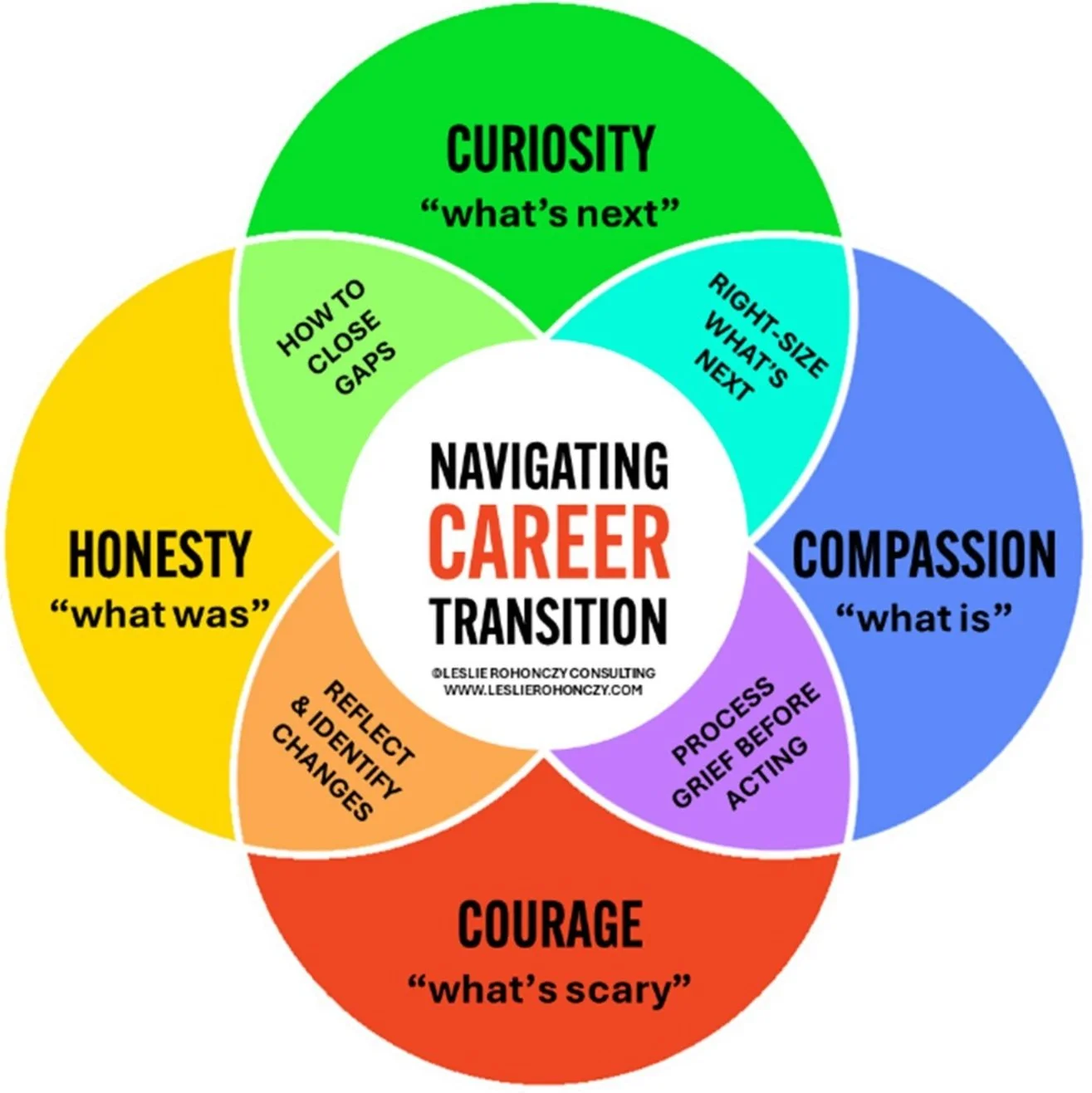
This is why I created the Career Transition Model. Grounded in four core qualities – Curiosity, Compassion, Courage, and Honesty – this framework provides a structured, human-centered approach to navigating the complexities of career change. By focusing on each section of this model, we can transform a tumultuous experience into an opportunity for clarity, growth, and meaningful next steps.

Let’s explore the model in depth and uncover the benefits of focusing on each element in the transition.

1. COMPASSION: Accepting "What Is"

This is a tough time – it’s time to be gentle with yourself. When faced with career disruption, it’s natural to feel a range of emotions: grief, frustration, shame, or even anger. Compassion invites us to sit with these feelings without judgment. Instead of rushing to act or denying our emotions, this stage encourages us to:

• Acknowledge and honor what we’re feeling.

• Give ourselves the grace to process our grief or disappointment.

• Treat ourselves with the same kindness and understanding we would extend to a friend.

Compassion is about being present with our reality, no matter how uncomfortable it may feel. It’s the foundation for healing and ensures that our next steps come from a grounded and intentional place. Compassion creates space for emotional processing and clarity, reduces self-criticism, promotes self-acceptance, and prevents burnout by prioritizing emotional well-being.

2. HONESTY: Reflecting on "What Was"

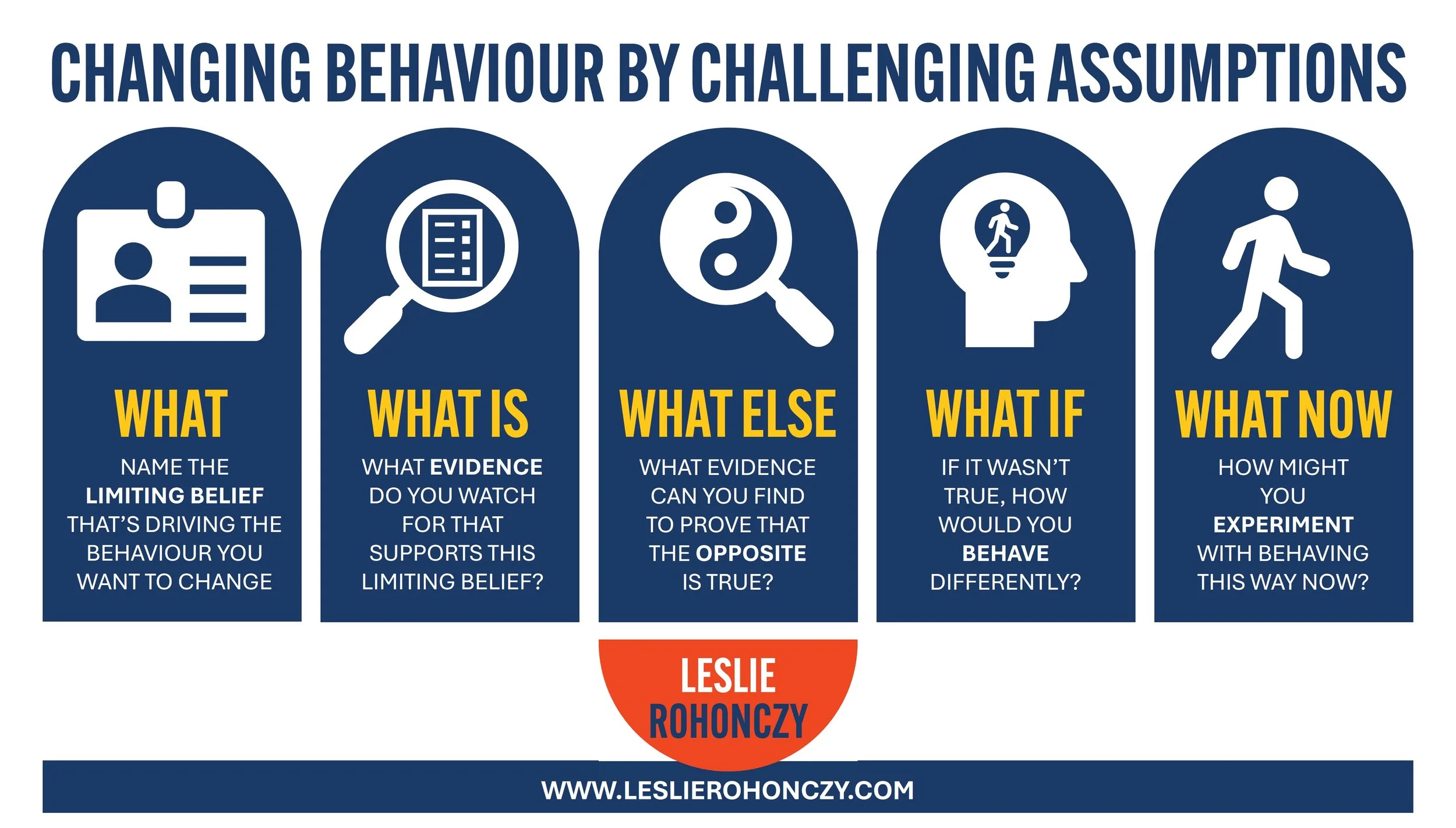
Transitions are an opportunity to reflect on the past with clarity and honesty. This doesn’t mean dwelling on what went wrong, but rather assessing what worked and what didn’t in our previous role or career, so that we can identify limiting beliefs, behaviour patterns, strengths to be leveraged, and areas for growth to close gaps. It required us to ask ourselves tough but valuable questions like: “What lessons can I carry forward?” “What was I good at that I want to do more of?” “What gaps do I need to address?”

Honesty with ourselves – or what I like to call ‘accurate self-assessment’ – requires us to reflect on our past performance and engagement, so that we can move forward with a deeper understanding of what we need in order to thrive in our next chapter. This level of honestly with ourselves is a key step in the process because it promotes self-awareness and growth, provides clarity on what’s truly important to us, helps us identify gaps to be closed, and aligns our next steps with our values.

3. COURAGE: Facing "What’s Scary"

Fear often accompanies career transitions. The fear of failure, rejection, or making the wrong decision can feel paralyzing. Courage is about acknowledging our fears, leaning into them, and taking action that helps us overcome them. It’s about asking ourselves: “What am I afraid will happen?”, “What risks am I willing to take to move forward?” “What do I need to have / feel / believe in order to face this uncertainty with resilience?” “What’s one small step I can take today to address my biggest fear?”

Courage doesn’t mean eliminating fear; it means not letting fear dictate our choices. By taking small, intentional steps, we build momentum and confidence, even in the face of uncertainty. Acting with courage empowers us to take action despite our fear, builds resilience and confidence over time, and helps us confront challenges head-on, rather than avoiding them.

4. CURIOSITY: Exploring "What’s Next"

Curiosity invites us to lean into the unknown with a sense of openness and possibility. Rather than viewing this transition solely as a loss, curiosity encourages us to ask, “What opportunities might this open up for me?” “What have I always wanted to explore but haven’t had the chance to?” “What skills or passions can I leverage in new ways?”

This mindset shift allows us to see beyond the immediate turbulence and imagine our ideal state, and the potential of what could be. Curiosity is not about having all the answers – it’s about giving ourselves permission to wonder and explore, and cultivating the courage to dream without the pressure of immediate certainty. Maintaining our curiosity through this process encourages creative thinking and new possibilities, helps us shift from a reactive to a proactive mindset, and opens doors to opportunities we might not have considered before.

THE POWER OF INTEGRATION: The Intersections of the Model

Here’s where the Career Transition Model gets exciting: the intersections between these four qualities take us deeper, where meaningful action and transformation happen:

COMPASSION + COURAGE = Process your grief and other uncomfortable emotions before acting.

COURAGE + HONESTY = Self-reflect and identify the changes you want to make.

HONESTY + CURIOSITY = Consider how you will close the gaps you’ve identified, and what you’ll need in your next role.

CURIOSITY + COMPASSION = Combine expansive thinking with self-compassion as you dream boldly, and right-size what’s next.

WHY COACHING MATTERS DURING CAREER TRANSITIONS

It can be challenging to navigate career transitions alone. Working with an Executive Coach to help guide you in navigating the Career Transition Model can provide a deeply transformative, supportive, and human-centered program.

Executive coaching provides:

• A safe, judgment-free space to explore your emotions and aspirations.

• Tailored strategies and support to help you stay focused and grounded.

• Practical tools and accountability to move forward with confidence.

If you’re navigating a career transition, coaching can help turn uncertainty into clarity and fear into opportunity. Whether you’re an executive seeking career guidance, or an HR professional looking to support an exiting employee, this model and coaching approach can make a transformative difference.

Career transitions are rarely easy, but they don’t have to define us. By focusing on Curiosity, Compassion, Courage, and Honesty, we can navigate this time with resilience, intention, and hope. The Career Transition Model is a roadmap through the turbulence, helping you emerge stronger, wiser, and ready for what’s next.

If you’re ready to take the next step or want to offer meaningful support toy our team, let’s connect.

For more information on executive coaching or to explore how this model can support you or your team, contact me at www.leslierohonczy.com.

#CareerTransition #ExecutiveCoaching #LeadershipDevelopment #GrowthMindset #HRSupport


SUCCESSFUL MERGERS: How Coaching Transforms Change from the Inside Out

Corporate mergers are high-stakes, high-pressure events that can determine the trajectory of an organization for years to come. Yet, despite the billions spent on due diligence, integration planning, and cultural assessments, one critical factor remains underutilized: executive coaching. Research consistently shows that leadership development and coaching during mergers lead to better financial outcomes, smoother transitions, and stronger organizational alignment. So why do so many companies ignore this powerful tool when they need it most?

The High Cost of Overlooking Leadership Development in Mergers

Organizations often delay investing in leadership development and coaching during a merger due to the belief that there is "no time for coaching now." However, prioritizing executive coaching during a merger can actually save time and money, mitigate integration challenges, and enhance long-term success. Consider these research-backed insights:

Cost Reduction

  • Reduced Integration Costs: Poorly managed mergers can increase costs by 15-30% due to inefficiencies (EY, 2022). Leadership coaching helps teams anticipate challenges, resolve conflicts efficiently, and minimize redundancies (McKinsey, 2021).

  • Return on Investment (ROI): The ICF Global Coaching Study reports an average coaching ROI of 5.7 times the initial investment. PwC’s analysis indicates an ROI of seven times the cost of employing a coach.

  • Turnover Reduction: Misaligned cultures and uncertainty during mergers lead to higher turnover. Leadership coaching improves engagement, reducing turnover by up to 40% and saving replacement costs, which can be 1.5 to 2 times an employee’s annual salary (Harvard Business Review).

Efficiency Gains

  • Improved Productivity: According to the International Coach Federation (ICF), 70% of coaching clients report improved work performance, and 51% note enhanced team effectiveness.

  • Accelerated Decision-Making: Leaders receiving coaching are 86% more likely to make effective, timely decisions (Leadership Quarterly), preventing costly delays.

  • Faster Integration Timelines: Companies with strong leadership during mergers report up to 22% faster integration timelines (McKinsey, 2021).

  • Reduced Inefficiencies: Leadership alignment initiatives can reduce post-merger inefficiencies by 30% (Deloitte, 2022).

Change Management & Culture Integration

  • Increased Likelihood of Success: Research by Boston Consulting Group shows that coaching senior leaders boosts the probability of successful transformations by over 70%.

  • Stronger Stakeholder Confidence: Organizations demonstrating proactive leadership during mergers experience 20% higher stakeholder confidence (Boston Consulting Group, 2022).

  • Cultural Alignment: Up to 70% of mergers fail due to cultural incompatibility (Deloitte, 2020). Leadership coaching helps integrate differing corporate cultures, unifying teams toward a shared vision.

  • Higher Employee Retention: Companies prioritizing leadership coaching during mergers experience 40% higher employee retention rates (Boston Consulting Group, 2023).

Leadership Development: The Key to a Unified Strategy

  • Stronger Leadership Strategies: Mergers with aligned leadership are 33% more likely to achieve their objectives (PwC, 2022).

  • Better Team Performance: Executive coaching has been shown to increase team performance by 50%, fostering better communication and collaboration.

  • Collaboration Gains: Harvard Business Review (2021) found that executive coaching programs led to a 70% improvement in cross-functional team collaboration during mergers.

  • Increased Leadership Confidence: 95% of leaders report better utilization of new leadership behaviors after coaching, and 94% report increased confidence (International Coaching Federation).

  • Improved Integration Outcomes: Companies investing in leadership development during mergers see a 25% improvement in integration outcomes (McKinsey, 2023).

Research on Executive Coaching in Mergers

If you’re still skeptical about the power of coaching in mergers, consider these groundbreaking studies:

  • "Coming Together: A Grounded Theory Study of the Role of Coaching in the Mergers & Acquisitions Process" (2021) – Heiki Thomas & Jonathan Passmore found that coaching mitigates pressures and tensions, improving leadership, culture, and communication (CoachHub).

  • "Guiding Through Turbulent Times: Coaching During Merger and Acquisition" (2024) – This qualitative study highlights how coaching supports employees in coping with merger transitions (Taylor & Francis Online).

  • "Leadership Strategies for Improving Mergers and Acquisitions Performance" (2020) – Walden University research underscores the necessity of leadership development for post-merger integration success (Walden ScholarWorks).

  • "Why a Winning Leadership Team Matters for M&A Strategy" (2022) – Korn Ferry identifies leadership development as a key predictor of M&A success, reinforcing the need for executive coaching (Korn Ferry).

Make Coaching Your Competitive Advantage

Organizations that invest in executive coaching during mergers are better positioned to reduce costs, improve efficiency, and accelerate integration timelines. Coaching equips leaders with the skills to navigate complexity, drive performance, and inspire their teams through uncertainty.

The question isn't whether you can afford to invest in leadership coaching—it’s whether you can afford not to.

If your organization is navigating a merger or acquisition, and you’re looking to align, integrate, and thrive in this high-stakes transition, let’s connect. Book a discovery call today to explore how executive coaching can be your secret weapon for merger success.

FORGET THE OFFICE: CAN YOU COMMAND A ROOM OVER ZOOM?

MASTERING VIRTUAL EXECUTIVE PRESENCE IN A HYBRID WORLD

by Leslie Rohonczy, Executive Coach, IMC, PCC | ©2024 | www.leslierohonczy.com

In a surprising twist, it looks like hybrid work isn’t going anywhere. Even as many companies are calling employees back to the office, recent data shows that hybrid work arrangements are actually growing.

In fact, 43% of U.S. companies have adopted hybrid policies in 2024, up from 29% the previous year. Here in Canada, hybrid work has become a significant aspect of our professional landscape. According to the C.D. Howe Institute, 26% of paid employees worked remotely in some way by the end of 2023, with hybrid models becoming increasingly prevalent. And according to the HR Reporter, 74% of Canadian business leaders have reduced their traditional office space by adopting hybrid models, resulting in average annual savings of about $400,000. And experts predict that even with an increase in return-to-office mandates, hybrid models will remain a significant part of the professional landscape through 2025.

As physical offices give way to blended virtual workspaces, the concept of executive presence has undergone a dramatic transformation. This dual reality requires leaders to master executive presence across both physical and virtual environments – to project authority, inspire trust, and foster connection through a screen. Making this shift requires a unique set of skills and strategies to help leaders command a room, even when the room is entirely digital.

THE NEW RULES OF EXECUTIVE PRESENCE

Executive presence has traditionally been defined by traits like confidence, poise, and the ability to connect with others in person. In virtual and hybrid environments, these traits are still crucial, but how we demonstrate them has shifted.

Here are the new rules:

  1. Clarity is King: In a virtual setting, clarity in communication takes precedence. Leaders who articulate their ideas succinctly, and as transparently as possible, help to ensure their messages resonate, even without the benefit of physical cues like body language.

  2. Non-Verbal Communication Matters More Than Ever: While body language in a physical space conveys authority and confidence, in virtual settings, it’s about how you use your voice, facial expressions, and gestures that appear within the frame.

  3. The “Halo Effect” of Technology: Your tech setup (lighting, sound quality, and background) contributes significantly to how we are perceived. A well-lit and professional-looking environment can enhance our credibility.

  4. Authenticity Rules: Let people see your personality (see my previous article ‘What’s Your ‘Ness’ and are you making the most of it?’). In a world of polished LinkedIn profiles and pre-recorded webinars, showing genuine authenticity stands out, because people connect with leaders who are transparent, relatable, and human.

STRATEGIES TO BOOST VIRTUAL LEADERSHIP PRESENCE

Here are a few strategies you can experiment with, to help you develop your virtual leadership presence:

Master Your Delivery

Your delivery – how you communicate your message – is critical:

  • Storytelling: Put what you want to say in the form of a story. It’s how we humans learn and process information best.

  • Intentional Pauses: Strategic pauses can emphasize key points and give your audience time to process your message. Resist filling your pauses with additional information. Use silence to your advantage.

  • Active Listening: Demonstrate active listening by nodding, maintaining eye contact, and summarizing key points shared by others and why they resonated with you. Become aware of your listening style, and the mitigants you can use to remain present.

  • Language: Be precise and concise. Avoid jargon and focus on clear, impactful language. Say what you mean and avoid over-massaging key points – your cautious wordsmithing may cause your point to be lost on others.

  • Empathy: Acknowledge challenges and emotions, especially during difficult discussions. Authentic empathy builds vulnerability-based trust.

Manage Your Virtual Energy

The way you demonstrate your engagement and enthusiasm for what you’re talking about can help your audience deeply connect with your message:

  • Eye Contact: Look directly at the camera to simulate eye contact. This small gesture creates a sense of connection and engagement. If you’re sharing presentation slides, stop presentation mode as soon as you’re able, so that participants can see your face fully.

  • Facial Expressions: Smile when appropriate and use expressions to mirror the emotional tone of the conversation. Grow your awareness of what your face does when someone disagrees with you, presents a surprising point, or delights you.

  • Hide Your Self-View: Once you’ve become familiar with your facial expressions, hide your self-view, so that you can’t see your own image. This simple move will improve your presence and help you to come across more authentically.

  • Pace and Tone: Speak at a measured pace and modulate your tone to convey your energy and engagement. A monotonous delivery will lose your audience.

  • Gestures: Use hand gestures within the frame to emphasize key points but avoid overdoing it.

Optimize Your Tech Setup

Your environment is your stage, and every element contributes to the impression you leave:

  • Lighting: Natural light is ideal, but if that’s not an option, invest in a ring light or other soft lighting options to illuminate your face evenly.

  • Camera Angle: Position your camera at eye level to simulate a face-to-face conversation. Avoid angles that look up at or down on you, as these can distort perception.

  • Audio Quality: Poor audio can be distracting, and detract from your message, so invest in a clear and professional-sounding microphone.

  • Background: Virtual backgrounds are acceptable but shouldn’t be distracting or overly artificial. Choose simple and professional options.

Measuring Your Virtual Executive Presence

How do you know if you’re succeeding in projecting a strong virtual executive presence? Here are some indicators you can use to measure your performance:

  • Engagement Metrics: Are participants actively engaging with you during virtual meetings? Do they ask questions, participate in discussions, and provide feedback?

  • Feedback: Solicit feedback from trusted colleagues, peers, other leaders, or mentors. Ask them to observe your virtual interactions and provide constructive feedback and ideas for improving your virtual presence.

  • Self-Assessment: Record your virtual meetings and watch them back to identify areas you can improve, such as pacing, tone, clarity, or visual setup.

THE FUTURE OF EXECUTIVE PRESENCE

As the workplace continues to evolve, so will the expectations for executive presence. Leaders must stay adaptable, learning to leverage new technologies and approaches to lead their diverse and distributed teams well. Executive presence is no longer confined to physical spaces. It’s about making an impact, whether you’re face-to-face or behind a screen. The tools and strategies outlined here will help you embrace this new reality and thrive in the digital age of leadership.

Are you ready to elevate your virtual executive presence? Schedule a free consultation call with me today to explore how executive coaching can help you lead with impact, clarity, and confidence.

LOOK BACK TO MOVE FORWARD: 3 Steps to Define Your Year Ahead

by Leslie Rohonczy, Executive Coach, IMC, PCC | ©2024 | www.leslierohonczy.com

We’re approaching the end of November, and before you know it, this year will be over. If you’re like many executives and leaders I work with, the past eleven months have likely been a whirlwind of decisions, problem-solving, and strategic pivots.

Now, as the year draws to a close, this cacophony of demands are competing loudly for our attention: year-end deadlines, deliverables, and objectives, holiday plans, and a persistent pressure to think ahead. It can feel overwhelming, much like the relentless blanket of tinny holiday music playing everywhere this time of year.

It’s so easy to get lost in this din, but what if we took a powerful pause? What if we step back from the hustle of deliverables and the noise of social expectations, to reflect on the year we’ve just experienced? Reflection isn’t just a feel-good exercise; it’s a leadership tool that turns hindsight into insight. This single act of pausing to reflect could be a game-changer for the road ahead.

As high-performing leaders know that impactful forward momentum often starts with purposeful reflection. In my executive coaching practice, I encourage clients to conduct an annual ‘Year in Review’ practice. This process goes beyond tallying wins and losses; it’s a focused exploration of the intentions you set at the start of the year, the journey you’ve been on (both professionally and personally), the lessons learned from their experiences, and where they want to go in the future. It’s about uncovering patterns – positive and negative, identifying and challenging limiting beliefs, clarifying priorities, and laying the foundation for intentional growth.

The timing for this exercise is perfect. Starting your reflection in early December gives you the space to recalibrate before diving into the new year. So, let’s hit the pause button for a moment. Before you dive headfirst into planning what’s next, take a moment to ask yourself two critical questions: How did I get here? And where do I want to go next?

STEP 1: Reflect on Your Year

Think of your life as a book, with each year representing a new chapter. This is your opportunity to review the chapters that have already been written, to uncover recurring themes, to see how this year’s chapter fits into your overall story, and to decide how you want the next chapter to unfold.

Start by setting the stage for your review:

  • Find a quiet space where you won’t be interrupted.

  • Bring tools that help you capture your thoughts: a journal, digital notebook, or voice recorder app.

  • Set aside at least an hour for this process to ensure depth and focus.

Now, dive into these reflection prompts:

1. What worked?

Look back at the moments when you felt aligned, accomplished, brave, energized, or proud. What decisions, habits, or relationships contributed to those successes? One of my clients, am SVP at an insurance company, discovered that her most impactful projects came from effective delegation. Not only did this alleviate her capacity challenges, but it also created a career development opportunity for an up-and-coming Director. This insight became a catalyst for how they would revamp their talent development system the following year.

2. What didn’t work?

This isn’t about self-criticism—it’s about curiosity. What efforts didn’t pan out, and why? Where did things feel off-track? What unproductive or unintended results emerged? A client once shared how, through this reflection practice, he realized that at the beginning of every year, he would overcommit himself in Q1 by taking on too many projects that didn’t align with his long-term goals. Once he identified this pattern, it allowed him to shift his approach: he committed to saying “no” more often in the future, making the mental space for him to be more discerning with what he said “yes” to.

3. What surprised you?

It’s often the unexpected moments - both positive and challenging - that shape us the most. Did you navigate a crisis with grace and strength you didn’t know you had? Did you make spontaneous decisions that led to amazing outcomes? Were you surprised at what opportunities opened up as a result of trusting your instincts?

4. What will you leave behind?

Growth requires creating space for what truly matters, which often means letting go of what no longer serves you. Is it a limiting belief? An unproductive habit? Or perhaps a role or commitment that no longer aligns with your values? As you reflect, remember to think of your life as a book: How will you clear the page to write a meaningful next chapter?

STEP 2: Choosing Your Word of the Year

Once you’ve sifted through your reflections, it’s time to look ahead with clarity. One simple but profound way to focus your intentions is by choosing a Word of the Year.

This word acts as your North Star—a guiding principle that helps you make decisions, prioritize, and stay grounded in what matters most. It’s less about setting rigid goals and more about defining the energy, mindset, or intention you want to carry into the new year.

How to Choose Your Word

1. Look for themes in your reflection.

What patterns emerged from your review? If you noticed a need for better boundaries, perhaps your word is No. If your highlights revolved around creativity, your word might be Innovate. The CEO of a national manufacturing company told me about a bold experiment he tried last year: launching a pilot program to test same-day delivery in select locations. The program required cross-departmental collaboration, quick problem-solving, and innovative thinking - qualities he loved seeing in action. To his surprise, the program not only exceeded revenue projections but also revealed untapped talent and creativity within his team. He realized that these results were born from taking calculated risks and empowering his team to innovate. He set a clear intention for the next year: to prioritize initiatives that foster collaboration and bold experimentation. As a result, he intends to scale up the business next year while keeping his team engaged and motivated.

2. Think about your aspirations.

What would make 2025 feel successful - not just professionally, but personally as well? One client, a CFO balancing high stakes work with parenting, chose the word Presence to remind herself to stay engaged in the moment, whether at the office or the dinner table.

3. Make it personal and inspiring.

Avoid words that feel trendy or vague. Your word should resonate deeply with you. Once you’ve chosen your word, give it a place of honor. One of my clients wrote hers on the first page of her planner. Another set it as a weekly calendar reminder. And another created a colourful painting of her word to hang in her office. These small acts keep the intention front and center.

Here are a few examples of words and the themes they can represent. Remember that your word should be deeply meaningful to you, so if you don’t see one that really resonates for you, find a word that does.

  • Abundance: Focusing on opportunities, growth, creating a mindset of plenty rather than scarcity.

  • Alignment: Ensuring your actions, values, and goals are in harmony.

  • Authenticity: Leading with your true self, building trust, encouraging openness.

  • Balance: Managing work, life, and personal well-being with greater harmony.

  • Clarity: Clear vision, focused decision-making, and transparent communication.

  • Collaboration: Working more closely with others, creating synergies, building stronger teams.

  • Confidence: Strengthening self-belief, taking decisive action, trusting your judgment.

  • Connection: Building deeper relationships with your team, peers, clients, family.

  • Courage: Taking bold risks, making tough decisions, stepping out of your comfort zone.

  • Empowerment: Giving yourself and others the tools, authority, and confidence to take initiative.

  • Focus: Prioritizing what matters most, eliminating distractions, staying on track.

  • Freedom: Gaining autonomy in your decisions, actions, lifestyle choices.

  • Generosity: Giving more of your time, knowledge, or resources to support others.

  • Gratitude: Fostering appreciation for both big wins and small victories, finding joy in everyday moments.

  • Growth: Personal development, business expansion, learning, career development.

  • Impact: Making meaningful contributions, both professionally and personally, that leave a lasting legacy.

  • Inclusion: Fostering an environment where all voices are heard, valued, and respected, promoting diversity and equity in decision-making, ensuring equal opportunities for all.

  • Innovation: Introducing new ideas, processes, technologies that drive change.

  • Integrity: Staying true to your values, being authentic, holding yourself accountable.

  • Joy: Finding fulfillment and pleasure in both work and personal life.

  • Mastery: Committing to honing your skills, becoming an expert, excelling in your field.

  • Mindfulness: Staying present, reducing stress, cultivating awareness in every aspect of your life.

  • Patience: Cultivating the ability to wait, listen, allow things to unfold at their own pace.

  • Presence: Being fully engaged in the moment, enhancing focus, being mindful in your interactions.

  • Purpose: Deepening your understanding of what truly drives you and aligning your actions with your mission.

  • Resilience: Bouncing back from challenges, maintaining strength in tough times, staying adaptable.

  • Service: Helping others, adding value to your community, creating a positive influence.

  • Simplicity: Streamlining processes, reducing clutter, focusing on what truly matters.

  • Sustainability: Prioritizing long-term health, work-life balance, eco-friendly practices in your personal and professional life.

  • Transformation: Embracing change, personal reinvention, leading transformative projects or teams.

  • Vision: Creating a compelling future, setting ambitious goals, inspiring others.

STEP 3: Bridging Reflection and Action

Reflection and intention-setting are valuable on their own, but their true power lies in translating them into action. Here are a few ways to bring the process to life:

1. Turn your lessons into strategies: For example, if you noticed a pattern of over-committing, create a filter you can use for saying “yes” in the future. One of my clients asks herself, “Will this move me closer to, or further away from my vision?” before agreeing to new projects.

2. Anchor your word in your habits: Let’s say your word is Balance. What specific changes will help you live that word? Perhaps it’s blocking off time for self-care or limiting after-hours emails. Or looking for as many examples of balance in your life as you can find – what we go looking for, we usually find.

3. Share your word: Accountability is a game-changer. Share your word with a coach, mentor, trusted friend, or family member. One leader I worked with even shared hers with her entire team, framing it as a shared commitment to living the value of Transparency.

WHY THIS MATTERS

Leadership is about more than just driving results - it’s about intentional growth. Taking time for a Year in Review and choosing a Word of the Year isn’t just a reflective exercise; it’s a powerful leadership development practice.

When you understand where you’ve been and where you want to go, you can lead yourself - and others - with clarity, purpose, and confidence.

As the saying goes, “The best way to predict the future is to create it.” Before the December cacophony takes over, pause to reflect on your story so far, so you can be intentional about the next chapter you’re about to write.

YOUR TURN

Ready to give this a try? Schedule some reflection time before the new year. And when you’ve chosen your Word of the Year, I’d love to hear it, so message me!

Here’s to closing this year with insight, and to writing the next one with intention and greater awareness. Onward to your next great chapter!

POWERFUL QUESTIONS & WHERE TO FIND THEM

by Leslie Rohonczy, Executive Coach, IMC, PCC | ©2024 | www.leslierohonczy.com 

As a leader, your role often involves sharing your wisdom and experience with employees, peers, partners, and superiors. But before offering advice, ask yourself a powerful question: “How might I help this person to create insights and grow awareness through asking a powerful question?”

You’ll know you’re on the receiving end of a powerful question by the impact you feel from its weight. A powerful question sparks significant "a-ha" moments, suddenly illuminating new perspectives, provoking insight and new awareness, and acting as a catalyst for personal and professional growth. The power of a powerful question is undeniable.

When we’re on the receiving end of a powerful question, our brains naturally go looking for an answer. We’re wired for it. But the effectiveness of this process largely depends on how, when, and what type of question is asked.

One of the most common questions I encounter in my coaching and leadership training sessions is, “What makes a question ‘powerful,’ and where can I find them?” Unfortunately, there’s no standard cheat sheet of powerful questions you can tuck into your back pocket and whip out when you need a good one – it just doesn’t work that way. The most powerful questions are created in the moment, born of genuine curiosity, emerging from what we’re hearing, and intended to create new insights.


THE NATURE OF POWERFUL QUESTIONS

Powerful questions prompt people to think in new ways, leading to new insights, actions, or commitments. They are delivered with a keen sense of timing and rapport, respecting the individual's current state. For instance, consider asking, “I understand this is a big decision for you and that it naturally causes some anxiety. How do you think you’ll feel once the decision is made and you’re ready to move forward?” This question acknowledges the present concern and guides the person towards visualizing a positive outcome.

Questions can vary greatly in their effectiveness. Closed-ended questions typically yield yes or no answers and may not encourage deeper thought. On the other hand, 'good enough' questions offer some value, helping individuals explore their feelings or instincts. For example, asking a colleague, “What does your instinct tell you to try next?” might help them tune into their intuition. However, the most impactful questions expand awareness while inspiring action. Avoid questions that merely suggest a course of action or present a laundry list of possible solutions without engaging deeper thinking.


WHAT MAKES A QUESTION POWERFUL?

The intention behind your question is critical; it should be to create new awareness in the other person. This requires genuine care and curiosity, with questions often starting with "What," "When," "How," "Who," or "If." Notice that “Why” isn’t listed. If you ask your employee "Why haven't you made a decision?", they may not know why. A more powerful question might be, “What are you most concerned about in making this decision?” This encourages the person to reflect on underlying fears or concerns.


DISCOVERING POWERFUL QUESTIONS

To find powerful questions, you must listen carefully to uncover the real issue and what's beneath the surface of what's being said. Stretch your thinking and encourage others to do the same. Often, the simplest questions are the most powerful. “What’s next?” “How will you do that?” “What might get in your way?” and “What do you want?” Listening attentively allows you to tailor your questions to the person's unique situation.

But not all questions are created equal. Avoid closed-ended questions and those that suggest solutions disguised as questions. For instance, asking, “Why don’t you try X?” is not as effective as asking, “What options have you considered?” Additionally, avoid multiple-choice questions that can overwhelm the person with choices. The most effective questions are open-ended and invite exploration, without fishing for specific answers.


EXAMPLES OF POWERFUL QUESTIONS

  • "What would you like to achieve by the end of this 1:1 coaching conversation?"

  • "What would you like more of in your life? Less of?"

  • "If you could change just one thing right now, what would it be?"

  • "What's the first (or easiest) step you could take within the next week?"

  • “What are you avoiding? What do you NOT want to look at or talk about?”

  • "How does that serve you?"

  • “How might you show up differently if you weren’t worried about being judged”?

  • "How will you celebrate reaching that milestone? Describe how it will feel to achieve it."

  • “What do you need to see, feel, have, or do, in order to be brave?

  • "What are you taking away from this conversation today?"


CHARACTERISTICS OF GREAT QUESTIONS

Three aspects make questions great: curiosity, authenticity, and fluidity. Great questions are curious: they reflect a genuine interest in the person’s experiences, beliefs, and assumptions. It’s essential to be comfortable with silence after asking a question and avoid filling the space with more words. Great questions are authentic: they do not lead the person to a preconceived answer.

Instead, they are open and exploratory. And great questions are fluid: they adapt, based on the responses you receive as the conversation evolves. If a question doesn’t yield a clear answer or deeper insight, approach the issue from a different angle.


TIPS FOR ASKING POWERFUL QUESTIONS

  1. Minimize "why" questions: These can often be unproductive for two reasons: they may put the person on the defensive; or the person may not know ‘why’ they behave a certain way. Instead, get more specific in your question.

  2. Avoid sharing similar experiences: Resist the ‘me too’ urge and stay in exploration mode with your employee. Their experience may feel familiar, but it’s not the same as your experience. Sharing your experience may come across as ‘counterfeit empathy’, stealing the learning opportunity away from your employee, and the coaching opportunity away from you.

  3. Embrace silence: Give the person time to think and respond without rushing to fill the gap. This is especially true for more introverted types, who prefer to think before speaking. If you ask a great question, and then add more details to fill the silence, you’re interrupting their think time. Learn to sit in silence while someone processes your question.

  4. Avoid multiple-choice questions: It isn’t helpful to offer potential ‘right answers’ (e.g.: “Did you miss the deadline because you’re over-capacity, or just not interested in this project?”). The truth may be completely different than the two choices you offered, but the question has them focused on which choice is closest to their truth. Multiple-choice questions can limit exploration and overwhelm the person.


THE COURAGE TO ASK QUESTIONS
Asking questions rather than offering advice takes courage. It requires you to resist the urge to provide solutions and instead foster a space where others can develop their own understanding and solutions. This process not only helps them grow, but also strengthens your mentoring and coaching abilities.

While there is no handy, back-pocket list of powerful questions (because they arise from what you’re hearing), Michael Bungay Stanier’s book "The Coaching Habit" is an excellent resource for learning how to amp up your question game. It delves into the various question types and provides practical examples to enhance your skills.


SEVEN AWESOME QUESTIONS TO GET YOU STARTED
While there isn’t a handy ‘cheat sheet of powerful questions’ to pull out when you’re stuck, thanks to Michael Bungay Stanier, author of The Coaching Habit, here are seven CATEGORIES of questions that can be super helpful:

  1. The KICKSTARTER Question: It's a great opening question that replaces small talk with something a little crunchier. For example, ‘So what's on your mind today?’ This question says, "Let's talk about the thing that matters most to you."

  2. The AWE Question: That's A.W.E., which is an acronym for ‘and what else?’ This magic little question creates a lot more wisdom, insight, self-awareness, and possibilities out of thin air. ‘And what else’ can also be ‘and who else’, or ‘and why else’, or ‘how else’.

  3. The FOCUS Question: This helps you to help someone focus on and solve the right problem. It can help them grow a new problem-solving muscle while demonstrating that you're really interested in their input and can also help drive accountability and engagement.

  4. The FOUNDATION Question: Sometimes this can cause a deer-in-the-headlights reaction in that the person may not be able to answer your question. That's okay… ask it anyway. It's planting a seed that they can reflect on which will create new insight for them and help them untangle their wants from their needs. For example, ‘What do you want and what is really driving that want?’

  5. The LAZY Question: Sometimes, in our good intentions to be helpful, we can kind of get in the way. If, for example, we step in and take over or become too directive, it can create an unintended but uncomfortable power dynamic between the two of you. Instead, simply ask, ‘How can I help?’ An even more direct version of this is ‘What do you want from me?’ Just make sure that your tone is positive on that one.

  6. The STRATEGIC Question: This is focused on what NOT to do. It helps your employee to be really clear and committed to their yeses, bringing clarity to both of you. For example, you can ask, ‘So if you're saying yes to this, what are you saying no to?’

  7. The LEARNING Question: According to neuroscience research, most classroom learners will not retain most of the content they’re taught, unless they can put it into action quickly, actively processing and integrating the information. You can help to create the space for those learning moments when meeting with your employees. When they return from a conference, training session, or workshop, ask what was most useful to them in that learning experience. This helps them really make the connection between new information, and what's already within their awareness.

FUTURE OF LEADERSHIP: Innovative Leadership Development

by Leslie Rohonczy, Executive Coach, IMC, PCC | ©2024 | www.leslierohonczy.com

Imagine that we lived in a world where traditional leadership skills are obsolete; replaced by a need for constant innovation, adaptability, and lifelong learning. In this scenario, the old playbook for leaders is no longer sufficient. Clearly, what got you here, won’t get you – and your organization – where you need to go.

The question isn't whether you're keeping up with the latest trends—it's whether you're anticipating the future and preparing for it today. Tomorrow’s effective leaders aren't just competent; they're curious, agile, emotionally intelligent, and relentlessly focused on personal and organizational growth.

Let’s explore some of the innovative leadership development methods that can help you ‘future-proof’ your skills and cultivate a culture of continuous learning within your organization.


Experiential Learning Beyond the Classroom

Experiential learning isn't just the latest leadership buzzword. It's a proven, innovative, and dynamic approach that puts leaders in real-world scenarios, enabling them to develop their leadership skills through direct experience.

Unlike traditional classroom settings that focus on downloading theory and information to students, experiential learning helps leaders learn by doing. Think of it as the difference between reading about the physics of balance required to ride a bike without falling, versus actually hopping on a two-wheeler and learning by feeling it for yourself. Sure, you can read all you want about balance, but until you can experience the physical sensation of it, with all the subtle adjustments and awareness required, it’s just theoretical, and not yet ‘in your bones’. 

For example, imagine taking part in a simulation where you’re leading a complex project launch. In this scenario, you must guide your cross-functional team through the entire project lifecycle, from initial planning to execution and post-launch evaluation. Team members come from different departments, each with their own priorities, challenges, methodologies, and processes. Your role as the leader is to navigate these dynamics, align the team's efforts, and ensure clear communication and decision-making for a successful project delivery.

Scenarios like these are powerful learning opportunities that let leaders experience delegation, conflict resolution, and motivational skills in real-time, and help embed nuanced learning and insights about managing diverse teams. Putting theory into practice in this way improves learning retention, raises self-awareness and skill levels, and is a great opportunity to evaluate your strengths and gaps.

Another example involves a "leadership rotation" where leaders switch roles with their peers, to lead a different division or function. Over a set period, they must lead their temporary teams to address specific challenges, like managing a product recall or launching a new customer loyalty program. This rotation not only provides a holistic view of the business, which helps grow these leaders to be ready for the next level of leadership but also challenges them to adapt their leadership style to different team dynamics and operational demands.


Coaching, Mentoring, and a Hybrid Model: The Best of Both Worlds

Coaching focuses on the "inner game" of leadership. Working with a coach, or holding peer coaching circles, can help leaders identify and overcome limiting beliefs, improve self-awareness, develop emotional intelligence and awareness of others’ ‘wiring’, adapt their style to different communication preferences, set boundaries, and hold others accountable.

Mentoring brings in practical, hands-on experience. Mentors are typically further down the road that the mentee is traveling. They share their experiences, providing real-world examples of what works and what doesn't, valuable insights about specific challenges, and advice and strategies based on their personal experiences. Sometimes mentors are less experienced, as in the case of ‘reverse mentoring’, where young employees mentor senior leaders about emerging culture and industry trends, and first-hand customer experience challenges.

Bring these two powerful concepts together, and you have a hybrid coaching and mentoring program that pairs a new executive with an experienced coach to work on growing their leadership EQ (emotional intelligence) while also having access to a mentor who has led similar projects and is willing to share their guidance. The beauty of this model is its versatility—it can be tailored to the specific needs of the leader, whether they require more focus on personal growth or practical business acumen (which may fluctuate over time).


Resilience and Agility: Thriving in Uncertainty

We hear a lot about ‘resilience’ and ‘agility’ in leadership books and articles, often in the context of coping with an increasingly volatile and unpredictable world. Think of this dynamic duo of skills as your leadership compass that helps you navigate the complexities of your business. Resilient leaders can withstand setbacks and adapt to new challenges, while agile leaders are quick to pivot and embrace change.

But resilience isn't just about bouncing back from adversity; it's about thriving while you’re knee-deep in challenge. It involves cultivating a positive mindset, practicing self-care, and maintaining a sense of purpose. A resilient leader views a ‘failed’ project not as a defeat but as a learning opportunity. She prefers to reframe the outcomes as ‘unintended results’ and explores all aspects of the engagement with curiosity, specifically to grow and improve her leadership skills, improve the process, and empower her team.

Agility, on the other hand, is about being flexible and open to new ideas. It's the ability to shift gears quickly in response to changing circumstances. Agile leaders are not bogged down by rigid plans; instead, they are comfortable with ambiguity and willing to experiment. This helps you quickly adapt to new technologies, crises, shifting business strategies, or emerging opportunities.

Leaders can cultivate these skills through practical exercises like scenario planning and resilience training workshops, peer coaching, and executive coaching. Scenario planning involves imagining various future scenarios and developing strategies for each. This exercise helps leaders think on their feet and prepare for the unexpected. Resilience training might include mindfulness practices, stress management techniques, and workshops on fixed and growth mindsets, and positive psychology.


Empathy and Virtual Presence: Leading from Afar

Empathy and virtual presence have become critical in the age of remote work. With teams often spread across different locations, leaders who find new ways to connect and communicate create engaged, successful teams. And that means empathy is more important than ever. The ability to understand and share the feelings of others helps leaders build trust, foster collaboration, and support teams' well-being.

In a virtual environment, empathy is expressed through active listening, open communication, and genuine interest in team members' experiences. For example, during video calls, leaders can ask about their team's well-being, show appreciation for their work, and acknowledge their challenges. This practice not only strengthens relationships; it also fosters a supportive and inclusive culture.

Practicing empathy also involves actively seeking feedback from team members and taking the time to understand their unique perspectives and concerns. This feedback loop is essential for continuously improving virtual leadership and ensuring the team feels heard and valued.

Being "present" even when not physically co-located is not only possible, it’s a core skill for leaders in the future. There are several ways to develop your leader presence and influence through digital platforms:

  • Set the tone for digital engagement by mastering and proficiently using collaboration platforms like Zoom, Microsoft Teams, or Slack yourself. When you embrace and model using these collaboration tools, and a myriad of others that surely will follow, you’ll streamline communication and improve engagement for your organization. It will also make you more accessible to your employees, a key factor in employee engagement.

  • And speaking on engagement, set clear expectations about engagement, communication, and transparency. Have a team discussion about how and when you expect team members to engage, define the service level agreements for responding to emails or messages, identify the preferred channels for urgent issues versus casual updates, and the level of transparency expected in communications.

  • Host virtual town halls regularly to communicate important updates, share organizational news, and connect with the team. These meetings provide a platform to address your entire organization, answer questions, and offer insights into the company's direction. They also allow employees to voice concerns, ask questions, and feel heard. Regular town halls help maintain transparency and keep everyone informed, reinforcing a sense of community and shared purpose.

  • Video updates from leaders can be a powerful way to communicate key messages, especially when they require a more personal touch, such as a briefing on company performance, reassurance during crisis management, key departure information, emerging opportunities, and new initiatives announcements. Leaders can use video to explain the reasoning behind certain decisions, with nuanced context that written communications might lack. This transparency in decision-making helps build trust, as employees can see the thought process and considerations that contributed to your decisions.

  • Spontaneous check-ins (I call them ‘J5’ meetings: ‘just five minutes’) are similar to the random encounters in hallways or lunchrooms when we’re in person. Try instant messaging an employee with a quick thank you for sending you an interesting article. Ping someone a birthday wish. Ask a question to help a colleague discover a new perspective. These casual, informal connections go a long way to building team engagement and cohesion.


Encouraging Lifelong Learning: Never Stop Growing

Leaders who commit to lifelong learning not only enhance their own capabilities but also set a powerful example for their teams. Start by creating a culture where it’s safe to be curious and experiment. Being transparent about your own learning journey means that you share links to great articles, insights from the books you’re reading, and takeaways from workshops, webinars, and online courses you enjoyed. This simple leadership move not only demystifies the learning process but also inspires others to invest in their development. And employees who attend industry conferences, participate in cross-departmental projects and pursue further skills development help to foster a culture of continuous improvement.

In the future, employees will look for ample learning opportunities as part of their employee experience, beyond the standard mandatory training programs. One effective approach is to provide access to online learning platforms like Coursera, LinkedIn Learning, or Udemy, where employees can explore courses on a wide range of topics at their own pace. This flexibility allows them to tailor their learning to specific interests and career goals. You might even arrange internal workshops and training led by industry experts or in-house career development and learning specialists.

And, while you’re establishing a learning culture in your organization, build in the expectation for employees and leaders to ‘teach back’ what they learned while attending seminars, workshops, conferences, or courses. Encouraging employees to share their expertise through lunch-and-learn sessions, blogs, or peer coaching builds the foundation for a knowledge-sharing culture, helps disseminate knowledge across the organization, and empowers employees to take ownership of their learning journey.


If you’re looking for innovative, diverse learning opportunities to help grow your leadership into the future, reach out to explore Executive Coaching and Leadership Development, at www.leslierohonczy.com.

BUILDING EXECUTIVE PRESENCE: Elevate Your Impact

by Leslie Rohonczy, Executive Coach, IMC, PCC | ©2024 | www.leslierohonczy.com

As a leader on a career path to the Executive floor, you may have been told to invest in developing your ‘executive presence’. That term gets tossed around in leadership development discussions and HR conversations, often without a frame of reference for what it means or the specific actions required to develop it.


WHAT IS EXECUTIVE PRESENCE?

Pinning down a singular definition can be elusive. Definitions will vary across corporate cultures and can be influenced by the company’s strategic goals, your leader’s ‘wiring’, HR’s leadership competencies and talent grid criteria, the company’s culture around the level of accountability, the scope of decision-making at each leadership level, and your own beliefs about what it means to "take up your leadership space."

What constitutes executive presence in a brand-new tech startup might look very different from what it means in a traditional legal firm. But at its core, executive presence is the ability to project confidence, gravitas, and authenticity that inspires, influences, and steers the organization toward success.


ENABLER #1: AUTHENTICITY

Think about someone with an amazing leadership presence who you’ve observed in action. They likely come across as strong in their convictions, well-engaged with people, and passionate about ideas. They probably seem genuine in their thoughts and emotions and exude a balance of confidence, humility, and curiosity.

 In fact, a compelling leadership presence is fuelled by authenticity. There’s little point in projecting a false, curated version of yourself. For one thing, people can often suss that out a mile away; for another, it inhibits your ability to be present with others, or your capacity to focus on what’s happening in the moment. The drive to control others’ perceptions of you is performative and focused on the fear of others’ judgment. This ‘protection instinct’ can often get in the way of truly authentic executive presence.

Think of your leadership authenticity as a magnet, attracting people to you. When you are present, and demonstrating your authenticity, others will want to offer you their authentic selves as well. As I’ve covered in previous articles, the higher up in leadership you climb, the less willing people may be to speak truth to power. But when you can show up authentically, and fully present, you allow others to become present, too. They feel seen and heard by you and it becomes safer for them to tell you what they really think.

When your leadership presence brings out others’ authenticity, you elevate everyone. And authenticity is required to build trust with others. Trust doesn’t rely on facades. It lets others reveal their true thoughts and selves. And speaking of trust…


ENABLER #2: FIVE Cs of TRUST

Executive presence is the medium through which trust and ideas travel. Trust is the conduit of influence, and the only way to establish real trust is by being present. trust allows us to accept the possibility of failure while knowing that if we fail, we won’t be knocked off our axis as a result. And each of us pays attention to distinct aspects of trust, depending on our unique wiring.

Here are the ‘5 Cs of Trust’ – see if you can determine which one is your go-to, and which one(s) you want to experiment more with:

  1. CONSISTENCY: How reliable we are to do what we say we will, and how intentional we are about our yeses and our nos. Our consistency can be observed in our actions, in how we hold ourselves accountable for commitments. It’s how we do what we say we’ll do, when we say we’ll do it.

  2. COMPETENCE: Our abilities, standards, skills, and demonstration that we know what we’re talking about. It’s part facts, knowledge, theory, and skills; and part presence (how we look, act, speak, and communicate). It’s also humility to say we don’t know, when we don’t, instead of pretending to know more than we actually do. People often see through smoke and mirrors eventually.

  3. COMMITMENT: Some people look for the passion in someone’s eyes to know they are trustworthy. Making our commitments visible helps inspire the trust of others. Commitment helps us have productive conflict that moves everyone forward.

  4. CONNECTION: The focus is on creating close, open, accepting connections, others will open up to us more easily because they trust that we won’t judge or criticize them when they’re being vulnerable. They feel seen and heard and can be themselves when they most need to.

  5. CARE: We show that we’re concerned with the welfare of others, rather than pushing our agenda solely for our own benefit. Showing care for others looks like being a good listener, genuinely wanting to understand others’ experiences and emotions, and help them. We demonstrate care with our congruent words and actions. Caring also means offering your observations and feedback with candor, to help the other person grow their awareness (care isn’t about being ‘nice’ while withholding important information the person needs in order to grow).


ENABLER #3: POWER SOURCING

Understanding the difference between personal power and social power is essential for developing executive presence.

Personal power is an internal resource that fuels your most confident and authentic self. It’s about being open, optimistic, and willing to take risks. Personal power gives us the ‘power to’ control our own emotions, states, and behaviors. It’s limitless and rooted in self-assurance, enabling us to lead with integrity and resilience. Personal power is driven by self-confidence and authenticity. Personal power fosters trust and open communication. Personal power is sustainable and grows with self-awareness and continuous improvement.

Social power, on the other hand, is about dominance, influence, or control over others. It’s a finite resource focused on having ‘power over’ others. Social power often seeks control and can lead to fear-based leadership, which undermines trust and collaboration. Social power is driven by a need for control and dominance. It can create fear and reduce team morale. Social power has limited longevity and can diminish over time because it depends on external validation.

As you grow your executive presence and experiment with balancing personal and social power, remember to dial up intimacy, not intimidation. Building relationships based on trust, empathy, and genuine connection is far more effective than exerting control. Contrary to the common myth, power doesn’t corrupt; it reveals. How you wield power, whether personal or social, reflects your character. Choose to lead with personal power to inspire and elevate those around you.


ENABLER #4: NON-VERBAL COMMUNICATION

What we say with our bodies is far more extensive than what we say with our words. Non-verbal communication, including body language, facial expressions, gestures, and sounds, is a critical aspect of developing your executive presence.

Your body language should be congruent with your words, and when it’s not, others notice. A confident posture, firm handshake, and steady (although not creepily long) eye contact can convey authority and assurance. Standing tall with shoulders back and head held high projects confidence and readiness. Using hand gestures to emphasize points conveys enthusiasm and creates a powerful, engaged presence, but overuse can be distracting. Be mindful of your facial expressions to ensure they align with your message. Remember that when we’re under stress, others will believe our non-verbal reactions before our words.


ENABLER #5: ACCURATE SELF-ASSESSMENT

Developing executive presence requires a willingness to self-assess, seek feedback, experiment and adapt, and to continuously improve. Regularly observing your behavior in different situations, taking note of what works and what doesn’t, and then reflecting on your interactions will help you acknowledge your strengths, and identify areas for improvement.

Actively seeking feedback from colleagues, mentors, and peers can provide valuable insights into how others perceive your executive presence. Based on these third-party observations, and your own self-assessments, you can experiment with adjusting your approach and behaviors to see what resonates best with you and your audience.

Your commitment to ongoing growth and development (through experimentation, books, workshops, coaching, mentoring, and leadership trends) will enhance your executive presence over time.


SELF-OBSERVATION EXERCISE

To understand and develop your own executive presence, try this self-observation exercise:

  1. Reflect on Influential Leaders: Think about leaders you admire. What qualities do they possess that contribute to their executive presence? Is it their communication style? Their ability to stay calm under pressure? Their knack for inspiring others? What is it that resonates for you?

  2. Identify Your Strengths and Weaknesses: Take an honest inventory of your own leadership traits. Where do you excel? Where could you improve? Consider seeking feedback from trusted colleagues to gain additional insights.

  3. Notice Where Your Power Comes From: Notice how you source your power. Is it an internal resource that helps you manage your emotions? Does it feel authentic or performative? Is it about dominance, influence, or control over others? What evidence do you check to know you’ve got the right balance?

  4. Observe Your Body Language: Pay attention to how you carry yourself in different situations. Do you stand tall and make eye contact? Make yourself smaller to avoid confrontation? What small adjustments to your posture and gestures might change how you are perceived?

  5. Evaluate Your Communication Skills: How effectively do you convey your ideas? Are you clear and concise, or rambling? Practice active listening and aim to be more deliberate in your speech.

Developing your executive presence is a continuous journey that requires self-awareness, humility, courage, and consistent practice.

If you're ready to take your executive presence to the next level and elevate your impact as a leader, I invite you to reach out and connect with me for Executive Coaching development. Together, we will create a tailored plan to enhance your inspirational leadership skills, build your confidence, and ensure you’re making the impact you aim to achieve.

BUILDING TRUST UPWARD: Strategies for New Managers

by Leslie Rohonczy, Executive Coach, IMC, PCC | ©2024 | www.leslierohonczy.com

Congratulations on your new leadership role!

As a new manager, your natural focus will be on getting to know your new employees and building team trust. And it’s equally essential for your success and the smooth functioning of your team to focus on building trust with your own leader and your peers.

Investing in building trust with your leadership team fosters open communication, facilitates collaboration, and can significantly contribute to your own professional growth and career advancement.

Here are strategies to help new managers build trust upwards, with examples of some common challenges you may experience as a new leader, and some of the best practices you can experiment with.


UNDERSTANDING COMMON CHALLENGES

1. Navigating Unfamiliar Dynamics: New managers often face unfamiliar organizational dynamics and may struggle to understand their bosses' and peers' priorities and expectations.

2. Balancing Authority and Approachability: Striking the right balance between being authoritative and approachable can be difficult, especially when dealing with more experienced peers or superiors.

3. Managing Perceptions: New managers must carefully manage how they are perceived to establish credibility and avoid being seen as inexperienced or overconfident.


BEST PRACTICES TO OVERCOME CHALLENGES


1. Effective Communication

Example: Imagine a new manager, Sarah, who has just taken over a team in a large organization. Sarah regularly updates her boss on her team's progress through concise, clear reports and sets up bi-weekly one-on-one meetings to discuss key issues and seek feedback.

Practice: Maintain transparent and consistent communication. Share progress updates, challenges, and successes openly. This shows that you are proactive and accountable.

Tip: Utilize tools like project management software to keep everyone informed and reduce misunderstandings.


2. Building Relationships

Example: Praveen, a new manager, takes the initiative to invite his peers for casual coffee meetings. During these informal chats, he learns about their projects, challenges, and how they prefer to work, fostering a sense of camaraderie and understanding.

Practice: Invest time in building relationships with your peers and superiors. Show genuine interest in their work and offer your support where possible.

Tip: Attend cross-departmental meetings and social events to expand your network and understand the broader organizational landscape.


3. Demonstrating Competence and Reliability

 Example: Emily, a newly promoted manager, consistently delivers on her promises. When she commits to a deadline, she meets it or communicates any potential delays well in advance. Her boss and peers quickly learn that they can rely on her.

 Practice: Be dependable and consistent. Meet your deadlines, keep your promises, and be prepared for meetings. Demonstrate your competence through your actions and decisions.

Tip: Document your achievements and challenges, and be ready to discuss them during performance reviews or informal check-ins.


4. Seeking and Acting on Feedback

 Example: Tom regularly seeks feedback from his boss and his peers. He then takes actionable steps to address any concerns and shares his progress with those who provided the feedback, showing that he values their input.

 Practice: Actively seek feedback and act on it. This shows that you are committed to continuous improvement and value the perspectives of others.

 Tip: Use tools like anonymous surveys or suggestion boxes if direct feedback is not forthcoming.


5. Leading by Example

 Example: Mei leads by example by adhering to the company's values and ethics. And when her team experiences conflict , Mei supports them by modelling transparency, and by facilitating problem-solving conversations that explore assumptions and collaboration challenges. This demonstrates her commitment to the team’s success and earns their respect and trust.

 Practice: Model the behavior you want to see in others. Show integrity, respect, and dedication in all your interactions.

 Tip: Highlight and reward examples of positive behavior in your team, reinforcing the standards you set.


WHAT ‘SUCCESS’ LOOKS LIKE

 As we’ve explored, building trust upward as a new manager requires a combination of effective communication, relationship-building, reliability, openness to feedback, and leading by example.

 Here are two examples to illustrate how new managers can establish strong, trust-based relationships with their bosses, their leader’s bosses, and their peers, by addressing common challenges with these best practices.


CASE STUDY 1 | Transforming Team Dynamics

 Michael, a new manager at a tech company, faced resistance from his team and peers due to his young age. By consistently communicating his vision, involving his team in decision-making, and demonstrating his technical expertise, Michael gradually earned their trust. His efforts culminated in a successful product launch that exceeded company expectations, earning him accolades from his boss and peers.

 Situation: Michael was promoted to manage a team of experienced software developers. Some team members doubted his capabilities due to his age and perceived lack of experience.

 Actions Taken:

  • Communication: Michael held a series of team meetings to clearly communicate his vision and goals for the team. He encouraged open dialogue and invited team members to share their thoughts and concerns.

  • Involvement in Decision-Making: He involved his team in key decisions, such as choosing the technology stack for a new project. This inclusion made the team feel valued and respected.

  • Demonstrating Expertise: Michael took the lead on a critical part of the project, showcasing his technical skills and problem-solving abilities. He also organized knowledge-sharing sessions where team members, including himself, could present on their areas of expertise.

 Outcome: The team's initial skepticism turned into respect and trust. The collaborative approach led to innovative solutions, and the project was completed ahead of schedule with high-quality results. The successful product launch earned Michael recognition from his superiors and helped him solidify his leadership role.

 Try-Its:

  • Hold Regular Team Meetings: Schedule weekly or bi-weekly meetings to discuss project progress, address concerns, and share updates.

  • Encourage Open Dialogue: Create a safe space for team members to voice their opinions and ideas without fear of judgment.

  • Lead by Example: Take on challenging tasks and demonstrate your expertise to inspire confidence in your team.


CASE STUDY 2 | Overcoming Initial Resistance

 Linda, a new marketing manager, found herself at odds with a more experienced peer who felt overlooked for the promotion. Linda addressed the issue head-on by inviting her peer to collaborate on a high-visibility project. By acknowledging her peer's expertise and working together, they developed a strong working relationship, and her peer became one of her biggest advocates.

 Situation: Linda was promoted over a colleague, James, who had more years of experience in the company. James felt slighted and was initially uncooperative, creating tension in the department.

  Actions Taken:

  • Open Conversation: Linda invited James for a coffee to discuss his concerns. She listened actively and acknowledged his feelings, expressing her respect for his experience and contributions.

  • Collaboration: Linda proposed that they co-lead a major marketing campaign, leveraging James's expertise and her fresh perspective. She delegated key responsibilities to James, empowering him to take charge of important aspects of the project.

  • Recognition: Throughout the project, Linda publicly recognized James' contributions, in team meetings and reports to upper management.

 Outcome: James appreciated Linda's approach and began to see her as a collaborator rather than a rival. Their combined efforts led to a highly successful marketing campaign, which significantly boosted the company's brand visibility. This success not only improved their working relationship, it also earned them both praise from senior executives.

 Try-Its:

  • Address Conflicts Early: Don’t ignore tension or conflict. Address it openly and constructively.

  • Leverage Strengths: Identify and utilize the strengths of your team members, giving them opportunities to shine.

  • Acknowledge Contributions: Publicly recognize and celebrate the contributions of your peers and team members.

THE ART OF TOUGH CONVERSATIONS: Best Practices for Leaders

by Leslie Rohonczy, Executive Coach, IMC, PCC | ©2024 | www.leslierohonczy.com

In the realm of leadership, tough conversations are inevitable. And no matter how high your level of seniority is, the challenging emotions we might experience during these interactions can be uncomfortable. Whether delivering critical feedback, discussing performance issues, or, perhaps most challenging of all, letting someone go, these conversations are an integral part of your leadership accountability.

 As an executive coach, I've helped many leaders navigate the emotional and professional complexities in preparing for challenging conversations. Here are some of the challenges I’ve seen senior leaders wrestle with, and some of the best practices to consider when preparing for tough conversations.


THE CHALLENGES


Emotional Toll | The emotional burden of tough conversations can be significant. Leaders often feel a sense of personal responsibility and empathy towards their employees, making the act of delivering bad news particularly stressful. This emotional toll on the leader can lead to procrastination, avoidance, and increased anxiety. For example, you may hesitate to let an underperforming team member go because you know the individual is going through personal hardships, such as a family illness. Your empathy can make it difficult to separate your personal feelings from your professional responsibilities.

 Maintaining Professionalism | Balancing empathy with professionalism is crucial. Leaders must convey the necessary messages without letting their emotions cloud their judgment or delivery. Striking this balance is often easier said than done, especially when the conversation has significant consequences for the employee. For example, during a performance review, you may feel tempted to downplay negative feedback to avoid hurting the employee’s feelings. However, this could lead to misunderstandings about the seriousness of the issues and hinder the employee's growth.

 Legal and Ethical Considerations | Navigating the legal and ethical implications of difficult conversations, particularly terminations, adds another layer of complexity to an already-challenging discussion. Ensuring the conversation is conducted fairly, respectfully, and in compliance with legal standards is essential to avoid potential repercussions. For example, when terminating an employee, ensure that the specific reasons for termination are well-documented and legally sound to prevent claims of wrongful dismissal or discrimination. This requires careful preparation and adherence to HR policies and legal guidelines.


BEST PRACTICES & ‘TRY-ITS’


Preparation is Key | Thorough preparation is vital for any tough conversation. Leaders should clearly outline the key points they need to convey and reflect on likely potential reactions from the employee. Practicing the conversation beforehand can help in articulating thoughts more clearly and confidently. Try-it: Before a meeting to discuss a significant performance issue, prepare by reviewing the employee’s performance records, noting specific incidents that illustrate the problem, and rehearse how to present this information in a clear, constructive, and respectful way.

 Be Direct but Compassionate | Honesty is crucial, but it must be balanced with compassion. Be direct about the issues at hand, but also express empathy and understanding. This approach helps to respect and maintain the person’s dignity while clearly communicating the necessary message. Clear is kind. Try-it: When informing an employee about their termination, you could say, “This decision was incredibly difficult, and I understand it’s a lot to take in. We’ve seen a consistent pattern in performance that hasn’t improved despite our efforts, and we need to make this change. I’m here to support you through this transition.”


Create a Safe Environment | Conduct the conversation in a private, comfortable setting where the employee feels safe. This environment encourages open communication and helps manage the emotional intensity of the situation. Ensure there are no interruptions and that the focus remains on the conversation topic. Try-it: Schedule the conversation in a private office or a neutral, quiet space where you won’t be interrupted. This setting helps the employee feel respected and ensures the conversation remains confidential.

 Listen Actively | Active listening is a critical skill during tough conversations. Allow the employee to express their thoughts and feelings without interruption. Acknowledge their emotions and show that you value their perspective. This approach fosters a sense of respect and understanding, even in difficult circumstances. Try-it: If an employee reacts emotionally to feedback, you might respond, “I hear that you’re feeling frustrated and upset. Your work is important to us, and I want to understand your perspective. Let’s talk more about what’s been challenging for you.”

 Provide Support and Resources | When letting someone go, offer support and resources to help them through this transition. Support could include outplacement services, references, or guidance on the next steps. Demonstrating your commitment to their well-being, especially through their departure, conveys that you care about them, and that the company is committed to supporting them. Try-it: After informing an employee of their termination, you could offer, “We’ve arranged for outplacement services to help you find your next opportunity. They’ll be really helpful in helping you navigate the next steps to finding the role that’s right for you.”

 Follow Up | After the conversation, follow up with the employee to ensure they are coping well. This could be a brief check-in or offering additional support if needed. For remaining team members, communicate about the change to the team as transparently as possible – while respecting the departing employee’s confidentiality – and address any concerns they might have. This will help you to monitor morale and trust within the team, as forced departures tend to create fear and anxiety in remaining employees. Try-it: A few days after a tough conversation with your employee, reach out to them with an email or call, saying, “I wanted to check in and see how you’re doing. If you need any additional support, please let me know.” And when an employee has been terminated, you can say to the remaining employees, “I want to address the recent changes and reassure you that we are here to support each of you through this transition. I won’t communicate the specific reasons for the departure, because I’m respecting their privacy, but I invite your questions and concerns.”


As a leader, tough conversations are part of your role. Embrace challenging conversations as opportunities to foster growth and resilience within your team and organization and as a leadership development opportunity. These experiences will not only help you strengthen your leadership, but they can help you cultivate a culture of candor and accountability in your organization.

CHANGING BEHAVIOUR BY CHALLENGING ASSUMPTIONS

by Leslie Rohonczy, Executive Coach, IMC, PCC | ©2024 | www.leslierohonczy.com

Do you ever find yourself lost in thought, unaware of what's really going on in your mind? Many of us move through life on autopilot, unconsciously navigating our daily routines. This mental shortcut is often helpful—imagine having to think about every step of making coffee each morning! Thankfully, our brains have already made a mental map of the rooms and daily behaviors that we typically engage in. We don’t have to make every little decision consciously – where the light switch is located, how many steps to the sink, where the cups are located, how to make the tap water flow – these are all done on autopilot, reserving our cognitive brain power for more important things.

This autopilot mode becomes evident when we arrive at work without remembering the commute or realize we've nodded through a meeting without absorbing a word. We might even snap, "I'm not mad!" when we're clearly upset. These moments show how much we operate on unconscious patterns.

But what if we could expand our awareness and become more intentional about our thoughts, feelings, and perceptions? By practicing 'intentional noticing,' we can step outside our immediate experiences, view them from new perspectives, and uncover hidden insights that can transform our mindset and behavior.

Awareness isn't easy; we often live subject to our perceptions, believing our beliefs and behaviors are fixed parts of our identity. You might see yourself as shy, conflict-averse, or unable to learn new skills. These self-narratives can limit us, driving unconscious beliefs and actions.

The goal of this coaching practice is to foster self-awareness, identify limiting beliefs, and generate fresh insights. It helps you explore unseen possibilities and guides you toward your aspirational self. By turning 'subject' into 'object,' we can examine what's causing our discomfort, gaining clarity and new choices.

Instructions: Five Steps to Unpack Limiting Beliefs

Find a quiet spot and spend 30 minutes reflecting on the following five questions. Capture your thoughts in a journal as the foundation of your actionable plan.

Step 1: WHAT - Identify the Limiting Belief

Name the belief driving the behavior you want to change. For instance, if you see the world as dangerous, you might avoid speaking up in meetings, focus on safety, and shy away from conflict. For example: "I believe it’s unsafe to speak up, so I stay quiet to avoid drawing attention."

Step 2: WHAT IS - Gather Supporting Evidence

Identify evidence you use to support this belief. You might focus on negative news, crime statistics, and potential risks. For example: "I worry about criticism and negative feedback, ruminating on times when others were shut down or ridiculed for their ideas."

Step 3: WHAT ELSE - Seek Opposing Evidence

Find evidence that contradicts your belief. Ask how you are safe right now, what systems maintain order, how risks can be beneficial, and what rewards may be possible as a result. For example: "When I think about it, there have been meetings where colleagues who spoke up were praised for their input, and their ideas led to productive discussions. My workplace values open communication and has structures in place for respectful dialogue."

Step 4: WHAT IF - Imagine a New Behavior

Visualize how you would act if the limiting belief weren't true. Consider how you'd behave differently and the potential positive outcomes. For example: "If I believed it was safe to speak up, I would share my ideas confidently during meetings, knowing that my contributions are valued and can lead to positive changes. I would engage more actively in discussions and build stronger relationships with my colleagues, and would be recognized for my contributions."

Step 5: WHAT NOW - Experiment with New Actions

How might you experiment with behaving this way now? Start small and gradually build your confidence in acting against your limiting belief. For example: "In the next team meeting, I'll prepare a few points I want to share. I'll start by making a small comment or asking a question to ease into speaking up. Over time, I'll present my ideas and perspectives regularly, inviting feedback and discussion from my colleagues."

HAPPY EXPERIMENTING!

For more coaching and leadership development practices, visit www.leslierohonczy.com.

BREAKING BUSY: Toxic Productivity and the Dark Side of Hustle Culture

by Leslie Rohonczy, Executive Coach, IMC, PCC | ©2024 | www.leslierohonczy.com

 In a world that glorifies hustle, many of us have fallen into the toxic productivity trap: the relentless drive to be constantly busy and accomplished, often at the expense of our well-being. This obsessive pursuit of success can become a destructive cycle, leaving us feeling guilty when we're not working, dissatisfied and exhausted when we are.

But what if there was a way to break free from the chains of toxic productivity? What if we could redefine success in a way that allowed us to mindfully embrace downtime, set boundaries, allow support, and hold ourselves with compassion?


The Productivity Pressure

For many, the pressure to be productive is a constant companion. It urges us on, driven by societal expectations, cultural norms, and the pervasive influence of social media that features perfect, shiny people in states of perpetual productivity. The underlying message is clear: to be valuable, we must be busy, accomplished, and continuously achieving.

I’ve wrestled with toxic productivity for most of my life. I remember always feeling ‘antsy’ in stillness and rarely let myself become truly bored. If boredom somehow snuck through my defense shields, I would twitch and whinge for awhile, and then try to find ways to self-sooth, usually through creative ideation (aka having a party in my head) just so that I would feel productive in some way. Of course, that’s been beneficial in some ways: for channeling creativity, innovation, and problem-solving, for example. But this kind of productivity also has a dark side: it’s been a relentless taskmaster that leaves no room for stillness; only a subtle (and sometimes not so subtle) gnawing feeling of guilt tied to the perception of laziness, or an anxious feeling that I’ve wasted precious time that could have been used more productively. And when I haven’t kept it in check, this constant drive has led to stress, overwhelm, and a sense of not being ‘enough’, no matter how much I achieved.

Even now, people frequently comment on my busyness and level of output. There’s no denying that a part of me that finds it energizing to list the ‘productive’ activities I love so much: executive coaching, team and leadership development sessions, mentoring coaches, making Coaching Minute videos, songwriting, recording and producing original music, rehearsals and live performances, teaching music, writing articles like this one, book events, painting and making jewellery. FUN!! And yet… there’s also considerable discomfort when I read it all in one sentence, because it reveals how deeply I’ve internalized the need to be constantly producing. The concept of 'rest' becomes intertwined with laziness, further fueling a toxic cycle of productivity, guilt and anxiety.

Perhaps this experience resonates for you, too.


The Personal Experience of Toxic Productivity

The internal conflict between the urge to 'do' and the need to 'be' is a common struggle. On one hand, there is a drive to meet deadlines, achieve goals, and maximize every moment. On the other, there’s a longing for peace, for time spent in the present without the looming shadow of the next task. This dichotomy can lead to significant mental and emotional distress. When we're not actively producing, we might feel a pervasive sense of worthlessness or fear that we're falling behind. This can manifest in various ways: stress, burnout, irritability, and physical health issues. When this happens, we know that our productivity has become toxic.

Toxic productivity can show up in different ways: you may seem to others to really have it all together, but you may secretly be battling a constant need to outperform your last achievement. Perhaps you come across as always on top of your game, but you are sacrificing your personal life and mental health to maintain that image. And as much as you’d like to think you’ve got it under control, toxic productivity is not a solitary experience. Many people around us, regardless of their background or profession, can be impacted by our toxic productivity, as they struggle with similar feelings.

The signs of toxic productivity include restlessness and difficulty relaxing, a constant need to be busy, resistance or discomfort with boredom, feeling guilty during downtime, and an inability to enjoy leisure activities without thinking you should be working or producing something useful.

Addressing toxic productivity requires a multifaceted approach. Here are some strategies to help break free from its grip:


Redefine Success

Success has long been equated with constant productivity and visible achievements. However, this narrow definition overlooks the importance of personal fulfillment and well-being as measures of true success. When we expand our understanding of what it means to lead a successful life, we recognize that a balanced integration of achievement with personal satisfaction, happiness, and health is what defines true success.

Consider my client, Laurie, a C-suite executive who, after years of non-stop work, realized she was deeply unhappy despite a long list of professional accomplishments. She began to redefine success by setting goals that included spending quality time with her family, travelling to bucket list destinations, pursuing hobbies, and prioritizing her mental health. As she shifted her focus, Laurie found that she felt more content and balanced in all aspects of her life. She was surprised to discover that her productivity didn't diminish, as she had expected it would; instead, it became more meaningful as it was aligned with her broader sense of purpose and values.

By redefining success, we begin to value moments of joy and relaxation as much as we value career milestones. Wouldn’t it be great if we could feel equally fulfilled by completing a 30-minute meditation as we would by signing a new client. Radical, I know! But this shift allows us to see downtime not as wasted time, but as essential to our overall success.

Redefining success can help mitigate the anxiety associated with feeling unproductive. When we no longer see productivity as the sole measure of our worth, we free ourselves from the constant pressure to perform. This liberation can lead to a healthier, more sustainable work and personal life.

Ultimately, redefining success is about creating a life that feels meaningful and fulfilling, beyond just the narrow definition and metrics of productivity. It encourages us to celebrate our achievements in all areas of life, including those that might not traditionally be recognized, such as personal growth, relationships, and self-care.


Set Boundaries

Boundaries are crucial for maintaining a healthy balance between our work and personal lives. Creating clear lines that separate work time from leisure time, ensuring that one does not encroach on the other, is essential for preventing burnout and preserving mental health.

Travis, the owner of an online marketing business, and self-proclaimed king of the side hustle, used to work around the clock, often sacrificing weekends and evenings to meet client demands. He was proud of the fact that he was a workaholic, and held it as a badge of honour, until he had a medical emergency that was stress-induced. Realizing the toll this was taking on his health and relationships, Travis knew he had to start setting some firm boundaries. He adjusted his pace and communicated his specific working hours to his clients. Outside of these hours, he focused on personal activities and rest. Travis feared he might lose clients by not being constantly available to them, however, to his surprise, most clients respected his boundaries, and his productivity improved significantly during his set working hours. He felt more energized and motivated, and his creativity flourished as he gave himself permission to recharge.

In addition to time-focused boundaries, there are others to experiment with, like creating the physical space for work that is separate from areas designated for relaxation. This can be challenging, especially for those working from home, but even small changes can make a big difference. For example, using a specific desk and chair for work, not having a cell phone beside his bed to charge, and avoiding bringing work-related activities into the family room or bedroom will help us reinforce the mental and physical distinction between work and personal time.

Boundaries are not just about limiting work hours; they also protect and generate specific, intentional time for rest and leisure. By setting boundaries, we prioritize our well-being and ensure that we have the necessary space to recharge. This practice can significantly reduce the feelings of guilt associated with downtime, as we come to see it as a vital part of our overall productivity, health, and self-care.


Practice Mindfulness

My client, Emma, found herself constantly anxious about work. She was a rising star who believed it was her extreme level of productivity that was fuelling her success. Emma longed to be in a steady, loving relationship, but there was just no room in her life for someone else. Emma realized she needed to make some changes, and she began by incorporating some mindfulness activities into her daily routine, beginning with a simple 4-minute breathing meditation (https://youtu.be/ZM3eYRODNbc) in the morning and evening. Over time, she added short meditation sessions and mindful walks during her lunch breaks. These practices helped her feel more grounded and less overwhelmed by her to-do list. And they also helped bring her more clarity and innovation ideas. Emma was thrilled to realize that she had become even more successful by producing less.

Mindfulness involves being fully present in the moment and accepting it without judgment. It can be a powerful tool to combat toxic productivity by helping us focus on the present rather than worrying about future tasks or dwelling on past performance. Mindfulness teaches us to observe our thoughts and feelings without getting caught up in them. For instance, when we notice the feeling of guilt about not working, we can acknowledge it without letting it dictate our actions. After all, this guilty feeling is just an emotion you’re experiencing in the moment, not a directive to take action. This perspective allows us to choose a more compassionate response to ourselves and our need for rest.

Mindfulness isn’t all about sitting cross-legged and chanting ‘ohmmm’ however. We can develop the ability to be mindful and fully present right there in the thick of it! Being fully present while we’re doing tasks can improve our focus and levels of output, lead to more efficient and effective work, and reduce the overall time spent on each task, which in turn, can create more space for relaxation and leisure activities without compromising our productivity. Mindfulness enhances overall quality of life by encouraging us to savour moments of joy and relaxation, making them more fulfilling.


Embrace Downtime

Despite how it may feel, downtime is not a luxury; it's a necessity. Periods of rest are essential for our mental, emotional, and physical well-being. Making time to recharge and enjoy life is a true measure of success, rather than a threat to our productivity.

David, the VP of a software engineering firm, used to feel guilty every time he took a break. He was driven by the belief that constant work was the only path to success. After experiencing some early signs of burnout, David wanted to change his approach, and began an executive coaching program focused on improving his work/life balance. The simple practice of scheduling regular breaks throughout his day had a profound effect on his wellbeing. David ran with the program, and re-dedicated his weekends to rest, family, and playing sports. Over time, he noticed a significant improvement in his energy levels, personal and professional relationships, and overall job satisfaction. David was promoted to CFO shortly after and vowed to maintain this healthy balance. His commitment to protecting downtime had an ancillary effect: because he was able to model healthier behaviours for his team, the engineering firm’s corporate culture, recruiting efforts, and employee retention improved as a result.

Embracing downtime means giving ourselves permission to rest. It involves recognizing that taking a break does not make us lazy; it makes us human. Rest helps our bodies and minds recover and refuels our energy. Engaging in hobbies, spending time in nature, reading, or simply doing nothing can be valuable ways to recharge and enhance our overall sense of well-being. When we view rest as a crucial part of our productivity cycle, we can value it just as much as the work. This shift in perspective can reduce feelings of guilt and anxiety associated with rest, leading to a healthier, more balanced approach to life. Incorporating regular downtime into our schedules can also improve our relationships. When we’re not constantly preoccupied with work, we can be more present with our loved ones, fostering deeper connections and a greater sense of support and fulfillment.


Seek Support

Seeking support is a vital step in addressing toxic productivity. It involves reaching out to friends, family, or mental health professionals to share our experiences and gain perspective. Support systems can provide encouragement, validation, and practical advice for managing the pressures of productivity.

Talking about our feelings can be incredibly liberating. When we share our struggles, we often find that others have experienced similar issues, which can reduce the sense of isolation. Friends and family can often contribute valuable insights and support that help us navigate the pressures of productivity more effectively.

And when friends and family aren’t enough, professional support, such as therapy or coaching, can also be valuable. Mental health professionals can help us identify unhealthy patterns and develop strategies to change them. They can provide tools for managing stress, setting boundaries, and practicing self-compassion.

Support groups can also offer a sense of community and shared experience. Being part of a group where others understand our struggles can be incredibly validating and empowering, as members share practical tips and encouragement for making positive changes.

Consider Maria, a marketing director at a highly successful agency who felt overwhelmed by her workload. During coaching discussions, we discovered that her anxiety response was far beyond the scope of what can be managed through coaching alone, so I encouraged her to seek out a therapist. Through therapy, Maria learned some critical coping strategies that helped her manage her significant anxiety, and through coaching, she learned to set and hold healthier boundaries. She also joined a support group for women who were facing similar challenges, which provided a sense of community and shared understanding. This three-pronged approach to support made a tremendous difference to Maria’s quality of life.

Seeking support can transform our relationship with productivity by helping us recognize that we don’t have to face these challenges alone. It can provide the reassurance and tools we need to prioritize our well-being and redefine our approach to work and rest.


Cultivate Self-Compassion

When we’re in the throes of toxic productivity, self-compassion rarely gets a seat at the table – striving and critical self-judgment take up all the space. But cultivating self-compassion is a powerful antidote to the toxic cycle: treating ourselves with the same kindness and understanding that we would offer to a friend means that we recognize and tolerate our imperfections and struggles, without the guilt-inducing layers of harsh judgment.

Take the example of James, a writer who often berated himself for not meeting aggressive, self-imposed deadlines. His inner critic was relentless, leaving him feeling inadequate, and leading to signs of burnout. After learning about self-compassion as part of his assigned coaching practices, James started speaking to himself differently; with kindness and compassion; with patience, acknowledging his efforts, even when he didn’t meet his goals. This shift in mindset helped him feel more at peace and less stressed.

Self-compassion involves recognizing that everyone makes mistakes and experiences setbacks. It’s about understanding that these moments are part of being human, not signs of failure. Cultivating self-compassion changes the way we view productivity. Instead of seeing it as a measure of our worth, we can see it simply as one aspect of our lives, which reduces the pressure to constantly perform and produce.

Ultimately, self-compassion can help us build a more positive relationship with ourselves. It encourages us to celebrate our efforts and achievements, no matter how small, to be gentle with ourselves when we fall short, and to examine our personal definition of success.

Remember, in the midst of all of the doing, it’s okay to just be. Embrace the present moment and embrace rest as a vital part of a successful, fulfilling and balanced life.

MICROMANAGER DETOX: The Career-Killing Habit You Need to Break Now

Leslie Rohonczy, IMC™, PCC, Executive Coach, Leadership Expert, Speaker, Author

In my work as an executive coach, I've encountered numerous leaders and teams who are grappling with the pitfalls of micromanagement. Recently, I worked with three different leaders whose micromanaging style highlighted the pervasive nature and detrimental effects of this derailing leadership behaviour.

 My first client, an ambitious manager, was bright, capable, experienced, and determined. After finding himself passed over repeatedly for a promotion, with no good explanation as to why, he was desperate. Despite  his stellar operational expertise and experience, the inability to relinquish control over minor operational details stifled his team's growth, created poor employee satisfaction scores, and undermined his leadership potential.

 The second client faced a different challenge. His micromanagement instinct stemmed from a deep-seated inability to trust his employees. This lack of trust wasn't due to any inherent untrustworthiness in his team; rather, it was his failure to invest time in building meaningful relationships with them. His need for control created a barrier that prevented the development of trust and intimacy so essential for high-functioning teams.

 The third client, a newly promoted senior leader, struggled under the weight of her own leader's micromanaging style. Despite her new executive role, my client’s boss continually overstepped into her sandbox, making decisions on her behalf, and undermining her authority in the presence of other executives. This not only made her feel untrusted and incapable, but also prevented her from growing into her new responsibilities and taking up her full leadership space with her team, peers, and the Board of Directors.

RECOGNIZING THE SIGNS OF MICROMANAGEMENT

 Micromanagement can create an unhealthy work environment by stifling employee growth, reducing productivity, and preventing individuals from performing at their best. By identifying micromanagement tendencies early, you can adopt healthier leadership practices before the situation deteriorates.

 Here are some signs that you might be micromanaging. As you read each one, ask yourself, “Do I do this?”

  1. Constant Oversight: You find yourself frequently checking in on your team's work, even when they haven't asked for feedback. You often involve yourself in minor project details that your team should handle independently. You notice that your hovering creates tension in your employees.

  2. Resistance To or Difficulty Delegating: You take on most responsibilities yourself, even when your team is fully capable. You are reluctant to delegate tasks, fearing they will fail without your direct involvement. You see how hard employees are working, and feel you’d be burdening them, so you do it yourself instead.

  3. Lack of Trust: You require employees to check in with you before making every decision, and you insist on approving all project deliverables before they proceed.

  4. Perfectionism: You have high standards and expect output from employees to be perfectly executed. You strive to control every aspect of your team's work. You feel anxious when tasks are not done exactly your way.

  5. Focus on Minor Details: You concentrate more on correcting insignificant details rather than focusing on strategic goals and opportunities, solving critical issues facing the team, or fostering employee development. Sometimes, you miss the big picture because you are focused on the minor details.

  6. Taking Over Tasks: When you spot a mistake, you prefer to fix it yourself instead of allowing the employee to correct it and learn from the experience. You insert yourself in certain tasks that you enjoy, even though your team is fully capable and expected to deliver on them.

  7. Discouraging Independence: You want to be informed about every move your team makes, no matter how trivial. You discourage independent thinking, new ways of working, or creative experimentation. You don’t appreciate it when employees express opinions that challenge your own.

  8. Overworking: Believing you are the most capable person for the job, you often work overtime to rectify others' mistakes and ensure everything is perfect. You can’t shut off work at the end of the day. You expect employees to respond to your emails in the evenings and on weekends.


If you're still uncertain about whether you're micromanaging, seek feedback from your employees. An anonymous survey can provide an honest assessment of your level of involvement. While this feedback may be hard to hear, it's essential to listen to your team's input and take action to address your micromanagement habits.


 MICROMANAGER SELF-ASSESSMENT TOOL

 Self-assessment can provide valuable insights into your management style and highlight areas for improvement. By reflecting on your behavior and assessing your tendencies, you can gauge the level of micromanagement that feels natural to you and determine how it affects your team.

 This self-diagnosis tool is designed to help you evaluate your management style objectively. Consider the following questions and rate yourself on a scale from 1 to 5, where 1 represents "hands-off" and 5 signifies "micromanager." Reflect on your typical behaviors and interactions with your team to get an accurate assessment.

 Remember, this exercise aims to foster self-awareness and promote healthy leadership practices.

  1. How often do you check in on your team’s progress?

    • (1: Occasionally, 3: Often, 5: Constantly)

  2. How comfortable are you with delegating important tasks?

    • (1: Very comfortable, 3: Somewhat comfortable, 5: Very uncomfortable)

  3. Do you feel the need to review and edit the work your team produces?

    • (1: Rarely, 3: Sometimes, 5: Almost always)

  4. How often do you provide detailed instructions on how to do tasks?

    • (1: Rarely, 3: Sometimes, 5: Regularly)

  5. How frequently do you override decisions made by your team?

    • (1: Seldom, 3: Sometimes, 5: Very frequently)

 INTERPRETING YOUR SCORE

After rating yourself, analyze your scores to understand your micromanagement tendencies better. High total scores (19-25) suggest that you are likely to have micromanaging behaviours, while lower scores (5-11) indicate a less controlling, more hands-off approach. Moderate scores (12-18) can suggest a balanced approach but may also hint at areas where you could improve your delegation and trust in your team.

 If you find that your scores are at the higher end of the scale, reflect on the potential reasons that are likely driving these behaviors. Are you struggling to trust your team's capabilities? Do you have a perfectionist streak that drives you to control every detail? Recognizing these patterns is the first step towards adopting a more empowering leadership style.

 To further refine your self-awareness, solicit feedback from your team in the form of an anonymous survey. This can provide you with insights into how your management style affects your employees. While this feedback may be difficult to hear, it’s a valuable tool for identifying areas where you can curb your micromanagement tendencies and develop a healthier, more productive work environment.


8 IMPACTS OF MICROMANAGING

The ‘habit’ of micromanagement can damage your team, organization, and career. Here are the eight major impacts of micromanagement:


IMPACT 1: LOSS OF CONTROL

Ironically, micromanagement often results in losing the very control you're trying to maintain. By relying solely on control as your management tool, you limit your flexibility and effectiveness. Instead of gaining control over your team and projects, you end up losing it, along with valuable time. Different management styles can be effective with different staff members, and excessively controlling behaviors will not only diminish your ability to adapt and communicate effectively as an effective leader; it will demotivate certain employees.

Takeaway: Over-relying on control narrows your management style, ultimately reducing your capacity to manage and communicate effectively.


IMPACT 2: LOSS OF TRUST

Micromanagement erodes trust between you and your team. When employees feel micromanaged, they view you not as a supportive leader but as a control freak. This leads to a breakdown of trust, which can drastically reduce productivity and can cause your best performers to leave. Trust is a two-way street; your team needs to trust you just as much as you trust them.

Takeaway: Micromanagement destroys trust, which affects employee engagement, output, and retention.


IMPACT 3: DEPENDENT EMPLOYEES

Micromanaged employees become overly dependent on your guidance and approval. This dependency stifles their confidence and initiative, making them less capable of performing tasks independently. This not only takes a toll on your time and energy as a leader, but it also wastes the unique skills and talents that each employee brings to the table. When employees are allowed to think independently, innovation and great achievements are possible.

Takeaway: Micromanagement fosters dependency, and radically diminishing the unique contributions and growth of your employees.


IMPACT 4: MANAGER & EMPLOYEE BURNOUT

As a leader who constantly oversees every detail of your team’s work, this exhausting and unsustainable level of micromanagement can quickly lead to burnout, affecting both your professional and personal life. Burnout can cause you to become disillusioned with your job, potentially leading to departure from your role (voluntary or not!) and can also lead to wider disengagement and stress across your team as a result. Employees who feel micromanaged often experience low morale and reduced job satisfaction, leading to burnout and disengagement.

Takeaway: Micromanagement not only harms your employees but also poses a significant risk to your own mental and physical health.


IMPACT 5: HIGH TURNOVER OF STAFF

Most people find micromanagement unbearable and will eventually leave. You may feel that you have valid reasons for the urge to micromanage your employees (ego, insecurity, or inexperience, for example). But none of these justifies the misery of this particular employee experience, not to mention the high turnover rates it causes. Constantly having to train new staff is costly, and disrupts team momentum and morale, resulting in the loss of skilled employees and a decline in overall team performance. It can also make it difficult to attract top talent, as word spreads about the controlling work environment.

Takeaway: Micromanagement leads to high staff turnover, costing your organization valuable talent and stability.


IMPACT 6: LACK OF AUTONOMY

Micromanagement strips employees of their autonomy, which is one of the basic human needs. This loss of autonomy creates a drop in motivation and can lead employees to do only the bare minimum. When employees feel they lack control over their work, they become disengaged and are unlikely to go beyond what is demanded of them. Conversely, granting autonomy empowers employees, fostering pride, engagement, and initiative in their work.

Takeaway: Lack of autonomy stifles employee growth and motivation, preventing them from taking ownership of their work.


IMPACT 7: LACK OF INNOVATION

One of the most significant dangers of micromanagement is the suppression of creativity and innovation. Your employees are closest to the work, and that means they often have incredibly valuable insights into your customers’ needs, potential innovations and products to meet those needs, and how to improve processes to make work more efficient. By micromanaging, you stifle their ability to innovate and take risks, which can halt progress and prevent good ideas from surfacing.

Takeaway: Micromanagement crushes innovation, hindering progress, and limits the potential for creative solutions.


IMPACT 8: THE BOTTOM LINE: Stifled creativity and innovation, low autonomy and trust, decreased productivity and inefficiencies, and high turnover due to micromanagement will directly affect your bottom line and can result in missed opportunities because employees may be hesitant to take initiative.

Takeaway: There’s a quantifiable measure of the impact of micromanagement: drop in revenue, innovation, efficiency, employee satisfaction and retention.


THE STRATEGIC SHIFT FOR HIGH-LEVEL LEADERS

As leaders advance in their careers, it becomes increasingly important to shift from a focus on day-to-day operations to a more strategic perspective. This transition is vital for several reasons:

  • Long-Term Vision: Higher-level leaders need to focus on the long-term goals and vision of the organization. This requires stepping back from the minutiae to see the bigger picture, and creating an inspiring connection between those big, bold goals and the workers who will help the company achieve them.

  • Empowering Teams: By stepping away from the details, leaders can empower their teams to take ownership and responsibility for their work. This fosters a culture of trust and autonomy – two elements of high-performing teams.

  • Innovative Thinking: Strategic leaders are better positioned to drive innovation and change, identify trends, anticipate challenges, and develop solutions that align with the organization’s goals. Micromanaging leaders are missing this strategic aspect of the role.


RECOMMENDATIONS FOR OVERCOMING THE MICROMANAGEMENT INSTINCT

 Now that you've identified your micromanagement tendencies, it's crucial to take proactive steps to shift towards a more empowering management style. Here are ten actionable recommendations, supplemented with insights from Gallup research and best practices:


Nurture Trusting Relationships: Building trust within your team is essential for fostering autonomy and productivity. Trust empowers employees to take ownership of their work and move projects forward without constant oversight. Providing constructive feedback reinforces this trust and encourages a growth-oriented mindset.

 Perfect Isn’t Perfect: Acknowledge that perfectionism often drives micromanagement and inhibits innovation. Understand that there are multiple paths to success, and minor details are not always critical. Encourage experimentation and embrace failure (I prefer to call it ‘unintended results’) as opportunities for growth and learning.

 Encourage Learning and Experimentation: Give your team the autonomy to experiment and innovate. Adopt a fail-forward mindset, where mistakes are viewed as valuable learning experiences. Provide guidance and support, intervening only when necessary to address recurring issues.

 Set Expectations: Establish clear expectations for your team upfront, including project objectives, timelines, and success metrics. Clear communication reduces the need for micromanagement by ensuring everyone understands their roles, responsibilities, and deliverables.

 Delegate Like a Boss: Effective delegation is crucial for empowering your team and freeing up your time for strategic priorities. Assign tasks based on individual strengths and development goals, providing necessary resources and authority. Remember, effective delegation generates higher revenue and boosts employee morale.

 Stay In Your Leadership Lane: Prioritize tasks that leverage your unique skills and expertise, such as goal-setting and strategic planning. Delegate operational tasks to your team, allowing them to take ownership of their roles and contribute to organizational success. Ensure decisions are made at the right level, and push decision-making accountability down whenever possible.

 Embrace Transparency: Utilize project management tools to monitor project progress without micromanaging. These tools provide visibility into individual tasks, enabling you to identify issues early and intervene as needed. Foster open communication about progress, challenges, and collaboration to build trust and accountability.

 Hire Well: Invest in hiring the right people for your team. Hiring individuals with the right skills and qualifications minimizes the need for micromanagement and fosters a culture of autonomy and accountability. Take the time to understand each employee's preferences and strengths to tailor your management approach accordingly.

 Seek Feedback from Your Team: Engage in open dialogue with your team to understand their preferred communication styles and preferences. Respect their opinions and perspectives and adjust your communication style to each individual. By actively listening to your team, you demonstrate trust and respect, and your commitment to growing strong relationships with each employee.

 Practice Self-Compassion: Recognize that transitioning from micromanagement to a hands-off leadership style is a journey that requires patience and self-compassion. Be open to self-observation, to learning from mistakes, and to continuously improving your leadership skills. Cultivate a growth mindset and celebrate progress, both for yourself and your team.


COACHING PRACTICES TO COMBAT MICROMANAGEMENT

  • Reflective Journaling: Keep a journal to reflect on your management behaviors and identify patterns. Note situations where you felt the urge to micromanage and explore what was driving that urge. Look for themes. Explore how your micromanaging reflex is about you, rather than about your employees or the tasks.

  • Mindfulness Practices: Engage in mindfulness exercises to stay present when your micromanager becomes activated by the thought of relinquishing control. This can help reduce the anxiety you feel and allow you to dial down the need to overcontrol.

  • Accountability Partner: Work with a coach who can help you understand your motivations, and help you build the muscles to hold yourself accountable, by providing valuable perspectives, observations and objective feedback about your leadership approach.

  • Training and Development: Invest in leadership training programs that emphasize delegation, trust-building, and strategic thinking.

WHAT’S YOUR ‘-NESS’ (And Are You Making the Most of It?)

Leslie Rohonczy, IMC™, PCC, Executive Coach, Leadership Expert, Speaker, Author


Finding Your '-Ness': The Journey to Your True Self

I get to work with some pretty amazing people every day, each on their own unique and personal journey of self-discovery and evolution. And with so much focus on running faster, jumping higher, and succeeding at any cost, it's easy to get caught up in thinking that our external achievements, titles, and accolades are what defines us. But there's a deeper, more profound definition of ourselves that beckons us all: the journey to find our '-ness'.

This concept can be elusive, but it is the essence of who we truly are; our soul, our intrinsic self. It takes practice, patience, and a lifetime of exploration, but it's a journey worth undertaking. In fact, some would argue (me, for one) that this hero’s journey is the one that matters most.


What is '-Ness'?

'-Ness' is a term that encapsulates the core of your being; the authentic self that exists beyond societal roles, expectations, and superficial layers. It's your unique combination of passions, values, strengths, talents, gifts, and quirks. Think of it as your soul’s personal fingerprint: distinctive, irreplaceable, and uniquely you.

For example, my own ‘Leslie-ness’ is related to creativity, empathy, and emotional intelligence. It makes me good at helping people understand their own wiring; at inspiring them to try something new; and at helping them to feel ‘seen’ and understood. My husband’s ‘Imre-ness’ is connected to planning, making others feel safe, and by being in service. How would you describe your own ‘-ness’?

Finding our '-ness' means connecting with our core self, below persona, beyond our title and training, to the deepest place that guides our beliefs, actions, decisions, and interactions. Consider other ‘-ness’ words: 'kind-ness,' 'bold-ness,' 'happi-ness,' and 'calm-ness'; each represents a state, or quality of being, that comes from within.

Your '-ness' is the sum of the authentic traits that blend together to form the essence of your true self. And finding your '-ness' means identifying and embracing those unique qualities and states of being.

When I’m coaching a client who wants to connect to his sense of purpose (let’s call him ‘Steve’), I’ll ask “what is your ‘Steve-ness’?” as a playful way to get him to tell me about himself; to better understand his gifts, how he sees himself, what he values about himself, and how he wants others to see him in return. -Ness is a valuable tool for us both!


The Lifelong Journey Within

For most of us, discovering our '-ness' is not an instant revelation, but rather, a gradual process that unfolds over a lifetime. It requires introspection, self-awareness, and a willingness to face both our light and shadow sides. The journey within can be exhilarating! It can also be challenging. And sometimes it’s both at the same time! But every step we take to discover and define our ‘-ness’ brings us closer to it.


1. Introspection and Self-Reflection

The first step in finding our '-ness' is introspection. This means setting aside time for self-reflection, away from the noise and distractions of everyday life. It involves reflecting on powerful questions: What truly matters to me? What are my core values? What activities bring me joy and fulfillment? What gifts do I value most in myself? Journaling, meditation, and spending time in nature can be powerful tools to guide this introspective process. And if these self-directed activities aren’t your jam, and you feel the need for more structured support, it can be powerful to work with a coach to help you dig deep.

2. Embracing Vulnerability

One of the most essential aspects of discovering your ‘-ness’ throughout this journey is embracing vulnerability. That means being honest with yourself about your fears, weak-nesses, and past mistakes. It’s about acknowledging that you are a work in progress and that it's okay to be imperfect. The renowned vulnerability researcher, Brené Brown, says in her book "Daring Greatly", that embracing our vulnerabilities is the path to greater creativity, innovation, and connection with others.

3. Listening to Your Inner Voice

In our busy lives, we often ignore our inner voice; the quiet, persistent whisper that guides us towards our true path. This inner voice is the manifestation of our '-ness'. Learning to listen to and trust this ‘knowing’ requires mindful-ness and a conscious effort to tune out external pressures and expectations. Practice mindful-ness meditation to help sharpen this inner listening.

4. Living Authentically

As you become more attuned to your '-ness', the next step is to look for more opportunities to live authentically in your ‘-ness’. This means aligning your actions and decisions with what allows you to be the most authentic version of yourself possible. It might involve making difficult choices, such as changing careers, ending relationships, or pursuing a path that others might not understand or accept. Authentic living is not about conforming to societal norms; it’s about honoring your unique essence.

5. Continuous Growth and Learning

Finding our '-ness' is not a one-time achievement; it’s an ongoing journey. As you grow and evolve, so will your understanding of your true self. This requires a commitment to continuous learning and self-improvement. When we stay curious, embrace new experiences, and are open to change, each new experience becomes an opportunity to discover more about ourselves.


The Rewards of Finding Your '-ness'

The journey to finding your '-ness' is challenging, but the rewards are profound. When you connect with your true self, you experience a sense of peace, purpose, and fulfillment that cannot be achieved through external accomplishments alone. Your relationships become more genuine; your work feels more meaningful; your life evolves to be more aligned with your deepest values.


Helping Others on Their Journey

As an executive coach, one of my most rewarding roles is to guide others on their journey to finding their '-ness'. I encourage my clients to explore their inner landscapes, name and confront fears, and embrace their authentic selves. Through this process, they not only become better leaders but also more fulfilled individuals.

Finding your '-ness' is not the end of the journey; it’s the beginning. Your ‘-ness’ becomes the foundation upon which you can build a life of true purpose and joy. It’s about being who you are meant to be, evolving and growing into your potential, and living a life that reflects your deepest truths. As you embark on this lifelong journey, remember that every step, no matter how small, brings you closer to your true self.

Embrace the most important journey of your life­­­: the one within. It is the only journey worth taking, and it is where the real adventure begins.


If you’re interested in discovering your '-ness' with the support of a certified Integral Master Coach™, reach out for a free consultation. I’d be happy to guide you through the transformative process that leads to greater self-aware-ness, authenticity, and fulfillment.

THE TRUTH ABOUT SUCCESSFUL INTERVIEWS: 3 Messages from an Executive Coach

by Leslie Rohonczy, Executive Coach, IMC, PCC | ©2024 | www.leslierohonczy.com


In the realm of job interviews, there’s a common misconception that candidates must meticulously craft themselves into the ‘perfect’ mould, fitting every criterion outlined by the prospective employer.

 In fact, you may have heard about research[1] highlighted in a Forbes article, that found men exhibit confidence when they meet 60% of the criteria, whereas women typically wait until they've ticked off every item on the list. This means that men tend to apply for a job when they meet approximately 60% of the listed qualifications. In comparison, women often won’t even apply unless they fulfill 100% of the requirements. It's frequently interpreted as evidence of a confidence gap between genders. And prevailing and well-intentioned advice often focuses on encouraging women to cultivate greater self-confidence in their abilities.

 While striving to present the best version of ourselves is undoubtedly crucial during job searches, it's equally essential to remember that interviews are a two-way street, where compatibility, values, and mutual interest play pivotal roles.


Message 1: You're The Unicorn

As an executive coach, I often witness individuals grappling with nerves and insecurities as they prepare for the interview process. Their fears are typically that each of their imperfections (real or imagined) will be ferreted out and scrutinized under the interview microscope. But here’s the reality check: interviewers are not on a crusade to find your flaws; nor are they eagerly scouring your every word, ready to pounce on any misstep. In fact, they're fervently hoping that you are the elusive unicorn; that magical candidate who embodies the values, skills, and fit they’ve been seeking. Could that unicorn be you?

 How might this shift in perspective change the way you actually show up in an interview? Rather than tiptoeing cautiously, laden with self-doubt, and minimizing ourselves, what would be possible if we embraced the opportunity to let our authentic selves shine? Allowing this shift in perspective creates increased confidence, and that, coupled with genuine enthusiasm, can often outweigh an inauthentic, meticulously polished ‘persona’ delivering a rehearsed script. Remember, they invited you because they believe in your potential – now, it’s your chance to show them that their intuition was right.


Message 2: It's About You Too

When we find ourselves swirling in the fervent desire to impress, it's easy to overlook a crucial aspect: our own preferences, values, and aspirations. While the company assesses your suitability, it's equally important (if not more important) for you to gauge whether the role – and the company – aligns with your employer expectations, career goals, and personal values. Don’t settle for being a round peg in a square hole; instead, actively explore whether the company culture, growth opportunities, and job responsibilities resonate with your vision for your future self. And if you don’t have a vision for your future self, create one by reflecting on what kinds of things you’d like to do every day, the type of people you want to do those things with, the cultural elements you’d enjoy being part of, the development opportunities that will help you shine, and the meaning you want to derive from your daily contributions.

 There are free websites that use employee reviews to measure employers’ culture, leadership, values, pay and benefits, among other factors (eg: GlassDoor, ZipRecruiter, LinkedIn Job Search). And LinkedIn is a great way to search out and connect with individuals who work for the company you’re interested in. Invite them to chat about their employee experience, and what they enjoy most about working there. And based on the things you learn about the company’s culture and values, you can then determine whether this would be a long-term fit with your own needs and values. And if you decide to proceed to the interview stage, mention those individuals in your interview. It’s a great way to demonstrate that you’ve done your homework, and are motivated to join the team.


Message 3: Ten Questions

To facilitate this important exploration of fit, culture, and values, here are ten questions you can pose during interviews:

  1. Can you tell me about the company’s culture and values?

  2. How do the day-to-day responsibilities of this role link to the company’s vision and mission?

  3. What qualities do successful employees in this position typically possess?

  4. How does the company foster collaboration and teamwork?

  5. Can you share examples of recent projects or initiatives the team has undertaken?

  6. What opportunities for growth and advancement exist within the organization?

  7. How does the company support professional development and learning?

  8. What challenges and opportunities do you foresee for the team in the upcoming year?

  9. How does the company prioritize work-life balance and employee well-being?

  10. Can you describe the onboarding process for new hires?


By posing these questions, you not only gain valuable insights into the company but also demonstrate your proactive approach and commitment to making an informed decision.

 The art of interviewing transcends the mere presentation of skills and qualifications; it’s a nuanced dance between showcasing your potential and evaluating compatibility. So, step into the interview room with confidence, as their coveted unicorn, while also keeping a discerning eye on whether the role aligns with your aspirations. After all, the ultimate goal is not just to secure a job. You are about to embark on a fulfilling journey of career development, growth and self-discovery.


[1] Original research from Hewlett Packard, as shared in Lean In, The Confidence Code, Forbes, Harvard Business Review, and numerous articles, 2014.

TOPOGRAPHY OF LEADERSHIP: The Hidden Landscape Beyond Roadmaps

by Leslie Rohonczy, Executive Coach, IMC, PCC | ©2024 | www.leslierohonczy.com

Navigating the vast landscape of leadership requires more than just a roadmap. Don’t get me wrong: roadmaps are essential to leadership – showing us the layout of well-traveled highways (eg: established strategic goals, clear objectives, and robust processes to deliver on them), residential streets (eg: organizational structure, employee and team development, team culture, and the systems that support them), and points of interest along the way (eg: refocusing the team to respond to external market forces, inspiring employees to experiment with product innovation, forming a new strategic partnership, and crisis management). Yay for roadmaps! But they don’t give us a fulsome picture of the entire leadership landscape.

To lead well, we must understand the topography of leadership and its nuances, beyond the familiar super-highways and existing structures. It’s time to hop off the beaten path and explore what else is out there.

Throughout your leadership journey, you’ll be required to navigate some diverse terrain: strategic visioning; tactical planning; risk mitigation; business and technology transformations; crisis management; collaborative innovation; hiring, development, and retention of employees; and growing an inclusive culture of accountability, to name a few.

Using the leadership topography metaphor, let’s explore the landscape of essential skills and insights leaders need for success in each locale.


SCALING STRATEGY MOUNTAIN: Gaining the Panoramic View

It may seem like a daunting journey, but strategic leadership lies at the summit of Strategy Mountain. Here, leaders gain a panoramic view of the landscape, and from this vantage point, can see a vast horizon, set a clear vision, and chart the course for a sustainable future. They anticipate challenges, make bold decisions, and collaborate with key stakeholders and employees to understand their purpose and how they deliver on that purpose to customers.

Strategic leaders know this journey is critical to the success and sustainability of their businesses. They make time for it in busy calendars, gather necessary resources and information, and determine the route of ascent. They pay attention to the timing of the climb and know how often to revisit it, and who to invite on the journey.

To successfully scale Strategy Mountain:

  1. Craft a compelling vision for the company that you want to be in 10-20 years. This vision should inspire and motivate employees and leaders, satisfy the board and shareholders, and delight customers. When it’s used well (and not just trotted out once a year as a tick box activity), this aspirational, future state vision will be the north star from which to ‘reverse-engineer’ all tactical plans.

  2. Align resources effectively to support the strategic goals and pause or close projects that don’t align with your strategy. Non-aligned projects (often pet projects or outdated initiatives that don’t directly support the strategic objectives) can steal valuable resources and attention from what’s strategically most important.

  3. Encourage bold decision-making while mitigating risks. This is the time to be bold, and bravely challenge your organization to stretch in new ways, beyond what is currently possible. And just like preparing to climb a mountain, the boldness of this strategy adventure requires attention to the associated risks and how they can be tempered with thorough risk assessment and safety mitigants.

  4. Cultivate collaboration with key stakeholders and team members in the strategic planning process. Their perspectives are valuable inputs to developing your strategy, and this collaborative approach fosters buy-in and alignment. Strategy done in a vacuum of senior leaders, without the benefit of front-line employees’ perspective, the customer’s perspective, or the competitors’ perspective, is like throwing darts in the dark.

  5. Regularly revisit and adapt the strategic plan as needed. (And it’s likely needed more often than once a year!) Instead, use it as a business alignment lens, to ensure that tactics, branding, project management, program design, resourcing, and every other part of your business is traveling in the right direction, at the right speed, with the right resources.


STEPPING INTO TACTICAL VALLEY: Where the Rubber Meets the Road

Tactical leadership is about aligning and equipping resources to deliver on strategic objectives. Typically, it’s middle managers who spend the most time and attention in Tactical Valley. It’s about empowering employees with decision-making power as a learning opportunity (and having their backs on their decisions, even when you would have chosen differently); and supporting your team when the going gets tough. It requires resilience to endure setbacks; and empathy to support employees; it also requires leadership agility to maneuver through this rough, low-lying terrain without becoming stuck in the mud of execution.

When a more senior level of leadership is called to step in, it’s usually because a significant challenge has arisen, a strategic shift is needed, or the team must rally in the face of adversity. Sometimes, senior leaders notice their teams struggling, and want to help them navigate obstacles and challenges at the ground level, so they instinctively hop into the trenches where the work is being done. Sometimes this works, but more often, it creates challenges (eg: the perception of micromanaging, and the seeming lack of trust you have in their ability to figure it out as a team). It’s important to team health and employee engagement to have empowered employees and leaders who feel ownership of their work and skills development.

When entering Tactical Valley:

  1. Know when to empower and support others and when to step in (and it may be less often than you think). Particularly for senior leaders, balance hands-on involvement with delegation of decisions and oversight. This will empower your team members, create leadership and employee development opportunities, and demonstrate your trust in the team to deliver.

  2. Provide empathetic support and guidance to team members, to help them feel safe to express their concerns and speak truth to power; to experiment with innovation and learn; to challenge the status quo with new thinking; and to freely contribute authentic perspectives without fear of judgment.

  3. Monitor the execution of tactical plans, to ensure all tactics being worked on are on the strategic path and that no unaligned projects are diverting essential resources.

  4. Lead by example to foster a culture of accountability and execution excellence. And when you end up with ‘unintended results’ (a nicer way to say ‘failed projects’), avoid blame. Instead, demonstrate your curiosity about what valuable lessons can be applied next time. Modeling resilience in the face of setbacks can help employees build their resilience muscles, too.


NAVIGATING ADAPTIVE RIVER: Riding the Currents of Change

Sometimes it may feel like the Adaptive River of Change is threatening to flood its banks (and often, it does!) As you navigate the high water of change, adaptive leadership helps you steer your team through turbulent, ever-shifting currents, embracing change and innovation along the way. By remaining flexible, you can adjust the course as needed, and build the resilience your team needs to weather storms.

This also requires you to build and leverage your leadership super-power: emotional intelligence (EQ).  Adaptive leadership is about riding the currents of change, staying agile while the ground shifts underfoot, navigating the complex interpersonal dynamics that come with change, and inspiring others to embrace innovation, even (or especially) amidst the strong undertow of uncertainty.

When navigating the Adaptive River of Change:

  1. Develop and leverage your emotional intelligence to help you and your organization navigate the interpersonal dynamics that come with large-scale change. Go beyond the all-to-common corporate value of ‘our people are our biggest asset’, and get to know how those people are wired, what their concerns are, what inspires them, and how you might reframe aspects of the change to help them feel seen and heard as the change moves forward.

  2. Transparently and authentically communicate both the ‘current state’ you’re moving away from and why, and the aspirational ‘future state’ you’re moving towards and why, to foster understanding, trust, and alignment. Leverage town hall meetings, team and project discussions, employee one-on-ones, collaboration platforms, leader videos, etc. to ensure a shared understanding.

  3. Challenge the instinct to protect the ‘current state’ and invite innovation and creativity amidst the uncertainty. Great innovations and ideas often emerge from these swirling waters of change, so

  4. Remain agile and flexible in how you respond to changing circumstances. Employees take cues from their leaders and will watch how you navigate change and follow your lead. Model a healthy, balanced, and productive approach to change for them.

  5. Build resilience within the team to weather turbulent times by investing in key support systems: change management, team development, leadership development and coaching, culture and employee experience.


BRAVING THE DESERT OF CRISIS: Leading Through Adversity

In the arid Desert of Crisis, leaders must summon their courage and resilience, to endure the harsh conditions. Crisis leadership demands a calm and anchored stance, transparent and efficient decision-making, personal and organizational resilience, attention to self-care, and clear communication systems amid the chaos.

It also requires a culture of psychological safety within your organization that encourages open communication and support during crises. Leaders who can maintain balance under pressure, rally their teams around a common purpose, and navigate treacherous and uncertain terrain know that crisis leadership is about leading from the front lines by empowering and instilling confidence in others and by guiding the organization through the sandstorm.

When braving the Desert of Crisis:

1.      Maintain a calm, clear, and connected stance to instill confidence during a crisis. Employees will follow your lead and feel more reassured by this grounded presence. Techniques like a coaching program, journaling reflection, and meditation are great ways to help you feel grounded.

2.      Prioritize and model self-care. It’ll help you sustain personal and organizational resilience, by establishing boundaries to protect things like time for rest, physical activity, and email response times. This one small move has great potential, not only for your well-being but also for setting an example of self-care for employees.

3.      Amidst the chaos, empower and rally the team around a common direction. Communicate clearly, effectively, and frequently. Make transparent and timely decisions to guide the organization, and share your thinking behind your decisions, not just the decision itself, to help the organization understand and adapt.

4.      Seek support from trusted colleagues, an executive coach, a mentor, or your professional network, in the form of advice, reassurance, and different perspectives to strengthen your resilience


ENTERING COLLABORATION FOREST: Cultivating Healthy Ecosystems

Leaders who cultivate an ecosystem of teamwork and inclusivity in the lush Collaboration Forest empower teams, foster a culture of trust and respect, and leverage the diverse perspectives of employees and peers. Collaboration is, by its very nature, a group adventure, not a solo journey, and requires a relentless nurturing of relationships, clear communication, and continuous alignment. Collaborative leadership is about fostering a sense of belonging, embracing diversity, and harnessing collective wisdom and creativity.

As you make your way through Collaboration Forest:

1.      Nurture relationships and trust among team members by creating opportunities for them to connect through team-building events, team development activities, town halls, and employee conferences. Foster a culture of transparency by creating opportunities for open dialogue and feedback exchanges within their teams, encouraging constructive input and active listening. And when you get the feedback that you asked for, do something with it.

2.      Embrace diversity of thought, backgrounds, and experience, by encouraging team members to share their ideas and opinions without fear of judgment. These fresh ideas and insights can drive innovation and problem-solving.

3.      Ensure collaboration goals are clearly defined and communicated across teams. Encourage knowledge sharing and cross-functional collaboration by creating opportunities for team members to share their expertise, research, ideas, and opinions, to cross-pollinate innovation.


USING YOUR UNIQUE TOPOGRAPHICAL MAP: Navigating with Confidence

As we’ve seen in this topographical journey, effective leadership requires a nuanced understanding of the terrain and skills required to navigate each area with confidence, clarity, and agility. As you continue on your leadership journey, engage in continuous learning, embrace change, and leverage the hell out of your curiosity.  


KEY TAKEAWAYS:

  • Identify the specific geographic area you’re in, including specific challenges and opportunities of each locale, and reflect on what leadership approaches will best suit the demands of that specific environment. Continuously assess your readiness and leadership capabilities in each specific landmark, and frequently ask: “Am I at the right place, at the right time, with the right people, to navigate this leadership terrain?”, then adjust if your answer is anything but ‘yes’.

  • Notice which areas of the Leadership Topography Map you spend most of your time in, which you long to travel to more often, and which areas you tend to avoid. Challenge yourself to explore a wider leadership terrain than is your habit or comfort zone.

  • Speaking of habits, grow your self-awareness and develop the habit of reflection. Seek feedback and mentoring to enhance your awareness, leadership skills, and capabilities. Reach out for executive coaching support when you need to develop a new muscle. Put what you learn into action, experimenting, reflecting, and adjusting as you go.

THE VULNERABILITY OF LEADERSHIP: Embracing Vulnerability & Authenticity for High-Performance Success

by Leslie Rohonczy, Executive Coach, IMC, PCC | ©2024 | www.leslierohonczy.com

In the realm of leadership, vulnerability is often perceived as a liability, a chink in the proverbial armor of strength and authority. We see this represented in media, movies, and television shows, like the inept and self-aggrandizing Michael Scott from ‘The Office’, whose misguided attempts at leadership and constant need for validation provide a stark contrast to the notion of vulnerability. His fear of being seen as incompetent leads him to maintain a facade of confidence, often at the expense of his team's well-being and morale.

Or the ruthless and uncompromising Frank Underwood from ‘House of Cards’’. Frank’s Machiavellian tactics and manipulative demeanor exemplify the dark side of leadership, where vulnerability is perceived as a threat to his dominance and authority.

Then there’s the exacting and brutal Miranda Priestly from ‘The Devil Wears Prada’. Her perfectionism and icy personality create a culture of fear and intimidation at ‘Runway’ magazine, stifling any semblance of vulnerability or authenticity among her subordinates.

These characters epitomize the traditional archetype of leadership, where vulnerability is viewed as a weakness to be concealed, rather than embraced. Their portrayals serve as cautionary tales, highlighting the pitfalls of prioritizing power and control over authenticity and connection.

Are these just fictional characters in some of our favourite shows? Well, yes. But also no. These caricatures of leadership are reflections of how our culture interprets and even underscores the message that vulnerability is antithetical to effective leadership, which in turn perpetuates the myth that to be a good leader, you must be invulnerable; impervious; unmoved; unflappable.

Not only is this a terrible way to lead because it ultimately undermines trust, collaboration, and engagement within organizations, but it also is a terrible way to live! Constructing an inauthentic, performative version of yourself can create physical and mental health concerns, career challenges, fractured relationships, poor results, and limited options.

But take a deeper dive into the complexities of leadership, and we see that true strength lies not in the absence of vulnerability, but in the willingness to embrace it. Yet, a growing body of research suggests that embracing vulnerability is not just courageous; it's paramount to becoming a high-performing, successful leader.

Let’s delve deeper, and explore the significance, benefits, and implications of embracing leadership vulnerability, and how it drives personal, team, and organizational success.


Rethinking Leadership: From Strength to Authenticity

When you think about strong leadership, who springs to mind? Our traditional ideas of leadership have often glorified decisiveness, assertiveness, strength, confidence, and even invulnerability. In this myopic, narrow definition, leaders are expected to project an image of unwavering confidence and infallibility, creating a facade of invincibility that leaves little room for doubt, uncertainty, or grace.

However, the landscape of leadership is evolving. In today's complex, dynamic business environment, where uncertainty and change are constants, the need for authentic leaders who aren’t afraid to show vulnerability, acknowledge their limitations, admit mistakes, and openly express their true thoughts and emotions has never been greater.

Consider the character of Captain Jean-Luc Picard from ‘Star Trek: The Next Generation.’ Despite his position of authority as the captain of the USS Enterprise, Picard is depicted as a leader who values empathy, compassion, and open communication. He is not afraid to seek advice from his crew, admit when he's wrong, or express his emotions when faced with difficult decisions. Picard's vulnerability humanizes him as a leader, earning the respect and loyalty of his team.

Or President Josiah Bartlet from "The West Wing" who is admired for his authentic leadership style. Bartlet's response to crises and moral dilemmas exemplifies empathy, compassion, and humility. He has open, transparent dialogue with his advisors, seeks diverse perspectives, and grapples with the ethical implications of his decisions. Bartlet's vulnerability as a leader resonates with audiences, inspiring them to believe in the possibility of principled and compassionate governance.

And let’s include the master of all things vulnerable, the wonderfully goofy human called Ted Lasso from the series of the same name. Ted provides another compelling example of vulnerable leadership. Despite being a fish out of water in his role as a soccer coach in England, Ted Lasso leads with unwavering optimism, kindness, and vulnerability. He openly acknowledges his lack of expertise in the sport and relies on his emotional intelligence and interpersonal skills to connect with his team and foster a supportive environment. Ted's vulnerability allows him to form genuine connections with his players and staff, ultimately leading to their success on and off the field.

These examples challenge the notion that vulnerability is a weakness in leadership and illustrate how embracing vulnerability can foster trust, collaboration, and resilience within organizations. Authentic leaders like Picard, Bartlet, and Lasso inspire others to do the same, creating a culture where authenticity is valued, and leadership is defined by empathy, integrity, and humility.


The Power of Vulnerability: Research Insights

Research in psychology and organizational behavior has shed light on the transformative power of vulnerability in leadership. Recent studies have shown that leaders who exhibit vulnerability are perceived as more authentic, relatable, and trustworthy by their followers. This authenticity fosters deeper connections and stronger relationships within teams.

A study published in the Journal of Applied Psychology (2020, Leroy et al) found that leaders who displayed vulnerability were seen as more approachable and were able to build stronger bonds with their team members.

And, embracing vulnerability has been linked to the creation of a culture of psychological safety within organizations. According to research published in the Journal of Management Development (2019, Day and Fleenor), leaders who create an environment where it's safe to take risks and share ideas foster a sense of belonging and empowerment among employees which, in turn, fuels innovation, creativity, and resilience, driving organizational performance and adaptability in the face of challenges.


Leading with Vulnerability: Strategies for Success

But embracing vulnerability doesn't mean relinquishing authority or competence; rather, it requires a shift in mindset and behaviors towards greater authenticity and humility.

Here are some strategies for integrating vulnerability into your leadership approach:

  • Lead by Example: Sharing personal stories, challenges, and failures with your team fosters empathy and trust, and creates a culture where vulnerability is celebrated rather than stigmatized.

  • Share Your Interior: Allow your employees to see your internal thought processes and emotional reactions, what lights you up, and what makes you nervous or uneasy. And when you don’t know something, just say so. These glimpses of your humanness foster empathy and help you create a culture of trust, where vulnerability is celebrated rather than stigmatized.

  • Encourage Open Communication: Create opportunities for honest and transparent dialogue within your team, and make sure you’re creating psychological safety for them to be transparent, to share feedback, and to speak truth to power. Listen actively and acknowledge your own areas for growth. This sets the tone and promotes a culture of continuous learning and improvement.

  • Embrace Failure as a Learning Opportunity: Share personal stories of your challenges and failures with your team. Instead of hiding mistakes or shortcomings, openly acknowledge them and use them as teachable mentoring moments. Cultivate a growth mindset that views failure not as a setback but as a learning opportunity.

  • Empower Others: Remind your employees (and peers and leader, for that matter) to be authentic and vulnerable in their own interactions, fostering a culture of mutual support and accountability. Using vulnerability in this way is a sign of strength. Recognize your team members when you see them being vulnerable – it’ll help others to step into their power, too.


The Lasting Impact of Embracing Leadership Vulnerability

In this tumultuous modern business world, vulnerability isn't just a buzzword, it's a strategic imperative. It's time to shatter the myth that vulnerability is a weakness; in fact, consider it one of the most important indicators of true leadership potential.

By embracing vulnerability, leaders wield a powerful tool to cultivate authenticity, trust, and resilience within their organizations, igniting a chain reaction of success.


As you continue to lead, remember this: vulnerability isn't a sign of weakness; it's a badge of emotional maturity, courage, and authenticity. It's about daring to show up, flaws and all, and inviting others to do the same. By leading with vulnerability, you set the tone for a culture where authenticity thrives, and trust propels success.

So, let's make a bold commitment to leading with vulnerability, and create a workplace where authenticity isn't just valued—it's celebrated. Let's inspire our teams to embrace their vulnerabilities, take risks, learn by trying, and realize their full potential. The path to lasting leadership impact begins with embracing our own vulnerability first and then empowering others to do the same.

It's time to lead with courage, authenticity, and boldness. Are you ready to take the leap?

FREE COACHING PRACTICE: JAR MEDITATION

 by Leslie Rohonczy, Executive Coach, IMC, PCC | ©2024 | www.leslierohonczy.com

In our fast-paced world, finding moments of stillness and clarity can seem like a luxury. Yet, these moments are essential for our mental and emotional well-being. One powerful practice that can help us cultivate a sense of inner peace and allow for new insights to drop into us, is meditation. Today, we're going to explore a technique that will help you experience meditation in a different way.

Imagine yourself standing in the middle of a huge room. It's spacious, and completely empty, except for one thing—a large glass jar. This jar represents your mind, and it holds your thoughts, represented by different colourful bubbles.

As you stand in the room, allow yourself to become aware of your thoughts. Just notice them, as you think about your day, your life, your worries, your dreams—anything that happens to float by or that typically occupies your mind.

Now, as these thoughts pop up, one by one, imagine that you are gently placing each thought bubble into the jar. Visualize each thought taking on this round shape as you do this—positive or negative, it doesn't matter. Once you've filled the jar with your thoughts, step back and observe. Notice that you're not engaging with the thoughts anymore; you're simply watching them, neutrally observing.

Now, imagine yourself slowly backing away from the jar. You move towards the door and can still see the jar with your swirling thoughts, as you step outside through the door. In this state of neutral observation, you're detached from the thoughts, just observing without judgment or analysis.

Spend a few peaceful moments (30 seconds, or 30 minutes; it’s up to you) in this calm state, then allow yourself to say thank you to the day, and return into the large room. Thank the room for holding this space for you, and send your gratitude to the jar that is holding all of your thoughts.

And if there are some thoughts that you feel would be better off remaining in the jar, leave them there. You can always come back for them another time if you really need them. But for now let them remain here. Feel the lightness in your body; in your heart; in your mind.

Remember, meditation is not about suppressing or controlling your thoughts. It's about cultivating awareness and acceptance of whatever arises in your mind. By focusing outside the jar of your thoughts, and observing them from a distance, you'll gain valuable insight into your inner world.

So, the next time you feel overwhelmed or stressed, find a quiet space, close your eyes, and visualize yourself in that vast room, with your jar of thought bubbles. Allow yourself to become aware of your thoughts, then gently place them into the jar where you can just observe them, as they are. With practice, you'll find yourself feeling more centered, grounded, and able to tap into your wisdom and find greater clarity in your life.

WOOHOO CAREER MOMENTS: Embracing the Power of Courage

 by Leslie Rohonczy, Executive Coach, IMC, PCC | ©2024 | www.leslierohonczy.com


Last week, two coaching conversations left me cheering with joy, and celebrating the courage and determination of two remarkable individuals.

As an executive coach, I have the privilege of witnessing the leadership development journeys of clients who find themselves at a crossroads, wondering how to advance their careers or navigate difficult work environments. And whether they’re looking for strategies to get promoted, or for ways to protect themselves in a toxic culture (or for help in making the difficult decision to leave), the journey towards career fulfillment demands courage.

Recently, I had the pleasure of celebrating with a coaching client who, after months of deep dives into leadership EQ and coaching, bravely addressed a gap identified by her leader. At the beginning of our coaching session, she proudly announced that she had gotten the promotion to a leadership role she’d been working so hard for! I was so excited, a resounding "WOOHOO!" flew out of my mouth!

That same afternoon, I had a very different conversation. It was a heartfelt coaching chat with a senior leader, who shared that she’d finally found the courage to leave her toxic work environment. She spoke with such brave resolve about her pivotal decision, and I was truly inspired by her. And, you guessed it, another resounding "WOOHOO!"

To be clear, I’m not a habitual “WOOHOO-er”. But I had the same reaction to these two very different situations because I was so thrilled by their courage.

Coaching clients invest in their own growth and development with the willingness to take a courageous look at their gaps, assumptions, aspirations, strengths, and shortcomings. They embrace and explore the gift of feedback. They identify and work hard for what they most want from their career. They set boundaries, and then enforce them when those boundaries are crossed. They bravely make a change when opportunity comes calling their name. And they make empowering decisions like these two examples, putting themselves well on the path to healthier, fulfilling, personal and professional growth opportunities!


Unlocking Your "WOOHOO" Moment:

There will be many triumphs, rough patches, and transformations throughout our careers, and no matter whether we’re trying to secure a long-awaited promotion, or to navigate a change in pursuit of greater fulfillment, our courage and resilience will be the cornerstones of our success.

Through personalized guidance and support, coaching programs are tailored to address individual unique needs, personalities, and aspirations. Imagine what might be possible for you if you invested in honing your essential leadership skills, growing your emotional intelligence, and mastering the art of effective communication. From cultivating resilience in the face of adversity to fostering a growth mindset that fuels innovation, coaching equips you with the tools and mindset to overcome obstacles and seize opportunities. By investing in executive coaching, you are investing in your future success, unlocking new possibilities for advancement, fulfillment, and leadership excellence.

If you’re navigating a career decision, or coaching someone who is, here are 5 aspects of the career journey with questions to help you reflect on your own courageous career aspirations (hot tip for leaders: you can use these questions to coach your employees during career development discussions):

1.      DEFINE CAREER SUCCESS

  • What is your definition of ‘career success’? How does this definition support you? And how might it limit you?

  • Imagine your ideal work environment where you feel most fulfilled and energized. What values and culture would it embody, and how does this differ from your current situation?

  • Reflect on the values, priorities, and culture dynamics in your current workplace. How do they align with your personal values, priorities, and working style preferences?

2.      ADDRESS GAPS

  • What feedback have you received in your current role about an area for growth or improvement?

  • How are you leveraging this feedback to propel your career forward?

  • What strengths do you possess that can help you address your gaps, and how will you leverage them?

3.      DECISION-MAKING

  • If you’re facing a challenging career decision, what factors are influencing your choice?

  • What outcomes are you hoping to achieve?

  • What decision would your ‘head’ make? Your ‘heart’? Your ‘gut’? How does each perspective inform or influence your decision?

4.      TAKING ACTION

  • What would you do if you felt more ‘brave’? What’s holding you back from doing that?

  • What do you need to see/hear/feel/do, in order to take more courageous action? What steps can you take today, this week, and this month?

  • Who could help you build the professional skills and experience you need, including stretch assignments or additional training opportunities?

  • Reflecting on your long-term career aspirations, how can you align your actions today with your future goals?

5.      COURAGEOUS MINDSET

  • Considering the importance of a courageous mindset in career choices, when navigating career decisions and transitions, how will you cultivate and maintain your resilience in the face of uncertainty or setbacks?

  • What personal reward will you give yourself for your bravery?

  • What self-compassion messages will you give yourself when you feel uncomfortable, or when things don’t go the way you hoped they would?


If you want to pursue your own ‘WOOHOO” career moment, visit www.leslierohonczy.com to learn more about how my executive coaching and leadership development services can help propel you towards success.

WHAT LIMITING BELIEFS ARE HOLDING YOU BACK?

by Leslie Rohonczy, Executive Coach, IMC, PCC | ©2024 | www.leslierohonczy.com


In a recent coaching session, I worked with a client who had made an important career decision. Together, we explored how certain unconscious, limiting beliefs can silently influence our experiences, behaviors, and perceptions. These beliefs often lurk beneath the surface, shaping our lives without us even realizing it.

What I’ve noticed is that it doesn’t matter whether my client comes from the business or music world; emerging or seasoned professional; CXO or entry-level employee; limiting beliefs can keep us small, stuck, and blocked from living our best lives.

Research by Dr. Carol Dweck, the renowned psychologist who coined the terms "fixed mindset" and "growth mindset", highlights the pervasive nature of limiting beliefs. She describes how beliefs about our abilities can profoundly impact our success. Those with a fixed mindset have the limiting belief that their abilities (or lack of abilities) are innate and unchangeable, leading them to shy away from challenges. Conversely, those with a growth mindset view challenges as opportunities for growth and embrace them wholeheartedly.

Take, for instance, a common limiting belief I’ve seen with clients: expecting other people to react with the same emotions WE would have in a similar situation. The reality is that we’re all wired differently, and we can’t rely on our own emotional wiring and internal perceptions to map how others will react.

Another limiting belief that many of us unconsciously hold is believing that we can somehow control others' thoughts or opinions about us. As I've written in my book, ‘Coaching Life: Navigating Life’s Most Common Coaching Topics’, what others think of you is simply none of your business. Others’ reactions to you – negative or positive – just shows you how others are wired, and what THEY pay attention to. It doesn’t reveal any more to you about who YOU are, your worth, or your value.

If, like many others, this topic of limiting beliefs resonates for you too, here's a powerful four-step coaching practice to tackle limiting beliefs head-on.


Challenge Assumptions with Evidence

1.      Identify the Limiting Belief: Start by pinpointing the belief that is underlying a behavior you wish to change. What limiting belief prevents you from acting they way you want to, or causes you to second-guess yourself? Reflect on past experiences and patterns to uncover the root cause of your limiting belief.

2.      Seek Supporting Evidence: Ask yourself: what evidence can I find that reinforces this belief? Considering both internal experiences and external influences, what evidence or proof confirms this belief to be true? And how do you know they’re true?

3.      What Evidence Proves the Opposite is True: Seek out evidence to challenge or disprove your limiting belief. Challenge yourself to adopt a curious and open-minded approach, striving for as many other perspectives as you can find. The simple act of looking for opposite examples to our limiting beliefs creates relief from the anxiety of harsh self-judgment. (When we go looking for this contrary evidence, we have a pretty good chance of finding it.)

4.      How Would You Behave Differently: Finally, envision how you would behave if this limiting belief were not holding you back, and the opposite were in fact true. Visualize yourself taking bold and confident actions aligned with your true desires and values. Experiment with showing up in this new way, and notice what is more accessible to you as a result – inside of you in the moment; in the room with others; how people respond differently to you; and how you feel differently about yourself, as a result.


Remember, while beliefs shape our reality, they are not immutable truths. By ferreting out our limiting beliefs, one at a time, and then challenging and reshaping them with a growth mindset, we transform our experiences, and have more resources available to realize our true potential.