OUR CAREER-LIMITING ADDICTION TO CERTAINTY: Why Some Leadership Decisions Stay Stuck

(LISTEN TO NARRATED AUDIOARTICLE VERSION)

Are you waiting for information you can’t possibly obtain? I don't mean that you're looking in the wrong place. I’m talking about information you’re waiting for that literally does not yet exist.

That may sound strange, but I see it regularly in my executive coaching work with leaders. The decision might involve any number of challenging scenarios: a strategic shift, a career move, a difficult conversation, an investment in a new opportunity. The details vary, but the pattern is remarkably consistent: a leader wants more information, clearer insight, and greater confidence that the decision will work out as they intend. On the surface, that sounds sensible. And most of us would prefer thoughtful leaders to impulsive ones.

The challenge, however, is one of diminishing returns: some decisions eventually reach a point where additional thinking stops producing additional clarity. The facts have been gathered, the options have been explored, trusted people have offered their perspectives, and the risks are reasonably well understood. But there it sits, parked, waiting for... what?

In my executive coaching work with leaders, I've noticed that people rarely get stuck because they haven't thought enough. By the time they're talking to me, they've usually considered their situation from every conceivable angle. They've researched, talked it through with trusted colleagues, slept on it, revisited it, and probably had the conversation with themselves a dozen times.

But something often goes unnoticed: the quest for information that belongs to a future chapter of the story. They assume that if they think a little deeper, analyze a little harder, or wait a little longer, the missing piece will eventually appear. Sometimes it does, and sometimes the information they're looking for can only emerge after action begins.

I was reminded of this recently while speaking with a client who was considering a significant career move. She had done her homework thoroughly. She understood the opportunity, the risks, and the trade-offs involved. She had spoken with people she respected and spent considerable time reflecting on the decision. At one point, she made a joke about it and said she was waiting for the universe to send her a registered letter confirming she was making the right choice. The image made us both smile because it captured the situation, and her wiring, perfectly. (Sometimes, clients come up with the perfect metaphor on their own.)

She wasn't avoiding the decision or being careless. She had simply reached the point where further analysis was unlikely to produce anything meaningfully new. The information she wanted was on the other side of the decision, the result of experiencing it firsthand.

Many leadership decisions eventually arrive at this point. More analysis feels productive because analysis has served us well throughout our careers. Gathering information is often the right response to uncertainty. The difficulty comes when we continue gathering long after we've exhausted what the current chapter can teach us.

Ronald Heifetz's work on Adaptive Leadership offers a useful distinction here. Technical problems can often be solved through expertise and existing knowledge. Adaptive challenges are different. They require learning, experimentation, and movement into territory where important answers emerge only after action has begun.

Senior leaders encounter these challenges constantly. Markets change. Technologies reshape industries. Customer expectations evolve. Business models that once seemed stable begin to shift. In situations like these, leaders often keep searching for information that nobody has access to yet. Not the board. Not the consultants. Not the person with twenty years of industry experience.

Reality is frustrating that way. It tends to hold onto certain information until somebody actually does something. Leaders who would never describe themselves as risk-averse can find themselves waiting for reassurance that cannot be obtained ahead of time. The decision remains under review, another meeting gets scheduled, another discussion takes place, and the future remains politely on hold.

Meanwhile, reality keeps moving. Competitors make decisions, employees draw conclusions, and opportunities evolve. More importantly, new information appears when somebody tests an idea, enters a market, has a conversation, launches a project, accepts a role, or declines one. Action reveals things that analysis cannot.

That's why people who move sometimes appear to have better information than everyone else. In many cases, they created it. I’m not advising recklessness or abandoning thoughtful analysis. Good leaders should examine assumptions, consider consequences, and seek wise counsel. The challenge is recognising when analysis has delivered everything it can reasonably provide. Many important leadership decisions don't begin with certainty. They begin with a willingness to learn.

My client eventually made her move. What struck me afterwards wasn't whether the decision worked out. It was how little new information appeared between the moment she felt stuck and the moment she finally acted. The certainty she had been waiting for never arrived. What arrived was the next chapter of information. Once she stepped into the experience, she began learning things that had been impossible to know beforehand. Those insights had never been available to her while she was standing still.

That realization has stayed with me because it applies to far more than career decisions. Some of the information we want most is unavailable until we begin moving toward it.

YOUR COACHING CHALLENGE

  • Think about a decision you've been carrying for a while.

  • Write down the information you believe you still need before acting. Then write down what information could only become available after you take action.

  • As you compare the two lists, notice whether you've been waiting for information that genuinely exists or information that belongs to a future chapter of the story.

  • If certainty never arrives, what decision would you make based on what you already know?

  • Sit with that question for a few minutes and notice what emerges.

Reach out for a free exploratory Executive Coaching conversation at www.leslierohonczy.com.

WHAT MUSICIANS CAN TEACH US ABOUT LEADERSHIP: Lessons from the Stage

(LISTEN TO NARRATED AUDIOARTICLE VERSION)

I've read hundreds of leadership books. Some were brilliant, some were forgettable, and a surprising number appeared to have been written by people who’ve likely never actually met another human being in the wild.

In fact, some of the most useful leadership advice I've ever encountered came from a conductor, a bass player, a jazz musician, a record producer, and a pop star.

Let’s start with one of the most profound leadership books I’ve ever read. It was co-written by Benjamin Zander, conductor of the Boston Philharmonic Orchestra, and Rosamund Stone Zander, who was trained as a family systems therapist and has coached organizations around the world. I read their book, The Art of Possibility years ago, and it has stayed with me in a way most leadership books haven’t.

That raises a fair question. Why write about a book that is more than two decades old when leaders are already drowning in newer books, newer models, newer acronyms, and newer ways to make a perfectly good meeting sound like a government procurement process?

Because while some ideas age, other ideas deepen. The Zanders’ work has deepened for me because it speaks to something leaders are still wrestling with every day: How do you help people perform at their best when pressure is high, trust is fragile, attention is scattered, and everyone is carrying more than they are saying out loud?

Benjamin Zander has a famous line that has lodged itself permanently in my leadership brain: the conductor does not make a sound. The person standing at the front, a visible focal point for the performance, and getting all the attention and accolades, never plays a single note. In fact, they don’t make a sound. That idea is so simple it almost sneaks past you. A conductor has enormous responsibility and very little direct control, which is a pretty accurate description of senior leadership on most days.

You can't force trust. It doesn’t magically appear because you demand it. Engagement is not something people hand over on command. Creativity, courage, and ownership don't show up because someone in a leadership role says they should, no matter how inspiring your town hall deck may be.

What you can do is create conditions for clarity. You can set the tempo. You can help people hear one another. You can notice when the brass section is overpowering the strings, which is also an excellent metaphor for certain executive teams I've seen in action.

This is where I think musicians have a strange and wonderful advantage as leadership teachers. They spend their lives working with the same forces leaders work with every day: ego, pressure, collaboration, uncertainty, discipline, and the occasional public flop.

They also can't hide behind strategy language when things go sideways. If the music is off, everyone knows it, even if they can't name the particular instrument or musical error. But they feel it.

Victor Wooten, the great bassist and author of another of my favourite books, The Music Lesson, offers a leadership insight I wish we talked about more. He writes about music as a language, something learned through listening, feel, relationship, and practice. Victor talks about how we learn language as babies, as a metaphor for becoming a skilled musician. As babies, we’re not taught the grammatical rules and structure of the English language; we learn to speak English by being immersed in it, observing, experimenting, and trying new moves.

Leadership is similar. We can study the grammar of leadership all day, and I love a good leadership model as much as the next executive coach, but people do not experience us as models. They experience our attention, curiosity, timing, style, and whether we listen before we jump in with the answer we had already tucked in our pocket.

Wooten also writes about space as part of music. That one should be required reading for anyone who has ever filled a silence in a meeting because the pause made them feel squirmy. But silence isn't something to be avoided at all costs. The moment a pause appears, there's no need to rush to fill it with another opinion, explanation, or attempt to move the conversation along.

Musicians know the value of silent pauses, called ‘rests’ in music notation. The rests are part of the music, equally as important (and sometimes even more important than) the notes. In leadership, the pause is often where the more honest thought finally has room to arrive.

Herbie Hancock has told a story about playing with Miles Davis that has stayed with me for years. During a performance, Hancock played what he thought was the wrong chord, and was rattled in the moment. Miles responded by playing something that made the chord work. That story captures one of the most mature leadership behaviours I know: the ability to work with what has happened rather than burn energy wishing the original plan had survived contact with reality.

Leaders face wrong chords all the time. A project stalls, a stakeholder reacts badly, a talented person disappoints you, or the meeting takes a turn no one predicted. Some leaders freeze because reality has deviated from the sheet music in front of them. Others adjust and find the next note by listening for what's emerging.

Then there's Taylor Swift. She may seem like an unusual addition to a list that includes conductors, jazz musicians, classical performers, and music producers, but I think she offers one of the most powerful leadership lessons of all.

Years ago, when ownership of her master recordings became a highly public issue, she faced a situation many leaders encounter in one form or another. Something important was no longer under her control.

Most people, when faced with that situation, focus on the fight. They pour their energy into winning the argument, defeating the opponent, or getting back what was lost. Taylor Swift chose a different path. Rather than spending years fighting a battle on someone else's terms, she re-recorded her catalogue and created a new version of the future. That strikes me as a remarkably useful leadership lesson.

When leaders feel stuck, they often assume they have two choices: accept reality or fight reality. Sometimes there is a third option. Build a different game. I can't tell you how many times I've watched leaders exhaust themselves trying to force a door open when they would have been far better served looking for a different entrance altogether.

Rick Rubin brings a different kind of wisdom into the conversation. In his amazing book, The Creative Act, he writes about creativity through the lens of attention, receptivity, and noticing what wants to emerge. That may sound a bit woo-woo until you consider the damage that can be caused by action without awareness. Many leaders are praised for moving quickly, making decisions, and pushing things forward, even when they are moving quickly in the wrong direction. Rubin’s work reminds me that insight often starts before action. It starts with noticing the pattern, the tension, the missing conversation, or the thing everyone has learned to politely step around.

Yo-Yo Ma offers another leadership lesson, especially through his long-standing work with Silkroad, the organization he founded to bring together artists and cultural traditions from around the world to create something meaningful together. At first glance, that sounds like a music project. In reality, it is a masterclass in collaboration across difference. How do people with different histories, perspectives, experiences, and ways of seeing the world create something together without sacrificing what makes each of them unique?

That feels painfully relevant right now. Many leaders are trying to create alignment in environments where people don't see the world the same way, don't process information the same way, and don't always feel safe saying what they really think. Ma's work reflects a deep respect for curiosity, difference, and the discipline required to create something meaningful across traditions. Curiosity is not decorative in those conditions. It is operationally useful.

Then there is Wynton Marsalis, who has often described jazz as a metaphor for democracy. I think it also offers a useful lens for leadership. Jazz succeeds because each musician has the freedom to contribute their own voice while staying accountable to the rhythm, structure, and needs of the ensemble.

That is also what healthy organizations are trying to build. People need room to think and contribute, but they also need enough shared structure that the whole thing does not turn into twelve soloists competing for oxygen.

I think this is why music keeps giving me better leadership metaphors than most leadership books. Music understands influence without control. It understands dynamics, tension, timing, cadence, pace, listening, calibration, collaboration, and the reality that performance depends on both individual mastery and collective trust. When we pay attention to the whole sound, we notice who is carrying too much and who has gone silent, and we can sense when the tempo is too fast for the quality of performance that’s required.

True leadership is not about proving your own brilliance; it's about making more brilliance possible around you. What stays with me is that every one of these musicians, in very different ways, points to the same truth. Leadership involves shaping the conditions that allow great performances to happen, helping people contribute their best work and connect it to something larger than themselves. The leaders people remember are the ones who helped others find their voice, trust one another, and create something better than any one person could have produced alone.

If you want to expand your leadership repertoire, reach out for a free exploratory Executive Coaching conversation at www.leslierohonczy.com.

YOU DON'T NEED TO BE LESS HUMAN TO BECOME MORE STRATEGIC: Growing into Senior Leadership Without Losing Yourself

Leslie Rohonczy, IMC, PCC, Executive Coach & Author

 (LISTEN TO NARRATED AUDIOARTICLE VERSION)

I don’t often write about the end of a coaching engagement. Usually, the stories I share in these Leadership articles come from the beginning, when a leader is naming the thing that isn’t working, or from the messy middle, where self-awareness is rising, old habits are getting exposed, and trying on different ways of leading can feel awkward, vulnerable, and occasionally a bit like wearing someone else’s shoes. The ending is different. It's where you find out what actually changed.

I recently wrapped up a coaching program with a senior leader I’ve had the genuine pleasure of working with over several months. Near the end of our conversation, she named something that many leaders I've coached have wrestled with. She reflected on how much of her early career success had come from being deeply involved, highly responsive, emotionally available, and someone people could count on without hesitation. She built strong teams, led in a highly hands-on, relational way, and noticed what others missed.

She said, “What I’m realizing is that the strengths that helped me succeed as a Manager and Director still matter, but how I express them has to change as I grow into a more senior role.”

That landed, because I have heard versions of this tension many times in coaching conversations. A leader gets promoted because they are capable, dependable, thoughtful, and trusted. They build a reputation by being the person who gets things done, notices what others miss, responds quickly, supports their people, and carries a lot without complaint. Then, somewhere along the way, the feedback changes. Suddenly, they are being told to be more strategic, to lead at a higher level, to stay out of the operational weeds, or to focus less on execution and more on enterprise thinking.

And what many deeply relational leaders hear in that feedback is something far more unsettling. "Does that mean I need to stop caring so much? Be less available? Become one of those polished executives who have mastered the art of sounding profound while saying almost nothing at all?"

It can create a genuine identity wobble because, for many leaders, especially high performers, the behaviours that built their early success were quite intentional. They became trusted because they were emotionally present for their people. They became promotable because they were dependable and productive. They earned influence because people experienced them as thoughtful, caring, and deeply committed. So when leadership growth requires change, it can create a real fear that the people around you may experience you as less caring, less accessible, or somehow less 'you'. Becoming more strategic can feel unsettlingly close to becoming less recognisable to yourself.

My client said something else in our closing conversation that I suspect will resonate with more than a few people. We were talking about confidence in the context of external validation, positive feedback, visible signs of success, and being seen as capable. She said, “Even just becoming aware of that has shifted my thinking.” Because once you notice that your confidence has been partly outsourced to the reactions of others, you begin to reclaim some authorship over it.

She also described a deeply human aspect of this coaching work: we build insight and self-awareness, and our confidence can feel steady for weeks, until something comes along that throws us off balance, and we find ourselves slipping back into old habits of thinking and reacting. That’s normal. Greater self-awareness does not mean those moments disappear forever. It means we recognize them faster. With practice, the distance between being triggered and catching ourselves in our 'old way' gets shorter and shorter. We still have the occasional wobble. We just recover quicker.

I see this pattern so often in coaching with leaders growing into more senior leadership roles. Many eventually discover that some of their most valued strengths become 'over-strengths' at more senior levels. Responsiveness can become reflexive order-taking, where the instinct to be helpful overrides the discipline to assess whether the ask actually belongs at your altitude. Inclusiveness can become over-consulting, where the desire to bring people along starts slowing decision-making long after sufficient input has been gathered. Ownership can become over-functioning, where personal accountability turns into doing work that should be delegated, because trusting others feels riskier than stepping in yourself. Emotional generosity can become protective insulation, where the instinct to care protects people from meaningful accountability, hard truths, and the consequences that would ultimately help them grow.

Those qualities are not inherently problematic. The challenge is that leadership context changes, and with it, what the role actually requires. Many of the skills that help someone thrive as a manager aren't the same ones required for senior or executive leaders to be successful. If you remain endlessly accessible, when do you think? If every decision requires broad consensus, when do you decide? If you keep solving problems your team should be solving, how do they grow? And if your calendar looks like a losing game of executive Tetris, where exactly is strategic leadership supposed to happen?

This is where many leaders give me the hairy eyeball, because this developmental ask can feel emotionally confusing, as the internal questions sound like: "Am I becoming colder? Am I losing what made me effective? Am I becoming less authentic?"

In my experience, the leaders who successfully navigate this transition don't become less human as they grow, but they do become more discerning. They get clearer about where their time creates the most value, become more intentional with their energy and attention, stop equating constant 'doing' with leadership contribution, and learn that protecting thinking time is part of the role, not an indulgence. They also become more willing to disappoint someone in the short term if the longer-term decision serves the broader organization. That is leadership maturity in action.

Let me put on the gender lens for a minute. For many women, there can be extra complexity layered into this transition. I say this thoughtfully, not as a sweeping generalization. Many women have spent years being socially rewarded for being accommodating, relational, highly capable, emotionally tuned in, and endlessly dependable. Add perfectionism, caregiving conditioning, or internalized pressure to be both competent and likeable, and this transition can carry extra emotional texture. And that means the leadership identity work can sometimes be more nuanced for women.

What I have consistently seen in leaders who navigate this transition well is something I deeply respect. They don't harden or become emotionally beige, and they don't confuse detachment with sophistication. They keep their humanity, while becoming much more deliberate about where that humanity gets expressed.

Before we wrapped up, my client said something that captured this beautifully: “It’s really about becoming more aware of where I put my energy and time. The things that helped me succeed still matter. But how I do them has just evolved.” That is leadership growth. Learning how to lead in a way that matches the altitude of the role, without losing the parts of yourself that made people want to follow your lead in the first place.


YOUR COACHING CHALLENGE

For the next two weeks, become a curious observer of your own leadership habits.

Pay attention to moments where you instinctively step in, respond immediately, over-consult, solve a problem that arguably belongs to someone else, say yes when your calendar is already gasping for oxygen, or stay deeply involved in work that may no longer require your altitude.

The goal is not to change anything immediately. The goal is to notice. Catch yourself in real time and ask: Is this a strength serving the current role, or a legacy habit from an earlier chapter of leadership?

At the end of your observation period, spend some time reflecting on these questions:

  1. Which behaviour(s) showed up most often?

  2. Which of these once served you well, and how?

  3. What leadership need were these behaviours originally helping you meet: competence, control, belonging, approval, usefulness, certainty, or something else?

  4. Which of these habits now creates drag, exhaustion, bottlenecks, or unintended consequences for you and/or others?

  5. Where might your team, your peers, or your organization need something different from you now?

  6. What is one small experiment you could try that would better match the altitude of your current role?

If you're a leader navigating this leadership transition and want to grow your strategic impact without losing the humanity that helps people trust you, reach out for a free exploratory Executive Coaching conversation at www.leslierohonczy.com

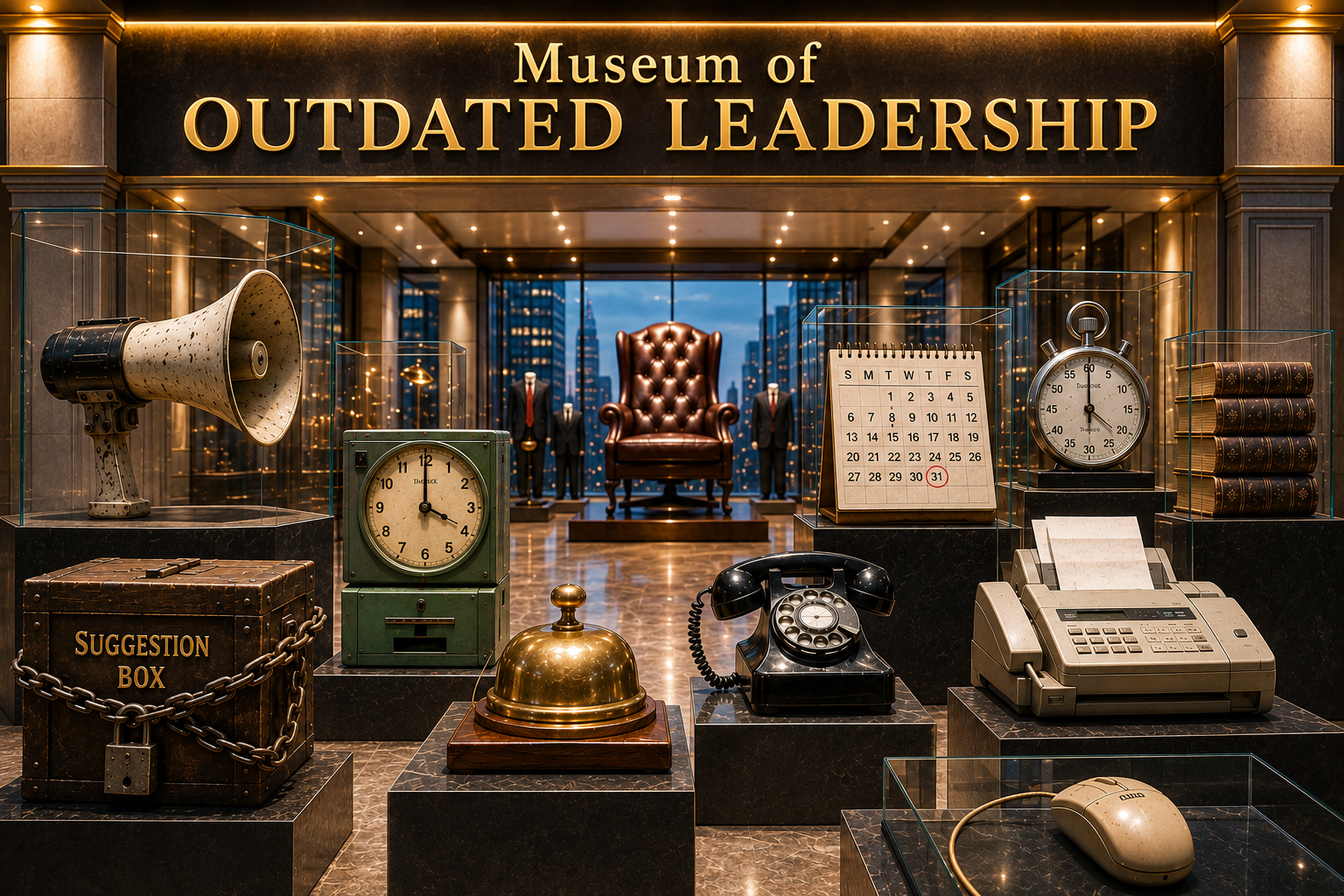
STILL FOLLOWING MOLDY LEADERSHIP ADVICE? What We've Unlearned Since Then

Leslie Rohonczy, IMC, PCC, Executive Coach & Author

 (LISTEN TO NARRATED AUDIOARTICLE VERSION)

I recently fell down one of those internet rabbit holes that begins with good intentions and ends with me wondering how humanity has survived itself thus far. One of the rabbit holes I fell into (consider yourself warned) was a website called theretrocodex.com, which is essentially a curated archive of things people once believed with remarkable confidence, only to be proven outrageously wrong later. Medical advice, scientific assumptions, cultural 'facts,' all neatly organized by decade, like a museum of human certainty gone terribly sideways. Honestly, it is fantastic!

There is something I find comforting about discovering that entire generations confidently believed things that now sound absurd. Weirdly, it makes me hopeful about the future, and hey, I'll take hope wherever I can find it these days.

Did you know, for example, that margarine was once marketed as a healthy alternative to butter? Or that doctors once endorsed cigarettes? Entire industries were built on 'facts' that now seem unfathomable to most of us.

And naturally, I wondered: where is the RetroCodex for leadership? Well, friends, I'm sorry to be the bearer of bad news, but there isn't one. But if one did exist, some of the outdated leadership beliefs I've helped clients with in my executive coaching work would deserve a prominent place of honour, right beside smoking cigarettes in the office and mandatory skirts and stockings dress code (yep, it used to be a thing.)

The uncomfortable truth is that outdated leadership beliefs rarely look outdated when you're on the inside of them. They usually appear dressed up as other things, like professionalism, accountability, belonging, executive presence, or 'the way things are done around here.'

So in the spirit of public service, let’s scrape the mold off a few winners and see how today's truth challenges those outdated assumptions.

1.  GOOD LEADERS ALWAYS HAVE THE ANSWERS

This one has had an impressively long shelf life. For decades, leadership was often associated with certainty. The person at the top was expected to know, decide, direct, and project confidence, preferably without visible hesitation. That may have worked when business environments were slower and hierarchies were tighter. Today, that model starts to crack under complexity.

Amy Edmondson’s research on psychological safety at Harvard has shown that high-performing teams thrive when leaders create the conditions where people can raise concerns, share ideas, and challenge assumptions without fear. Learning organisations depend on candour, not theatrical certainty.

We have all seen the alternative: a leader makes a spectacularly wrong decision with unwavering confidence, and no one flags their concerns.

TODAY'S TRUTH: Don't pretend to know everything. People can often tell when you're bullshitting anyway, and that erodes trust faster than honest uncertainty ever will. Focus instead on creating enough trust that the best thinking in the system actually surfaces.

2.  IF YOU WANT SOMETHING DONE RIGHT, DO IT YOURSELF

Ahhh... the unofficial anthem of overwhelmed leaders everywhere. This belief often disguises itself as high standards. Sometimes it's called accountability. Sometimes it is a genuine focus on quality. And sometimes, if we are being really honest, it is ego dressed up in sensible shoes.

Liz Wiseman’s work in Multipliers draws a sharp distinction between leaders who expand the capability around them and those who unintentionally diminish it by becoming the bottleneck.

If every important decision, approval, rescue mission, or client issue must pass through you, that is not leadership excellence. It is a leadership model built on dependency.

TODAY'S TRUTH: Your job is not to be the hero of every operational subplot. Modern leadership means building capability, trusting good people with meaningful ownership, and resisting the seductive little voice that says, “Honestly, it’ll just be faster if I do it myself.”

3.  PROFESSIONALISM MEANS EMOTIONAL RESTRAINT

There was a time when professionalism seemed to require becoming emotionally indistinguishable from office furniture. Steady; controlled; stoic even (and before the modern Stoicism enthusiasts come for me, I'm referring to emotional suppression, not Stoic philosophy.) 

The assumption was that emotion made leaders look weak, messy, or unstable. Daniel Goleman’s work on emotional intelligence helped challenge that premise by showing that leadership is deeply relational work. People don't stop being human when they log in to work in the morning.

This does not mean unfiltered emotional leakage, dramatic oversharing, or turning every meeting into personal theatre, but real emotion that others can feel, recognize, and understand because it's authentic and universally human.

TODAY'S TRUTH: Professionalism is not the same as emotional suppression. Knowing and naming what you're feeling, understanding how it affects your behaviour, and paying attention to what others may be experiencing in response to you are all aspects of emotional maturity.

4.  PEOPLE NEED TO BE WATCHED TO STAY PRODUCTIVE

Well, this belief got a fresh makeover during the Covid pandemic, didn't it? While remote work was a lifesaver (and business saver), it was also uncharted territory for businesses. Suddenly, some leaders became strangely obsessed with green dots, login times, and whether Margaret was really still working at 4:17 p.m.

Microsoft’s 2022 Work Trend Index report identified what they called productivity paranoia: 87% of employees said they were productive at work, but only 12% of leaders said they had full confidence their team was productive. Yikes, talk about a delta! This should not have surprised anyone: adults generally perform better when treated like adults.

TODAY'S TRUTH: Trust, clear expectations, autonomy, and meaningful accountability outperform surveillance. If your management strategy involves monitoring mouse movement, the issue may be less about productivity and more about trust and empowerment. Either way, it's worth exploring with a curious mindset.

5.  PSYCHOLOGICAL SAFETY MEANS BEING NICE

This one needs to be escorted out of the building along with its little cardboard box full of platitudes, toxic positivity, and matching 'Teamwork Makes the Dream Work' mugs.

Somewhere along the way, psychological safety got mistaken for permanent politeness, with no space or tolerance for disagreement, no discomfort, and no challenge. But that interpretation misses the point entirely.

Amy Edmondson has been clear that psychological safety supports high standards and honest conversations. It creates the conditions for people to speak honestly, take interpersonal risks, admit mistakes, and challenge thinking.

TODAY'S TRUTH: On a high-performing, healthy team, people can respectfully disagree, raise concerns, share their authentic views, and challenge ideas without fearing social punishment. If everyone is smiling while important truths remain unsaid, what you may be looking at is conflict avoidance dressed up as harmony.

6.  YOU NEED MORE EXECUTIVE PRESENCE

Translation: Somehow be more impressive (but we will provide zero operational definition for what that means, or how to do it.)

Executive presence has suffered some unfortunate branding. For years, executive presence has been confused with airtime, extroversion, charisma, confidence theatre, and that oddly polished panel-discussion voice people seem to acquire at conferences.

Susan Cain’s bestselling book Quiet challenged the long-standing assumption that extroversion naturally equals leadership effectiveness. Adam Grant’s research has also highlighted that leadership effectiveness depends far more on context and behaviour than personality stereotypes.

TODAY'S TRUTH: Influence is not volume, charisma, theatre, or performative posturing. Some of the most compelling leaders I've seen in action are quiet. They don't suck all the air out of the room trying to show how smart they are. They may say less, but when they do speak, people pay attention because their contribution actually moves the conversation forward.

7.  IF I'M BUSY, I'M IMPORTANT

Does your calendar resemble an aggressive game of Tetris? For years, chronic busyness has functioned as a strange status symbol. Packed calendars, midnight email replies, and performative exhaustion sends the message that if I am overwhelmed, I must be important.

Microsoft’s research on the 'infinite workday' has shown how digital work has steadily eroded boundaries, recovery time, and focus.

Packed calendars and performative exhaustion do not signal importance. Sometimes they convey weak boundaries, poor capacity management, or reactive operational focus with little strategic value.

TODAY'S TRUTH: Busy is not a leadership competency. Modern leadership requires protected thinking time, sound judgment, and enough strategic altitude to notice what others miss. If your calendar leaves no room to think, you may be demonstrating operational stamina while actively undermining your strategic credibility.

8.  LEADERS ARE NOT TO BE CHALLENGED

There was a time when leaders were expected to project authority and maintain distance. They did not invite dissent, challenge, input, or inconvenient truths from the people below them. Leadership was something to be respected, and in some workplaces, even feared. Suggesting to your boss that they might handle something differently would have been career-limiting behaviour.

Some remnants of that thinking still linger. Edgar Schein wrote extensively about how hierarchy can inhibit honest communication, especially when leaders fail to create the conditions for upward candour. And as leaders progress up the ladder and gain more authority, people often become even more selective about what they share with them.

TODAY'S TRUTH: If people decide that telling you the truth is unsafe, inconvenient, or pointless, you may be the last person to know what is actually going wrong. Strong leaders create the conditions for honest feedback to travel upward, not just downward.


SO WHAT IS STILL SITTING IN YOUR LEADERSHIP ATTIC?

The tricky thing about outdated leadership beliefs is that many of them genuinely did work back in the day, or at least seemed to. Some rewarded us earlier in our careers, which is exactly what makes them so sticky. The people who believed those old RetroCodex 'facts' were not foolish; they were operating with the assumptions, norms, and accepted wisdom of their time. Leadership is no different.

Nobody wakes up in the morning and consciously decides to lead like it's 1987. Old beliefs linger because they once helped us succeed, feel competent, or stay safe in systems that rewarded them. That does not make someone a bad leader. It simply means leadership has evolved.

Some of today’s most confidently held leadership beliefs will eventually look just as dated. The more interesting question is which ones you may still be holding onto without realizing it.

YOUR COACHING CHALLENGE

Most outdated leadership beliefs do not announce themselves with a little flag that says Hello, I am obsolete. They tend to feel sensible, responsible, and strangely familiar. This practice is designed to help you uncover one belief that may still be shaping your leadership, and then test whether it still deserves shelf space.

YOUR LEADERSHIP RETROCODEX

STEP 1: SPOT THE MOLD: Read through the beliefs in this article and notice which one made you uncomfortable, slightly defensive, oddly validated, or uncomfortably seen. That reaction is useful. Complete this sentence: One leadership belief I may still be holding onto is... Examples: "Good leaders should always have the answer." "If I want something done right, I should handle it myself." "Being busy means I am valuable."

STEP 2: TRACE ITS ORIGIN STORY: Most leadership beliefs started life as adaptations, not mistakes. Ask yourself: Where did I learn this? Who modelled this for me, or rewarded me for it? When did this belief first help me succeed? What did it help me avoid?

STEP 3: EXAMINE THE CURRENT COST: Now get brutally honest. Ask yourself: How might this belief be limiting me now? What does it cost my team? How does it affect trust? What undesirable behaviour does this belief keep reinforcing?

STEP 4: WRITE THE UPDATED LEADERSHIP TRUTH: If your old belief belongs in the RetroCodex, what replaces it? Complete this sentence: Today’s truth for me is... Example: Old belief: I need to stay involved in everything important. Today’s truth: My leadership value grows when I build capability instead of dependency.

STEP 5: RUN A LIVE EXPERIMENT: Within the next week, experiment with deliberately behaving according to your updated belief. Say less in the meeting. Delegate the thing. Ask the uncomfortable question. Admit you don't know. Protect thinking time. Invite dissent. Whatever your belief requires.

STEP 6: REFLECTION QUESTIONS: What happened? What surprised me? What story did my inner narrator start telling? What felt easier than expected? What still felt risky? What does this tell me about my next experiment?

If outdated leadership beliefs are influencing how you lead, and you're curious about what stronger, more modern patterns might serve you better, reach out for a free exploratory Executive Coaching conversation at www.leslierohonczy.com.

HAS YOUR TEAM BECOME BEIGE? How Humour, Playfulness, and Humanity Make Your Team Stronger

By Leslie Rohonczy, IMC™, PCC

(LISTEN TO NARRATED AUDIOARTICLE VERSION) 

There’s a guy at the front of the room, droning over his Powerpoints with the emotional range of a beige filing cabinet. Someone mumbles, “Great point, Ken,” without looking up from his phone. Someone else suggests they “circle back for confirmation and feedback” after the meeting. The rest of the team is not-so-subtly filling out their Meeting Buzzword Bingo cards: “Low-hanging fruit.” “Move the needle.” “Bandwidth.” “Synergy.” “Let’s socialize this.” And the senior leader stares into the abyss of his endless, joyless, budget meeting.

There is no joy here. Nobody laughs. Nobody relaxes. Not a single smirk was had.

And we still wonder why creativity, innovation, and engagement are disappearing faster than the free donuts in the lunchroom.

I spend a lot of time coaching senior leaders, and I’ve noticed something, well, funny. The leaders with the healthiest, highest-functioning teams are usually the most human. Not sloppy or inappropriate. And not trying too hard, like trying to amp up the latest TikTok slang.” Trust me, nobody wants to hear the VP say “it’s giving disruption.”

The best leaders often know how to create emotional oxygen - and they do it with humour and forms of play. Their teams laugh. There’s looseness. People interrupt each other with excitement. Someone occasionally says something weird, and they all laugh together; not 'at', but 'with' each other. The atmosphere feels alive.

And before somebody rushes into the comments to say, “Well, business is serious,” yes, of course it is. So is heart surgery. Research on surgical teams has shown that appropriate humour can reduce tension, strengthen team cohesion, and help clinicians cope in high-stress environments. Serious work has never required emotional sterility. Human beings are not machines.

Research has also consistently linked humour and positive emotional states with lower stress, stronger social bonding, better creativity, and improved cognitive flexibility under pressure; all aspects that contribute to high-performance teams.

A study published in the journal Emotion found that positive moods broaden attention and improve creative problem solving ("The Broaden-and-Build Theory of Positive Emotions," Fredrickson, 2001). Research from Stanford Graduate School of Business has also explored how humour increases status and interpersonal connection in leaders ("Humour, Power, and Status," Cooper, Kong & Crossley, 2018). Even the Mayo Clinic has written extensively about humour’s physiological impact on stress reduction and resilience ("Stress Relief from Laughter? It’s No Joke," Mayo Clinic, updated 2023).

It makes sense. Nobody does their sharpest thinking while simultaneously trying not to sound foolish. You can feel people editing themselves before they speak. Every sentence arrives pre-approved by Legal, rinsed and fluffed by Corporate Communications, and carefully scrubbed of anything that might accidentally sound human.

Meanwhile, belly laughs are coming from down the hall. "Why can't I be part of THOSE meetings?", we grumble. Teams doing extraordinary work often sound like they're having fun. It's a little chaotic, there’s energy, and teasing. There's room for personality and authenticity, and enough psychological safety that people stop rehearsing every sentence before speaking.

I once worked with an executive who was widely respected for her brilliant strategic mind. She was equally well known (one might say notorious) for her relentless intensity and razor-sharp scrutiny. When she entered meetings, it was a sphincter-shifting moment for her team. People physically changed posture! Backs straightened. Shoulders tightened. Voices flattened. And any remnants of humour disappeared instantly. Think the Devil Wears Prada's Miranda Priestly without the zinger punchlines. When she arrived on the floor, instant messages pinged across the team, as staff alerted each other to her presence. You could almost hear everybody’s internal monologue as she arrived: “Okay, everyone, gird your loins.”

In one of our coaching sessions, she said she wanted to find a way to get her team of Vice Presidents to lead more strategically. She thought they typically spent too much time in the weeds, and she'd noticed that they answered carefully, second-guessed themselves, and spoke as if they were students trying not to disappoint a terrifying university professor. She didn't realize that every interaction with her felt high stakes. Again, a wonderful human being and a smart leader with good intentions. But somewhere along the line, she had unconsciously equated seriousness and a critical edge with good leadership. 

Lots of leaders do this. Everything becomes heavy, measured, controlled, earnest, and they become emotionally exhausting in the name of professionalism. Meanwhile, their employees are sitting there thinking: “At what point does a meeting legally qualify as a hostage situation?"

Humour matters because tension matters. Every workplace has tension: deadlines, politics, conflict, pressure, uncertainty, competing priorities. And leaders have enormous influence over whether that tension becomes corrosive or connective.

Connective tension is when the right kind of humour releases pressure without dismissing reality. It tells people: “We can survive hard things without becoming emotionally constipated.” That’s leadership.

And no, this is not permission to become the office comedian. Some leaders hear “bring more humour” and think they suddenly need to transform their PowerPoint presentation into a 12-minute stand-up routine. Please... just don’t. There’s a difference between performative humour and relational humour. One desperately needs attention. The other creates connection.

The most effective humour in leadership is usually self-aware, gentle, and human. It often comes from leaders who are comfortable enough with themselves to stop 'performing perfection'. That kind of humour builds trust because it lowers perceived hierarchy. People exhale around leaders who feel emotionally real and who can laugh at themselves.

I remember one CEO telling me about a disastrous presentation where his technology failed. His speaking notes disappeared, and he accidentally advanced to a slide containing a private reminder that simply said:

“SLOW DOWN. YOU LOOK LIKE A MAN BEING CHASED THROUGH THE WOODS BY A WOLVERINE.”

The entire audience burst out laughing. According to him, it became the strongest presentation connection point he'd had all year. Why? Because everybody suddenly relaxed. The mask cracked. Collective humanity appeared.

Nobody trusts perfection anymore, anyway. We’ve all met those leaders who speak in flawless corporate language while looking like they haven’t experienced a genuine emotion since 2014. That’s not executive presence; that's a corporate chatbot with a pension plan.

Playfulness also matters far more than most organizations realize. I'm not talking about childishness, but rather playfulness. Curiosity, experimentation, lightness, and the willingness to think sideways. Some of the strongest leadership teams I’ve ever encountered, or been lucky enough to be part of, spent some of their meeting time laughing, because they trusted each other enough to think and speak freely.

Research into “Happiness and Productivity” (University of Warwick, 2014) found that happiness can increase productivity by about 12 percent. Other studies have also connected positive emotional states with better problem-solving and broader cognitive flexibility.

This matters because some organizations slowly drain the spontaneity out of communication. People stop speaking casually. Comments get 'optimized', and every email starts sounding like it was reviewed by three lawyers and a hostage negotiator. Listen, nobody wants to say the wrong thing or look foolish. And when nobody is willing to loosen their grip for even ten seconds, eventually, people stop bringing bold ideas altogether. Boldness requires psychological safety, but we humans get cautious when our environment feels emotionally risky.

One of the most useful questions a leader can ask is this: “When was the last time this team laughed together naturally?” I'm not talking about forced fun, like mandatory bowling or trust falls. (Hey, nothing says “this workplace understands human dignity” quite like falling backward into the arms of Steve from Procurement.) I mean real laughter; the kind that happens when people feel safe enough to stop managing themselves so tightly.

Laughter can be diagnostic. Humour is often evidence of the presence of trust, of belonging, and nervous system regulation.  Healthy teams laugh. Not all day, and not constantly, but regularly. And leaders who understand that have an enormous advantage, especially now. Our modern workplaces are tired. People are carrying stress levels that would have sounded medically concerning ten years ago. Many employees feel emotionally overextended, socially cautious, and mentally saturated.

Leaders who can create moments of fun, relief, humanity, and emotional brightness without becoming performative become magnetic. People are drawn toward leaders who can help them feel human.


YOUR COACHING CHALLENGE

For the next two weeks, treat this like a social experiment. Your mission is to see whether small moments of humour and humanity change the emotional climate around you.

Try a few of these:

  • Show up to one meeting and announce a ban on corporate jargon entirely. Tell them that every time somebody says, “circle back,” “bandwidth,” or “move the needle,” you will all dramatically sigh like a Victorian widow.

  • Tell one story where you were genuinely ridiculous, awkward, or silly. Not polished vulnerability, but the kind where people laugh because they recognize themselves in it.

  • Notice how often people shrink their own ideas before speaking. You can usually tell what's coming because they offer qualifiers like “Maybe this is stupid…” “I haven’t thought this through…” "I might be wrong but..." When it happens, interrupt the self-editing with warmth: “Say the thing.” “No disclaimers.” “Now I really want to hear it.”

  • Monitor for Beige. Give everyone permission to call out moments when the team starts sounding emotionally over-polished. Encourage callouts like “That sounds a bit beige.” “Your answer sounds suspiciously lawyer-approved,” or “Try that again, but as a human.”

Then reflect on these questions:

  1. Which experiment created the biggest shift in energy, and what changed specifically?

  2. What surprised you most about your team’s response to a little more humanity?

  3. How often did you notice people softening, shrinking, or beige-ifying their contributions before speaking?

  4. What happened when you interrupted that pattern and invited the real thought instead?

  5. If your team had permission to be a little less polished and a little more human going forward, what might become possible?

Somewhere along the way, many organizations trained personality out of professionalism. I think it’s time to bring a little of it back.

If your team has become emotionally cautious, overly polished, or painfully beige, and you want to build a leadership culture where people think more freely, collaborate more honestly, and actually enjoy working together again, reach out for a free exploratory Executive Coaching conversation at www.leslierohonczy.com.

HOW DO YOU KNOW YOUR LEADERSHIP IS WORKING? Accurate Self-Assessment for High-Performance Leadership

(LISTEN TO NARRATED AUDIOARTICLE VERSION)

Most leaders I work with don’t struggle with effort. They’re showing up, working hard, and trying to get it right. The harder question just below the surface is whether all of that effort is translating into high-performance leadership.

If that question feels a bit uncomfortable, that’s understandable. Accurate self-assessment can be challenging. And as your leadership career moves up, signals get softer. People choose their words more carefully, and that makes it easy to fill in the gaps with our own assumptions. If things aren’t falling apart, it must be working. If the team is delivering, leadership must be effective. If no one is pushing back, things must be aligned. I’ve seen this play out with strong leaders more than once, and it rarely leads where they expect.

High-performance leadership shows up in patterns over time and in what happens when we are not present. The most useful indicators are often easy to miss because they sit in the background of day-to-day work. A more accurate read starts to show up when we pay attention to what repeats, not what happens once.

  • Ownership: When something important is in motion, where does it land? Does it move forward through others, or return to us? Work that consistently comes back often points to how expectations, trust, or decisions are set. Leaders who are highly responsive tend to step in quickly, which may help in the moment but can train the system to route work back to them. Over time, ownership concentrates instead of spreading.

  • Contribution: In meetings, are we hearing fully formed ideas, or cautious half-steps? High-performing teams speak before everything is perfectly shaped. When everything sounds safe, something is likely being held back. Leaders who jump in quickly with their own thinking can shorten the space others need to think out loud or challenge direction, which narrows contribution (even while conversations feel efficient).

  • Decision Durability: When an agreement has been made, does it stick, reopen, shift, or stall? Agreement can happen quickly, while commitment shows up later. A decisive leader can drive toward closure fast, which can be useful, but it can also lead to premature agreement that doesn’t hold after people leave the room.

  • Presence: How much depends on us being there? If momentum rises with our involvement and drops without it, the system is relying on us more than it should. What happens when we step out of an email thread or a meeting? Does work stall until we join, or do conversations stall until we weigh in with our opinion? High responsiveness amplifies this pattern by speeding up progress when we engage and slowing it down when we step back, creating uneven momentum.

If we watch closely, we start to notice patterns in how these signals show up in our everyday rhythm. And once those patterns become visible to us, we can't unsee them. A more interesting question then begins to emerge: How does my leadership style influence outcomes over time?

That question keeps our development work grounded in curiosity, and it opens up a different way of looking at what’s happening. If our impact is shaped by what others experience, rather than by what we intended, then a gap can open up. We may believe we are creating clarity while others feel pressure, or think we are being supportive while others experience us stepping in too quickly.

And here's another angle worth paying attention to: leadership is experienced over time through tone and timing. People learn how to respond to us based on repeated interactions, and those responses shape what becomes possible.

When we look at it this way, our self-assessment becomes more accurate because attention shifts toward observable patterns instead of internal confidence.

This is where experimentation becomes useful, because small adjustments create insights about what actually changes.


YOUR COACHING CHALLENGE

Choose one situation this week and run a small, deliberate experiment. Keep it simple so you can see what changes.

  • In a meeting where you normally drive the conversation, hold your view for a few beats longer than usual, then watch who steps in and what emerges before you speak.

  • Choose one decision that was made in a meeting and name ownership before closing the discussion, then leave the decision untouched for a few days and observe whether it holds or drifts.

Capture what you notice in real time. Look for shifts in ownership, contribution, and follow-through, and use those signals to adjust your next move.

Over time, your observations become data you can rely on. They show you where your leadership is creating movement, and where it is getting in the way. That’s the shift that sticks.

 If you are curious about how to evolve your leadership, reach out for a free exploratory Executive Coaching conversation at www.leslierohonczy.com.

WE HIRED ROCK STARS. WHY ARE WE STILL STUCK? How Strong Talent Reveals Weak Systems

By Leslie Rohonczy, IMC™, PCC

Executive Coach | Leadership Development Expert | Author | Speaker | ©2026 | www.leslierohonczy.com

 (LISTEN TO NARRATED AUDIOARTICLE VERSION)

On paper, it should be working. You raised the bar on hiring and brought in stronger talent; people who’ve operated at a high level, who aren’t easily rattled, and who get results. You expected lift, and fast!

I've heard versions of the following from leaders through my career: “We upgraded the team… and everything got slower. We need to do a better job recruiting the right people.” That 'diagnosis' sounds reasonable in the moment, especially when results don’t match expectations. But often, it isn’t the recruitment process that’s dropped the ball.

See if any of this sounds familiar: after an infusion of top talent, decisions take longer, time or resources get wasted as work circles back around, and conversations multiply. It can feel like the team got smarter and the work got stuck. This is often the point where the story starts to drift in the wrong direction, as leaders revisit hiring choices or question whether the new talent is as strong as it looked in the interviews. 

How is it possible to have less momentum when there’s more intelligence and experience in the room? Well, intelligence and experience aren’t usually the issue, even though this is the first place most leaders tend to look. In fact, hiring rock star talent doesn’t automatically improve performance; it reveals the limits of the systems that they are stepping into.

When capable people enter an environment where priorities aren’t consistently clear, where decision paths shift depending on who’s involved, and where expectations move midstream, the cracks become visible. They’re strong enough to feel the friction and unwilling to pretend it isn’t there.

Less experienced teams often push through messy systems without questioning them, assuming it’s 'just how things are done around here'. Strong talent does something different; they notice what’s off, they test assumptions, and they slow down when something doesn’t add up. Their hesitation is worth paying attention to, because what you may experience as a slowdown is often a system being exposed, which can feel frustrating until you see what it’s pointing to.

A team isn’t just a group of skilled individuals operating independently; it’s more like a busy airspace. You can have the best pilots in the world flying planes in and out, but without clear signals, defined flight paths, fueling and food service systems that keeps everything moving safely and efficiently, things start to circle, delay, and back up (or worse).

I've observed leadership teams full of smart, seasoned people spend an hour circling a decision that should have taken ten minutes, simply because ownership wasn’t clear and no one was quite sure who had the call. Even with highly capable people in place, an unclear structure will create bottlenecks.

This is where leadership habits begin to show up, especially when things feel messy. The instinct for many leaders is to tighten control by adding another checkpoint, getting more involved in decisions, and increasing oversight. It just feels responsible and accountable in the moment.

But what it often does is force high-performing people to adapt to outdated systems that were never designed for how they think or the high level they're used to operating at. You can almost feel their energy drop when that happens, which is where performance stalls and engagement begins to erode well before it becomes obvious. People still contribute, but with less conviction. They start conserving their energy instead of investing their discretionary effort, and they hold back valuable input and ideas when what's really needed is their best thinking and fresh perspectives.

The better leadership move is to examine the systems and processes those people are working within, rather than managing them more closely. Get curious about:

  • Where work slows down for reasons that no longer make sense

  • Where decisions are delayed because ownership is unclear

  • Where approvals add time without adding value

  • Where caution is rewarded more than thoughtful contribution

  • Where leadership steps in, when stepping back would actually move things forward

High-performing leaders encourage strong talent to question the systems they inherited, even the ones that once worked well, then simplify decision flow so ideas can flow and influence. They remove unnecessary steps instead of layering unnecessary oversight, and they create space for testing and refinement, knowing that good ideas rarely arrive fully formed.

They also invite challenge and stay in those conversations long enough for something better to emerge. This is where alignment actually develops, through people engaging with each other’s thinking and circling back to a shared understanding of what matters. The role of the leader starts to shift as they spend less time evaluating individuals and more time seeing their team as part of a system that is producing the results they’re getting. When different results are needed, the system itself must evolve.

If the environment isn’t set up to leverage the thinking, experience, and judgment of the new people you’ve hired, you aren’t fully leveraging the investment you’ve made in that talent, and you end up carrying the cost of capability without getting the benefit of it, which is a frustrating place to sit when you know how much potential is there.

So if you’ve raised the bar on talent and you're not seeing the lift you expected, look at the system, because that’s where the real leverage sits. If the airspace feels crowded and slow, don’t coach the pilots to fly harder; upgrade the system of signals, communications, and flight paths so air traffic can move efficiently.


YOUR COACHING CHALLENGE

Set aside 30 minutes this week and take a close look at how work actually moves through your team. Think of your team like a busy airspace. Your goal isn’t to fly every plane. It’s to make the routes, signals, and handoffs clear so everything moves without circling.

Choose one recent decision or project that felt slower or heavier than it should have, then write out how it unfolded step by step, noticing where it paused, where it looped, and where it required rework.

Then reflect on the following questions in a single sitting so you can see the full pattern rather than isolated moments.

  1. Where did the system make this harder than it needed to be?

  2. Where did I step in, and what impact did that have?

  3. Where did someone hold back when they could have pushed forward?

  4. What would’ve needed to be different for this to move with more clarity and pace?

You aren’t trying to fix everything in one sitting. You’re experimenting with looking for what’s slowing things down, and once you see it, you can clear the path. That’s how you keep the airspace moving the way it should, to create real lift for your rock stars.


If you notice this pattern in your own team, reach out for a free exploratory Executive Coaching conversation at www.leslierohonczy.com.
FEEDBACK ISN’T YOUR PROBLEM (But Your Relationship to Feedback Might Be)

By Leslie Rohonczy, IMC™, PCC

Executive Coach | Leadership Development Expert | Author | Speaker | ©2026 | www.leslierohonczy.com

(LISTEN TO NARRATED AUDIOARTICLE VERSION)

Most leaders believe they’re open to feedback… right up until the moment they hear something they don’t like. But it’s what happens next that reveals our relationship to it.

I remember sitting across from a senior leader who told me he was "very open to feedback". He wasn’t posturing; he meant it. He regularly asked for input, encouraged it, and even thanked people for it. Technically, he was doing all the right things, right up until that critical moment.

His peer offered him feedback about a client meeting they attended together. Within seconds of hearing her observations, he stepped in with all the context: a bit of background, a quick clarification, a touch of justification, a hint of over-explaining, even a suggestion that she had misread his intentions; then a gentle repositioning of what he meant versus what actually happened. It was a lot. He was articulate, calm, and had been completely effective at shutting the whole thing down. His peer didn't argue or push back, and the conversation just wrapped itself up. From his perspective, it was a good exchange. From hers, it wasn’t worth pushing any further - or doing in the future.

This is where the real issue lies: we each have our own special relationship to feedback, a unique pattern of reactions that show up in the first few seconds after we hear it. That relationship determines whether the conversation opens up or closes down. While we’re looking for clear, useful input, our team and colleagues are asking themselves how much of this is actually safe to say.

Amy Edmondson’s research at Harvard Business School has shown that when people sense even a small interpersonal risk, they adjust by softening their message, rounding off the edges, and removing the parts that might upset or land poorly. The feedback doesn’t disappear, but it loses its teeth, sometimes becoming so neutral and mushy that it's unrecognizable - and unusable as a result.

There’s another layer that shows up before feedback is even given: the way most leaders ask for feedback makes it harder to offer anything useful. “Is there anything I could do differently?” sounds generous, but it leaves the other person with too much space and not enough direction. The brain stalls. There’s nothing concrete to grab onto.

Now compare that to, “What’s one thing I could do differently in our next client meeting?” That question gives the other person somewhere to start. It’s specific, focused, and much easier to answer. This small shift can create a big difference.

Now layer that with what happens after the feedback lands, because this is where our relationship to feedback shows up in full colour. We rarely receive feedback as 'neutral data'. Most often, we see it as someone's interpretation of something they saw us say or do. It brushes up against our identity, competence, and reputation, and it pokes the part of us that wants to be seen as credible, valued, and in control. That means we're not just hearing the feedback; we're reacting to what we think it says about us as a person.

Our brains are wired to react fast. Research in social neuroscience by Matthew Lieberman at UCLA shows that perceived social threats, including criticism, can activate the same neural pathways as physical pain. Think about that: our brains interpret both as pain! So the urge to explain, clarify, or straighten the record isn’t a personality flaw; it's a hard-wired reflex. The issue shows up when we're not aware that the reflex has taken us over.

Our teams watch those micro-moments closely. They notice how long we stay with a hard comment, whether we get curious or defensive, and whether the conversation opens up or closes down. Over time, they adjust and bring us the version of feedback that keeps things moving, avoids friction, and sounds useful without creating risk.

And just like that, our access to deeper insights about ourselves narrows. Meetings still happen, conversations still feel productive, and we still believe we’re open to feedback. We just don’t realize how much of it never makes it to us.

Think about the last time someone offered you feedback. What did you do in the first few seconds after you heard it? Was there something that didn’t sit well? Was your instinct to move to resolve it? Did you stay open and curious with it? Did you explain? Did you have the urge to tidy the moment, or did you let it breathe? These are some common reactions to feedback in the moment. What's yours typically?

One leader I worked with ran a simple experiment. Every time he received feedback, he had to ask one more question about their observation. Not a deep dive series of questions that would feel like an interrogation, just one genuine question intended to help him understand what the other person was seeing. At first, it felt awkward and slower than his usual pace, and he worried it made him look unsure.

What actually happened was different. People started giving more details without being asked, offering examples, and staying in genuine conversation longer. The feedback became sharper and more useful because his stance in the moment had changed.

This is where stance matters. In feedback conversations, our job as the receiver is simple (but not easy): receive the feedback, thank the person for offering it, ask a clarifying question if something isn’t clear, and then reflect. Not defend; not explain; reflect. That reflection is where we close blind spots and gaps we can’t see on our own, and it’s the part most of us skip because it can be uncomfortable.

Nothing about the feedback itself had changed. His relationship to it had. We don’t need to agree with every piece of feedback we receive, and we don’t need to suppress our reactions. We do need to notice them and resist acting on them too quickly. Staying in the moment a little longer and asking a genuine question changes what becomes available to us. It also changes how people experience us, and that ultimately determines whether they will tell us what we need to hear.

YOUR COACHING CHALLENGE

Think about the last piece of feedback that stayed with you; the one that lingered, and felt genuinely uncomfortable. What happened in your head in the first few seconds?

Now imagine that moment again, but this time, you take on a deliberate stance as the receiver.

First, receive it fully. No interruption, no correction, no facial gymnastics. Just take it in without judgment or defense.

Second, acknowledge the person. Not just a quick “thanks,” but a genuine appreciation for both the perspective and the courage it took to offer it. Feedback, especially upward or sideways, feels risky. When we recognize that, we create the psychological safety for honesty in the future.

Third, get curious. Ask one question that helps you understand what they saw, heard, or experienced. Stay out of defending your intent and lean into understanding their reality. For example: “Can you say a bit more about what you noticed in that moment?” or “What impact did that have for you?”

Then, thank them for their feedback.

Lastly, and this is the part most people miss: reflect. Take time after the conversation to sit with it. Consider what might be true, even if it’s only partially true. Look for patterns, examples, and evidence of what others might be seeing that you’re not.

Reflect on these questions:

  • What part of this feedback felt most uncomfortable, and why?

  • What story did I start telling myself about what this means about me?

  • What pieces might be valid here, even if I don’t fully agree?

  • Where have I seen a version of this before?

  • If I took this seriously, what would I experiment with doing differently?

After your reflection, take some time to close the loop. Let the person know what you took from the conversation and what you’re thinking about doing with their feedback. This builds trust and reinforces that their voice matters.

Try this once this week. Not perfectly, just deliberately. That’s where the shift starts.

If this surfaced a blind spot, or you want to deepen your relationship to feedback, reach out for a free exploratory Executive Coaching conversation at www.leslierohonczy.com.

LACK OF PRODUCTIVE CONFLICT IS A WARNING SIGNAL: How Politeness Culture Filters Out the Truth

By Leslie Rohonczy, IMC™, PCC

Executive Coach | Leadership Development Expert | Author | Speaker | ©2026 | www.leslierohonczy.com

(LISTEN TO THE AUDIOARTICLE VERSION)

You’ve likely been in this meeting (and if you’re honest, you may have even been running it). You lay out a direction, walk the group through your thinking, and open the floor. A few people nod as you speak. Someone says 'It makes sense'. Another adds that they are on board and ready to move forward. The tone is smooth, the discussion feels easy, and nothing in the room signals friction. You leave that conversation reassured that you have alignment.

A few weeks later, the energy is different. The work is moving, but not with any real momentum. You find yourself stepping in more than expected, answering questions that shouldn't need your input, and wondering why something that seemed so clear is not gaining traction.

This is usually the point where leaders turn their attention to execution. They start tightening timelines, increasing check-ins, and stepping in more frequently to keep things moving. It feels like a delivery problem that needs more oversight or clearer direction.

But the breakdown did not start in the execution phase. It started earlier, in the meeting itself, when alignment appeared to be present but was never fully established. What looked like agreement, wasn't; it was a group of people making a rapid, often unconscious decision about how to respond in that moment. For some, it may have been about protecting the relationship. For others, it was about not slowing things down, not wanting to challenge too early, or not being certain their perspective would add value. And for some, it was simply easier to agree in the moment and revisit it later, even if that conversation never actually happened.

If this sounds familiar, you're in good company. In Canadian workplaces, politeness shapes how people respond in real time, especially when they are unsure how their input will land. It influences what gets said, how it is said, and in many cases, whether it even gets said at all.

Over time, that creates a gap between what is expressed in the room and what people are actually thinking. Leaders hear support. Teams experience something more complicated.

I recently coached a senior leader who couldn't understand why his teams weren't giving him honest feedback, or bringing forward stronger ideas to challenge the status quo. He had been very clear that he wanted input. He said it often, and he meant it. From his perspective, the invitation was wide open.

From his team’s perspective, they saw it differently. He moved quickly in meetings and responded to ideas as they were raised. He tended to build on what he liked and move past what he did not, often without much pause. He also closed discussions as soon as he felt he had enough to make a decision (which happened faster than he realized). None of his behaviour was aggressive or dismissive; it was just how he liked to operate.

In these conditions he'd created, his team had stopped testing ideas that were not fully formed. They held back perspectives that might have slowed the conversation down. They paid attention to where he seemed to be leaning and aligned themselves accordingly. The meetings stayed smooth, the tone stayed positive, and the appearance of agreement remained intact.

From the outside, the issue is easy to spot. From the inside, it is almost invisible. They were operating within it, shaped by it, adapting to it in real time, like fish that have no awareness of the water they're swimming in. People were no longer bringing their full thinking into the room. They were participating, but in a narrower way; contributing, but without the same level of ownership. They were staying engaged enough to keep things moving while gradually pulling back from conversations that held greater risk.

That shift is easy to miss because it does not create obvious disruption. There are no raised voices, no visible conflict, and no obvious signs that something is wrong. Everything continues to look professional and well-managed.

The cost shows up later, when decisions move forward without the benefit of a broader perspective. Execution starts to stall. Leaders find themselves carrying more of the load than they expected, stepping in to clarify, reinforce, and push things along.

At that point, it is tempting to question commitment, engagement, or capability. More often, the issue is access. Access to what people are actually seeing, thinking, and questioning. Access to the ideas that stayed in someone’s head because the moment did not feel right to share it. Access to the concerns that were softened beyond being recognizable, or left unsaid altogether. When that access narrows, the quality of thinking narrows with it.

This matters even more in the current environment. Canadian organizations are operating with tighter margins, higher expectations, and less room for missteps. Leaders need people who are willing to engage fully, especially when the path forward is not obvious. Politeness, when it goes unchecked, can work against that.

So the question shifts. Instead of wondering why people are not speaking up, it would be more useful to ask what they are responding to in how you lead. Your behaviour sets the conditions for how far others are willing to go. When you jump in within seconds of someone speaking, wrap a discussion before others have weighed in, or signal a preferred direction through your tone or follow-up questions, people notice. They constantly read your pace, your reactions, and your follow-through.

They notice how quickly you respond to ideas and which ones you stay with. They notice whether a differing perspective changes anything or simply gets set aside. They notice how much space there is to think before the conversation moves on.

These signals shape participation far more than any verbal invitation. When people see that their input can influence direction, they lean in. When they don't see that connection, they conserve their effort and contribute in more predictable ways that feel safer. And those conversations, while they may be easier to manage, are ultimately less useful.

Leaders who want stronger engagement often focus on saying the right things: asking for feedback, inviting challenge, and reinforcing candour and openness. Those behaviours matter, of course, but they're not the deciding factor. People are looking for evidence: for moments where input changes the course of a discussion; for signs that it'll be worth the effort to bring forward something that may not land perfectly; for a reason to believe that speaking up will make a difference. That evidence is created in how you handle the conversation, not in how you frame the invitation.

When that evidence is present, you experience a shift. Conversations deepen, and people stay in the discussion longer. When it is not present, politeness fills that space and limits what is shared. Over time, that creates distance between what leaders hear and what their teams are actually thinking. And that distance is where disengagement grows.

YOUR COACHING CHALLENGE

Think about a recent meeting where agreement came quickly; the kind of moment where everyone nodded, and you moved on without resistance.

In your next meeting, when that moment happens again, do something different: Pause the conversation and say, “Before we move on, I want to test something with you. What are we not saying right now?” Then stop talking. Hold the silence. Let the squirmy discomfort show up. Do not rescue the moment, and do not soften the question. This can be harder than it sounds, especially if we're used to a faster pace to a solution.

When someone offers a partial answer, stay with it longer than you normally would. Ask them what else they were considering but chose not to say. Let the room see that 'first layer thinking' isn't enough.

If nothing comes, name that too. Say what you are observing about the speed of agreement, and your curiosity about what might be underneath it.

After the meeting, reflect on what shifted; not just in what was said, but in how the room responded when you disrupted the well-worn pattern. That is where you start to regain access to what is actually in the room.

If you're starting to wonder what's going unsaid in your leadership meetings, that's a conversation worth having. Reach out for a free exploratory Executive Coaching conversation at www.leslierohonczy.com.

YOU’VE MADE YOURSELF THE SYSTEM: The Ego Payoff of Control

By Leslie Rohonczy, IMC™, PCC

Executive Coach | Leadership Development Expert | Author | Speaker | ©2026 | www.leslierohonczy.com

(LISTEN TO THE NARRATED VERSION)

 Leaders, have you ever had that moment where you pause, look around, and realize, “It’s all on me”…? You’re involved in everything, every decision, every escalation, every aspect of the work from strategy to execution. You send late-night messages that start with “Hey, quick question...” You carry the weight, you solve the problems, and you keep the whole machine running.

But if you listen closely, underneath what can start to feel like a kind of performative martyrdom, you might notice a sense of pride in being the one who holds it all together; the one who’s central, necessary, irreplaceable.

We don’t typically acknowledge this uncomfortable fact; hell, we’re often not even aware that it’s what’s driving us. Others might look at us and think, “Wow, that’s commitment.” But from the inside, it’s something deeper. Think about it: if it’s truly all on you, then either the system is broken, or you’ve made yourself the system.


IT FEELS LIKE LEADERSHIP, BUT...

So many of the leaders I coach tell me they haven’t been able to get away for a real break. There’s always something too important, too fragile, or too dependent on them.

The one that really stays with me was a woman who hadn’t taken a proper vacation in nine years. Her team leaned on her constantly, she was the implicit leader of her peer group, and her actual leader repeatedly rewarded her for being “indispensable.”

Nine years without a real break. In one session, after walking through yet another week of being pulled into everything, I asked her: "What do you get out of being needed like this?" She paused for a long time before answering, then she said, “I know that I matter.” Oof! Right in the feels!

It took real courage to say it out loud, to see how something in her was driving her behaviour, and even her identity.


THE SECRET PAYOFF

When you've set up the system so that everything must run through you, you receive constant reinforcement as the one who people turn to, the one who knows what’s going on, and the one who can fix things when they break. That creates a powerful internal reward that goes far beyond external validation.

Behavioural psychology says that we repeat behaviours that are rewarded, especially when the reward is tied to how we see ourselves. The feeling of being relevant, necessary, and relied upon isn’t trivial. It anchors identity.

So when a leader says "I need to delegate more", but then doesn’t follow through, I don’t assume it's a skill gap. I get curious, and invite them to get curious along with me, about the payoff they haven’t named yet. More often than not, that payoff is about keeping them at the center of a system that needs them to function, and reinforcing the belief that they need to stay at the center to remain relevant. It’s as if they believe they won't matter if they’re not involved in every decision and every thread, which helps to explain why letting go feels risky and why control feels so important to them.


CONTROL DISGUISED AS COMMITMENT

Now that we're digging deep, here’s another layer that’s even harder to see: carrying everything is about control. If work runs through you, you can see it, shape it, and intervene before it goes sideways. That reduces uncertainty, which matters more than most of us are willing to admit.

And the pattern reinforces and amplifies itself over time. You stay involved to reduce risk, your team stays dependent because you’re involved, and you feel even more responsible because they depend on you. Eventually, this stops being a leadership approach and becomes a closed system in the exact shape of you, with everything designed to run through you.


THE EGO TRAP

There’s a sharper edge to this that’s worth naming. Believing that it’s all up to you can carry a subtle (sometimes not-so-subtle) form of ego-centricity. It’s not just that you believe it, it’s that you’ve positioned yourself as the center through which everything has to move. Maybe it wasn’t intentional, and it may not look like arrogance in the obvious sense, but there’s a deeply held belief that things won’t function without you at the center.

It sounds responsible and committed, but when leaders place themselves at the center of every outcome, and hold that belief, even unconsciously, it will crowd out the capability of others. There’s little room for different approaches or shared ownership. Over time, it sends a message to the team that says, “I’ve got this...,” which people eventually hear as, “...and that's because I think you don’t.” It's not your intention, of course, but that's the impact nonetheless.

One of the reasons this pattern is so hard to shift is because it’s tied to how leaders see their relevance, their role, their value, and their responsibility.


STAND DOWN, HERO

Many leaders built their careers on being the person who steps in and saves the day, because they see problems faster than others, connect the dots, and move things forward. That ability is often rewarded early and often. Then they get promoted, and the rules change.

At more senior levels, the role is no longer to be the hero. The role is to build a team that doesn’t need one. And that shift is far more difficult than it sounds, because it requires us to let things wobble, to watch others struggle, and to resist stepping in when we can clearly see the answer.

For a leader whose identity is built on being capable and reliable, that can feel like negligence rather than growth. So they keep stepping in, and over time, they find themselves carrying more than they can sustain.


HIDDEN COSTS

This pattern doesn’t just lead to burnout. When everything runs through you, your team stops thinking at the same level. It doesn't just feel like everything runs through you; it actually does. Decisions bottleneck, ownership becomes unclear, and frustration builds. You begin to feel like you’re carrying people, while they begin to feel that they aren’t trusted.

There’s also a structural limit that shows up over time. As your role becomes more complex, your capacity won’t scale if you stay the central hub for everything. You don’t just feel like a bottleneck, you become one, even though your intention is to support the system. Here's a marker for a high-performing leader: they can step away for a good stretch (say the length of a proper vacation), and the team still functions well and achieves their objectives. If performance drops because decisions stall or everything waits for you, you know the system is built around you. And at senior levels, that doesn’t just create strain, it caps your career trajectory, because leaders who can’t step out without things slowing down or collapsing are difficult to move up.

Some leaders don’t fully want to let go of this pattern because it serves something important: it reinforces identity, creates a sense of value, and offers a level of control that feels stabilizing.

If that pattern were to change, a different question would emerge: If you’re not the one holding everything together, then who are you as a leader?


SHIFTING THE ROLE

Leaders who move through this don’t suddenly disengage. They become more deliberate about where they show up and why. The work isn’t just to take things off their plate; it’s to redesign the system so it doesn’t rely on them in the same way.

And a powerful upside: when you step back in the right places, your people step forward. They make decisions, test ideas, and start to question “the way we do it here” instead of waiting for your answer or permission. That’s where capability actually grows, not in perfectly executed instructions, but in imperfect attempts they own. If everything continues to run through you, your team adapts by bringing problems, not proposals, and waiting to be told rather than thinking it through. When you shift your role, you change that pattern and create space for judgment and challenge, and for different ways of doing things to emerge.

They begin to ask themselves more precise questions like, "What truly requires my involvement?" "Where am I stepping in out of habit rather than necessity?" "What am I preventing my team from learning?"

They also develop something that doesn’t get talked about enough in leadership development: tolerance. Tolerance for ambiguity, for imperfect execution, and for outcomes that don’t match exactly how they would have done it. Tolerance (what some might call grace) is what allows leadership to scale beyond the limits of one person.


YOUR COACHING CHALLENGE

Take a clear look at your current load, not just what you’re carrying, but how it got there. Approach this as an intentional practice, not a quick reflection.

STEP 1: MAP YOUR CURRENT LOAD Write down the key decisions, problems, and responsibilities that regularly flow through you.

STEP 2: IDENTIFY THE PATTERN For each item, ask yourself: Where does this genuinely require my involvement? Where am I stepping in because it feels uncomfortable not to? What do I get, emotionally, from being the one who carries this?

STEP 3: NAME THE PAYOFF Be honest here. What does being needed give you? Relevance, control, certainty, recognition? If you don’t name it, you can’t shift it.

STEP 4: EXPERIMENT WITH PULLING BACK Choose one or two areas where you can intentionally step back by about ten percent. Be specific about what you will stop doing, delay, or redirect.

STEP 5: BUILD TOLERANCE As you step back, notice what shows up. Discomfort, anxiety, the urge to jump back in. Don’t fix it immediately. Stay with it. This is where the real work is.

STEP 6: OBSERVE THE SYSTEM Watch what happens when you’re not in the middle. Do others step forward? Do things wobble? Do new ideas emerge? This is data, not a verdict.

The goal of this practice isn’t perfection. It’s awareness and experimentation. What you notice here will tell you more about your leadership than any framework ever will.

And if you want to make some leadership shifts in a practical, grounded way, reach out for a free exploratory Executive Coaching conversation at www.leslierohonczy.com.