
By Leslie Rohonczy, IMC™, PCC
Executive Coach | Leadership Development Expert | Author | Speaker | ©2026 | www.leslierohonczy.com
What if the behaviours you rely on to demonstrate that you’re a trustworthy leader aren't what others value most?
You may pride yourself on keeping your promises, while someone on your team is looking for evidence that you'll put the team's interests ahead of your own. That disconnect could mean the difference between hearing about an emerging problem early, and finding out when it's too late to fix it.
This is Part 3 of a six-part series adapted from my book Coaching Life, where I’m revisiting some of my favourite sections through the lens of what senior leaders face at work.
HOW DO YOU MEASURE TRUST?
In Chapter 18, 'Trust,' I share a personal example of how differently two people can assess someone's trustworthiness.
My instinct is to look for consistency. If you show up on time and do what you say you'll do, I trust you. It's really that simple for me. But break a few promises, and you'll have some ground to make up with me.
My husband (aka The Big Handsome) has quite a different set of trust measures. He pays much more attention to how people demonstrate that they care about others. He notices whose interests they prioritize, especially when there's something in it for them. Interestingly, of the five aspects of trust I describe in my book, consistency ranks lowest for him.
Imagine a newly appointed executive who wants to build trust with her leadership team by demonstrating her competence. She devotes considerable energy to understanding the business, sharing her expertise and making well-informed decisions. But one of her peers values personal connection as his trust measure. He wants to get to know her, understand what makes her tick, and feel that she values him as a person. He may be thoroughly impressed by her capabilities and still feel uncomfortable trusting her.
And that's where things can get interesting. We may be demonstrating our trustworthiness in ways that barely register with someone whose trust we're trying to earn.
WHAT KIND OF TRUST HAVE YOU EARNED?
Let's say you're a senior leader with an impressive track record. Your team respects your business acumen and has confidence in your ability to make strategic decisions. At first glance, it may seem like everyone trusts you. But is that accurate?
There's a simple and powerful way to tell: would they trust you with information that might reflect poorly on them? Would they come to you if they were struggling to fulfil an important commitment? Would they tell you they're feeling out of their depth on the big project you've asked them to lead, while there's still time to help?
There's a lot at stake in the distinction between trusting someone's capabilities and trusting them with our vulnerabilities.
In her 1999 study of 51 manufacturing teams, Harvard professor Amy Edmondson found an association between psychological safety and team learning behaviours, which in turn helped explain differences in team performance.
Think about what that means for you as a senior leader. If some of your people have reservations about sharing their struggles or admitting they've made a mistake, how accurate is your understanding of what's happening in your business? You could be making perfectly reasonable decisions based on an incomplete picture.
THE FIVE Cs OF TRUST
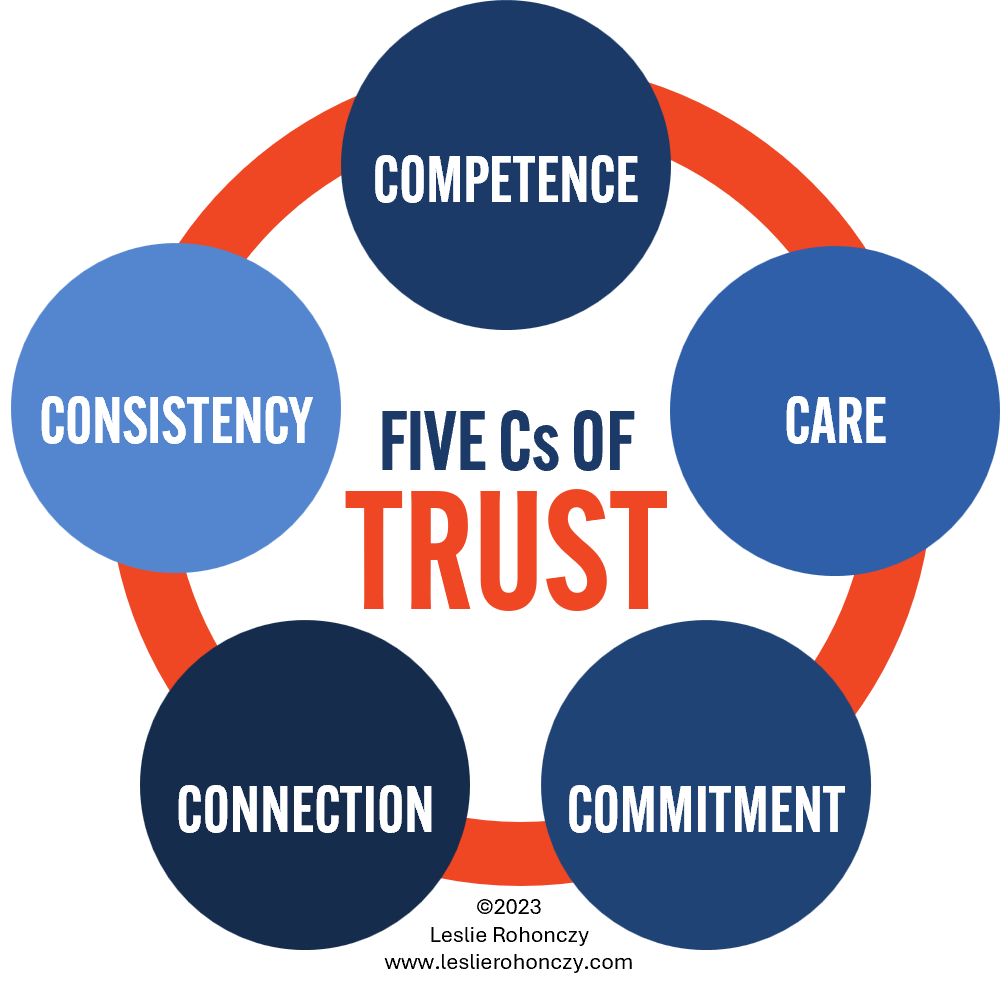
In Coaching Life, I describe five aspects of trust that can help us understand what we look for in others, and what others might be looking for in us. As you read through these, see if you can identify which ones you instinctively pay most attention to.
CONSISTENCY
This aspect is all about reliability: doing what we say we will, and being intentional about our yeses and our nos. This consistency is observed in our actions, in how we hold ourselves accountable for our commitments and follow through by doing what we say we'll do, when we say we'll do it. When people learn that they can't depend on us to keep our promises, no matter what great excuses we may have, it's a trust-killer.
We tend to judge others' reliability in terms of time and quality. Slow to return emails? Cancel plans often? Break promises? Show up late to events? What message does our behaviour send? We should never make promises we can't keep, even if we're just trying to calm a tricky situation. We'll build stronger trust with others if they know that we consistently follow through and do what we say we will.
COMPETENCE
Others will be more concerned with our abilities, standards, and skills. When we know what we're talking about, people believe that we are a credible source of information and insight. Our competence and credibility are a combination of how we present facts and theory, our skills and knowledge, and our presence (the way we look, act, talk, and communicate).
Humility is also a key aspect: when we pretend to know something that we actually don't, and others see through our smoke and mirrors (as they often do), we become untrustworthy to them.
COMMITMENT
Some people will be more focused on the passion in our eyes as we deliver our message, so that they can connect to the deeper purpose that inspires us. Making our commitments visible helps us inspire the trust of others. It's reassuring to see someone fully committed, because it lets us know that we can depend on them, especially when facing challenges.
When our commitment is solid, we can engage in productive conflict that moves everyone forward. Some believe that trust creates harmony, when in fact, trust allows us to have productive conflict that won't damage our relationship, and often strengthens our connections as a result.
CONNECTION
Speaking of connection, when we focus on creating close, open, and accepting connections, others feel comfortable talking to us about difficult things. People who are good at this aspect of trust walk their talk and are willing to get emotionally close to others.
Building this connection requires us to be transparent about our thoughts and emotions. When we're accepting and non-judgmental, people open up to us more easily because they trust that we won't judge or criticize them. They feel seen and heard and can be themselves when they most need to.
CARE
Finally, to build vulnerability-based trust, we show that we're concerned with the welfare of the other person, rather than pushing our own agenda solely for our benefit. Others may perceive us as self-interested if we care more about appearances, about getting our own way, about being liked or creating a favourable impression.
Caring people are typically good listeners and genuinely want to understand others' experiences and emotions. They have a desire to help and consistently show they care through their words and actions.
WHAT ARE YOUR PERSONAL TRUST MEASURES?
Did one of those descriptions feel more familiar to you? Did certain people come to mind as you read the other descriptions? Now consider which of these five aspects you demonstrate most consistently as a leader, and which ones might deserve more intentional effort. How could you test whether your efforts were actually building trust?
We're pretty sophisticated when it comes to measuring business performance. We can tell you how many customers we've gained or lost this quarter, how much it's costing us to deliver a service, and whether we're on track to meet our annual targets.
But what evidence do we have that we're becoming more trustworthy leaders?
Here are some observable behaviours that could help us assess the strength of the trust we've built with our people:
They disclose emerging problems before they've figured out how to solve them.
They ask for support before a deadline is missed.
They tell us about mistakes we might never have discovered ourselves.
They acknowledge when they're out of their depth.
They share their career aspirations with us, even when those aspirations might take them elsewhere.
They tell us when we've let them down.
None of these behaviours on their own definitively proves there's trust. But noticing changes in these patterns over time can give us some useful insights into the quality of our working relationships.
And here's something else worth considering: as the level of trust on your team grows, you might actually start hearing about more problems. Before you conclude that your team's performance is deteriorating, consider whether you're finally hearing about things that were happening all along.
If you're interested in developing more meaningful measures of your leadership impact, I explore this further in my article, In Pursuit of Better Metrics: Why KBIs (Key Behavioural Indicators) Matter More Than You Think.
YOUR COACHING CHALLENGE
In Coaching Life, I offer a practice called Personal Trust Measures. Let's adapt it to your senior leadership context.
Think about someone who you'd like to build a stronger, more trusting relationship with. It could be a peer on your leadership team, one of your direct reports, or your own leader.
Think about a recent situation where you needed that person to put their trust in you.
How did you demonstrate that you care?
How did you attend to consistency?
How did you establish your competence?
How did you demonstrate your commitment?
How did you build your connection?
Now comes the really interesting question: which of these five aspects of trust does this person seem to value most? What have you observed that tells you so? Are there aspects they value that you haven't been paying much attention to?
You can even share the Five Cs model with your leadership team and compare your respective trust measures. That's a fascinating conversation, especially when you discover that something you've always thought was relatively unimportant turns out to be a fundamental trust measure for someone else.
Choose one behaviour you can experiment with over the next few weeks that aligns with what you've learned about that person. Pay attention to whether anything changes in how they engage with you, what they're willing to share, or when they seek your support.
We may never fully understand all the criteria someone uses to assess our trustworthiness. But when we get curious about how our people measure trust, we can fine-tune our approach to building trust in ways that are more meaningful to them.
Perhaps one of the most meaningful measures of our leadership is how much of themselves people are willing to entrust to us. Earning that kind of trust is an accomplishment worth putting on our leadership scorecard.
If you’d like to explore more of Coaching Life, links to the paperback and audiobook are on Leslie Rohonczy’s book page. For more leadership articles like this one, connect with Leslie Rohonczy on LinkedIn, or visit www.leslierohonczy.com.