WHAT’S THE BEST PSYCHOMETRIC TEST TO TRANSFORM YOUR LEADERSHIP? (The answer may surprise you.)

Leslie Rohonczy, IMC™, PCC, Executive Coach, Leadership Expert, Speaker, Author

As an Executive Coach, I often use psychometric testing to enhance leadership development as part of my 1:1 coaching programs for leaders. Some clients bring past assessment results, while others take advantage of the two that I offer. Last week, one of my clients asked me: “What’s your take on the best psychometric test for leadership?” After years of coaching, and seeing firsthand which assessments create real impact, I have an answer that might surprise you.

Psychometric testing is a billion-dollar industry, promising insights into personality, communication styles, decision-making preferences, and leadership potential. Rather than ‘putting you in a box’, they reveal the box you’re already sitting in, looking at the world. All of these tests offer you more information about the lens you look through to make sense of yourself, and your relationship to others and the world around you. And while each test approaches this from a different angle, they all offer the potential to provide powerful insights, and personalized recommendations for development. But with so many options out there, it can be hard to choose the one best suited to developing your leadership, career, or team cohesion.

Curious to know which one I think is the best? First, let’s look at ten of the most widely used psychometric assessments.

THE TOP 10 CONTENDERS

1. Insights Discovery

Identifies: Leadership style, self-awareness, and communication preferences.

How it’s used: Based on Jungian psychology, Insights Discovery categorizes individuals into four colour energies: Fiery Red, Sunshine Yellow, Earth Green, and Cool Blue – offering a simple, yet powerful, framework for understanding behavior. Leaders and teams use it to adapt their communication styles, enhance collaboration, and build stronger workplace relationships. The model’s accessibility makes it a favorite for leadership coaching and team dynamics.

Benefit: Easy to grasp and apply for immediate team impact.

Limitation: The four colour model can feel simplistic compared to deeper personality models (however I think its simplicity is also a key strength).

2. MBTI (Myers-Briggs Type Indicator)

Identifies: Personality preferences, decision-making styles, and work dynamics.

How it’s used: MBTI categorizes individuals into 16 personality types based on four dichotomies (Introvert/Extrovert, Sensing/Intuition, Thinking/Feeling, Judging/Perceiving). Organizations and leaders use it to understand cognitive diversity, improve team interactions, and tailor leadership approaches. Its value comes from exploring how preferences shape leadership tendencies and identifying areas for growth.

Benefit: Provides insight into how people perceive the world and make decisions.

Limitation: Often misused as a rigid label rather than a developmental tool.

3. DISC Personality Assessment

Identifies: Behavioral tendencies in communication and conflict resolution.

How it’s used: DISC categorizes behavior into four types – Dominance, Influence, Steadiness, and Conscientiousness. Leaders leverage it to understand their natural communication style and adjust for different workplace dynamics. It’s particularly useful in high-pressure leadership roles, sales, and conflict resolution.

Benefit: Straightforward and practical for improving workplace communication.

Limitation: Lacks depth in assessing motivation and underlying personality traits.

4. SuccessFinder

Identifies: Leadership strengths, career fit, and team performance insights.

How it’s used: SuccessFinder provides highly detailed behavioral data to help leaders align their strengths with career aspirations and leadership effectiveness. It’s widely used in executive development, helping leaders optimize decision-making, productivity, and long-term career strategies.

Benefit: Data-driven with strong predictive accuracy for leadership success.

Limitation: Less commonly known, requiring coaching guidance to help clients interpret results effectively.

5. Enneagram

Identifies: Core motivations, fears, and emotional intelligence.

How it’s used: The Enneagram maps individuals into nine personality types, each with distinct worldviews and coping mechanisms. Leaders use it for deep self-reflection, personal growth, and emotional intelligence development. It’s particularly effective for those looking to strengthen empathy and resilience.

Benefit: Encourages profound self-awareness and emotional growth.

Limitation: Requires significant reflection and coaching support to apply effectively.

6. Hogan Personality Inventory

Identifies: Leadership potential, derailers, and risk factors.

How it’s used: The Hogan suite assesses personality traits related to leadership success and risk factors under stress. Organizations use it for executive coaching, talent selection, and succession planning. It’s one of the most research-backed tools for identifying both strengths and possible career-limiting behaviors.

Benefit: Helps leaders recognize and mitigate potential blind spots.

Limitation: Can feel confrontational to participants if not framed as a developmental tool.

7. EQ-i 2.0 (Emotional Intelligence)

Identifies: Self-regulation, interpersonal effectiveness, and leadership resilience.

How it’s used: Emotional intelligence is a critical leadership asset. The EQ-i 2.0 measures self-awareness, self-regulation, motivation, empathy, and social skills. Leaders use it to enhance workplace relationships, manage stress, and develop high-performance teams.

Benefit: Strong correlation between EQ and leadership effectiveness.

Limitation: Requires ongoing practice to translate insights into real behavior change.

8. Gallup CliftonStrengths (formerly StrengthsFinder)

Identifies: Core strengths and leadership potential.

How it’s used: CliftonStrengths identifies an individual’s top talents from a list of 34 strengths. Leaders use it to maximize their potential, align with career paths, and build high-performing teams by focusing on strengths rather than weaknesses.

Benefit: Encourages a strengths-based leadership approach.

Limitation: Doesn’t address potential blind spots or growth areas.

9. Thomas-Kilmann Conflict Mode Instrument (TKI)

Identifies: Conflict-handling styles and negotiation strategies.

How it’s used: The TKI assesses five conflict-handling styles: Competing, Collaborating, Compromising, Avoiding, and Accommodating. Leaders and teams use it to navigate conflict more effectively, improving decision-making and negotiation tactics.

Benefit: Helps teams constructively manage conflict.

Limitation: Focuses on conflict behavior rather than deeper leadership traits.

10. FIRO-B (Fundamental Interpersonal Relations Orientation-Behavior)

Identifies: Interpersonal needs, leadership compatibility, and team dynamics.

How it’s used: FIRO-B assesses interpersonal needs in three key areas: Inclusion, Control, and Affection. Leaders use it to improve workplace relationships, enhance leadership compatibility, and align their management approach with team expectations.

Benefit: Strengthens understanding of team dynamics and leadership interactions.

Limitation: Less well-known, requiring interpretation for effective use.

SO, WHICH ONE IS THE BEST?

Here’s my take: The best psychometric test is the one you commit to using.

There are abundant and valuable insights and a-has to be had from any well-designed, personalized psychometric test, no matter which instrument is used. But the real value is not inherently in the results themselves. It comes from the reflection, discussion, and application of those results. Pay attention to any resistance you feel when reading your report. Is it truly inaccurate, or does it reveal a blind spot or limiting belief? Often, discomfort or resistance to certain insights arises from something we don’t like about ourselves, a blind spot we’re unaware of, area of growth we haven’t yet explored, or a perceived weakness that we want to protect from being seen by others. But the areas that challenge us most often hold the greatest growth potential – if we’re willing to reflect, practice, and experiment.

Many of my clients are surprised by the accuracy of their assessments. Even the skeptics have joked that it feels like someone must’ve been watching them for weeks. But no matter how precise the results seem, they’re just the starting point. A test won’t transform you – but what you do with it will.

CHOOSE THE RIGHT TOOL FOR YOUR GROWTH

Different tools will resonate with different people and serve different purposes. A skilled coach can help you assess your development needs and recommend the appropriate instrument that will have the greatest impact on your development investment.

If you’re ready to go beyond the assessment and start applying new insights and awareness, let’s talk. I help leaders and teams translate their results into real-world impact.

Which psychometric tool has been most useful for you? Drop a comment below – I’d love to hear your experiences!

YOUR BRAIN IS WIRED FOR ANXIETY: 6 Simple Questions to Stop the Spiral

Leslie Rohonczy, IMC™, PCC, Executive Coach, Leadership Expert, Speaker, Author

If you’ve been feeling overwhelmed lately (and let’s be honest – who isn’t these days), you’re not alone. The world feels like a pressure cooker on the verge of exploding, and even the strongest among us are feeling the heat. Unprecedented levels of uncertainty, political upheaval, economic instability, and global tensions can make even the most resilient leaders feel anxious. But here’s the thing: anxiety thrives in ambiguity. When everything feels out of control, our minds spin stories of worst-case scenarios, feeding a cycle of stress that can feel impossible to escape.

The good news? You don’t have to tackle everything at once. Research shows that our brains can only process a limited amount of information at a time. This is known as cognitive load. When we try to manage everything at once, decision fatigue sets in, making it harder to think clearly or take effective action. By focusing on just one thing at a time, we can reduce mental overwhelm and make it easier to regain control. Instead, you can break it down into something much more manageable; just one thing at a time.

This exercise, which I call the One Thing Practice is like a mental reset button, giving you a chance to pause, assess, and shift your mindset before stress takes the wheel. By answering six simple questions, you’ll create a sense of clarity and control, even in turbulent times. Let’s walk through them together.

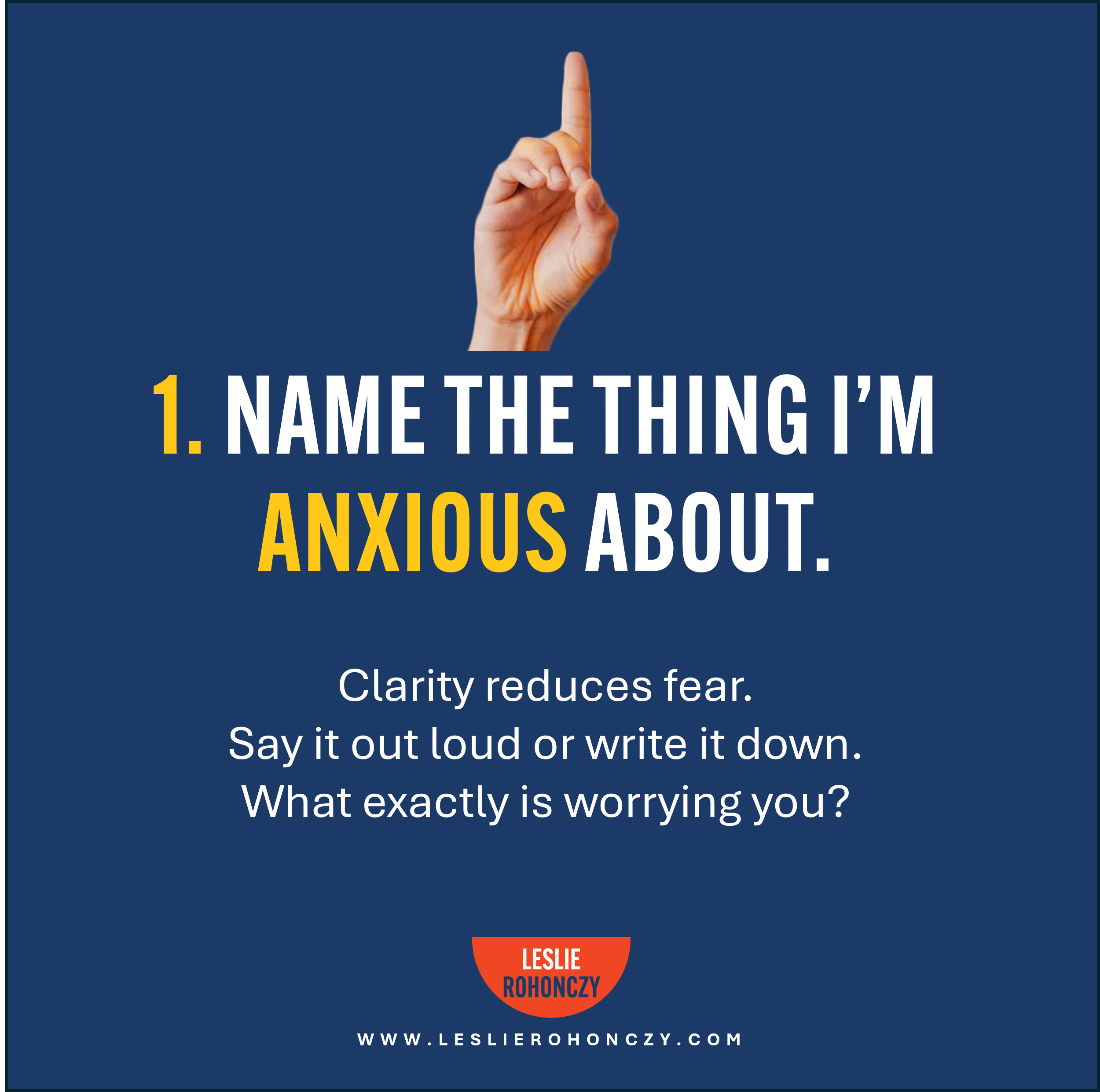
1. Name the thing I’m anxious about.

When stress hits, our minds tend to generalize: “Everything is a mess.” “Nothing is going right.” “The world is falling apart.”

But what exactly is causing your anxiety? Naming it is the first step in reclaiming control. Instead of saying, “I’m stressed about the state of the world,” get specific: “I’m worried that the financial downturn will impact my job security.” Or “I’m anxious about how a new policy change will affect my business.”

Once you’ve named it, you’ll notice that your stress becomes something you can begin to examine and explore, rather than experiencing it as an overwhelming cloud of fear.

2. Name one thing I can do to prepare for it.

Now that you’ve identified the source of your anxiety, it’s time to shift into action. What’s one small, concrete step you can take to feel more prepared?

If you’re worried about job security, can you update your resume? Strengthen your network? If economic uncertainty is affecting your business, can you revisit your budget or explore ways to diversify revenue streams?

The message here is that action reduces anxiety (though it doesn’t eliminate it entirely; some anxiety is natural.) Even the smallest step forward reminds you that you are not powerless.

3. Name one reason that it won’t be as bad as I fear.

Our brains are wired to anticipate worst-case scenarios, but reality is rarely as catastrophic as we imagine. Consider this: how many times have you worried about something that never actually happened?

Let’s say you’re worried about an upcoming presentation you have to make to the Board. Your brain is already crafting the script for a horror film: the lights come up, your mind goes blank, and the audience stares in awkward silence as you struggle to remember even one of your key messages. Harsh judgment is revealed on the faces of the Board members and your boss, as they roll their eyes and shake their heads in disappointment. Roll credits.

Your mind might be telling you: “I’ll freeze, forget everything, and embarrass myself.” But in reality, you’ve prepared, you’ve done this before, and even if you stumble, people are usually far more forgiving than we assume.

Challenge your fear with logic. Ask yourself: What’s another possible outcome that’s not worst-case?

4. Name one reason I know I can handle it.

This is where you tap into your resilience. You’ve faced challenges before. You have overcome obstacles. You have proof that you are capable, even when things get tough.

Think about a past situation where you faced uncertainty and made it through. Maybe you successfully navigated a career change, managed a crisis, or led your team through a tough period. You are stronger than you think. And you already have experience proving it.

If it helps to look at others’ experiences and approaches to resilience, think about some of the real Canadians whose examples shine a light on the path forward. Leaders like Arlene Dickinson, who built a multi-million-dollar marketing empire despite early financial struggles, proving that resilience and reinvention go hand in hand. Or Terry Fox, whose determination to run across Canada despite losing a leg to cancer inspired a global movement in cancer research. Or Clara Hughes, who transformed personal struggles with mental health into advocacy, using her platform to champion resilience and well-being. Just like them, you have faced challenges, adapted, grown stronger, and inspired others with your resilience. Your past experiences are proof that you can handle this too.

5. Name one upside to the situation.

Even in difficult times, there is always a silver lining—though sometimes you might need to squint to see it. Finding an upside doesn’t mean pretending everything is great, however. It’s about recognizing that even tough situations can lead to unexpected benefits. Maybe this challenge forces you to develop a new skill, strengthen relationships, or rethink outdated strategies that no longer serve you. What is one possible positive outcome of this situation?

A challenging economic climate might push you to be more innovative. A leadership struggle could highlight opportunities for growth. Even personal setbacks often lead to greater self-awareness and resilience.

This doesn’t mean dismissing the difficulty – it means acknowledging that opportunities often come disguised as obstacles. To help uncover the upside, ask yourself: What new skills or strengths might I develop as a result of this challenge? How might this experience shift my priorities for the better? What doors could this situation open that I wouldn’t have considered before? If I look back on this a year from now, what might I appreciate about what I learned or how I grew?

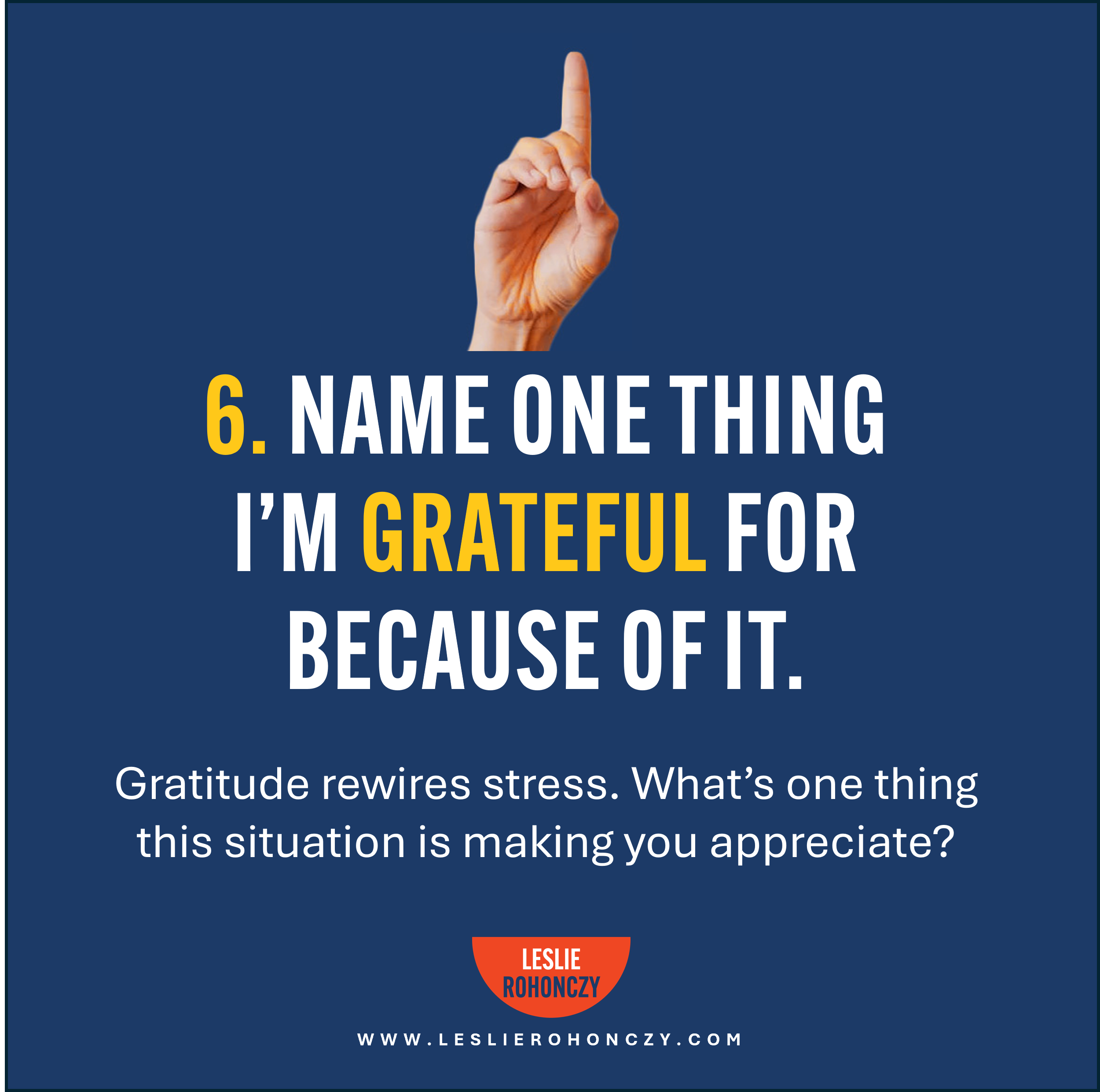
6. Name one thing I’m grateful for because of it.

Gratitude is one of the most powerful tools for shifting perspective, especially when stress tries to convince us that everything is negative. Instead of focusing on what’s lost or uncertain, gratitude helps us anchor to what remains steady and meaningful. It might be the support of a close friend, the lessons gained from a tough experience, or even the personal growth that comes from pushing through adversity. Even in stressful situations, there is something to be grateful for. This doesn’t mean ignoring or downplaying the difficulty of what you’re facing. Instead, it’s about finding balance—acknowledging the challenges while also recognizing the positives that exist alongside them. What is it?

Maybe this challenge is forcing you to slow down and focus on what truly matters. Maybe it’s revealing who your real support system is. Maybe it’s teaching you something invaluable about yourself and your ‘wiring’.

Speaking of wiring, did you know that gratitude rewires stress? When we consciously shift our focus to what we appreciate, we break the cycle of fear and reframe our experience.

Putting It All Together

This practice is simple, but don’t underestimate its power. In just a few minutes, you can shift from feeling overwhelmed to feeling focused and in control. The next time anxiety creeps in, pause and walk yourself through these six questions. Write them down. Reflect on your answers. Notice how your mindset changes.

One thought at a time. One step at a time. No need for superhero-level resilience, just a willingness to take the next right step. Practicing these six questions consistently helps build long-term resilience, training your brain to approach stress with clarity instead of panic. Over time, you’ll find that shifting your perspective becomes second nature, making you more adaptable and confident in the face of uncertainty. And with this new awareness, you stand at a new vantage point, from which you can take a step in any direction, toward more anchored choices. That’s all it takes to move forward.

If this practice resonates with you, I encourage you to share it with someone who might need it today. The world needs more calm, clear-headed leaders right now, and that can start with you.

Interested in more leadership and mindset strategies? Subscribe to my blog or reach out to explore executive coaching and leadership development opportunities tailored to your needs.


NAVIGATING TRUMP’S TRADE WAR: Grounded Strategies for Canadian Executives

Leslie Rohonczy, IMC™, PCC, Executive Coach, Leadership Expert, Speaker, Author

In a move driven by short-term political interests, Donald Trump’s latest round of tariffs targeting Canada, Mexico, and China has thrown our economic landscape into turmoil. As markets react, Canadian businesses are bracing for uncertainty and rethinking their strategies for resilience.

But Donald Trump’s trade war isn’t just a policy decision – it’s a disruption sending shockwaves through global markets. Canadian leaders now face an era where economic and political uncertainty isn’t just a possibility; it’s a daily reality. Supply chains are disrupted, key industries face instability, and businesses are left wondering how to adapt in a climate of unpredictability.

This fundamental shift in the way global trade and leadership operate is creating ripple effects of protectionist policies, retaliatory tariffs, and market instability that not only impacts corporate strategy, but also the livelihoods of Canadian families (Canada announces robust tariff package in response to unjustified US tariffs, 2025.

As an executive leader, you may find yourself wondering: How do I navigate this turmoil while maintaining stability for my organization and my team? The good news? You’re not alone. And you have more choices than you may realize.

THE NEW REALITY: CHALLENGES FACING CANADIAN EXECUTIVES

Change isn’t just coming – it’s already here. Many Canadian leaders find themselves:

  • Grappling with career transitions and shifting roles as industries restructure in response to new tariffs and market instability, particularly in manufacturing, agriculture, and natural resources (Canadian factory PMI tumbles as tariff uncertainty hits sentiment, 2025.)

  • Struggling to keep employees engaged amid uncertainty, as fear of job losses and financial strain grows – especially in trade-dependent regions like Ontario, Alberta, and British Columbia.

  • Managing organizational change with limited clarity on the path forward due to fluctuating trade agreements and unpredictable policy shifts, including Canada’s ongoing negotiations within USMCA (United States-Mexico-Canada Agreement).

  • Facing decision fatigue, making high-stakes choices daily about cost-cutting, diversifying markets, supply chain adjustments, and workforce management in response to the impact of tariffs on steel, aluminum, and automotive exports.

At the same time, leaders must balance financial sustainability, regulatory changes, and technological advancements that are reshaping industries at an unprecedented pace. The ability to stay grounded, agile, and forward-thinking will determine who thrives in this new reality (PwC Canada CEO Survey: Adapting to economic uncertainty, 2025.)

STAYING GROUNDED AS THE GROUND SHIFTS

1. NAVIGATE WITH A STRONG INTERNAL COMPASS

Your past experiences – both successes and failures – are invaluable. Reflect on what worked, and what didn’t. Honest self-assessment allows you to see where your strengths lie and where growth is needed. Leadership resilience starts with self-awareness.

In the face of shifting trade policies, having a clear set of leadership principles can serve as your anchor AND your compass. Take time to revisit your core values. What principles have guided your best decisions in the past? Aligning your leadership with these values fosters consistency, even in turbulent times (see my previous article that covers key leadership strategies in Leading Through Economic Uncertainty.)

2. RETHINK GOALS: FROM SURVIVAL TO STRATEGY

The brain craves direction. Neuroscience tells us that goals tied to clear rewards become habits more easily. Whether you’re leading a transformation or stabilizing your company, frame objectives in a way that motivates both yourself and your team: are you moving toward opportunity (growth mindset) or away from risk (fixed mindset)? The distinction matters.

For example, instead of reacting to trade restrictions with fear-driven cuts, reframe your approach: How can we reposition our business to capitalize on new markets or emerging trade agreements? Set three levels of goals with this question in mind: 1) short-term (adjusting strategy for immediate shifts); 2) mid-term (exploring alternative suppliers or partnerships, particularly within Canada and Europe through CETA, and especially as Provincial trade barriers fall); and 3) long-term (future-proofing your business against similar disruptions by diversifying exports beyond the U.S.). This structure ensures that no matter how unstable the present feels, you always have a guiding vision.

3. COLLABORATE OR COLLAPSE: WHY TEAMWORK MATTERS MORE THAN EVER

Many organizations are still structured around outdated competitive silos. But high-performing leaders know that success is collective. Redefine success within your teams by rewarding collaboration. Shared goals breed stronger, more adaptable teams.

And think beyond your own structure and resources: in the wake of supply chain disruptions, many Canadian companies have turned to industry alliances and local partnerships to navigate the challenges. Consider implementing cross-functional teams that bring together diverse perspectives from operations, finance, and strategy, with external partners and industry advisors, to create solutions that benefit your organization and the whole industry. Look to government-supported initiatives such as Canada’s Trade Commissioner Service (TCS) and expertise from Canadian crown corporation Export Development Canada (EDC) for insights and funding options that can support businesses through this transition (Canada's big banks push for reforms in Ottawa to confront tariff risks - Reuters).

4. THE EMPATHY ADVANTAGE: LEADING WITH HUMANITY IN TURBULENT TIMES

People don’t just follow plans; they follow people. Employees are experiencing economic anxiety and are worried about job stability, rising costs, and business viability. Acknowledge their concerns. Adapt your communication to show that you understand their challenges. Trust is built in conversations, not in directives.

Regularly check in with your team – not just about work, but about their well-being. A simple “How are you managing these changes?” can open up valuable insights and strengthen trust. Transparency about company decisions in response to the trade war can also help alleviate uncertainty and prevent misinformation (See how Canadians are adapting in: Economic uncertainty has 83% of Canadians changing their financial habits, 2025.

HOW EXECUTIVE COACHING CAN FUTURE-PROOF YOUR LEADERSHIP

Even the best leaders need a space to step back, reflect, and refine their strategies. Executive coaching provides that, offering tailored guidance, accountability, and fresh perspectives. Through deep conversations, structured frameworks, and actionable strategies, executive coaching helps leaders:

  • Gain clarity in decision-making amid economic and trade instability.

  • Build confidence in leading through uncertainty and market shifts.

  • Strengthen their leadership EQ ‘super-power’: developing your emotional intelligence can guide employees through financial and operational stress.

  • Identify blind spots that may be limiting strategic thinking in crisis management.

Coaching isn’t about fixing what’s broken – it’s about elevating what already exists. Leaders who invest in their own development create stronger, more resilient organizations that can withstand geopolitical turbulence. (Discover how strong leadership is shaping the future in Celebrating visionary leadership at a critical moment for Canada, 2025).

THE CONVERSATION THAT COULD CHANGE EVERYTHING

You don’t have to navigate this alone. The strongest leaders are not those who stand alone – they are the ones who know when to seek support, challenge their perspectives, and adapt to change with purpose. If you’re ready to explore how executive coaching can help you lead with clarity, confidence, and resilience, let’s talk. Schedule a free discovery consultation to see how you can turn today’s uncertainty into tomorrow’s strength. Powerful coaching conversations can make all the difference.

TAMING THE LONE WOLVES: Transforming Cutthroat Competition into High-Performing Collaboration

Leslie Rohonczy, IMC™, PCC, Executive Coach, Leadership Expert, Speaker, Author

A Team That Should Be Winning (but isn’t)

You’ve worked your butt off to build your team. You interviewed multiple high-flyers, chose a select few who rose above the rest, and hired yourself a highly driven, results-oriented team of rock stars. They’re confident, competitive, and relentless in their pursuit of bold goals. Congratulations! On paper, it’s a recipe for record-breaking success.

And yet…

Month after month, instead of celebrating big wins, they miss their targets, and you’re spending your already-squeezed time playing referee in a never-ending cycle of infighting, back-channeling, posturing, and finger-pointing. You’re frustrated. Opportunities are slipping through the cracks. Turnover is up, which means you’ll have to go back out there again, in search of your next unicorn.

Sound familiar? You’re not alone.

Many teams suffer from a ‘lone wolf’ culture, where individuals operate as fiercely independent agents, more focused on personal wins than collective success. While competition can be a powerful motivator, unchecked rivalry can be fatal. When team members view each other as threats rather than allies, trust erodes, collaboration disappears, and opportunities are lost.

The good news? It doesn’t have to be this way. You can harness that competitive energy and channel it toward team-wide success.


Why Lone Wolf Cultures Persist

Before we dive into solutions, let’s look at why this problem exists in the first place. Lone wolf cultures often emerge because:

1. Incentive Structures That Reward Individual Wins: When promotions, bonuses, and recognition are tied exclusively to individual performance, team members naturally strive for personal success over team outcomes, and efforts to work together may be seen as a distraction or nuisance, rather than a strategic advantage. If leaders don’t actively reward collective achievements over personal achievements, the message you’re sending is clear: winning alone matters more than winning together. Over time, this breeds a cutthroat environment where employees guard their insights, resist collaborating and knowledge-sharing, and view colleagues as competitors rather than allies.

2. Lack of Shared Goals: When success is measured solely by individual KPIs, team members naturally prioritize their own objectives over the broader mission. Without well-defined team goals that require collaboration, individual priorities often clash, inefficiencies rise, and friction becomes inevitable. And don’t kid yourself into thinking that having a few collective goals is enough. If most of the leader’s is focus is on individual targets, employees chase personal wins, often at the expense of the organization’s success. It’s not intentional; it’s human nature. High-performing teams don’t just coexist; they work toward a shared vision that unites individual efforts into a cohesive, results-driven force.

3. Lack of Accountability: And, while we’re on the topic of KPIs and metrics, let’s also look at KBIs: key behavioural indicators. When accountability rests solely on the leader’s shoulders to hold employees accountable, team dynamics suffer. Without clear expectations for team members to hold each other accountable in a constructive way, small frustrations fester into major conflicts. Instead of open, solution-focused conversations, tensions simmer beneath the surface, fueling competition, blame, and disengagement.

4. Scarcity Mindset: When employees believe opportunities, recognition, or resources are in short supply, they default to a survival mode of competition. In environments where promotions are rare, leadership roles are limited, or high-value projects are assigned to a select few, employees can feel pressured to outshine rather than collaborate. This scarcity-driven competition often leads to posturing, hoarding information, withholding support, and prioritizing personal advantage over team cohesion. Without a culture that reinforces abundance (where success is not a zero-sum game), trust erodes and true collaboration becomes nearly impossible.

5. Poor Leadership Reinforcement: Even well-intentioned leaders can inadvertently fuel a lone-wolf culture by rewarding individual achievement over collective success. If company leaders consistently celebrate top performers without acknowledging the team effort behind them, they reinforce a mindset of ‘everyone for themselves.’ And leaders who fail to model collaboration (eg: making unilateral decisions, keeping information siloed, or playing favorites) send a message that teamwork is secondary to individual success. To foster a culture of cooperation, be intentional about how you recognize and reinforce behaviors that strengthen, rather than divide, the team.

6. Fear of Losing Control: Some employees see their expertise, knowledge, or unique skills as their competitive advantage – and resist helping each other succeed because sharing assets feels like a direct threat to their success. Whether it’s withholding key insights, avoiding feedback or mentorship, or resisting teamwork, individuals who fear losing their edge often isolate themselves, unintentionally weakening the team’s overall effectiveness. This fear-driven behavior not only stifles innovation; it also creates an unhealthy dynamic where personal protectionism overrides collective problem-solving. To break this cycle, organizations must emphasize psychological safety – where sharing expertise is seen as a strength, not a risk.


The Cost of a Lone Wolf Culture

A hyper-competitive, cutthroat environment might sound like a high-performance culture to some, but in reality, it can have severe consequences to your bottom line and corporate reputation. Teams that operate in silos often miss out on significant opportunities that are only possible through cross-functional collaboration. Without a cohesive approach, projects stagnate, innovation suffers, and major deals or game-changing breakthroughs slip through the cracks.

Beyond lost opportunities, think about what a slog it is to come to work every day in a culture of lone wolves. Individuals prioritize their own success over the team's; distrust grows along with a toxic work environment; constant infighting, backstabbing, showboating; lack of transparency; and an atmosphere of stress and resentment. No wonder burnout and turnover rates are higher in lone wolf teams. Leaders can find themselves caught in a never-ending cycle of conflict resolution and recruiting, rather than focusing their valuable time on strategic initiatives and growth.

A fragmented team also confuses your clients and stakeholders. When different team members present conflicting strategies or undermine each other, it affects the credibility of the whole team – and its leader. This inconsistency damages trust and can result in lost business and diminished reputation.

Ultimately, a lone wolf culture doesn’t just hinder individual performance, it can cripple an entire organization.


Breaking the Lone Wolf Mentality: Leadership Strategies for Change

Surprise! There’s no quick fix! If your team is stuck in a lone wolf mentality, changing it will require deliberate, overt, and consistent shifts over time: in mindset, structure, and leadership approach.

The first step is redefining success. Instead of measuring performance purely through individual KPIs (key performance indicators), establish shared team goals that reward collective achievements. Celebrating wins as a team fosters a sense of unity and reinforces the idea that success is not a zero-sum game. Leaders should publicly recognize collaborative efforts, highlighting how teamwork contributes to overall success.

BCE Inc., Canada's largest communications company, introduced a comprehensive recognition program in 2021 that celebrated achievements within departments and teams to acknowledge collaborative efforts and foster a culture where teamwork is integral to success. And Canadian athletic apparel and accessories giant Lululemon Athletica implemented a team-based cash bonus program to reward groups for reaching store-specific goals, incentivizing collective performance while strengthening team cohesion and aligning individual efforts with broader organizational objectives.

Beyond KPIs, include a set of KBIs in your performance dashboard: Key Behavioural Indicators. What behaviours will you watch for to let you know your team culture is healthy, employees are engaged, motivated, focused on the right things, and interpreting your strategy and objectives the way you intended? (Check out my ‘Coaching Minute’ video on Key Behavioural Indicators.)

Adjusting incentives and recognition structures is a crucial step in the strategy. Implementing team-based bonuses, peer-nominated awards for collaboration, and recognizing those who contribute to a project rather than just those who close the deal can reshape workplace dynamics. When employees see tangible rewards for working together, mentoring each other, and receiving straightforward feedback that helps them succeed, they become more inclined to share knowledge and resources.

Leadership also plays a pivotal role in shifting the team's mindset. The narrative must change from celebrating individual top performers to spotlighting collaborative successes. Be relentless in looking for ways to reinforce this message. Talk about it at cross-functional meetings, open forums for sharing strategies, and 1:1 coaching sessions focused on EQ growth and career development. As a leader, modeling this behavior by demonstrating your openness, cooperation, and a commitment to collective growth at every opportunity, helps your team adapt to the ‘new way we do things around here now'.

Cultivating a culture of trust is another essential element. Transparency is key – giving employees visibility into projects, expectations, decision-making processes – and even the performance ratings process – helps eliminate secrecy and encourages open dialogue. Group Coaching, Peer Coaching, and Mentorship programs can also bridge gaps between team members, fostering knowledge-sharing and reducing territorial behavior. Addressing conflicts quickly and constructively reinforces the expectation that undermining others will not be tolerated. Equip your employees with training, coaching, and frequent opportunities to practice the ideal team behaviours.

Healthy competition doesn’t have to be eliminated – it just needs to be reframed. Gamifying collaboration through contests that reward joint efforts, rotating leadership roles to prevent hoarding of responsibilities, and creating team challenges can maintain motivation while promoting unity. Providing training on the value of collective intelligence can further reinforce why working together is more powerful than operating alone.


What the Research Says About Collaborative Teams

A recent Harvard Business Review study found that companies with strong collaboration cultures outperform their competitors by 27% in revenue growth. Another study by the Corporate Leadership Council revealed that top-performing teams spend 50% more time sharing best practices than their lower-performing counterparts. And a 2022 study published in the Journal of Applied Psychology found that teams engaging in collaborative problem-solving exhibited a 20% increase in performance metrics compared to those working individually. A 2023 report by Deloitte highlighted that organizations fostering a culture of collaboration were five times more likely to experience high performance.

The message is clear: Teams that work together, win together.


Turning Lone Wolves into a Winning Pack

A fiercely competitive team may look strong on the surface, but if they’re constantly undermining each other, they’re losing more than they’re winning. The highest-performing teams aren’t just a collection of individual stars – they’re a well-oiled machine that balances competition with collaboration.

As a leader, your role isn’t just to drive numbers – it’s to build a sustainable, high-performing culture. That means shifting the narrative from ‘me vs. them’ to ‘us vs. the challenge.’ It means rewarding teamwork as much as individual success. And it means leading by example.

The lone wolf era is over. It’s time to build a pack that wins together.


Need Help Shifting Your Team Culture?

If your team is struggling with internal competition and missed targets, let’s talk. As an executive coach specializing in leadership development and team dynamics, I help leaders build high-performing team cultures that drive results. Schedule a consultation today at www.leslierohonczy.com.


LEADING THROUGH ECONOMIC UNCERTAINTY

Strengthening Our Canadian Leadership Mindset

LESLIE ROHONCZY, IMC™, PCC, Executive Leadership Coach | FEBRUARY 2025


I’ve noticed a shift in the focus of many of my executive coaching clients in the past several weeks. Because the global business and political landscape is evolving so rapidly, and even erratically at times, Canadian executives and senior leaders are wrestling with next-level economic uncertainty.

While this current crisis may feel familiar in some ways to the economic challenges that we experienced during the COVID-19 global health crisis a few years back, this is significantly different. During Covid, we faced a common threat that united industries and nations. Specifically, Canada and our U.S. counterparts were in the Covid battle together; brothers and sisters, fighting side by side as members of the same family; looking out for one another. Doesn’t it feel like that was light-years ago?

Our current economic pressures, shifting trade policies, political changes, and global instability demand a mindset shift so significant that it will define not just the future of our businesses, but the resilience of Canada’s economy itself. And while these changes bring risks, they also present tremendous opportunities: greater clarity, adaptability, and strength – as individual leaders, as Canadian organizations, and as a nation.

Using Ken Wilber’s Integral Theory as a framework, let’s look at leadership mindset across four critical perspectives of the Integral Quadrants model: Action, Systems, Relationships, and Values.

1. ACTION: Embracing Agility, Accountability, and Ownership

Uncertainty can be paralyzing, but it’s time for leaders to lean into action. The question isn’t if the landscape will change – it’s how fast and how well we adapt. We don’t have the luxury of waiting for complete clarity before we act.

Key Mindset Shifts:

  • Control the Controllable: Instead of fixating on external forces like tariffs or supply chain disruptions, focus on what you can control – efficiency, innovation, and strategic positioning.

  • Act Before You’re Ready: Take calculated risks and iterate quickly rather than waiting for perfect conditions.

  • Adopt a Learning Mentality: Every challenge presents an opportunity for reinvention. Embrace experimentation and learning to drive transformation. Try experimenting with reframing the challenge as a chance to develop local manufacturing partnerships, lobby for inter-provincial trade reforms, reduce reliance on foreign supply chains, and strengthen your industry.

Executive Coaching Reflection Questions:

  1. What assumptions about the future might be limiting my options, and how can I reframe them to uncover new opportunities?

  2. How will we challenge those assumptions to uncover new opportunities?

2. SYSTEMS: Thinking in Complexity, Acting with Precision

Uncertainty requires leaders to step back and see the broader system at play – political forces, economic trends, industry shifts – and make data-informed but decisive moves.

Key Mental Models:

  • Zoom Out, Then Zoom In: Toggle between macro and micro views. Analyze global trends but translate insights into specific, actionable decisions.

  • Decisiveness Over Perfection: Waiting for perfect data leads to stagnation. Instead, make high-probability bets based on emerging patterns.

  • Scenario Thinking as a Superpower: Plan for multiple outcomes to give you an edge when volatility strikes. For example, when you recognize that your traditional supply chains are fragile, experiment with AI-driven forecasting and diversifying supplier regions, to help you transform uncertainty into a competitive edge.

Executive Coaching Reflection Questions:

  1. How am I balancing immediate pressures with long-term strategic vision, when making decisions?

  2. What evidence, criteria, or data points do I typically rely on?

  3. What other information might I explore to gain a fuller perspective?

3. RELATIONSHIPS: Leading with Emotional Intelligence and Stability

Markets fluctuate, but people are the heart of your business. Whether it’s your employees, your customers, or your stakeholders, they are all navigating this uncertainty along with you, and this is your opportunity to provide calm, transparent, and values-driven guidance.

Key Leadership Attitudes:

  • Transparency Builds Trust: Uncertainty is unsettling, but withholding information is worse. Leaders who share challenges openly build credibility and loyalty. Be as transparent as you are able, without putting your team or company at risk.

  • Empathy Over Authority: Instead of just driving performance, seek to identify and understand the emotional toll of this uncertainty. From that vantage point, lead with humanity. Employees and customers are loyal to leaders and companies who care about their well-being.

  • Confidence Without False Promises: As employees and investors look to you for assurance, demonstrate your confidence while staying honest about challenges. If you’re facing supply shortages, lead with radical transparency – openly communicate challenges while directing the pivot to Canadian suppliers. This is likely to increase customer trust, build stronger employee engagement, and strengthen your reputation for integrity.

Executive Coaching Reflection Questions:

  1. How am I fostering trust and psychological safety within my leadership team and through my organization?

  2. Am I sharing with enough transparency, and how do I know what’s ‘enough’?

4. VALUES: Leading with Purpose and Resilience During Uncertainty

At its core, leadership is about more than just profitability – it’s about principles. In times of upheaval, strong leaders ground themselves in what truly matters.

Key Leadership Principles:

  • Commit to National Resilience: Investing in Canadian talent, manufacturing, and innovation isn’t just patriotic – it’s smart business.

  • Lead with Long-Term Ethics: In a crisis, the temptation is to focus on short-term survival. Strong, resilient leaders make decisions that align with their values and their company’s legacy.

  • Champion Collective Strength: Uncertainty is best navigated through partnership, not isolation. Industry collaboration strengthens national stability. Instead of outsourcing to the U.S., invest in a Canadian R&D hub – securing government incentives and attracting top talent to future-proof your company while reinforcing Canada’s innovation economy.

Executive Coaching Reflection Question:

  1. What are the foundational core values of my business?

  2. How are my decisions reinforcing my core values and long-term vision?

  3. What upcoming decisions may create pressure on my core values? How will I prepare mitigants for that?

Strengthening Leadership Mindset in Uncertain Times

While uncertainty is challenging, it is also an opportunity to refine and grow your leadership. By cultivating a mindset of adaptability, strategic thinking, emotional intelligence, and purpose-driven leadership, you can guide your business – and Canada – toward a more resilient future.

Want to strengthen your leadership resilience and impact in the face of uncertainty? Executive coaching is a powerful tool in developing the clarity, confidence, and strategic insight to thrive in an evolving landscape. Schedule a discovery call with Leslie Rohonczy today to explore how executive coaching can help you lead with confidence.

WHEN THE LADDER BREAKS: Four Pillars of Career Transition

Turning Turbulence Into Opportunity

Career transitions are among the most challenging moments in our professional journey. Whether we’re stepping into a new role, considering a significant pivot, or facing the unexpected disruption of being let go, the emotional and practical demands can feel overwhelming. And on top of all that, the uncertainty of “what is,” the grief of “what was,” and the fear of “what’s scary” often collide, leaving us unsure how to move forward into “what’s next”.

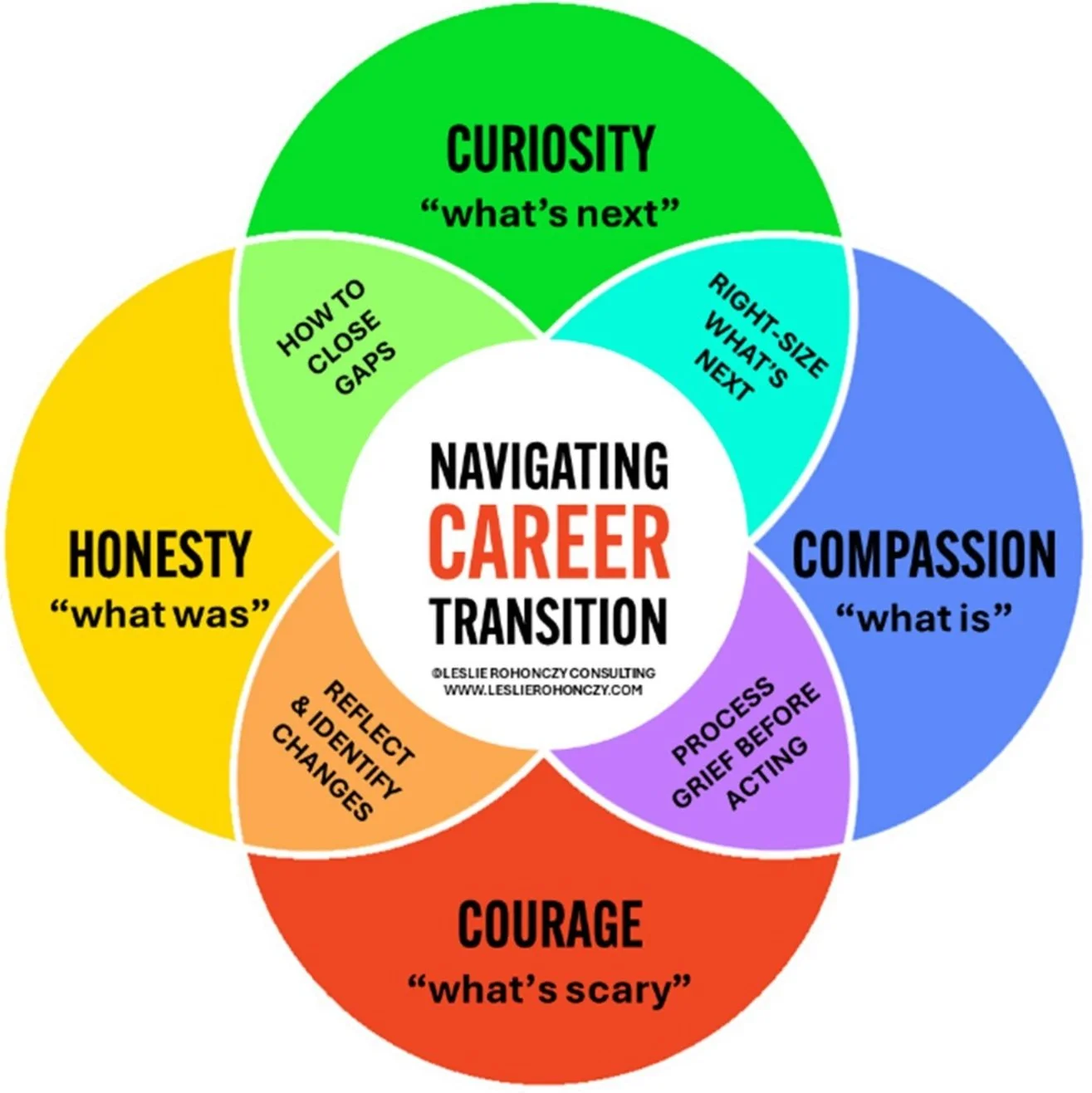
This is why I created the Career Transition Model. Grounded in four core qualities – Curiosity, Compassion, Courage, and Honesty – this framework provides a structured, human-centered approach to navigating the complexities of career change. By focusing on each section of this model, we can transform a tumultuous experience into an opportunity for clarity, growth, and meaningful next steps.

Let’s explore the model in depth and uncover the benefits of focusing on each element in the transition.

1. COMPASSION: Accepting "What Is"

This is a tough time – it’s time to be gentle with yourself. When faced with career disruption, it’s natural to feel a range of emotions: grief, frustration, shame, or even anger. Compassion invites us to sit with these feelings without judgment. Instead of rushing to act or denying our emotions, this stage encourages us to:

• Acknowledge and honor what we’re feeling.

• Give ourselves the grace to process our grief or disappointment.

• Treat ourselves with the same kindness and understanding we would extend to a friend.

Compassion is about being present with our reality, no matter how uncomfortable it may feel. It’s the foundation for healing and ensures that our next steps come from a grounded and intentional place. Compassion creates space for emotional processing and clarity, reduces self-criticism, promotes self-acceptance, and prevents burnout by prioritizing emotional well-being.

2. HONESTY: Reflecting on "What Was"

Transitions are an opportunity to reflect on the past with clarity and honesty. This doesn’t mean dwelling on what went wrong, but rather assessing what worked and what didn’t in our previous role or career, so that we can identify limiting beliefs, behaviour patterns, strengths to be leveraged, and areas for growth to close gaps. It required us to ask ourselves tough but valuable questions like: “What lessons can I carry forward?” “What was I good at that I want to do more of?” “What gaps do I need to address?”

Honesty with ourselves – or what I like to call ‘accurate self-assessment’ – requires us to reflect on our past performance and engagement, so that we can move forward with a deeper understanding of what we need in order to thrive in our next chapter. This level of honestly with ourselves is a key step in the process because it promotes self-awareness and growth, provides clarity on what’s truly important to us, helps us identify gaps to be closed, and aligns our next steps with our values.

3. COURAGE: Facing "What’s Scary"

Fear often accompanies career transitions. The fear of failure, rejection, or making the wrong decision can feel paralyzing. Courage is about acknowledging our fears, leaning into them, and taking action that helps us overcome them. It’s about asking ourselves: “What am I afraid will happen?”, “What risks am I willing to take to move forward?” “What do I need to have / feel / believe in order to face this uncertainty with resilience?” “What’s one small step I can take today to address my biggest fear?”

Courage doesn’t mean eliminating fear; it means not letting fear dictate our choices. By taking small, intentional steps, we build momentum and confidence, even in the face of uncertainty. Acting with courage empowers us to take action despite our fear, builds resilience and confidence over time, and helps us confront challenges head-on, rather than avoiding them.

4. CURIOSITY: Exploring "What’s Next"

Curiosity invites us to lean into the unknown with a sense of openness and possibility. Rather than viewing this transition solely as a loss, curiosity encourages us to ask, “What opportunities might this open up for me?” “What have I always wanted to explore but haven’t had the chance to?” “What skills or passions can I leverage in new ways?”

This mindset shift allows us to see beyond the immediate turbulence and imagine our ideal state, and the potential of what could be. Curiosity is not about having all the answers – it’s about giving ourselves permission to wonder and explore, and cultivating the courage to dream without the pressure of immediate certainty. Maintaining our curiosity through this process encourages creative thinking and new possibilities, helps us shift from a reactive to a proactive mindset, and opens doors to opportunities we might not have considered before.

THE POWER OF INTEGRATION: The Intersections of the Model

Here’s where the Career Transition Model gets exciting: the intersections between these four qualities take us deeper, where meaningful action and transformation happen:

COMPASSION + COURAGE = Process your grief and other uncomfortable emotions before acting.

COURAGE + HONESTY = Self-reflect and identify the changes you want to make.

HONESTY + CURIOSITY = Consider how you will close the gaps you’ve identified, and what you’ll need in your next role.

CURIOSITY + COMPASSION = Combine expansive thinking with self-compassion as you dream boldly, and right-size what’s next.

WHY COACHING MATTERS DURING CAREER TRANSITIONS

It can be challenging to navigate career transitions alone. Working with an Executive Coach to help guide you in navigating the Career Transition Model can provide a deeply transformative, supportive, and human-centered program.

Executive coaching provides:

• A safe, judgment-free space to explore your emotions and aspirations.

• Tailored strategies and support to help you stay focused and grounded.

• Practical tools and accountability to move forward with confidence.

If you’re navigating a career transition, coaching can help turn uncertainty into clarity and fear into opportunity. Whether you’re an executive seeking career guidance, or an HR professional looking to support an exiting employee, this model and coaching approach can make a transformative difference.

Career transitions are rarely easy, but they don’t have to define us. By focusing on Curiosity, Compassion, Courage, and Honesty, we can navigate this time with resilience, intention, and hope. The Career Transition Model is a roadmap through the turbulence, helping you emerge stronger, wiser, and ready for what’s next.

If you’re ready to take the next step or want to offer meaningful support toy our team, let’s connect.

For more information on executive coaching or to explore how this model can support you or your team, contact me at www.leslierohonczy.com.

#CareerTransition #ExecutiveCoaching #LeadershipDevelopment #GrowthMindset #HRSupport


SUCCESSFUL MERGERS: How Coaching Transforms Change from the Inside Out

Corporate mergers are high-stakes, high-pressure events that can determine the trajectory of an organization for years to come. Yet, despite the billions spent on due diligence, integration planning, and cultural assessments, one critical factor remains underutilized: executive coaching. Research consistently shows that leadership development and coaching during mergers lead to better financial outcomes, smoother transitions, and stronger organizational alignment. So why do so many companies ignore this powerful tool when they need it most?

The High Cost of Overlooking Leadership Development in Mergers

Organizations often delay investing in leadership development and coaching during a merger due to the belief that there is "no time for coaching now." However, prioritizing executive coaching during a merger can actually save time and money, mitigate integration challenges, and enhance long-term success. Consider these research-backed insights:

Cost Reduction

  • Reduced Integration Costs: Poorly managed mergers can increase costs by 15-30% due to inefficiencies (EY, 2022). Leadership coaching helps teams anticipate challenges, resolve conflicts efficiently, and minimize redundancies (McKinsey, 2021).

  • Return on Investment (ROI): The ICF Global Coaching Study reports an average coaching ROI of 5.7 times the initial investment. PwC’s analysis indicates an ROI of seven times the cost of employing a coach.

  • Turnover Reduction: Misaligned cultures and uncertainty during mergers lead to higher turnover. Leadership coaching improves engagement, reducing turnover by up to 40% and saving replacement costs, which can be 1.5 to 2 times an employee’s annual salary (Harvard Business Review).

Efficiency Gains

  • Improved Productivity: According to the International Coach Federation (ICF), 70% of coaching clients report improved work performance, and 51% note enhanced team effectiveness.

  • Accelerated Decision-Making: Leaders receiving coaching are 86% more likely to make effective, timely decisions (Leadership Quarterly), preventing costly delays.

  • Faster Integration Timelines: Companies with strong leadership during mergers report up to 22% faster integration timelines (McKinsey, 2021).

  • Reduced Inefficiencies: Leadership alignment initiatives can reduce post-merger inefficiencies by 30% (Deloitte, 2022).

Change Management & Culture Integration

  • Increased Likelihood of Success: Research by Boston Consulting Group shows that coaching senior leaders boosts the probability of successful transformations by over 70%.

  • Stronger Stakeholder Confidence: Organizations demonstrating proactive leadership during mergers experience 20% higher stakeholder confidence (Boston Consulting Group, 2022).

  • Cultural Alignment: Up to 70% of mergers fail due to cultural incompatibility (Deloitte, 2020). Leadership coaching helps integrate differing corporate cultures, unifying teams toward a shared vision.

  • Higher Employee Retention: Companies prioritizing leadership coaching during mergers experience 40% higher employee retention rates (Boston Consulting Group, 2023).

Leadership Development: The Key to a Unified Strategy

  • Stronger Leadership Strategies: Mergers with aligned leadership are 33% more likely to achieve their objectives (PwC, 2022).

  • Better Team Performance: Executive coaching has been shown to increase team performance by 50%, fostering better communication and collaboration.

  • Collaboration Gains: Harvard Business Review (2021) found that executive coaching programs led to a 70% improvement in cross-functional team collaboration during mergers.

  • Increased Leadership Confidence: 95% of leaders report better utilization of new leadership behaviors after coaching, and 94% report increased confidence (International Coaching Federation).

  • Improved Integration Outcomes: Companies investing in leadership development during mergers see a 25% improvement in integration outcomes (McKinsey, 2023).

Research on Executive Coaching in Mergers

If you’re still skeptical about the power of coaching in mergers, consider these groundbreaking studies:

  • "Coming Together: A Grounded Theory Study of the Role of Coaching in the Mergers & Acquisitions Process" (2021) – Heiki Thomas & Jonathan Passmore found that coaching mitigates pressures and tensions, improving leadership, culture, and communication (CoachHub).

  • "Guiding Through Turbulent Times: Coaching During Merger and Acquisition" (2024) – This qualitative study highlights how coaching supports employees in coping with merger transitions (Taylor & Francis Online).

  • "Leadership Strategies for Improving Mergers and Acquisitions Performance" (2020) – Walden University research underscores the necessity of leadership development for post-merger integration success (Walden ScholarWorks).

  • "Why a Winning Leadership Team Matters for M&A Strategy" (2022) – Korn Ferry identifies leadership development as a key predictor of M&A success, reinforcing the need for executive coaching (Korn Ferry).

Make Coaching Your Competitive Advantage

Organizations that invest in executive coaching during mergers are better positioned to reduce costs, improve efficiency, and accelerate integration timelines. Coaching equips leaders with the skills to navigate complexity, drive performance, and inspire their teams through uncertainty.

The question isn't whether you can afford to invest in leadership coaching—it’s whether you can afford not to.

If your organization is navigating a merger or acquisition, and you’re looking to align, integrate, and thrive in this high-stakes transition, let’s connect. Book a discovery call today to explore how executive coaching can be your secret weapon for merger success.

FORGET THE OFFICE: CAN YOU COMMAND A ROOM OVER ZOOM?

MASTERING VIRTUAL EXECUTIVE PRESENCE IN A HYBRID WORLD

by Leslie Rohonczy, Executive Coach, IMC, PCC | ©2024 | www.leslierohonczy.com

In a surprising twist, it looks like hybrid work isn’t going anywhere. Even as many companies are calling employees back to the office, recent data shows that hybrid work arrangements are actually growing.

In fact, 43% of U.S. companies have adopted hybrid policies in 2024, up from 29% the previous year. Here in Canada, hybrid work has become a significant aspect of our professional landscape. According to the C.D. Howe Institute, 26% of paid employees worked remotely in some way by the end of 2023, with hybrid models becoming increasingly prevalent. And according to the HR Reporter, 74% of Canadian business leaders have reduced their traditional office space by adopting hybrid models, resulting in average annual savings of about $400,000. And experts predict that even with an increase in return-to-office mandates, hybrid models will remain a significant part of the professional landscape through 2025.

As physical offices give way to blended virtual workspaces, the concept of executive presence has undergone a dramatic transformation. This dual reality requires leaders to master executive presence across both physical and virtual environments – to project authority, inspire trust, and foster connection through a screen. Making this shift requires a unique set of skills and strategies to help leaders command a room, even when the room is entirely digital.

THE NEW RULES OF EXECUTIVE PRESENCE

Executive presence has traditionally been defined by traits like confidence, poise, and the ability to connect with others in person. In virtual and hybrid environments, these traits are still crucial, but how we demonstrate them has shifted.

Here are the new rules:

  1. Clarity is King: In a virtual setting, clarity in communication takes precedence. Leaders who articulate their ideas succinctly, and as transparently as possible, help to ensure their messages resonate, even without the benefit of physical cues like body language.

  2. Non-Verbal Communication Matters More Than Ever: While body language in a physical space conveys authority and confidence, in virtual settings, it’s about how you use your voice, facial expressions, and gestures that appear within the frame.

  3. The “Halo Effect” of Technology: Your tech setup (lighting, sound quality, and background) contributes significantly to how we are perceived. A well-lit and professional-looking environment can enhance our credibility.

  4. Authenticity Rules: Let people see your personality (see my previous article ‘What’s Your ‘Ness’ and are you making the most of it?’). In a world of polished LinkedIn profiles and pre-recorded webinars, showing genuine authenticity stands out, because people connect with leaders who are transparent, relatable, and human.

STRATEGIES TO BOOST VIRTUAL LEADERSHIP PRESENCE

Here are a few strategies you can experiment with, to help you develop your virtual leadership presence:

Master Your Delivery

Your delivery – how you communicate your message – is critical:

  • Storytelling: Put what you want to say in the form of a story. It’s how we humans learn and process information best.

  • Intentional Pauses: Strategic pauses can emphasize key points and give your audience time to process your message. Resist filling your pauses with additional information. Use silence to your advantage.

  • Active Listening: Demonstrate active listening by nodding, maintaining eye contact, and summarizing key points shared by others and why they resonated with you. Become aware of your listening style, and the mitigants you can use to remain present.

  • Language: Be precise and concise. Avoid jargon and focus on clear, impactful language. Say what you mean and avoid over-massaging key points – your cautious wordsmithing may cause your point to be lost on others.

  • Empathy: Acknowledge challenges and emotions, especially during difficult discussions. Authentic empathy builds vulnerability-based trust.

Manage Your Virtual Energy

The way you demonstrate your engagement and enthusiasm for what you’re talking about can help your audience deeply connect with your message:

  • Eye Contact: Look directly at the camera to simulate eye contact. This small gesture creates a sense of connection and engagement. If you’re sharing presentation slides, stop presentation mode as soon as you’re able, so that participants can see your face fully.

  • Facial Expressions: Smile when appropriate and use expressions to mirror the emotional tone of the conversation. Grow your awareness of what your face does when someone disagrees with you, presents a surprising point, or delights you.

  • Hide Your Self-View: Once you’ve become familiar with your facial expressions, hide your self-view, so that you can’t see your own image. This simple move will improve your presence and help you to come across more authentically.

  • Pace and Tone: Speak at a measured pace and modulate your tone to convey your energy and engagement. A monotonous delivery will lose your audience.

  • Gestures: Use hand gestures within the frame to emphasize key points but avoid overdoing it.

Optimize Your Tech Setup

Your environment is your stage, and every element contributes to the impression you leave:

  • Lighting: Natural light is ideal, but if that’s not an option, invest in a ring light or other soft lighting options to illuminate your face evenly.

  • Camera Angle: Position your camera at eye level to simulate a face-to-face conversation. Avoid angles that look up at or down on you, as these can distort perception.

  • Audio Quality: Poor audio can be distracting, and detract from your message, so invest in a clear and professional-sounding microphone.

  • Background: Virtual backgrounds are acceptable but shouldn’t be distracting or overly artificial. Choose simple and professional options.

Measuring Your Virtual Executive Presence

How do you know if you’re succeeding in projecting a strong virtual executive presence? Here are some indicators you can use to measure your performance:

  • Engagement Metrics: Are participants actively engaging with you during virtual meetings? Do they ask questions, participate in discussions, and provide feedback?

  • Feedback: Solicit feedback from trusted colleagues, peers, other leaders, or mentors. Ask them to observe your virtual interactions and provide constructive feedback and ideas for improving your virtual presence.

  • Self-Assessment: Record your virtual meetings and watch them back to identify areas you can improve, such as pacing, tone, clarity, or visual setup.

THE FUTURE OF EXECUTIVE PRESENCE

As the workplace continues to evolve, so will the expectations for executive presence. Leaders must stay adaptable, learning to leverage new technologies and approaches to lead their diverse and distributed teams well. Executive presence is no longer confined to physical spaces. It’s about making an impact, whether you’re face-to-face or behind a screen. The tools and strategies outlined here will help you embrace this new reality and thrive in the digital age of leadership.

Are you ready to elevate your virtual executive presence? Schedule a free consultation call with me today to explore how executive coaching can help you lead with impact, clarity, and confidence.

LOOK BACK TO MOVE FORWARD: 3 Steps to Define Your Year Ahead

by Leslie Rohonczy, Executive Coach, IMC, PCC | ©2024 | www.leslierohonczy.com

We’re approaching the end of November, and before you know it, this year will be over. If you’re like many executives and leaders I work with, the past eleven months have likely been a whirlwind of decisions, problem-solving, and strategic pivots.

Now, as the year draws to a close, this cacophony of demands are competing loudly for our attention: year-end deadlines, deliverables, and objectives, holiday plans, and a persistent pressure to think ahead. It can feel overwhelming, much like the relentless blanket of tinny holiday music playing everywhere this time of year.

It’s so easy to get lost in this din, but what if we took a powerful pause? What if we step back from the hustle of deliverables and the noise of social expectations, to reflect on the year we’ve just experienced? Reflection isn’t just a feel-good exercise; it’s a leadership tool that turns hindsight into insight. This single act of pausing to reflect could be a game-changer for the road ahead.

As high-performing leaders know that impactful forward momentum often starts with purposeful reflection. In my executive coaching practice, I encourage clients to conduct an annual ‘Year in Review’ practice. This process goes beyond tallying wins and losses; it’s a focused exploration of the intentions you set at the start of the year, the journey you’ve been on (both professionally and personally), the lessons learned from their experiences, and where they want to go in the future. It’s about uncovering patterns – positive and negative, identifying and challenging limiting beliefs, clarifying priorities, and laying the foundation for intentional growth.

The timing for this exercise is perfect. Starting your reflection in early December gives you the space to recalibrate before diving into the new year. So, let’s hit the pause button for a moment. Before you dive headfirst into planning what’s next, take a moment to ask yourself two critical questions: How did I get here? And where do I want to go next?

STEP 1: Reflect on Your Year

Think of your life as a book, with each year representing a new chapter. This is your opportunity to review the chapters that have already been written, to uncover recurring themes, to see how this year’s chapter fits into your overall story, and to decide how you want the next chapter to unfold.

Start by setting the stage for your review:

  • Find a quiet space where you won’t be interrupted.

  • Bring tools that help you capture your thoughts: a journal, digital notebook, or voice recorder app.

  • Set aside at least an hour for this process to ensure depth and focus.

Now, dive into these reflection prompts:

1. What worked?

Look back at the moments when you felt aligned, accomplished, brave, energized, or proud. What decisions, habits, or relationships contributed to those successes? One of my clients, am SVP at an insurance company, discovered that her most impactful projects came from effective delegation. Not only did this alleviate her capacity challenges, but it also created a career development opportunity for an up-and-coming Director. This insight became a catalyst for how they would revamp their talent development system the following year.

2. What didn’t work?

This isn’t about self-criticism—it’s about curiosity. What efforts didn’t pan out, and why? Where did things feel off-track? What unproductive or unintended results emerged? A client once shared how, through this reflection practice, he realized that at the beginning of every year, he would overcommit himself in Q1 by taking on too many projects that didn’t align with his long-term goals. Once he identified this pattern, it allowed him to shift his approach: he committed to saying “no” more often in the future, making the mental space for him to be more discerning with what he said “yes” to.

3. What surprised you?

It’s often the unexpected moments - both positive and challenging - that shape us the most. Did you navigate a crisis with grace and strength you didn’t know you had? Did you make spontaneous decisions that led to amazing outcomes? Were you surprised at what opportunities opened up as a result of trusting your instincts?

4. What will you leave behind?

Growth requires creating space for what truly matters, which often means letting go of what no longer serves you. Is it a limiting belief? An unproductive habit? Or perhaps a role or commitment that no longer aligns with your values? As you reflect, remember to think of your life as a book: How will you clear the page to write a meaningful next chapter?

STEP 2: Choosing Your Word of the Year

Once you’ve sifted through your reflections, it’s time to look ahead with clarity. One simple but profound way to focus your intentions is by choosing a Word of the Year.

This word acts as your North Star—a guiding principle that helps you make decisions, prioritize, and stay grounded in what matters most. It’s less about setting rigid goals and more about defining the energy, mindset, or intention you want to carry into the new year.

How to Choose Your Word

1. Look for themes in your reflection.

What patterns emerged from your review? If you noticed a need for better boundaries, perhaps your word is No. If your highlights revolved around creativity, your word might be Innovate. The CEO of a national manufacturing company told me about a bold experiment he tried last year: launching a pilot program to test same-day delivery in select locations. The program required cross-departmental collaboration, quick problem-solving, and innovative thinking - qualities he loved seeing in action. To his surprise, the program not only exceeded revenue projections but also revealed untapped talent and creativity within his team. He realized that these results were born from taking calculated risks and empowering his team to innovate. He set a clear intention for the next year: to prioritize initiatives that foster collaboration and bold experimentation. As a result, he intends to scale up the business next year while keeping his team engaged and motivated.

2. Think about your aspirations.

What would make 2025 feel successful - not just professionally, but personally as well? One client, a CFO balancing high stakes work with parenting, chose the word Presence to remind herself to stay engaged in the moment, whether at the office or the dinner table.

3. Make it personal and inspiring.

Avoid words that feel trendy or vague. Your word should resonate deeply with you. Once you’ve chosen your word, give it a place of honor. One of my clients wrote hers on the first page of her planner. Another set it as a weekly calendar reminder. And another created a colourful painting of her word to hang in her office. These small acts keep the intention front and center.

Here are a few examples of words and the themes they can represent. Remember that your word should be deeply meaningful to you, so if you don’t see one that really resonates for you, find a word that does.

  • Abundance: Focusing on opportunities, growth, creating a mindset of plenty rather than scarcity.

  • Alignment: Ensuring your actions, values, and goals are in harmony.

  • Authenticity: Leading with your true self, building trust, encouraging openness.

  • Balance: Managing work, life, and personal well-being with greater harmony.

  • Clarity: Clear vision, focused decision-making, and transparent communication.

  • Collaboration: Working more closely with others, creating synergies, building stronger teams.

  • Confidence: Strengthening self-belief, taking decisive action, trusting your judgment.

  • Connection: Building deeper relationships with your team, peers, clients, family.

  • Courage: Taking bold risks, making tough decisions, stepping out of your comfort zone.

  • Empowerment: Giving yourself and others the tools, authority, and confidence to take initiative.

  • Focus: Prioritizing what matters most, eliminating distractions, staying on track.

  • Freedom: Gaining autonomy in your decisions, actions, lifestyle choices.

  • Generosity: Giving more of your time, knowledge, or resources to support others.

  • Gratitude: Fostering appreciation for both big wins and small victories, finding joy in everyday moments.

  • Growth: Personal development, business expansion, learning, career development.

  • Impact: Making meaningful contributions, both professionally and personally, that leave a lasting legacy.

  • Inclusion: Fostering an environment where all voices are heard, valued, and respected, promoting diversity and equity in decision-making, ensuring equal opportunities for all.

  • Innovation: Introducing new ideas, processes, technologies that drive change.

  • Integrity: Staying true to your values, being authentic, holding yourself accountable.

  • Joy: Finding fulfillment and pleasure in both work and personal life.

  • Mastery: Committing to honing your skills, becoming an expert, excelling in your field.

  • Mindfulness: Staying present, reducing stress, cultivating awareness in every aspect of your life.

  • Patience: Cultivating the ability to wait, listen, allow things to unfold at their own pace.

  • Presence: Being fully engaged in the moment, enhancing focus, being mindful in your interactions.

  • Purpose: Deepening your understanding of what truly drives you and aligning your actions with your mission.

  • Resilience: Bouncing back from challenges, maintaining strength in tough times, staying adaptable.

  • Service: Helping others, adding value to your community, creating a positive influence.

  • Simplicity: Streamlining processes, reducing clutter, focusing on what truly matters.

  • Sustainability: Prioritizing long-term health, work-life balance, eco-friendly practices in your personal and professional life.

  • Transformation: Embracing change, personal reinvention, leading transformative projects or teams.

  • Vision: Creating a compelling future, setting ambitious goals, inspiring others.

STEP 3: Bridging Reflection and Action

Reflection and intention-setting are valuable on their own, but their true power lies in translating them into action. Here are a few ways to bring the process to life:

1. Turn your lessons into strategies: For example, if you noticed a pattern of over-committing, create a filter you can use for saying “yes” in the future. One of my clients asks herself, “Will this move me closer to, or further away from my vision?” before agreeing to new projects.

2. Anchor your word in your habits: Let’s say your word is Balance. What specific changes will help you live that word? Perhaps it’s blocking off time for self-care or limiting after-hours emails. Or looking for as many examples of balance in your life as you can find – what we go looking for, we usually find.

3. Share your word: Accountability is a game-changer. Share your word with a coach, mentor, trusted friend, or family member. One leader I worked with even shared hers with her entire team, framing it as a shared commitment to living the value of Transparency.

WHY THIS MATTERS

Leadership is about more than just driving results - it’s about intentional growth. Taking time for a Year in Review and choosing a Word of the Year isn’t just a reflective exercise; it’s a powerful leadership development practice.

When you understand where you’ve been and where you want to go, you can lead yourself - and others - with clarity, purpose, and confidence.

As the saying goes, “The best way to predict the future is to create it.” Before the December cacophony takes over, pause to reflect on your story so far, so you can be intentional about the next chapter you’re about to write.

YOUR TURN

Ready to give this a try? Schedule some reflection time before the new year. And when you’ve chosen your Word of the Year, I’d love to hear it, so message me!

Here’s to closing this year with insight, and to writing the next one with intention and greater awareness. Onward to your next great chapter!

POWERFUL QUESTIONS & WHERE TO FIND THEM

by Leslie Rohonczy, Executive Coach, IMC, PCC | ©2024 | www.leslierohonczy.com 

As a leader, your role often involves sharing your wisdom and experience with employees, peers, partners, and superiors. But before offering advice, ask yourself a powerful question: “How might I help this person to create insights and grow awareness through asking a powerful question?”

You’ll know you’re on the receiving end of a powerful question by the impact you feel from its weight. A powerful question sparks significant "a-ha" moments, suddenly illuminating new perspectives, provoking insight and new awareness, and acting as a catalyst for personal and professional growth. The power of a powerful question is undeniable.

When we’re on the receiving end of a powerful question, our brains naturally go looking for an answer. We’re wired for it. But the effectiveness of this process largely depends on how, when, and what type of question is asked.

One of the most common questions I encounter in my coaching and leadership training sessions is, “What makes a question ‘powerful,’ and where can I find them?” Unfortunately, there’s no standard cheat sheet of powerful questions you can tuck into your back pocket and whip out when you need a good one – it just doesn’t work that way. The most powerful questions are created in the moment, born of genuine curiosity, emerging from what we’re hearing, and intended to create new insights.


THE NATURE OF POWERFUL QUESTIONS

Powerful questions prompt people to think in new ways, leading to new insights, actions, or commitments. They are delivered with a keen sense of timing and rapport, respecting the individual's current state. For instance, consider asking, “I understand this is a big decision for you and that it naturally causes some anxiety. How do you think you’ll feel once the decision is made and you’re ready to move forward?” This question acknowledges the present concern and guides the person towards visualizing a positive outcome.

Questions can vary greatly in their effectiveness. Closed-ended questions typically yield yes or no answers and may not encourage deeper thought. On the other hand, 'good enough' questions offer some value, helping individuals explore their feelings or instincts. For example, asking a colleague, “What does your instinct tell you to try next?” might help them tune into their intuition. However, the most impactful questions expand awareness while inspiring action. Avoid questions that merely suggest a course of action or present a laundry list of possible solutions without engaging deeper thinking.


WHAT MAKES A QUESTION POWERFUL?

The intention behind your question is critical; it should be to create new awareness in the other person. This requires genuine care and curiosity, with questions often starting with "What," "When," "How," "Who," or "If." Notice that “Why” isn’t listed. If you ask your employee "Why haven't you made a decision?", they may not know why. A more powerful question might be, “What are you most concerned about in making this decision?” This encourages the person to reflect on underlying fears or concerns.


DISCOVERING POWERFUL QUESTIONS

To find powerful questions, you must listen carefully to uncover the real issue and what's beneath the surface of what's being said. Stretch your thinking and encourage others to do the same. Often, the simplest questions are the most powerful. “What’s next?” “How will you do that?” “What might get in your way?” and “What do you want?” Listening attentively allows you to tailor your questions to the person's unique situation.

But not all questions are created equal. Avoid closed-ended questions and those that suggest solutions disguised as questions. For instance, asking, “Why don’t you try X?” is not as effective as asking, “What options have you considered?” Additionally, avoid multiple-choice questions that can overwhelm the person with choices. The most effective questions are open-ended and invite exploration, without fishing for specific answers.


EXAMPLES OF POWERFUL QUESTIONS

  • "What would you like to achieve by the end of this 1:1 coaching conversation?"

  • "What would you like more of in your life? Less of?"

  • "If you could change just one thing right now, what would it be?"

  • "What's the first (or easiest) step you could take within the next week?"

  • “What are you avoiding? What do you NOT want to look at or talk about?”

  • "How does that serve you?"

  • “How might you show up differently if you weren’t worried about being judged”?

  • "How will you celebrate reaching that milestone? Describe how it will feel to achieve it."

  • “What do you need to see, feel, have, or do, in order to be brave?

  • "What are you taking away from this conversation today?"


CHARACTERISTICS OF GREAT QUESTIONS

Three aspects make questions great: curiosity, authenticity, and fluidity. Great questions are curious: they reflect a genuine interest in the person’s experiences, beliefs, and assumptions. It’s essential to be comfortable with silence after asking a question and avoid filling the space with more words. Great questions are authentic: they do not lead the person to a preconceived answer.

Instead, they are open and exploratory. And great questions are fluid: they adapt, based on the responses you receive as the conversation evolves. If a question doesn’t yield a clear answer or deeper insight, approach the issue from a different angle.


TIPS FOR ASKING POWERFUL QUESTIONS

  1. Minimize "why" questions: These can often be unproductive for two reasons: they may put the person on the defensive; or the person may not know ‘why’ they behave a certain way. Instead, get more specific in your question.

  2. Avoid sharing similar experiences: Resist the ‘me too’ urge and stay in exploration mode with your employee. Their experience may feel familiar, but it’s not the same as your experience. Sharing your experience may come across as ‘counterfeit empathy’, stealing the learning opportunity away from your employee, and the coaching opportunity away from you.

  3. Embrace silence: Give the person time to think and respond without rushing to fill the gap. This is especially true for more introverted types, who prefer to think before speaking. If you ask a great question, and then add more details to fill the silence, you’re interrupting their think time. Learn to sit in silence while someone processes your question.

  4. Avoid multiple-choice questions: It isn’t helpful to offer potential ‘right answers’ (e.g.: “Did you miss the deadline because you’re over-capacity, or just not interested in this project?”). The truth may be completely different than the two choices you offered, but the question has them focused on which choice is closest to their truth. Multiple-choice questions can limit exploration and overwhelm the person.


THE COURAGE TO ASK QUESTIONS
Asking questions rather than offering advice takes courage. It requires you to resist the urge to provide solutions and instead foster a space where others can develop their own understanding and solutions. This process not only helps them grow, but also strengthens your mentoring and coaching abilities.

While there is no handy, back-pocket list of powerful questions (because they arise from what you’re hearing), Michael Bungay Stanier’s book "The Coaching Habit" is an excellent resource for learning how to amp up your question game. It delves into the various question types and provides practical examples to enhance your skills.


SEVEN AWESOME QUESTIONS TO GET YOU STARTED
While there isn’t a handy ‘cheat sheet of powerful questions’ to pull out when you’re stuck, thanks to Michael Bungay Stanier, author of The Coaching Habit, here are seven CATEGORIES of questions that can be super helpful:

  1. The KICKSTARTER Question: It's a great opening question that replaces small talk with something a little crunchier. For example, ‘So what's on your mind today?’ This question says, "Let's talk about the thing that matters most to you."

  2. The AWE Question: That's A.W.E., which is an acronym for ‘and what else?’ This magic little question creates a lot more wisdom, insight, self-awareness, and possibilities out of thin air. ‘And what else’ can also be ‘and who else’, or ‘and why else’, or ‘how else’.

  3. The FOCUS Question: This helps you to help someone focus on and solve the right problem. It can help them grow a new problem-solving muscle while demonstrating that you're really interested in their input and can also help drive accountability and engagement.

  4. The FOUNDATION Question: Sometimes this can cause a deer-in-the-headlights reaction in that the person may not be able to answer your question. That's okay… ask it anyway. It's planting a seed that they can reflect on which will create new insight for them and help them untangle their wants from their needs. For example, ‘What do you want and what is really driving that want?’

  5. The LAZY Question: Sometimes, in our good intentions to be helpful, we can kind of get in the way. If, for example, we step in and take over or become too directive, it can create an unintended but uncomfortable power dynamic between the two of you. Instead, simply ask, ‘How can I help?’ An even more direct version of this is ‘What do you want from me?’ Just make sure that your tone is positive on that one.

  6. The STRATEGIC Question: This is focused on what NOT to do. It helps your employee to be really clear and committed to their yeses, bringing clarity to both of you. For example, you can ask, ‘So if you're saying yes to this, what are you saying no to?’

  7. The LEARNING Question: According to neuroscience research, most classroom learners will not retain most of the content they’re taught, unless they can put it into action quickly, actively processing and integrating the information. You can help to create the space for those learning moments when meeting with your employees. When they return from a conference, training session, or workshop, ask what was most useful to them in that learning experience. This helps them really make the connection between new information, and what's already within their awareness.